

P0335 on 2011-2018 Ram 1500: Crankshaft Sensor Circuit Causes and Fixes
P0335 on a 2011-2018 Ram 1500 indicates a problem with the crankshaft position sensor (CKP) circuit. The PCM is not receiving a valid signal, which is critical for engine timing and fuel injection. The most common fix is replacing the sensor itself, which can cost between $83 and $172 for an OEM part. However, wiring issues are also a frequent cause and should be inspected before replacing parts, especially if the fault occurs after hitting a bump or during hard braking.
- P0335 is a serious code on the Ram 1500 that can cause stalling or a no-start condition and should be addressed immediately.
- The most common cause is a failed crankshaft position sensor, but wiring issues are a close second.
- Before replacing any parts, inspect the wiring harness for damage, especially near the engine block and exhaust.
- Check for Ram Technical Service Bulletins (TSBs), as your truck might only need a PCM software update to fix the problem, especially if other codes like P2299 are present.
- Using an OEM (Mopar) sensor is highly recommended for this critical repair to avoid compatibility issues.
What's Unique About the 2011-2018 Ram 1500

On this generation of Ram 1500, the P0335 code has been documented in several Technical Service Bulletins (TSBs). Interestingly, these TSBs often bundle P0335 with seemingly unrelated codes, such as P2299 for 'Brake Pedal Position/Accelerator Pedal Position Incompatible'. [Bulletin #18-006-16 REV. B, Bulletin #18-103-16 REV. B] This suggests that wiring harness problems or PCM software glitches can be a root cause, tricking the system into flagging multiple errors. One TSB even requested that technicians contact Ram engineering before replacing the sensor, indicating a deeper issue was under investigation at the time. [Bulletin #68079375A] The TSBs primarily point to a required PCM software update for 2014-2015 models to resolve these false codes.
Diagnostic Flowchart

Tap your situation to follow the diagnostic path that matches what you're seeing on this vehicle.
Symptoms You May Notice
- Engine stalls unexpectedly while driving, sometimes triggered by bumps or hard braking.
- Engine cranks but will not start (crank-no-start).
- Extended cranking time before the engine starts, especially when the engine is hot.
- Rough idling or engine misfiring.
- Check Engine Light is on.
- Tachometer needle drops to zero while the engine is stumbling or stalling.
- Vehicle enters 'limp mode' with reduced power.
- Traction control light may illuminate simultaneously.
- Replacing the Camshaft Position Sensor. While some technicians suggest replacing both cam and crank sensors together, P0335 specifically points to the crankshaft sensor circuit. Diagnose the specific code first before replacing unrelated parts.
- Replacing the PCM prematurely. As noted by mechanics, jumping to the conclusion that the PCM is bad without thoroughly testing the wiring, sensor, and checking for software updates is a common and expensive error.
- Ignoring the wiring. Many owners replace the sensor only to have the code return because the underlying issue was a chafed or damaged wire that was not properly inspected.
Most Likely Causes

- Failed Crankshaft Position Sensor 🔴 High Probability → Shop Engine Crankshaft Position Sensor The sensor is located on the lower passenger side of the engine block, near the transmission bell housing, exposing it to heat, moisture, and oil contamination which can lead to premature failure. Forum discussions and repair videos frequently point to the sensor itself as the primary culprit, with many owners recommending only using OEM Mopar parts to avoid compatibility issues.
How to confirm: Use a scan tool with live data to monitor the RPM signal while cranking the engine. If there is no RPM signal, the sensor or its circuit is the primary suspect. You can also test the sensor's internal resistance with a multimeter if specifications are available, but a lack of RPM signal is the most direct confirmation.
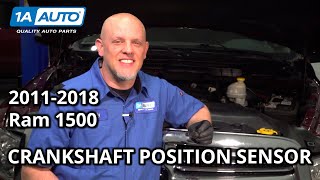
Typical fix: Replace the crankshaft position sensor. 🎬 Watch: Step-by-step replacement guide for the 3.6L V6 engine. It is strongly recommended to use an OEM Mopar part (Part #5149167AF for 3.6L/5.7L engines) as aftermarket sensors are known to fail prematurely or be incompatible. After replacement, a crankshaft position relearn procedure may be necessary.
Est. part cost: $80-$175 - Wiring Harness or Connector Damage 🟡 Medium Probability The wiring harness leading to the sensor can be damaged by heat from the engine/exhaust, become brittle and crack, or get chafed against the engine block or transmission. Rodents have also been known to chew through the wires. TSBs linking P0335 to other electrical codes also point to wiring as a possible systemic issue. [Bulletin #18-006-16 REV. B] One owner on RamForum.com reported a dealer quote of $927 to replace the sensor and a section of the wiring harness.
How to confirm: Visually inspect the entire length of the wiring harness from the sensor to the main engine harness. Check for melted or brittle insulation, chafing, and loose or corroded pins in the connector. Perform a continuity and voltage drop test on the power (5V reference), ground, and signal wires.
Typical fix: Repair the damaged section of wire or replace the connector pigtail. In severe cases, a new engine wiring harness may be needed. Ensure the harness is properly secured away from heat sources and moving parts after repair.
Est. part cost: $15-$100 for a pigtail; $500+ for a harness - PCM Software Glitch ⚪ Low Probability Multiple TSBs for the 2013-2016 model years mention P0335 as part of a list of codes that can be resolved with a PCM software update. [Bulletin #18-006-16 REV. B, Bulletin #18-103-16 REV. B] This seems particularly relevant for 2014-2015 models where P0335 appears with other unrelated codes.
How to confirm: A dealership or qualified shop with access to OEM software tools (like wiTECH) can check if your vehicle's PCM has the latest calibration. This is usually done after confirming the sensor and wiring are good.
Typical fix: Flash the PCM with the updated software. This is a dealer or specialty shop-level repair.
Est. part cost: $0 (if under warranty) - $200
Rare But Worth Checking
- Damaged Reluctor Ring: The reluctor ring (or tone wheel) is what the crankshaft sensor reads. While rare, damage to its teeth from debris or improper service can cause an erratic signal and trigger P0335. This is typically only suspected after sensor and wiring issues have been ruled out, as inspection requires significant disassembly.
- Faulty Powertrain Control Module (PCM): → Shop Engine Control Module (ECM) A failing PCM can cause a P0335 code, but this should be considered a last resort after all other possibilities have been exhausted. Misdiagnosing a bad PCM is a costly mistake.
- Shared Sensor Circuit Fault: On some vehicles, the 5-volt reference circuit is shared among multiple sensors. A short in another sensor, such as the engine oil pressure sensor, can pull the voltage down for the entire circuit and trigger a P0335 code along with others. This is an advanced diagnostic scenario but has been documented.
Diagnosis Steps
- Read all diagnostic trouble codes (DTCs) with an OBD-II scanner. Note any other codes that are present, as they can provide important clues (e.g., P2299, P0339).
- Use the scanner's live data feature to monitor Engine RPM while cranking the engine. A reading of '0' strongly suggests a problem in the CKP circuit.
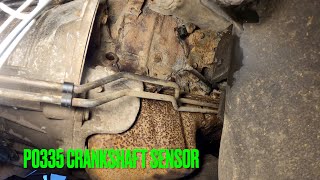
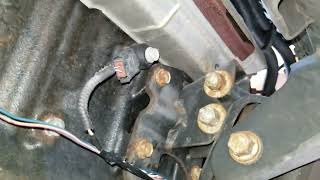
- Perform a thorough visual inspection of the crankshaft position sensor's wiring and connector. The sensor is on the passenger side of the engine block, near the transmission. Look for any signs of melting, chafing, corrosion, or oil contamination.
- If the wiring appears intact, disconnect the sensor and test the connector for a 5-volt reference, a good ground, and check the signal wire for continuity back to the PCM.
- If the circuit tests good (power, ground, and continuity to the PCM are confirmed), the crankshaft position sensor itself is the most likely culprit.
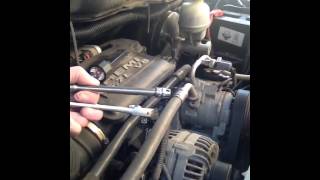
- Replace the crankshaft position sensor with a high-quality OEM Mopar part. The sensor is held by a single 10mm bolt. 🎬 Watch this repair video to see the sensor's tricky location.
- After replacement, clear the codes. Perform a crankshaft variation relearn procedure if the code returns or the engine runs rough. This can be done with a capable scan tool or by following a specific drive cycle.
- Check for any applicable TSBs for your vehicle's VIN, as a PCM software update may be required to resolve the issue, especially on 2014-2015 models.
Parts You'll Likely Need

- Crankshaft Position Sensor
(OEM #5149167AF (for 3.6L & 5.7L Hemi))— This sensor is the most frequent point of failure for the P0335 code due to its operating environment and electronic nature. Using the OEM Mopar part is highly recommended.
Trusted brands: Mopar (OEM), NTK, Delphi
OEM price range: $120-$175
Aftermarket price range: $40-$130
Related Codes That Often Appear With This One
- P0339 — This code for 'Crankshaft Position Sensor 'A' Circuit Intermittent' often accompanies P0335 and points towards a wiring issue or a failing sensor, especially if symptoms occur when hitting bumps.
- P2299 — 'Brake Pedal Position / Accelerator Pedal Position Incompatible'. Its appearance with P0335 is noted in Ram TSBs #18-006-16 REV. B and #18-103-16 REV. B, and strongly suggests a PCM software update is needed for 2014-2015 models.
- P2610 — 'PCM Internal Engine Off Timer Performance'. This code is also listed alongside P0335 in TSB #18-006-16 REV. A, pointing towards a potential PCM software-related problem. [Bulletin #18-006-16 REV. A]
- P0300 — 'Random/Multiple Cylinder Misfire Detected'. Since the CKP sensor provides primary timing data, a faulty signal can easily lead to misfires as the PCM cannot properly time spark and fuel.
Technical Service Bulletins (TSBs) & Recalls
- 14-007-21: Mentions P0335-00 - Crankshaft Position Sensor Circuit.
- 68079375A: Asks technicians to contact engineering before replacing the sensor for a P0335 fault.
- 18-006-16 REV. B: Lists P0335 alongside P2299, suggesting a PCM software update for 2014-2015 models.
- 18-103-16 REV. B: Also lists P0335 with P2299 and other codes, recommending a PCM flash for 2014-2015 models to resolve.
- 18-006-16 REV. A: Lists P0335 with P2610, pointing to a software fix.
Platform-Specific Known Issues
- A known issue documented in TSB #18-006-16 REV. B and #18-103-16 REV. B involves P0335 appearing with other codes like P2299 (Brake/Accelerator Incompatible). This often points to a need for a PCM software update rather than a hardware failure, particularly on 2014-2015 models.
- TSB #68079375A from 2015 specifically requested
Mechanic-Grade Diagnostic Values
- 5-Volt Supply Circuit Voltage — expected: Approximately 5.0 Volts (± 0.1V) with ignition on, engine off, and sensor connector disconnected.. Failure: No voltage or significantly low voltage indicates an open or short in the (F855) supply circuit or a PCM issue.
- Sensor Ground Circuit Resistance — expected: Below 5.0 Ohms.. Failure: Resistance above 5.0 Ohms indicates an open or high resistance in the (K900) ground circuit.
- Signal Circuit Voltage (Hall-Effect Sensor) — expected: A digital square wave signal that switches between 0V and 5V as the engine is cranked.. Failure: No switching voltage (stuck high or low) or an erratic signal indicates a failed sensor, wiring issue, or damaged reluctor ring. An oscilloscope is the best tool for viewing this signal.
Scan Tool Commands That Help
- wiTECH or capable aftermarket scan tool: Crankshaft Position Relearn / Cam/Crank Relearn — Required after replacing timing components (chain, gears) and sometimes recommended after replacing the crankshaft sensor itself if the engine runs rough or the code returns. The procedure calibrates the PCM to the exact position of the new or existing sensor and reluctor ring. Note: For a simple sensor swap, many find it to be plug-and-play without needing a relearn.
Wiring & Ground Locations
- CKP Sensor Connector — On the passenger side of the engine block, near the transmission bell housing, above the transmission cooler lines.. This is the primary connection point to test for power, ground, and signal. It is susceptible to heat and oil contamination.
- F855 (5-Volt Supply Circuit) — Wire running from the PCM (Connector C2) to the CKP sensor connector.. This wire provides the reference voltage required for the Hall-effect sensor to operate. A loss of this voltage will cause an immediate P0335.
- K900 (Sensor Ground Circuit) — Wire running from the CKP sensor connector back to the PCM (Connector C2).. Provides the ground reference for the sensor. High resistance or an open in this circuit will prevent the sensor from sending a valid signal.
Real Owner Repair Stories
- DodgeForum.com user 'Spacenerd' (2011 Ram 1500 5.7 Hemi) — Stalling and going into limp mode after hard braking or hitting a rough railroad crossing, throwing code P0335.
❌ Tried (didn't work) Replacing the crankshaft position sensor.
✅ What actually fixed it The problem returned after replacing the sensor, strongly indicating the root cause was a wiring harness issue that became apparent with jarring movements of the truck. - 2CarPros user 'MPINE88' (Vehicle not specified, but symptoms and diagnosis are identical.) — Car randomly stalls and shuts off while driving. Throws P0335.
❌ Tried (didn't work) A shop confirmed the sensor and wiring were 'fine'., Replacing the Powertrain Control Module (PCM) at a dealership.
✅ What actually fixed it The problem returned even after a PCM replacement. The actual cause was determined to be a wiring issue, likely a loss of the 5-volt reference signal, that was missed in the initial diagnosis, making the PCM replacement an expensive misdiagnosis. - RamForum.com user 'zeddy' (2012 Ram 1500) — Sputtering and stalling, service electronic throttle message, P0335 code.
❌ Tried (didn't work) Owner diagnosis.
✅ What actually fixed it A dealership diagnosed the issue as both a failed crankshaft sensor and a damaged wiring harness. The total repair cost was $927, highlighting how wiring damage significantly increases the cost over a simple sensor replacement.
"I Checked Everything" — The Actual Cause
- A common failure pattern for P0335 is not a failed smoke test, but a passed basic electrical test that leads to a misdiagnosis. A technician may check for basic continuity and find it's okay, or replace the sensor, only for the problem to persist. The actual cause is often an intermittent open or short in the wiring harness that only appears under specific conditions like heat or vibration. One owner had their PCM replaced after the sensor and wiring were deemed 'fine', but the stalling issue returned, pointing to a subtle wiring fault (like the 5V reference line) that was missed.
OEM Part Supersession History
5149167AD, 5149167AE→5149167AF— Standard part revision and improvement by the manufacturer.
Heads up: While all versions may fit, it is always recommended to use the latest part number (5149167AF) to ensure you have the most up-to-date revision.
Model Year Variations Within This Range
- 2014-2015: A PCM software glitch is a known issue for these model years, causing P0335 to be set falsely along with other unrelated codes like P2299 (Brake Pedal Position / Accelerator Pedal Position Incompatible). A PCM update is the specified fix per TSBs #18-006-16 REV. B and #18-103-16 REV. B.
- 2013: The 5.7L Hemi engine received a torque increase (to 410 lb-ft) and was paired with the new 8-speed automatic transmission, which involved different PCM calibrations compared to earlier models.
Helpful Videos

We Have This Part in Stock


The information in this article is provided for general reference and educational purposes only. Vehicle specifications, procedures, and part compatibility can vary by production date, trim level, and region. Always consult your vehicle's factory service manual and verify part numbers before purchasing or performing repairs. Safety-critical components such as airbags, seat belts, and braking systems should be installed by a qualified professional.
- Ram 1500:
- 🧭 Diagnostic Flowchart
- 🎬 Helpful Videos
- 🛍️ Shop This Part
- What's Unique About the 2011-2018 Ram 1500
- Symptoms You May Notice
- Most Likely Causes
- Rare But Worth Checking
- Diagnosis Steps
- Parts You'll Likely Need
- Related Codes That Often Appear With This One
- Technical Service Bulletins (TSBs) & Recalls
- Platform-Specific Known Issues
- Mechanic-Grade Diagnostic Values
- Scan Tool Commands That Help
- Wiring & Ground Locations
- Real Owner Repair Stories
- "I Checked Everything" — The Actual Cause
- OEM Part Supersession History
- Model Year Variations Within This Range
- 🎟️ Get 5% Off