

P0335 on 2009-2013 Subaru Forester: Crankshaft Sensor Failure Causes and Fixes
On a 2009-2013 Forester, code P0335 almost always means the crankshaft position sensor has failed. This is a critical failure causing stalling or a no-start condition. An OEM sensor (part #22053AA053) costs around $100-$125, and replacement is a common DIY job taking about an hour.
- P0335 on a 2009-2013 Forester is a critical code that will likely leave you stranded; do not drive the vehicle.
- The cause is almost certainly a failed crankshaft position sensor, which is a common and relatively inexpensive part to replace.
- The correct OEM part number is 22053AA053. Using an OEM or reputable aftermarket brand like Denso is strongly recommended, as some aftermarket parts fail to fix the issue.
- The sensor is held by one 10mm bolt that requires a very light torque of approximately 5 ft-lbs. Do not overtighten the plastic housing.
- You can confirm the failure at home with a multimeter; a good sensor should have a resistance of about 2,000 Ohms (2.0 kOhms).
What's Unique About the 2009-2013 Subaru Forester
For the third-generation Forester with the EJ253 engine, the P0335 code is a very common and straightforward issue. Unlike some other platforms where wiring or other components are frequent culprits, on this particular Subaru, the cause is almost always the sensor itself failing due to age and heat cycles. The sensor is located on the front of the engine block, making it a relatively simple fix that many owners choose to perform themselves.
Symptoms You May Notice
- Engine cranks but will not start
- Sudden engine stalling while driving, sometimes with 'bucking' or 'kangarooing' beforehand
- Engine struggles to start, then finally turns over
- Rough or uneven idle, with the tachometer needle hunting up and down
- Poor acceleration and reduced engine power
- Check Engine Light is on (often with a flashing cruise control light)
- Replacing the camshaft position sensor. While related, the camshaft sensor has its own specific codes (e.g., P0340) and is a different part located on the driver's side cylinder head.
- Replacing the starter motor. On some newer Subaru engines (FB series), a failing starter can cause a false P0335 due to electrical noise during cranking. While less common on the EJ253, if you have a slow crank or a single 'click' sound along with the code, the starting system should be investigated. 🎬 Watch this before you buy a new crankshaft position sensor.
Most Likely Causes
- Failed Crankshaft Position Sensor 🔴 High Probability → Shop Engine Crankshaft Position Sensor The sensor is mounted to the engine block where it is exposed to constant, intense heat and vibration, causing the internal electronics to fail over time. This is the most common point of failure for this code on the EJ253 engine.
How to confirm: Disconnect the sensor and test the resistance between its two pins using a multimeter set to Ohms 🎬 See this video for testing and removing a stuck sensor. (Ω). A good sensor should read approximately 1.9 to 2.0 kOhms (1,900-2,000 Ohms). An open circuit (infinite resistance/no reading) or a short (zero resistance) indicates a bad sensor.
Typical fix: Replace the crankshaft position sensor. It is held by a single 10mm bolt. Using a genuine Subaru part (22053AA053) is highly recommended as some aftermarket sensors have been reported to fail or not resolve the code.
Est. part cost: $40-$125 - Damaged Wiring or Connector ⚪ Low Probability The wiring harness and plastic connector near the front of the engine can become brittle from heat cycles or damaged during other repairs, such as an alternator replacement. Rodents have also been known to build nests in this area and chew through the wires.
How to confirm: Visually inspect the sensor's gray connector and the wiring leading to it for any signs of corrosion, breaks, melted plastic, or oil contamination. Wiggle the connector while the engine is running (if possible) to see if it causes a stall.
Typical fix: Repair the damaged section of wire or replace the connector pigtail.
Est. part cost: $10-$30
Rare But Worth Checking
- Damaged Timing Belt or Reluctor Ring: → Shop Engine Timing Chain If the timing belt has skipped a tooth or is broken, the crank and cam sensors will be out of sync, which can trigger this code. A damaged reluctor ring (the toothed wheel the sensor reads) on the crankshaft sprocket can also cause a faulty signal. This is usually accompanied by other symptoms, codes, or mechanical noise.
- Faulty Engine Control Module (ECM): → Shop Engine Control Module (ECM) This is extremely rare. The ECM should only be considered after all other possibilities, including the sensor and its wiring, have been definitively ruled out.
Diagnosis Steps
- Scan for Codes: Confirm P0335 is the primary code. Note any other codes present, such as P0340/P0345 for the camshaft sensors.
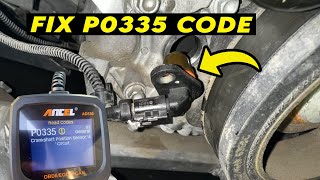
- Inspect the Sensor and Connector: Locate the sensor on the front of the engine, below the alternator, with a gray electrical connector. Visually inspect the sensor and its wiring for obvious damage, corrosion, or loose connections.
- Test the Sensor: Disconnect the sensor. Set a multimeter to measure resistance (kΩ) and test across the two pins of the sensor itself. The reading should be around 2.0 kOhms (2,000 Ohms). If the reading is infinite (open) or zero (shorted), the sensor is bad and must be replaced.
- Check for Signal (Advanced): If you have an oscilloscope, you can back-probe the signal wire at the ECM to see if the sensor is generating a square wave signal while the engine is cranked. This is the most definitive test of the sensor and wiring circuit.
- Inspect Mechanical Timing: If the sensor and wiring are good, but the problem persists, the next step is to inspect the timing belt and the reluctor teeth on the crankshaft sprocket for damage or misalignment. This is a more involved job that requires removing the front timing cover.
Parts You'll Likely Need
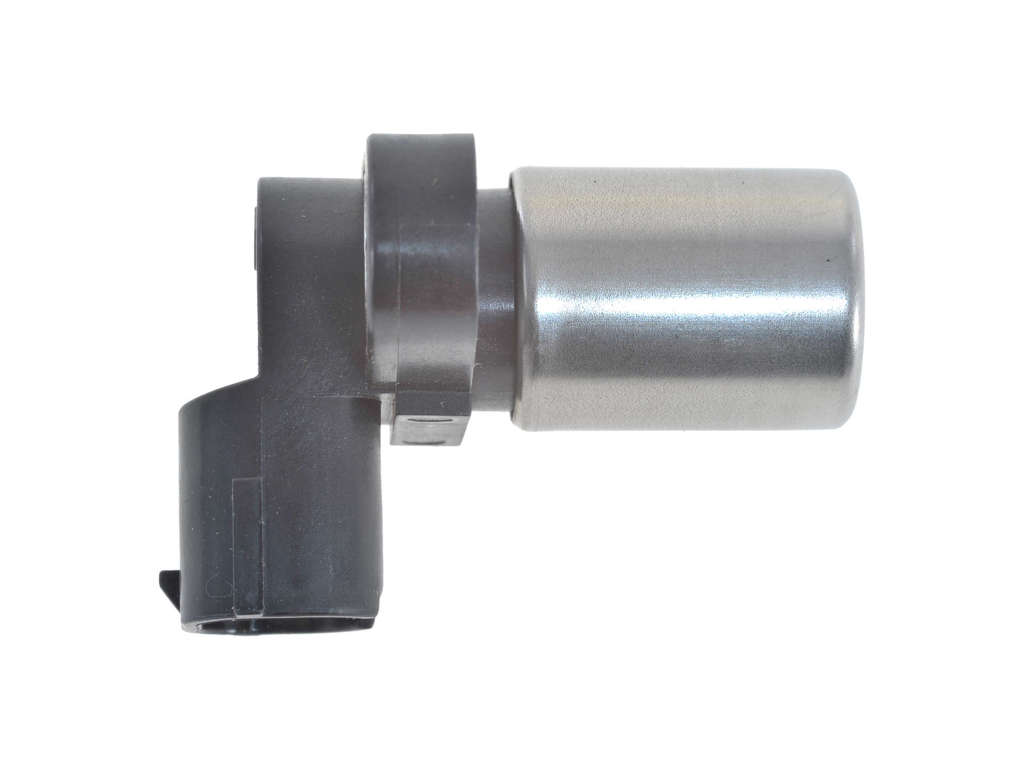
- Crankshaft Position Sensor
(OEM #22053AA053)— This is the most common failure point for code P0335 on this vehicle. The original sensor's electronics fail from heat and age. This part number supersedes previous versions 22053AA040, 22053AA050, 22053AA051, and 22053AA052.
Trusted brands: Subaru (OEM), Denso (often the OEM manufacturer), Hitachi
OEM price range: $99-$125
Aftermarket price range: $40-$80
Related Codes That Often Appear With This One
- P0340 / P0345 — These are codes for the camshaft position sensor(s). Seeing them with P0335 can indicate a widespread electrical issue (e.g., a wiring harness problem) or a serious mechanical timing problem, such as a jumped timing belt. In some cases, a failing starter motor has been known to cause all three codes to appear simultaneously.
Technical Service Bulletins (TSBs) & Recalls
- No specific Technical Service Bulletins (TSBs) from Subaru directly address the diagnostic trouble code P0335 for this platform in public databases. The issue is typically handled as a standard component failure.
Platform-Specific Known Issues
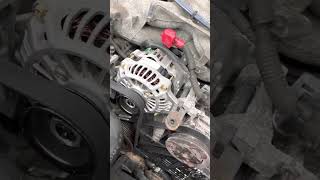
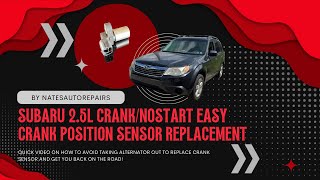
- Access to the sensor is tight. While it can be done from the top by removing the air intake snorkel, many owners find it much easier to remove the alternator for clear access 🎬 Watch: This walkthrough shows how to access and replace the sensor. to the 10mm bolt.
- The 10mm bolt holding the sensor can be difficult to reach. A long 10mm socket or a ratcheting wrench is highly recommended for removal.
- The electrical connector can be stubborn to release due to heat and age. A small flathead screwdriver may be needed to gently pry the locking tab while pulling.
Mechanic-Grade Diagnostic Values
- Crankshaft Position Sensor Resistance — expected: 1.9 kOhms to 2.0 kOhms. Failure: Open circuit (infinite resistance) or a reading significantly outside the expected range.
- Crankshaft Position Sensor AC Voltage Output (Dynamic Test) — expected: Fluctuating AC voltage greater than 0.5V while cranking the engine.. Failure: No voltage or voltage significantly below 0.5V AC indicates a dead or weak sensor.
- Voltage at Harness Connector (Signal Wire to Ground, Sensor Disconnected) — expected: 0 Volts with key on, engine off.. Failure: The presence of voltage (e.g., one user reported finding 1.33V) on the signal wire suggests a potential wiring short to power or an internal ECM fault.
Scan Tool Commands That Help
- Subaru Select Monitor (SSM) or equivalent professional scanner: Live Data > Engine Speed (RPM) — While cranking the engine, if the scan tool shows 0 RPM, it strongly indicates the ECM is not receiving a signal from the crankshaft position sensor or its circuit. This is a primary and effective diagnostic step.
- Professional Scan Tool (e.g., CGSULIT SC530): Special Functions > Crankshaft Position (CKP) Variation Learn / Cam crank relearn — This procedure is typically required after replacing a crankshaft sensor, timing belt, or ECM to allow the engine computer to learn the precise position of the new components and compensate for minor variations. Failure to perform a relearn can sometimes cause persistent codes or rough running.
Wiring & Ground Locations
- Crankshaft Sensor ECM Pins — At the Engine Control Module (ECM) connector.. For a 2010 Forester, the sensor signal wire (White) goes to pin A13, and the ground wire (White with Red stripe) goes to pin A14 on the ECM. The shielded wire ground connects to pin A24. This allows for continuity testing of the entire circuit from the sensor connector to the ECM.
- Main Engine Ground Straps — On the 2010 Forester, there are two braided ground straps on the left and right sides of the engine, bolting the block to the chassis/frame. Another critical ground point (GE1/GE2) is located at the top center rear of the engine, where harnesses for the ignition coils and sensors are grounded to the block.. A corroded or broken engine ground strap can cause a host of electrical issues, including erratic sensor readings. The ECM relies on a stable ground reference; a poor ground can introduce noise or voltage offsets into the crankshaft sensor signal, potentially triggering a P0335 code even with a good sensor.
Real Owner Repair Stories
- ScoobyNet.com forum user (Subaru (model not specified, but EJ engine)) — Sudden spluttering, kangarooing, loss of throttle response, engine hunting between 400-1200 RPM, then stalling and hard start.
❌ Tried (didn't work) Replacing the crankshaft position sensor with a new aftermarket part.
✅ What actually fixed it The user diagnosed 1.33V on the signal wire with the key on, engine off, which should have been 0V. This pointed to a wiring or ECM issue. While the final resolution isn't posted, the detailed diagnostic process is highly valuable in showing that replacing the sensor isn't always the fix and how to test the wiring. - Subaru Forester Club forum user (2010 Forester D (Diesel, but ground strap location is similar)) — Not specified, but was performing general maintenance.
✅ What actually fixed it Discovered one of the two main braided engine ground straps had completely corroded and broken. The user replaced it, highlighting the importance of these often-overlooked grounds which are critical for proper sensor function.
OEM Part Supersession History
22053AA040, 22053AA050, 22053AA051, 22053AA052→22053AA053— Standard part evolution for improved reliability, material changes, or manufacturing process updates.
Heads up: All previous versions are replaced by 22053AA053. Using the latest OEM part number is always recommended for best compatibility and performance.
Model Year Variations Within This Range
- 2009-2010: These years exclusively used the EJ253 SOHC engine, which has a timing belt. The P0335 diagnosis is very straightforward and almost always the sensor itself.
- 2011-2013: For the 2011 model year, Subaru began phasing in the newer FB25B DOHC engine, which uses a timing chain instead of a belt. While both engines were available during this transition, it's crucial to identify which engine your Forester has, as some part numbers and procedures may differ slightly. The FB engine is known for oil consumption issues, which is unrelated to P0335 but important for owners to be aware of.
Diagnostic Flowchart
Other Known Issues on This Vehicle
Issues unrelated to this code that are worth knowing about as an owner of this generation:
- External Head Gasket Leaks 🔴 High — Very common, typically occurs between 100,000 and 150,000 miles. The EJ253 uses a single-layer graphite-coated gasket prone to failure. (Ref: No specific recall, but a well-documented issue. Upgrading to multi-layer steel (MLS) gaskets, like those for the turbo EJ255 engine, is the recommended permanent fix.)
- Excessive Oil Consumption (2011+ models) 🟠 Medium — Primarily affects the newer FB25 engine introduced in 2011, but some late EJ253s can also consume oil. Caused by issues with piston rings. (Ref: TSB 02-157-14R (and subsequent revisions) addressed this, leading to a warranty extension and, in confirmed cases, replacement of the engine short block.)
- Catalytic Converter Failure (P0420) 🟠 Medium — Common at higher mileage, often as a secondary failure caused by oil consumption or other engine issues fouling the converter. (Ref: No recall, but Subaru systems are known to be very sensitive, and diagnosis should rule out exhaust leaks and faulty O2 sensors first.)
Used vs. New Parts: Buying Guide for This Vehicle
When a used part is the smart pick: For this specific repair, using a used crankshaft position sensor is NEVER recommended. It is a critical electronic component with a finite lifespan determined by heat cycles. A used sensor from a junkyard has unknown history and is likely near the end of its own life, making it an unreliable fix.
What to inspect on the donor part:
- Not applicable. Do not purchase this part used.
OEM-only on this vehicle (don't cheap out):
- Crankshaft Position Sensor
Aftermarket brands forum-validated for this vehicle:
- Denso (often the OEM supplier for Subaru)
- Hitachi
Brands owners have reported issues with on this vehicle:
- Unbranded, 'white-box' sensors from online marketplaces. Forum and professional experience strongly suggest these have a high failure rate and may not meet the precise resistance or signal output specifications, causing the code to return.
Real Owner Stories
Aggregated from forums and TSBs cited above. Mileages and costs reflect what owners reported in those sources.
2011 Subaru Forester EJ253
Symptoms: Whenever the engine got hot it would not start or would have an intermittent start.
What fixed it: Replacement of the crankshaft position sensor.
Source hint: youtube_comment - N8 Performance
2015 Subaru Forester
Symptoms: Failed to start with a 'click-no-crank' symptom; codes P0335, P0340, and P0345 were present.
What fixed it: New starter motor (after replacing sensors did not work).
Source hint: CarKiller.com - Thread: '2015 Subaru Forester failed to start (P0340, P0345, P0335)'
Subaru Forester EJ253
Symptoms: Sudden stalling, engine hunting up and down the revs (400-1200 rpm), excessive vibration, and then a crank-no-start condition.
What fixed it: Replacement of the crankshaft position sensor.
Source hint: ScoobyNet.com - Thread: 'P0335 Crankshaft Position Sensor A Circuit. Help please.'
2006 Subaru Forester
Symptoms: Intermittent crank-no-start and stalling with code P0335.
What fixed it: Replacement of the crankshaft position sensor.
Source hint: Reddit r/MechanicAdvice - Thread: 'My new/used Subaru is having some issues.'
Related OBD-II Codes
Frequently Asked Questions
Is there a Subaru TSB for the P0335 code on my 2009-2013 Forester?
Should I use an aftermarket sensor or a genuine Subaru part for the EJ253 engine?
I'm seeing P0335 along with P0340 and P0345. Could this be something other than the sensors?
Why does my Forester stall or buck specifically when the engine gets hot?
Can I test the crankshaft sensor myself with a multimeter?
Is it true I have to remove the alternator to reach the sensor?
Helpful Videos

We Have This Part in Stock


The information in this article is provided for general reference and educational purposes only. Vehicle specifications, procedures, and part compatibility can vary by production date, trim level, and region. Always consult your vehicle's factory service manual and verify part numbers before purchasing or performing repairs. Safety-critical components such as airbags, seat belts, and braking systems should be installed by a qualified professional.
- Subaru Forester:
- 🧭 Diagnostic Flowchart
- 🎬 Helpful Videos
- 🛍️ Shop This Part
- What's Unique About the 2009-2013 Subaru Forester
- Symptoms You May Notice
- Most Likely Causes
- Rare But Worth Checking
- Diagnosis Steps
- Parts You'll Likely Need
- Related Codes That Often Appear With This One
- Technical Service Bulletins (TSBs) & Recalls
- Platform-Specific Known Issues
- Mechanic-Grade Diagnostic Values
- Scan Tool Commands That Help
- Wiring & Ground Locations
- Real Owner Repair Stories
- OEM Part Supersession History
- Model Year Variations Within This Range
- Other Known Issues on This Vehicle
- Used vs. New Parts: Buying Guide for This Vehicle
- Real Owner Stories
- 2011 Subaru Forester EJ253
- 2015 Subaru Forester
- Subaru Forester EJ253
- 2006 Subaru Forester
- Related OBD-II Codes
- Frequently Asked Questions
- 🎟️ Get 5% Off