

P0340 on 2012-2017 Cadillac Escalade ESV: Camshaft Sensor Causes & Fixes
P0340 on a 2012-2017 Escalade ESV most often means the Camshaft Position Sensor 'A' on Bank 1 has a circuit problem. For 2015+ models, the most likely cause is not the sensor but a chafed wiring harness or corroded X154 connector on the front of the engine. For 2012 models built in Sept/Oct, a faulty sensor is more likely per TSB #PIP5099A. Inspecting the wiring harness is critical before replacing the sensor, which costs between $25 and $70.
- P0340 on a 2012-2017 Escalade points to a problem in the Bank 1 (driver's side) camshaft position sensor circuit.
- Before replacing the sensor, thoroughly inspect the wiring harness for chafing or damage, as this is a very common cause.
- If you have a 2012 model built in Sept/Oct, a faulty sensor is highly likely per TSB #PIP5099A.
- Do not ignore this code. It can lead to stalling or a no-start condition, which is a safety risk.
- If other codes like P0335 (crank sensor) are present, the likelihood of a wiring or mechanical timing issue increases.
What's Unique About the 2012-2017 Cadillac ESCALADE ESV
For this range of Escalades, which spans two V8 engine versions, the P0340 code is linked to specific documented issues. For the 3rd generation (2012-2014), a GM Technical Service Bulletin (TSB #PIP5099A) points to a potential batch of faulty sensors in models built in September or October of 2012. For the 4th generation (2015-2017), the issue is more commonly related to the wiring. TSBs like #PIP5335C and #PIP5553A identify problems with the engine wiring harness chafing or developing corrosion in the X154 connector, located on the front engine cover near the vacuum pump. Therefore, a thorough wiring inspection is highly recommended before replacing parts, especially on 2015 and newer models.
Diagnostic Flowchart
Tap your situation to follow the diagnostic path that matches what you're seeing on this vehicle.
Generation note: This range covers two Escalade generations. The 2012-2014 models are the 3rd generation (GMT900 platform) with the 6.2L L94 V8. The 2015-2017 models are the 4th generation (K2XL platform) with the 6.2L L86 V8. While the P0340 code applies to both, TSBs indicate specific issues like faulty sensors in 2012 models (TSB #PIP5099A) and potential wiring harness chafing and connector corrosion that is more documented on the 4th generation (TSBs #PIP5335C, #PIP5553A).
Symptoms You May Notice
- Check Engine Light is on.
- Difficulty starting the engine, or a long crank time before it starts. 🎬 Watch: Troubleshooting long crank times and the P0340 code.
- Engine cranks but does not start at all.
- Engine stalling or stopping on its own, sometimes unexpectedly in traffic.
- Rough or unstable idle.
- Noticeable loss of engine power and acceleration.
- Reduced fuel economy.
- Service Stabilitrak message may appear.
- Replacing the crankshaft position sensor. While related, P0340 specifically points to the camshaft sensor circuit.
- Replacing the camshaft position sensor without first inspecting the wiring harness. A chafed wire or corroded X154 connector is a very common cause on 2015+ models, and a new sensor will not fix the problem.
Most Likely Causes
- Damaged Wiring Harness or Connector 🔴 High Probability This is the most common cause on 2015-2017 models. TSB #PIP5335C points to corrosion inside the X154 connector on the front engine cover. Other TSBs mention the harness chafing against the X154 connector bracket or the engine vacuum pump pulley, causing a short.
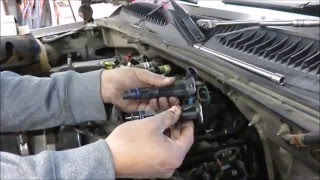
How to confirm: Visually inspect the entire length of the wiring harness from the sensor to the ECM. On 2015+ models, disconnect the X154 connector (on the front engine cover, near the vacuum pump) and check for green or white corrosion on the pins. Check for rubbing/chafing where the harness passes near brackets and pulleys.
Typical fix: Repair the damaged section of the wire or replace the connector pigtail (e.g., ACDelco PT2647). If the X154 connector is corroded, it must be cleaned or replaced.
Est. part cost: $15-$50 - Faulty Camshaft Position Sensor 🔴 High Probability → Shop Engine Camshaft Position Sensor For 2012-2013 models built in Sept/Oct 2012, TSB #PIP5099A suggests a known batch of problematic parts and recommends replacing the sensor if other diagnostics are inconclusive. The sensor also operates in a high-heat environment and can fail over time on any model year.
How to confirm: Test the sensor's output signal with an oscilloscope while cranking the engine. A missing or erratic square wave form indicates a failed sensor. A simpler test is to check for 5V reference and ground at the connector, and if present, replace the sensor as the next logical step.
Typical fix: Replace the camshaft position sensor for Bank 1.
Est. part cost: $25-$70 - Stretched Timing Chain or Failed Tensioner 🟡 Medium Probability → Shop Engine Timing Chain On high-mileage 6.2L V8 engines (typically over 150,000 miles), timing chain stretch can occur. This causes the camshaft and crankshaft signals to become unsynchronized, which the ECM can interpret as a sensor circuit fault. Forum users report this as a possible cause on higher mileage vehicles.
How to confirm: This is an advanced diagnosis. It requires checking for excessive slack in the timing chain, which involves partial engine disassembly. A professional scan tool may show a cam/crank correlation deviation, often accompanied by codes like P0016.
Typical fix: Replace the timing chain, tensioners, and guides. This is a significant and costly repair.
Est. part cost: $400-$800 - Weak Battery or Starting System Fault ⚪ Low Probability → Shop Vehicle Battery
How to confirm: Test the battery voltage during cranking. If it drops significantly (e.g., below 9.5V), it can cause spurious codes from various modules, including the ECM. Ensure the battery and alternator are functioning correctly.
Typical fix: Charge or replace the battery.
Est. part cost: $150-$350
Rare But Worth Checking
- Failed Engine Control Module (ECM): → Shop Engine Control Module (ECM) This is very rare. The ECM should only be considered after all other possibilities (sensor, wiring, mechanical timing) have been exhaustively ruled out.
- Damaged Camshaft Reluctor Wheel: → Shop Engine Camshaft The sensor reads a multi-toothed wheel on the camshaft. If this wheel is damaged, has debris on it (like metal filings), or has shifted, it can cause an erratic signal and trigger P0340. This is uncommon and typically only occurs after major engine work or a catastrophic failure.
Diagnosis Steps
- Read all stored fault codes with an OBD-II scanner and note the freeze-frame data.
- Visually inspect the Bank 1 camshaft position sensor (located on the front of the driver's side cylinder head) and its electrical connector for damage, oil contamination, or loose connections.
- Thoroughly inspect the engine wiring harness for signs of chafing, melting, or corrosion. On 2015+ models, pay special attention to the harness near the X154 connector on the front engine cover and near the vacuum pump.
- Disconnect the X154 connector (2015+ models) and inspect the pins for any signs of green or white corrosion.
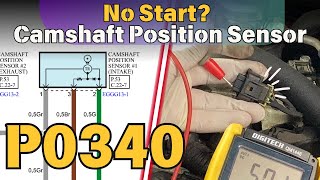
- With the key on and engine off, use a multimeter to check for the correct reference voltage (typically 4.8-5.2V) and a good ground at the sensor's connector.
- If power and ground are present, use an oscilloscope to observe the sensor's signal waveform while cranking the engine. A clean, consistent square wave should be present.
- If the signal is absent or erratic, and the wiring is confirmed to be good, replace the camshaft position sensor.
- If the signal is good but the code persists, the issue may be mechanical. Investigate the timing chain for stretch or damage, especially on high-mileage vehicles. This step may require professional assistance.
Parts You'll Likely Need
- Camshaft Position Sensor
(OEM #12680848 (supersedes 12591720 for some applications))— This is the most direct cause of a P0340 circuit code, either due to internal failure or as indicated by TSB #PIP5099A for specific 2012 models.
Trusted brands: ACDelco, Delphi, Bosch
OEM price range: $45-$70
Aftermarket price range: $25-$50 - Wiring Harness Connector Pigtail
(OEM #PT2647 (ACDelco))— If the connector at the sensor is damaged, corroded, or has broken wires, replacing the pigtail is the standard repair.
Trusted brands: ACDelco, Dorman
OEM price range: $20-$40
Aftermarket price range: $10-$25
Related Codes That Often Appear With This One
- P0341 — This code indicates a 'performance' issue with the same sensor circuit. TSB #PIP5335C mentions them appearing together, often due to the same wiring or connector corrosion issue.
- P0335 — This is for the Crankshaft Position Sensor. If both codes appear, it strongly suggests a wiring harness issue common to both sensors (as they are often routed together) or a more serious mechanical timing problem. TSB #PIE0416A and #PIP5553A group these codes.
- P0365 — This code is for the Camshaft Position Sensor 'B' circuit (Bank 2). TSB #PIE0416A groups this with P0340, suggesting a potential shared wiring, power, or ground issue affecting multiple sensors.
Technical Service Bulletins (TSBs) & Recalls
- PIE0416A: Notes a condition where DTCs P0335, P0340, or P0365 may be set, indicating a known pattern of related sensor faults GM was investigating.
Platform-Specific Known Issues
- TSB #PIP5335C / #PIP5335D: For 2015-2017 models, this bulletin advises inspecting connector X154 (or X159 on 2015 models) on the front engine cover for corrosion when P0340/P0341 are present.
- TSB #PIP5099A: For 2012-2013 models built in September or October 2012, this bulletin advises replacing the cam position sensor if standard diagnostics do not lead to a resolution, indicating a known batch of faulty parts.
- Wiring Harness Chafing: A widely reported issue, especially on 2015+ models, where the engine harness rubs against the X154 connector bracket or other engine components, causing shorts that trigger P0340 and other sensor codes.
Mechanic-Grade Diagnostic Values
- Camshaft Position Sensor Power Supply Voltage — expected: 4.8V - 5.2V. Failure: Voltage below 4.8V or above 5.2V indicates a problem with the ECM or the 5V reference circuit.
- Camshaft Position Sensor Ground Circuit — expected: Near 0V (less than 100mV). Failure: Voltage significantly above 0V indicates a poor ground connection, which can cause an incorrect signal.
- Camshaft Position Sensor Signal Circuit Voltage — expected: A fluctuating square wave, typically switching between near 0V and 5V as the engine is cranked.. Failure: A flat line (no voltage or constant 5V) or an erratic, inconsistent waveform indicates a failed sensor or a wiring issue.
Hidden / Shadow Codes Worth Checking
- P0641: 5-Volt Reference 'A' Circuit/Open. When seen with P0340, this strongly suggests a wiring short to ground or an open circuit in the harness that is affecting multiple sensors sharing the same 5V reference. (see via Standard OBD-II scanner; often appears alongside P0340.)
- P0016: Crankshaft Position - Camshaft Position Correlation (Bank 1 Sensor A). This code indicates a mechanical timing issue, such as a stretched timing chain or incorrect installation, rather than an electrical fault. The ECM is seeing a discrepancy between where the cam and crank *should* be versus where they are. (see via Standard OBD-II scanner; a critical code to watch for when P0340 is present on a high-mileage engine.)
Scan Tool Commands That Help
- GDS2 / Tech2: Crankshaft Position Variation Learn (CASE Learn) — This procedure is required after replacing the crankshaft, timing chain, or ECM. While not directly for the cam sensor, if P0340 is set alongside crank codes (P0335) or after major engine work, failure to perform this relearn can cause persistent correlation codes.
Wiring & Ground Locations
- X154 / X159 Connector — On the front engine cover, near the vacuum pump. TSB #PIP5335D identifies it as X159 on 2015 models and X154 on 2016-2017 models.. This is the single most critical checkpoint for 2015+ models. The connector is prone to corrosion from moisture, and the harness is known to chafe against its bracket, causing shorts or open circuits that directly trigger P0340 and P0341.
- G101 — Located at the front, lower-left side of the engine block.. This is a primary ground for the Engine Control Module (ECM). A loose or corroded connection here can cause a host of erratic sensor readings and spurious codes, including P0340, due to an unstable ground reference for the entire engine management system.
- G103 / G104 — G103 is on the front of the passenger side cylinder head. G104 is on the left (driver's side) rear corner of the engine, mounted to the cylinder head.. These are key engine-to-chassis grounds. Any degradation in these connections can lead to electrical noise and voltage offsets that interfere with low-voltage sensor signals like the one from the camshaft position sensor.
Real Owner Repair Stories
- Synthesized from multiple forum reports and TSBs (2015-2017 Cadillac Escalade ESV) — Check Engine Light on, vehicle stalls intermittently and has a long crank/no-start condition.
❌ Tried (didn't work) Replacing the camshaft position sensor. The P0340 code returned within a day or two.
✅ What actually fixed it After the new sensor didn't fix the issue, further inspection revealed corrosion inside the X154 connector on the front engine cover. The connector pins were cleaned, and a section of the wiring harness that was rubbing against the connector's metal bracket was repaired and protected. This permanently resolved the P0340 code.
"I Checked Everything" — The Actual Cause
- In cases where electrical diagnostics (voltage tests, wiring checks) find no faults and the code persists, the root cause is often mechanical. On high-mileage (150k+) engines, a stretched timing chain can cause the cam/crank correlation to drift just enough to set a P0340 or P0016 code, even though the sensor and wiring are perfectly fine. The fix is a full timing chain and tensioner replacement.
OEM Part Supersession History
12585545, 12568983→12591720— Updated design/supplier for Gen IV engines.
Heads up: This part is for the 2012-2014 L94 V8 and is physically different from the sensor used on 2015+ models.Unknown→12623093 / 12680848— Sensor for the Gen V L86 engine.
Heads up: This part is for the 2015-2017 L86 V8 and will not work on the earlier generation. The Pass 2 OEM number 12680848 is a valid number for this generation.
Model Year Variations Within This Range
- 2012-2014 (GMT900 Platform): The primary suspect for P0340 is often the sensor itself, especially for vehicles built in Sept/Oct 2012 per TSB #PIP5099A. The wiring harness is less of a documented systemic issue compared to later models. Uses sensor P/N 12591720.
- 2015-2017 (K2XL Platform): The primary suspect shifts dramatically to the wiring harness chafing near the X154 connector bracket and/or corrosion within the X154 (or X159 for 2015) connector itself. Replacing the sensor is often not the correct fix. Uses sensor P/N 12623093 or 12680848.
- 2015: A mid-year refresh ('2015.5') introduced the 8-speed automatic transmission and other features. The main P0340-related issue (X159/X154 connector) appears to affect all 2015 models, but be aware that early 2015 builds have the 6-speed transmission.
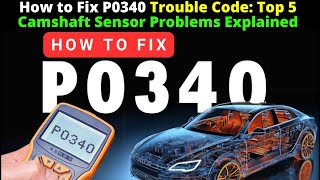
Helpful Videos
We Have This Part in Stock


The information in this article is provided for general reference and educational purposes only. Vehicle specifications, procedures, and part compatibility can vary by production date, trim level, and region. Always consult your vehicle's factory service manual and verify part numbers before purchasing or performing repairs. Safety-critical components such as airbags, seat belts, and braking systems should be installed by a qualified professional.
- Cadillac ESCALADE ESV:
- 🧭 Diagnostic Flowchart
- 🎬 Helpful Videos
- 🛍️ Shop This Part
- What's Unique About the 2012-2017 Cadillac ESCALADE ESV
- Symptoms You May Notice
- Most Likely Causes
- Rare But Worth Checking
- Diagnosis Steps
- Parts You'll Likely Need
- Related Codes That Often Appear With This One
- Technical Service Bulletins (TSBs) & Recalls
- Platform-Specific Known Issues
- Mechanic-Grade Diagnostic Values
- Hidden / Shadow Codes Worth Checking
- Scan Tool Commands That Help
- Wiring & Ground Locations
- Real Owner Repair Stories
- "I Checked Everything" — The Actual Cause
- OEM Part Supersession History
- Model Year Variations Within This Range
- 🎟️ Get 5% Off