

P0340 on 2003-2008 Honda Pilot: Cam Sensor, Wiring, or Timing Belt?
On a 2003-2008 Honda Pilot, P0340 most often points to a failing camshaft position sensor or a much more serious timing belt issue. If your vehicle has over 100,000 miles and an unknown timing belt history, suspect the belt first. A sensor is cheap (~$40), but a timing belt failure can destroy the engine.
- P0340 on a 2003-2008 Pilot is a critical code that demands immediate attention.
- DO NOT continue driving the vehicle, as a potential timing belt failure could destroy the engine.
- The most important diagnostic step is to verify the age and condition of the timing belt, especially if the vehicle has over 100,000 miles.
- While a bad camshaft sensor is a possible cause, it is crucial to rule out the timing belt first to avoid catastrophic engine failure and misdiagnosis.
What's Unique About the 2003-2008 Honda Pilot
The Honda J35A V6 is an interference engine, which is the most critical factor for this code. While the cause could be a simple, inexpensive sensor, there's a significant chance it indicates a stretched, jumped, or broken timing belt, often due to a failed hydraulic tensioner. Because it's an interference design, a timing belt failure allows the pistons to collide with the valves, causing catastrophic and expensive engine damage. Therefore, on a high-mileage Pilot with an unknown service history, P0340 must be treated with extreme seriousness until the timing belt's condition is verified.
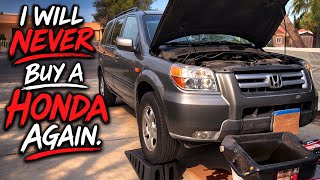
🎬 Watch: How a failed timing belt triggers the P0340 code.Symptoms You May Notice
- Engine will not start, or cranks for a long time before starting
- Engine stalls unexpectedly while driving
- Rough idling and engine misfires
- Noticeable loss of power and acceleration
- Check Engine Light is on
- In some cases, the transmission may not shift properly
- Car may run fine one day and then fail to start the next with no warning.
- Replacing the camshaft position sensor when the root cause is a stretched or jumped timing belt. This will not fix the problem and wastes time and money.
- Assuming the no-start condition is due to a bad battery, alternator, or fuel pump without first checking for diagnostic codes.
Most Likely Causes
- Stretched or Failed Timing Belt / Tensioner 🔴 High Probability → Shop Engine Timing Chain The J35A engine's timing belt has a service interval of 105,000 miles or 7 years. A common failure point is the hydraulic tensioner, which can leak and lose pressure, allowing the belt to go slack, jump a tooth, and cause cam/crank correlation to be off, triggering P0340.
How to confirm: Check service records for the last timing belt replacement. If unknown or overdue, a visual inspection of the belt's condition and timing marks is necessary. This involves removing the upper timing covers to check for belt slack and alignment marks on the cam gears. A very loose belt with no tension is a definitive sign of failure.
Typical fix: Replace the timing belt, water pump, hydraulic tensioner, and idler/tensioner pulleys as a complete kit. If the belt has failed, inspect for bent valves and damaged pistons via a compression test, which may require cylinder head repair or engine replacement.
Est. part cost: $150-$400 for a full kit - Failed Camshaft Position (CMP) Sensor 🟡 Medium Probability → Shop Engine Camshaft Position Sensor Sensors fail over time due to heat cycles and age. The Bank 1 sensor is on the rear cylinder head, near the firewall, and can be difficult to access. Using cheap, aftermarket sensors is a common cause of repeat failures or persistent codes on Honda vehicles.
How to confirm: After ruling out a timing belt issue, test the sensor's circuit. The easiest confirmation is often replacing the sensor with a known-good, high-quality (OEM, Denso, NTK) part.
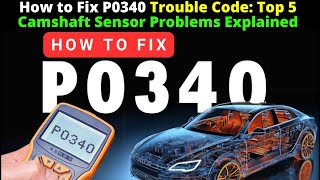
Typical fix: Replace the Bank 1 camshaft position sensor. It is located behind the rear camshaft pulley, requiring removal of the upper timing cover for access. 🎬 See this walkthrough on replacing the Bank 1 sensor.
Est. part cost: $20-$60 for aftermarket, $70-$110 for OEM. - Damaged Wiring or Connector ⚪ Low Probability The engine bay environment can make plastic connectors brittle and wires susceptible to damage from heat, oil, or rodents. The harness runs over the top of the engine and can be disturbed during other repairs.
How to confirm: Visually inspect the wiring harness and connector leading to the Bank 1 camshaft position sensor. Look for frayed wires, corrosion in the connector pins, or a loose connection. Check for continuity and voltage with a multimeter.
Typical fix: Repair the damaged section of wiring or replace the connector pigtail.
Est. part cost: $5-$25
Rare But Worth Checking
- Faulty Crankshaft Position (CKP) Sensor: → Shop Engine Crankshaft Position Sensor A failing crankshaft sensor can sometimes cause the PCM to misinterpret the data and throw a code for the camshaft sensor. If a new CMP sensor doesn't fix the issue, the CKP sensor is the next logical component to investigate.
- Damaged Camshaft Reluctor Wheel: → Shop Engine Camshaft The sensor reads notches on a wheel (reluctor) on the camshaft. If this wheel is damaged or has debris on it, the sensor cannot get a clean reading. This is rare and usually only happens during major engine work.
- Powertrain Control Module (PCM) Fault: → Shop Engine Control Module (ECM) This is extremely rare. The PCM itself can fail, but all other potential causes must be exhaustively ruled out before condemning the computer.
Diagnosis Steps
- Check for other codes: Scan the vehicle for any other stored trouble codes (like P0344, P0335, or misfires) to get a complete picture.
- Verify Timing Belt History: This is the most critical step. If the timing belt is over 105,000 miles/7 years old or its history is unknown, assume it is the primary suspect.
- Inspect Sensor Wiring: Visually inspect the camshaft position sensor connector (rear bank, near firewall) and its wiring for obvious damage, melting, or corrosion. Ensure the connector is seated firmly.
- Test the Sensor Circuit (if wiring is okay): Using a multimeter, back-probe the connector to check for a 5-volt reference, a good ground, and a fluctuating signal voltage as the engine is cranked.
- Replace the Sensor (with a quality part): If the timing belt is known to be good but the sensor or circuit test fails, replace the sensor. It is highly recommended to use an OEM, Denso, or NTK sensor, as cheap aftermarket sensors are known to cause issues.
- Inspect Timing Belt and Timing Marks: If the code persists or if the belt's history is unknown, the front engine covers must be removed. Check the hydraulic tensioner for leaks. Physically inspect the timing belt for damage, proper tension, and verify that the camshaft and crankshaft timing marks are perfectly aligned.
- Check for Engine Damage: If the timing belt has failed or jumped, perform a compression test to check for bent valves before proceeding with a simple belt replacement.
Parts You'll Likely Need
- Timing Belt and Water Pump Kit
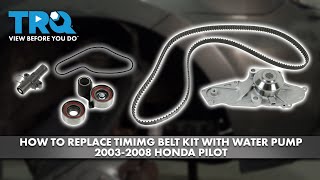
(OEM #14400-RCA-A01 (Belt Only))— This is the most likely and most critical failure point on a high-mileage J35A engine that causes a P0340 code. It should be replaced as a full kit with the tensioner and water pump. The Aisin TKH-002 kit is a widely trusted OEM-quality alternative. 🎬 Watch: Step-by-step guide to replacing the timing belt and water pump.
Trusted brands: Aisin (TKH-002), Gates, ContiTech, Honda OEM
OEM price range: $350-$500 (Kit)
Aftermarket price range: $180-$280 (Kit) - Camshaft Position Sensor (Bank 1)
(OEM #37510-P8E-A01 (superseded by 37510-RAA-A01, check VIN))— If the timing belt is confirmed to be in good condition, the sensor itself is the next most probable cause of failure. It is located on the rear bank.
Trusted brands: Honda OEM, Denso, NGK/NTK, Hitachi
OEM price range: $70-$110
Aftermarket price range: $20-$60
Related Codes That Often Appear With This One
- P0344 — Camshaft Position Sensor 'A' Circuit Intermittent. This often precedes a hard P0340 failure and can also be caused by a failing timing belt tensioner causing intermittent slack.
- P0335 — Crankshaft Position Sensor Circuit Malfunction. If the timing belt has failed or jumped significantly, both cam and crank sensor signals can be lost or become incoherent, often logging codes for both.
- P0300-P0306 — Random or specific cylinder misfire codes. Incorrect camshaft position data leads to improper ignition and fuel timing, which causes misfires.
Platform-Specific Known Issues
- The J35A is an interference engine, meaning a timing belt failure will almost certainly cause bent valves and require expensive cylinder head repairs or a complete engine replacement.
- The Bank 1 (rear) camshaft position sensor is located behind the rear cam pulley, requiring removal of the upper timing cover to access, making it more labor-intensive than sensors on many other vehicles.
- These Honda engines are known to be sensitive to aftermarket electronic sensors. Using a non-OEM or non-Denso/NTK camshaft position sensor can lead to premature failure or persistent codes even with a new part.
- Cross-manufacturer data from NHTSA ODI #10284957 shows that on other Honda models, P0340 can appear alongside P0102 and P0141, sometimes recurring shortly after being cleared.
Mechanic-Grade Diagnostic Values
- CMP Sensor Connector Pin 1 to Ground (Key On, Engine Off) — expected: 4.8V - 5.2V (5V Reference). Failure: Voltage below 4.5V or 0V indicates an open or short in the power supply circuit from the PCM.
- CMP Sensor Connector Pin 3 to Chassis Ground (Key Off) — expected: Less than 5.0 Ohms. Failure: High resistance (OL) indicates an open or poor ground connection, which is a common cause of sensor signal issues.
- CMP Sensor Connector Pin 2 (Signal) while cranking — expected: Fluctuating DC voltage (square wave). Failure: A flatline 0V or 5V signal indicates a failed sensor or a wiring short. This is best observed with an oscilloscope.
- CMP Sensor Internal Resistance — expected: Not a specified test for Hall effect sensors.. Failure: Honda does not provide a standard resistance specification for this sensor. Diagnosis is performed via voltage tests, not resistance.
Scan Tool Commands That Help
- Honda HDS, Launch X431, or other advanced scan tool: CKP Pattern Clear / CKP Pattern Learn (or Cam/Crank Relearn) — This function resets and relearns the correlation between the crankshaft and camshaft sensors. It is often required after replacing a CKP sensor or resolving a mechanical timing issue or persistent misfire. While not always mandatory for a simple CMP sensor swap, running this procedure can resolve issues if the code returns after repairs. One technician noted a Launch scanner successfully performed the relearn on a 2007 Pilot when a Snap-on tool could not.
Wiring & Ground Locations
- CMP Sensor Connector — On the rear cylinder head (Bank 1), near the firewall, behind the timing belt cover.. This is the 3-pin connector for the sensor itself. Pin 1 is 5V Power, Pin 2 is Signal, and Pin 3 is Ground. All voltage and signal tests are performed here.
- G101 — Typically located on the engine block near the thermostat housing.. This is a primary engine-to-chassis ground point. While not the specific ground for the CMP sensor circuit (which grounds through the PCM), a corroded or loose G101 can cause widespread electrical noise and erratic behavior in multiple sensors, potentially triggering a P0340.
Real Owner Repair Stories
- YouTube channel 'Check It Out !!!' (2007 Honda Pilot, 187,000 miles) — Vehicle died while driving, crank-no-start condition, P0340 code present.
❌ Tried (didn't work) Initially suspected a fuel pump or main relay failure before pulling the code.
✅ What actually fixed it The timing belt had broken. Visual inspection after removing the timing covers revealed the belt had no tension. Because it is an interference engine and the belt broke while driving, the pistons hit the valves. The final fix was a complete engine repair costing $4,900. - YouTube channel 'motoforlyfe' (Honda Odyssey (with J35 engine, same family as Pilot)) — Crank-no-start, P0340 code stored.
❌ Tried (didn't work) Replaced the camshaft position sensor with a new part.
✅ What actually fixed it The problem persisted, so the timing covers were removed. The timing belt was found to be extremely loose, 'almost burnt or melted,' and had jumped time, causing catastrophic internal engine damage (holes in pistons). The P0340 was triggered by the incorrect cam signal from the jumped timing, not a faulty sensor.
OEM Part Supersession History
37510-P8E-A01→37510-RAA-A01— Part update/revision by Honda.
Heads up: 37510-RAA-A01 is the correct replacement for the original sensor on this engine. Using other similar-looking Honda sensors (like 37510-RNA-A01) may result in continued issues as they are designed for different engines or applications.
Model Year Variations Within This Range
- 2003-2004: These models typically used the J35A4 engine.
- 2005-2008: These models used updated versions like the J35A6, J35A9, or J35Z1. A key change starting in 2005 (J35A6) was the introduction of an electronic throttle body. However, this change does not alter the fundamental diagnosis for P0340, as the timing belt system and camshaft position sensor function remain the same.
Diagnostic Flowchart
Real Owner Stories
Aggregated from forums and TSBs cited above. Mileages and costs reflect what owners reported in those sources.
2007 Honda Pilot — 187000 miles
Symptoms: Vehicle died while moving, crank no start. P0340 code was present.
What fixed it: Diagnosed as a broken timing belt. Because it is an interference engine, the pistons hit the valves and bent them, requiring major engine repair.
Source hint: YouTube comment 'Check It Out !!!'
2003 Honda Pilot — 190000 miles
Symptoms: Sudden no-start and P0340 code after the vehicle ran fine the previous day.
What fixed it: Towed for professional diagnosis due to the interference engine design; community consensus pointed to a probable timing belt or sensor failure.
Source hint: Reddit r/MechanicAdvice - 'P0340 Honda Pilot 2003'
2007 Honda Pilot
Symptoms: P0340 code caused by a broken timing belt, leading to bent valves.
What fixed it: Extensive engine repair to fix the bent valves caused by the broken timing belt.
Cost: $4500-$5000
Source hint: YouTube - 'HONDA PILOT P0340 TIMING BELT!'
Honda Pilot J35A — ~150000 miles
Symptoms: P0340 appearing with a no-start condition on a high-mileage vehicle.
What fixed it: Checking the timing belt status first before replacing the sensor, as a jumped belt was identified as the root cause.
Source hint: Piloteers.org
Documented NHTSA Reports
Honda Civic (Cross-Model Reference)
Symptoms: An owner reported an emission system failure at 70,000 miles where fault code P0340 was detected, possibly related to an injector failure.
Source hint: NHTSA ODI #11589806
Honda CR-V (Cross-Model Reference)
Symptoms: A driver experienced warning lights while entering a highway; a dealer inspection found codes P0102, P0141, and P0340.
Source hint: NHTSA ODI #10284957
Related OBD-II Codes
Frequently Asked Questions
Is the 2003-2008 Honda Pilot's J35A an interference engine, and what does that mean for a P0340 code?
Should I just replace the camshaft position sensor on my Pilot to fix P0340?
Where is the Bank 1 camshaft position sensor located on the J35A V6?
Can I use a cheap aftermarket camshaft position sensor for my Honda Pilot?
What is the service interval for the timing belt on the 2003-2008 Honda Pilot?
Why would my Pilot run fine one day and then crank but not start the next day with a P0340 code?
Helpful Videos
We Have This Part in Stock



The information in this article is provided for general reference and educational purposes only. Vehicle specifications, procedures, and part compatibility can vary by production date, trim level, and region. Always consult your vehicle's factory service manual and verify part numbers before purchasing or performing repairs. Safety-critical components such as airbags, seat belts, and braking systems should be installed by a qualified professional.
- Honda Pilot:
- 🧭 Diagnostic Flowchart
- 🎬 Helpful Videos
- 🛍️ Shop This Part
- What's Unique About the 2003-2008 Honda Pilot
- Symptoms You May Notice
- Most Likely Causes
- Rare But Worth Checking
- Diagnosis Steps
- Parts You'll Likely Need
- Related Codes That Often Appear With This One
- Platform-Specific Known Issues
- Mechanic-Grade Diagnostic Values
- Scan Tool Commands That Help
- Wiring & Ground Locations
- Real Owner Repair Stories
- OEM Part Supersession History
- Model Year Variations Within This Range
- Real Owner Stories
- 2007 Honda Pilot — 187000 miles
- 2003 Honda Pilot — 190000 miles
- 2007 Honda Pilot
- Honda Pilot J35A — ~150000 miles
- Documented NHTSA Reports
- Honda Civic (Cross-Model Reference)
- Honda CR-V (Cross-Model Reference)
- Related OBD-II Codes
- Frequently Asked Questions
- 🎟️ Get 5% Off