

P0340 on 2007-2015 Mazda CX-9 3.7L: Cam Sensor, Timing Chain, and Water Pump Causes
P0340 on a 2007-2015 Mazda CX-9 is often more than a bad cam sensor. While the sensor is a possible cause, this code is frequently a symptom of a stretched timing chain, often caused by a failing internal water pump leaking coolant into the oil. Check for milky oil immediately as this is a well-known, critical failure point for this engine.
- P0340 on a 2007-2015 CX-9 is a serious code that demands immediate attention.
- Before buying any parts, check your engine oil. If it looks milky or like coffee with cream, your internal water pump has likely failed, and the engine needs professional repair.
- Simply replacing the camshaft sensor is unlikely to fix the problem long-term; it often acts as an early warning for a failing timing chain and water pump.
- Due to the design of the 3.7L V6 engine, the repair for the most common cause of this code is extremely labor-intensive and expensive, often costing between $2,000 and $4,000.
- Do not continue to drive the vehicle with this code, as you risk stalling and causing irreversible engine damage.
What's Unique About the 2007-2015 Mazda CX-9
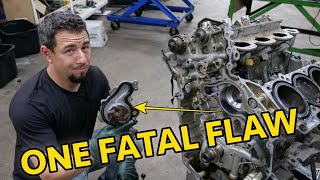
The 2007-2015 CX-9 uses a Ford-derived 3.7L V6, part of the 'Cyclone' engine family, with a critical design flaw: the water pump is located inside the engine and is driven by the primary timing chain. When the water pump's internal seal or bearing fails, it leaks coolant directly into the engine oil. This contamination destroys the oil's lubricating properties, leading to rapid wear and stretching of the timing chain and its guides. The resulting slack in the chain causes the camshaft timing to deviate from the crankshaft timing, triggering correlation codes like P0016 or a direct sensor circuit fault like P0340. Therefore, a P0340 code on this specific vehicle must be treated as a potential indicator of a severe internal engine problem, not just a simple sensor fault.
Generation note: The 2007-2015 year range covers the entire first generation (TB) of the Mazda CX-9, including the 2013 facelift. The MZI 3.7L V6 engine and its internal water pump design were used throughout this period, so the issues described are relevant to all vehicles in this range.
Symptoms You May Notice
- Check Engine Light is on
- Difficulty starting the engine, crank-no-start, or extended cranking time
- Engine stalls, especially at idle or when coming to a stop
- Rough, unstable idle
- Noticeable loss of power and acceleration
- Reduced fuel economy
- Audible timing chain rattle or slapping noise, especially on cold startup
- Replacing only the camshaft position sensor without checking for underlying mechanical timing issues. Many owners and shops replace the sensor multiple times only to have the code return because the root cause is the timing chain or water pump.
Most Likely Causes
- Failing Internal Water Pump 🔴 High Probability The MZI 3.7L V6 features a timing-chain-driven water pump located inside the engine. When the pump's bearing or seal fails, it leaks coolant into the oil and/or creates slack in the timing chain, leading to timing-related fault codes. This is a well-documented, widespread issue for this engine and its Ford Cyclone platform mates, and was the subject of a class-action lawsuit (Sonneveldt, et al. v. Mazda Motor of America, Inc.).
How to confirm: Check the engine oil on the dipstick and under the oil cap for a milky, frothy, or 'chocolate milk' appearance, which indicates coolant contamination. Also, monitor for unexplained coolant loss from the reservoir with no visible external leaks.
Typical fix: Replace the water pump, primary timing chain, secondary timing chains, all tensioners, and guides. This is a very labor-intensive job. Due to the contamination, multiple engine oil and filter changes (flushes) are required after the repair.
Est. part cost: $400-$800 - Stretched or Jumped Timing Chain 🔴 High Probability → Shop Engine Timing Chain This is almost always a direct result of a failing water pump or severe oil contamination. The chain can stretch due to poor lubrication or jump a tooth due to slack, causing the camshaft and crankshaft signals to be out of sync.
How to confirm: After ruling out sensors and wiring, a technician must physically inspect the timing marks on the camshafts and crankshaft. This requires significant engine disassembly to remove the valve covers and timing cover. A rattling noise on startup is a strong audible clue.
Typical fix: Replace the timing chain, guides, and tensioners. This is almost always done in conjunction with a water pump replacement, as the pump is the likely root cause.
Est. part cost: $300-$600 - Failed Camshaft Position Sensor (Bank 1) 🟡 Medium Probability → Shop Engine Camshaft Position Sensor Sensors can fail from heat cycles and age. While it's a common cause for P0340 on any vehicle, on the CX-9 it's often a misleading symptom of the larger mechanical timing issue. Many owners replace the sensor only to have the code return.
How to confirm: Swap the Bank 1 (rear, firewall side) and Bank 2 (front, radiator side) sensors. If the code changes to P0345 (Bank 2), the sensor is bad. A definitive test uses an oscilloscope to check for a clean square wave signal from the sensor. An ohmmeter can also be used; a good sensor should read between 0.95 and 1.25 kΩ.
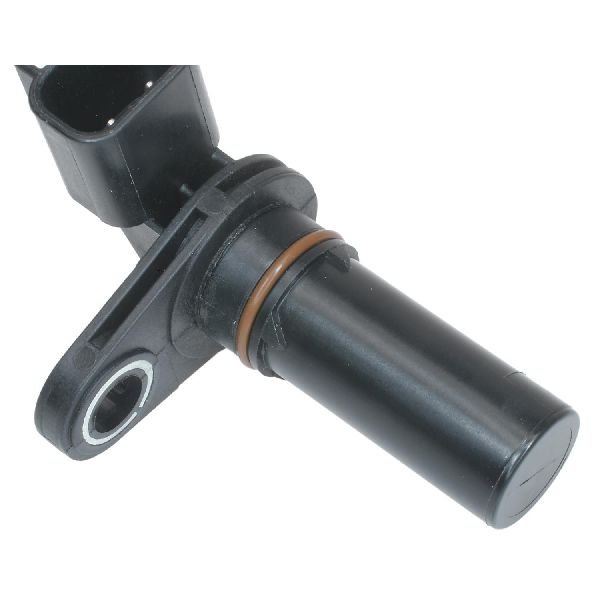
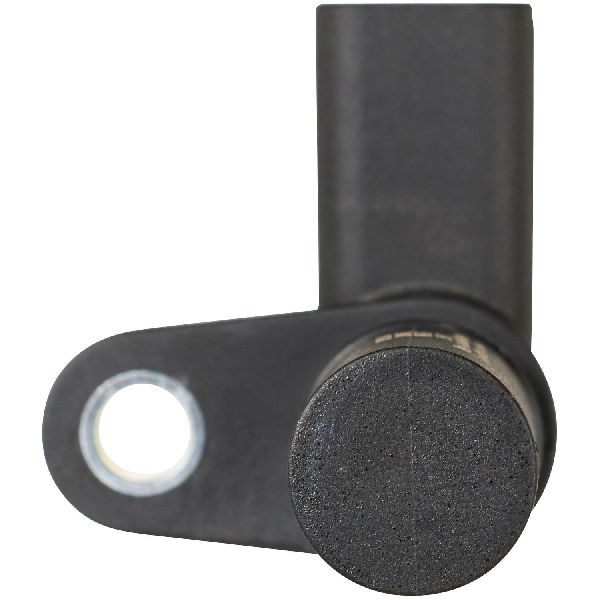
Typical fix: Replace the Bank 1 camshaft position sensor. The OEM part number is CY01-18-230 or CA01-18-230.
Est. part cost: $25-$75 - Wiring or Connector Issue ⚪ Low Probability The wiring harness, especially the section near the rear cylinder head (Bank 1), can become brittle or chafed over time, leading to an open or short in the sensor circuit.
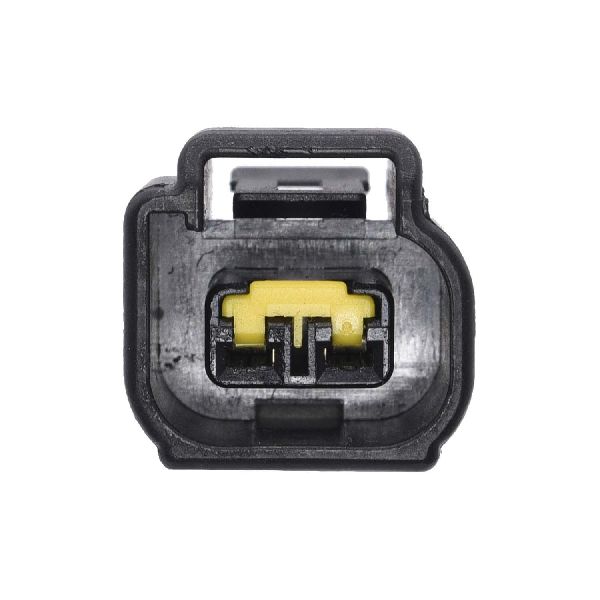
How to confirm: Visually inspect the wiring and connector for the Bank 1 cam sensor. Perform a continuity and voltage test on the signal, power, and ground wires between the sensor connector and the PCM.
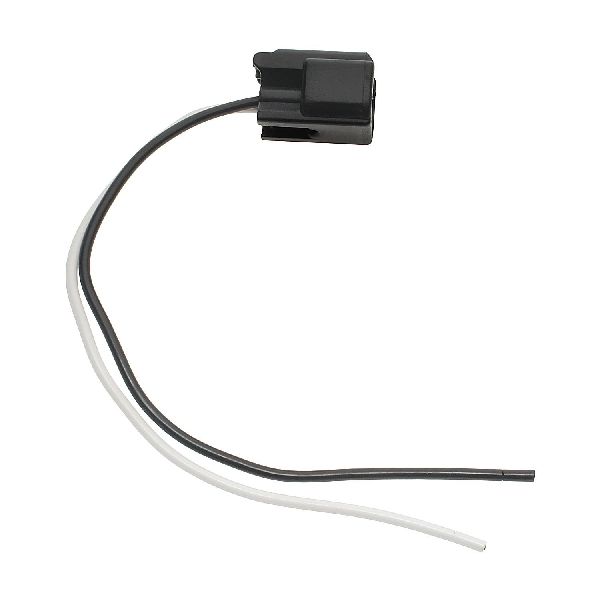
Typical fix: Repair or replace the damaged section of the wiring harness or the connector pigtail.
Est. part cost: $5-$50
Rare But Worth Checking
- Failed Powertrain Control Module (PCM): → Shop Engine Control Module (ECM) This is extremely rare. The PCM should only be considered after all other possibilities, including complex mechanical timing issues and circuit integrity checks, have been exhaustively ruled out by a professional.
- Damaged Reluctor Wheel on Camshaft: → Shop Engine Camshaft The teeth on the camshaft that the sensor reads can become damaged or obstructed by debris, causing an erratic signal. This is uncommon and would require removing the valve cover to inspect.
Diagnosis Steps
- Read all stored fault codes with an OBD-II scanner. Note any accompanying codes like P0016 or P0345.
- CRITICAL STEP: Inspect the engine oil on the dipstick and oil filler cap. If it appears milky, frothy, or like chocolate milk, STOP. This indicates coolant contamination from a failed internal water pump. The engine requires immediate, professional service for a timing chain and water pump replacement.
- If oil is clean, listen carefully to the engine during a cold start. A brief but distinct rattling or scraping sound from the front (passenger side) of the engine indicates a likely loose timing chain.
- Visually inspect the wiring harness and connector for the Bank 1 (rear, firewall side) camshaft position sensor for any signs of damage, corrosion, or loose connections.
- If wiring appears intact, swap the Bank 1 and Bank 2 camshaft position sensors. They are identical parts. Clear the codes 🎬 See how to access and replace the Bank 1 sensor and drive the vehicle. If the code returns as P0345, the sensor you moved is faulty and needs replacement.
- If the code P0340 returns after the swap, the issue is not the sensor. The problem lies in the circuit or, more likely, the mechanical timing of the engine.
- For advanced diagnosis, use an oscilloscope to check the signal from the Bank 1 cam sensor at the sensor connector and at the PCM. A missing or erratic square wave pattern indicates a problem in the circuit or with the sensor itself. A multimeter can also be used to back-probe the signal wire while the engine is running; it should show around 2.5V with minor fluctuations.
- If all sensor and circuit tests pass, the vehicle must be taken to a qualified technician to diagnose the timing system. This involves removing the timing cover to physically inspect the chain, guides, and timing marks, which is a labor-intensive process.
Parts You'll Likely Need
- Water Pump and Timing Chain Kit
(OEM #CY01-12-S00A (Kit often includes water pump, chains, guides, tensioners))— This is the most common root cause of P0340 on the 3.7L V6. The internal water pump fails, causing timing chain issues. They should always be replaced together.
Trusted brands: Mazda OE, Motorcraft, Cloyes
OEM price range: $600-$900
Aftermarket price range: $300-$500 - Camshaft Position Sensor (Bank 1)
(OEM #CY01-18-230 / CA01-18-230)— This is the component directly referenced by the code and is a potential failure point, though often it's just a symptom of the larger timing problem.
Trusted brands: Mazda OE, Bosch, Denso, NGK/NTK
OEM price range: $60-$90
Aftermarket price range: $25-$50
Related Codes That Often Appear With This One
- P0016, P0017, P0018, P0019 — These are Crankshaft/Camshaft Correlation codes. They are a very strong indicator that the timing chain has jumped or is stretched, which is a primary cause of P0340 on this engine.
- P0345 — This is the same code but for Bank 2 (front bank). If both P0340 and P0345 appear, it points more strongly toward a base timing issue affecting the entire engine, such as a stretched chain or a failing crankshaft position sensor.
- P0300, P0301-P0306 — Misfire codes can occur because the incorrect cam timing leads to improper valve operation, causing combustion failures in one or more cylinders.
Technical Service Bulletins (TSBs) & Recalls
- While no TSB is a direct match for P0340 on the CX-9, TSB 01-015/13 for older Mazda6 models addresses similar codes (P2135, P0123, P0222) caused by abnormal electrical noise, for which a harness with a diode is the fix. This highlights that electrical issues can sometimes mimic sensor failures and should be considered during diagnosis.
- Manufacturer TSB Bulletin #SA-022-19 notes that for some Mazda models, a customer complaint of lack of power, rough idle, or engine noise may be accompanied by stored DTC P0340:00.
Platform-Specific Known Issues
- The MZI 3.7L V6 engine has an internal, timing-chain-driven water pump. Failure of this pump is a widely known
Mechanic-Grade Diagnostic Values
- Camshaft Position Sensor (CMP) Resistance — expected: 0.95 - 1.25 kΩ (950 - 1250 Ohms). Failure: A reading outside of this range indicates a faulty sensor.
- Camshaft Position Sensor (CMP) Signal Wire Voltage — expected: Approx. 2.5V while running, with minor fluctuations.. Failure: Large voltage drops or spikes, or no voltage, indicates a circuit or sensor problem.
- Camshaft Position Sensor (CMP) Reference Voltage — expected: 5V. Failure: No or low voltage indicates a problem with the PCM or the wiring providing power to the sensor.
Scan Tool Commands That Help
- High-end OBD2 Scanner (e.g., CGSULIT): Crankshaft Position (CKP) Variation Learn / Cam crank relearn — After replacing a camshaft sensor, crankshaft sensor, or timing components, this function may be required to synchronize the new components with the PCM and clear persistent codes.
- Mazda M-MDS (Mazda Modular Diagnostic System): PCM Configuration — This is a dealer-level function required only when the entire PCM is replaced.
Wiring & Ground Locations
- Bank 1 CMP Sensor — On the rear cylinder head, which is closer to the firewall/bulkhead.. This is the specific sensor ('A' circuit) referenced by the P0340 code.
- G10 / G11 — Behind the left side of the dashboard.. These are primary interior ground points. A poor ground at these locations can cause a variety of sensor circuit malfunctions, including P0340.
- PCM Connectors — Located under the battery and battery tray.. Technicians need to access these connectors to test continuity of the CMP sensor circuit directly at the PCM, ruling out wiring harness issues.
Real Owner Repair Stories
- Mazdas247 Forum (2011 Mazda CX-9) — Not specified, but required timing component replacement.
❌ Tried (didn't work) The user noted that the Mazda service manual states the engine must be removed for timing chain/water pump service.
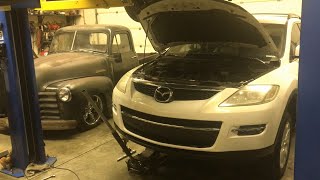
✅ What actually fixed it The user successfully replaced the timing chains, water pump, and VVT actuators without removing the engine from the vehicle, though it required raising and lowering the engine to access various bolts and the timing cover. - Imgur post referenced in a forum (2003 Mazda 6 2.3L (similar diagnostic principle)) — Consistent P0340 code, no-start after removing a 'spacer' (a penny) found under the sensor.
❌ Tried (didn't work) Replacing the camshaft position sensor, as the original sensor tested good., Editing the VIN in the ECU with ForScan software.
✅ What actually fixed it The root cause was a jumped timing chain. The previous owner had wedged a penny under the sensor to change its reading distance to compensate for the incorrect cam timing. The final fix was replacing the timing chain.
OEM Part Supersession History
CY01-18-230→CA01-18-230— Standard part number update or revision by Mazda.
Heads up: The parts are interchangeable. CA01-18-230 is the current replacement for CY01-18-230.ZZJ1-18-280→CA01-18-230— Standard part number update or revision by Mazda.
Heads up: The parts are interchangeable. CA01-18-230 is the current replacement for ZZJ1-18-280.
Model Year Variations Within This Range
- 2007-2010 vs 2011-2015: There was a change in the primary timing chain design around the end of 2010. Kits for 2007-2010 vehicles often list a 202-link primary chain. Kits for 2011-2015 models may specify a different chain (e.g., 254-link inverted tooth) and are often marked as for vehicles built 'From 12/14/2010'. It is critical to verify the vehicle's production date before ordering a timing kit.
- All years (visual confirmation needed): Some 3.7L engines were fitted with a single-sprocket water pump, while others used a dual-sprocket design. This must be visually confirmed by removing the valve cover to inspect the chain type before ordering a replacement kit.
Diagnostic Flowchart
Other Known Issues on This Vehicle
Issues unrelated to this code that are worth knowing about as an owner of this generation:
- Power Brake Booster Failure 🔴 High — Common enough that Mazda issued a warranty extension (SSP 93). Often presents as a hissing sound from the pedal area and a hard brake pedal. (Ref: Mazda Special Service Program (SSP 93))
- Transfer Case (PTU) Failure (AWD Models) 🔴 High — A very common failure point on AWD models. The PTU fluid overheats and breaks down, leading to gear and bearing failure. Often requires complete replacement. Regular fluid changes are recommended as a preventative measure.
- Front Strut Mount Squeaking/Failure 🟠 Medium — The upper front strut mounts are known to wear out, causing a persistent squeaking or creaking noise when going over bumps or turning the steering wheel at low speeds.
- Leaking Internal Water Pump 🔴 High — This is the primary issue discussed in the P0340 context. It is a chronic, well-documented failure on the 3.7L V6 that occurs in a significant percentage of vehicles, often between 90k-150k miles.
Used vs. New Parts: Buying Guide for This Vehicle
When a used part is the smart pick: For this specific P0340 issue, a used part is only a reasonable choice for the Camshaft Position Sensor itself, provided it's from a low-mileage vehicle and can be tested or comes with a warranty. Given the low cost of new aftermarket sensors, buying used is often not worth the risk.
Donor-vehicle mileage cap: roughly under 50000 miles for the part to have meaningful remaining life.
What to inspect on the donor part:
- For a sensor, check for physical damage, cracks in the plastic housing, or corrosion on the electrical pins.
- Ask for the VIN of the donor car to verify its year and mileage.
- Avoid parts from engines that show signs of heavy oil sludge or coolant contamination.
OEM-only on this vehicle (don't cheap out):
- While not strictly 'OEM-only', using a complete, high-quality kit for the timing chain and water pump job is critical. Mixing and matching components is not recommended. Ford's Motorcraft brand is equivalent to Mazda OE for this repair.
Aftermarket brands forum-validated for this vehicle:
- Cloyes: Widely regarded as a top-tier aftermarket brand for timing components.
- Gates: Known for quality water pumps and belts.
- Melling: A reputable brand for engine components, including timing sets.
- Denso / NGK / Bosch: Reliable choices for camshaft position sensors if not buying OEM.
Brands owners have reported issues with on this vehicle:
- Unbranded, 'white box' timing kits from online marketplaces should be avoided. The labor for this job is immense, and part failure is catastrophic. Some users have reported premature failures with lower-quality kits.
Real Owner Stories
Aggregated from forums and TSBs cited above. Mileages and costs reflect what owners reported in those sources.
2011 Mazda CX-9 3.7L V6 — 145000 miles
Symptoms: A water pump leak led to a stretched timing chain.
What fixed it: Replacement of the water pump and timing chain.
Source hint: Mazda Forum: Timing Chain at 145k, what next?
Mazda CX-9 3.7L V6 — 90000 miles
Symptoms: Internal water pump failure described as a 'time bomb' leading to engine concerns.
What fixed it: Immediate replacement of the water pump and timing chain components.
Source hint: Reddit (r/MazdaCX9): Timing chain and water pump on high mileage CX-9
Mazda CX-9 3.7L V6 — 240000 miles
Symptoms: High mileage vehicle requiring preventative maintenance of the internal water pump and timing system.
What fixed it: Full timing chain, water pump, and VVT actuator replacement performed without engine removal.
Source hint: Mazdas247: CX-9 Timing Chain, Water Pump, and VVT - Engine does not need to be removed
Related OBD-II Codes
Frequently Asked Questions
I have a P0340 code on my CX-9; should I just replace the Bank 1 camshaft sensor?
How can I tell if my P0340 code is actually caused by the internal water pump failure?
Is there a TSB for electrical noise causing sensor codes on the CX-9?
Can I test the camshaft sensors myself before buying new ones?
Do I need to remove the engine to fix the timing chain and water pump issue?
Why is the water pump failure so common on the 2007-2015 CX-9?
Helpful Videos
We Have This Part in Stock


The information in this article is provided for general reference and educational purposes only. Vehicle specifications, procedures, and part compatibility can vary by production date, trim level, and region. Always consult your vehicle's factory service manual and verify part numbers before purchasing or performing repairs. Safety-critical components such as airbags, seat belts, and braking systems should be installed by a qualified professional.
- Mazda CX-9:
- 🧭 Diagnostic Flowchart
- 🎬 Helpful Videos
- 🛍️ Shop This Part
- What's Unique About the 2007-2015 Mazda CX-9
- Symptoms You May Notice
- Most Likely Causes
- Rare But Worth Checking
- Diagnosis Steps
- Parts You'll Likely Need
- Related Codes That Often Appear With This One
- Technical Service Bulletins (TSBs) & Recalls
- Platform-Specific Known Issues
- Mechanic-Grade Diagnostic Values
- Scan Tool Commands That Help
- Wiring & Ground Locations
- Real Owner Repair Stories
- OEM Part Supersession History
- Model Year Variations Within This Range
- Other Known Issues on This Vehicle
- Used vs. New Parts: Buying Guide for This Vehicle
- Real Owner Stories
- 2011 Mazda CX-9 3.7L V6 — 145000 miles
- Mazda CX-9 3.7L V6 — 90000 miles
- Mazda CX-9 3.7L V6 — 240000 miles
- Related OBD-II Codes
- Frequently Asked Questions
- 🎟️ Get 5% Off