

P0340 on 2006-2013 Toyota Camry: Camshaft Sensor Causes and Fixes
On a 2006-2013 Toyota Camry, code P0340 most often means the camshaft position sensor for Bank 1 has failed or its wiring is damaged. This is a common failure item, but other causes like low battery voltage or a loose ground wire are known issues on this platform. A replacement sensor costs between $40 and $120 and is a straightforward DIY replacement for many owners.
- P0340 on a 2006-2013 Camry is most often a failed camshaft position sensor, which is a relatively inexpensive and easy part to replace.
- Before buying parts, always check for simple fixes: ensure the battery is fully charged, inspect the sensor's wiring for damage, and check for loose ground wires on the engine.
- Remove the sensor and clean its tip. Oil sludge can build up and block the signal, and cleaning it is a free potential fix.
- If you replace the sensor and the code returns, the problem is likely in the wiring or, more rarely, a mechanical timing issue.
What's Unique About the 2006-2013 Toyota CAMRY

For this generation of Camry, the cause of P0340 can be something other than a bad sensor. A widely-cited Toyota Technical Service Bulletin (TSB T-TT-0010-10 Rev) points to low battery voltage as a potential trigger, which can be caused by a weak battery or failing alternator. Owner reports specifically for the 2.4L (2AZ-FE) engine frequently cite a loose ground wire on the cylinder head as the culprit. On the newer 2.5L (2AR-FE) engine, mechanics have noted that poor quality oil or extended oil change intervals can lead to sludge buildup on the sensor tip, interrupting its signal. On the 3.5L V6 (2GR-FE), there are four camshaft sensors in total (intake and exhaust for each bank), so it's crucial to confirm P0340 corresponds to the correct sensor (Bank 1 Intake) before replacing parts.
Diagnostic Flowchart

Tap your situation to follow the diagnostic path that matches what you're seeing on this vehicle.
Generation note: The 2006-2013 year range covers the end of the XV30 (2006), the full XV40 (2007-2011), and the beginning of the XV50 (2012-2013). Engines include the 2.4L 4-cylinder (2AZ-FE), the 3.5L V6 (2GR-FE), and the 2.5L 4-cylinder (2AR-FE). While the primary causes are similar, sensor location and specific issues like ground wire placement can vary. P0340 specifically refers to the Bank 1 sensor, which on the V6 is the cylinder head closer to the firewall.
Symptoms You May Notice
- Check Engine Light is on
- Engine is hard to start or cranks but won't start
- Engine stalls, hesitates, or runs rough, sometimes specifically when shifting from Park
- Noticeable loss of acceleration and power
- Unstable or rough idle
- Replacing the crankshaft position sensor. While related, the crankshaft sensor has its own set of trouble codes (e.g., P0335).
- Replacing the ECM without first exhaustively checking the wiring, sensor, and mechanical timing.
- Replacing the wrong camshaft sensor on the V6 engine. P0340 refers to Bank 1 (firewall side), while P0345 refers to Bank 2 (radiator side).
Most Likely Causes

- Failed Camshaft Position Sensor 🔴 High Probability → Shop Engine Camshaft Position Sensor The sensor is an electronic component that operates in a high-heat engine environment and can fail over time due to thermal stress and wear. It is a very common replacement part.
How to confirm: After confirming wiring is intact, test the sensor's resistance with a multimeter. For the 2.4L (2AZ-FE), the expected resistance is 835-1,400 Ω when cold and 1,060-1,645 Ω when hot. For some other 2AZ-FE sensors, the spec is 1,630-2,740 Ω cold and 2,065-3,225 Ω hot. Always verify the correct spec for your specific part. An out-of-spec reading or an open circuit indicates a failed sensor. The easiest confirmation is often replacing it with a known good part, especially given the relatively low cost.
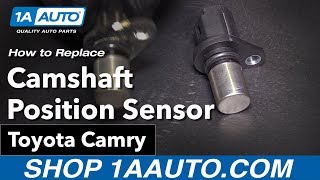
Typical fix: Replace the camshaft position sensor. On all Camry engines in this range, it is typically held by a single 10mm bolt and is easily accessible. 🎬 Watch this step-by-step guide to replacing the sensor yourself.
Est. part cost: $40-$120 - Wiring or Connector Issue 🟡 Medium Probability Engine vibration and heat can cause wires to become brittle, frayed, or loose. A well-documented issue on the 2.4L (2AZ-FE) engine is a loose ground wire on the cylinder head, which can cause intermittent signal loss and trigger P0340.
How to confirm: Visually inspect the wiring harness and connector leading to the camshaft position sensor for any signs of damage, corrosion, or looseness. Check for a solid ground connection, especially on the 2.4L engine at ground point 'EB' or 'EG'. Use a multimeter to check for continuity between the sensor connector and the ECM connector pins.
Typical fix: Repair or replace the damaged section of wiring. Clean corroded connectors with electrical contact cleaner or secure loose connections. Tighten any loose ground bolts.
Est. part cost: $5-$50 - Low Battery Voltage or Failing Alternator ⚪ Low Probability → Shop Vehicle Battery Toyota TSB T-TT-0010-10 Rev confirms that low battery voltage can cause inconsistent engine rotational speed during cranking, which the ECM can misinterpret as a camshaft sensor fault, triggering a P0340 code.
How to confirm: Test the battery voltage with the engine off (should be ~12.6V). Then, test the alternator output with the engine running (should be ~13.5-14.5V). A low reading in either test points to a charging system issue. This should be one of the first checks performed.
Typical fix: Charge or replace the battery. If the alternator output is low, it will need to be replaced.
Est. part cost: $150-$400 - Dirty Sensor from Oil Sludge ⚪ Low Probability Infrequent oil changes or using low-quality oil can lead to sludge buildup, a known issue on some Toyota engines. This sludge can coat the magnetic tip of the sensor, preventing it from accurately reading the camshaft's position.
How to confirm: Remove the sensor (one 10mm bolt) and visually inspect its tip for a thick film of dark, sludgy oil. The sensor should be relatively clean.
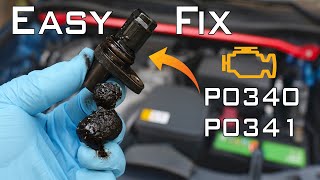
Typical fix: Clean the sensor tip with brake cleaner and a rag. If the code returns, the sensor may be permanently damaged. An engine flush and more frequent oil changes with quality oil are recommended to address the root cause. 🎬 See how dirty oil can trigger your P0340 code.
Est. part cost: $5-$15 for cleaner
Rare But Worth Checking
- Stretched or Jumped Timing Chain/Belt: → Shop Engine Timing Chain This is a more serious mechanical issue. If the timing chain has stretched or jumped a tooth, the camshaft and crankshaft will be out of sync, which can trigger the P0340 code because the sensor's reading doesn't match the crankshaft's reading. This is often accompanied by rattling noises from the engine.
- Faulty Engine Control Module (ECM): → Shop Engine Control Module (ECM) This is the least likely cause and should only be considered after all other possibilities (sensor, wiring, timing, battery) have been thoroughly ruled out by a professional.
Diagnosis Steps

- Read Stored Codes: Use an OBD-II scanner to confirm P0340 and check for any other codes that could provide more context (e.g., P0335, P0016).
- Check Battery & Charging System: Per TSB T-TT-0010-10 Rev, test the battery voltage (should be ~12.6V off) and alternator output (should be 13.5-14.5V running). Rule this out first.
- Inspect Wiring and Connector: Visually inspect the harness going to the Bank 1 camshaft sensor for damage. On the 2.4L (2AZ-FE), specifically check the ground wire on the cylinder head for tightness.
- Inspect the Sensor: Remove the sensor (one 10mm bolt). Check the tip for heavy oil sludge or metallic debris. Clean with brake cleaner if dirty and re-test.
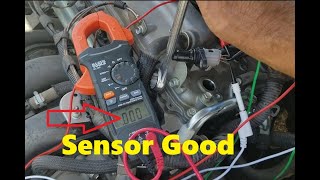
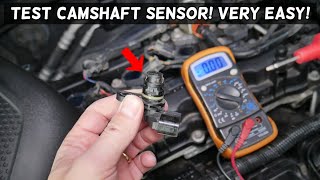
- Test the Sensor: With a multimeter, check the sensor's resistance between its pins. Compare to the service manual specification (e.g., 835-1,400 Ω for 2AZ-FE). An open or shorted sensor is bad. 🎬 Watch: How to test the sensor and circuit with a multimeter.
- Test the Circuit: With the sensor unplugged and key 'ON', use a multimeter to verify reference voltage (usually 5V for 3-wire sensors, not applicable for 2-wire inductive) and ground at the connector pins. For 2-wire sensors, check for continuity on both wires back to the ECM.
- Swap Test (if applicable): On V6 engines, if you suspect a bad sensor, you can swap the Bank 1 sensor with the identical Bank 2 sensor. Clear the codes and see if the fault follows the sensor (i.e., P0345 appears).
- Check Mechanical Timing: If all electrical checks pass, the issue may be mechanical. This is an advanced step involving inspecting the timing chain for slack or damage, which may require professional help.
Parts You'll Likely Need
- Camshaft Position Sensor
(OEM #90919-05060 (Verify for specific engine/year))— This is the most frequent point of failure for code P0340. It is an electronic sensor that eventually wears out. Note: The part number 90919-A5007 cited in Pass 1 is for newer model Camrys (2018+) and is incorrect for this vehicle generation. 90919-05060 is a common part number for many Toyota engines in this era, but always verify with VIN.
Trusted brands: Denso (OEM), NTK/NGK, Duralast, Standard Motor Products (SMP)
OEM price range: $80-$120
Aftermarket price range: $40-$75
Related Codes That Often Appear With This One
- P0335 — This is the code for the Crankshaft Position Sensor. Since the two sensors work together to verify engine timing, a fault in one system can sometimes lead the ECM to flag the other. The TSB T-TT-0010-10 Rev also links both codes to low battery voltage.
- P0010 - P0019 — These codes relate to camshaft position timing and the variable valve timing (VVT) system. A fault in the sensor that reads the camshaft's position can naturally lead to codes indicating a problem with the camshaft's timing itself.
- P0345 — On the 3.5L V6 (2GR-FE) engine, this code indicates a fault with the Camshaft Position Sensor 'A' Circuit for Bank 2. It's common to see this if there's a systemic issue like low oil pressure or if both sensors are failing around the same time.
Technical Service Bulletins (TSBs) & Recalls
- T-TT-0010-10 Rev: Notes that low battery voltage can cause P0340 due to inconsistent engine rotational speed during cranking.
Platform-Specific Known Issues
- A known Toyota TSB (T-TT-0010-10 Rev) indicates that low battery voltage can be a direct cause of P0340 on this vehicle.
- On the 2.4L (2AZ-FE) engine, a loose ground wire on the back of the cylinder head has been documented by owners as a specific cause for P0340.
- On the 3.5L V6 (2GR-FE), P0340 refers to the intake camshaft sensor on Bank 1 (firewall side). The exhaust camshaft sensor on the same bank would trigger P0365.
Mechanic-Grade Diagnostic Values
- Camshaft Position Sensor Resistance (2.4L 2AZ-FE) — expected: 835 - 1,400 Ω (Cold) / 1,060 - 1,645 Ω (Hot). Note: Some service documents show 1,630 - 2,740 Ω (Cold) / 2,065 - 3,225 Ω (Hot). Always verify against the specific part.. Failure: A reading outside the specified range, or an open/infinite resistance reading.
- VVT (Cam) Sensor Voltage Check at Connector (3.5L 2GR-FE) — expected: Ignition ON: Pin 1 (VC) to Ground should be 4.5 - 5.5 V. Pin 3 (E2) to Ground should have continuity (less than 1 Ω).. Failure: Voltage outside the 4.5-5.5V range indicates a problem with the ECM or wiring. No continuity to ground indicates a broken ground wire.
Scan Tool Commands That Help
- Toyota Techstream: Freeze Frame Data — Always check the Freeze Frame Data when a P0340 is stored. It records engine conditions (RPM, temp, vehicle speed) at the exact moment the fault occurred, which can help determine if the issue happens during cranking, at idle, or while driving.
Wiring & Ground Locations

- EB / EG (2.4L 2AZ-FE) — Ground points located on the cylinder head of the 2.4L engine. EB is on the left back of the cylinder head, EG is on the left side.. The pass 2 information mentioned a loose ground wire on the cylinder head being a common issue. These are the specific ground point designators. A poor connection at these points can cause intermittent sensor signal loss, triggering P0340.
- Engine to Chassis Ground Strap — Connects the engine block or transmission to the vehicle's chassis/frame, often near a motor mount.. A corroded or loose main engine ground can cause a host of electrical issues, including spurious sensor codes like P0340, as the sensors may not have a stable ground reference. This is a crucial check for any electrical fault diagnosis.
Real Owner Repair Stories
- Camry Forums user '2wonder' (1999 Toyota Camry 4-cylinder (similar 5S-FE engine but same diagnostic principle)) — Rough running and Check Engine Light with code P0340 immediately after a drive belt broke.
❌ Tried (didn't work) The user tested the camshaft position sensor, and its resistance was within the correct specification (1194 ohms).
✅ What actually fixed it The root cause was debris from the shredded drive belt getting behind the timing cover and damaging the wiring or interfering with the sensor's reading of the timing pulley. The fix involved removing the debris and repairing any damaged wiring.
Model Year Variations Within This Range
- 2006-2009 (2.4L 2AZ-FE): These models use a 2-wire inductive camshaft position sensor. Testing involves measuring resistance, which should be between 835-1400Ω when cold.
- 2007-2013 (3.5L 2GR-FE): These models use a 3-wire Magneto-Resistive Element (MRE) type sensor. Testing involves checking for a 5V reference voltage from the ECM, a good ground, and a signal that fluctuates as the engine turns. Resistance tests are not applicable to this sensor type.
Helpful Videos

The information in this article is provided for general reference and educational purposes only. Vehicle specifications, procedures, and part compatibility can vary by production date, trim level, and region. Always consult your vehicle's factory service manual and verify part numbers before purchasing or performing repairs. Safety-critical components such as airbags, seat belts, and braking systems should be installed by a qualified professional.
- Toyota CAMRY:
- 🧭 Diagnostic Flowchart
- 🎬 Helpful Videos
- What's Unique About the 2006-2013 Toyota CAMRY
- Symptoms You May Notice
- Most Likely Causes
- Rare But Worth Checking
- Diagnosis Steps
- Parts You'll Likely Need
- Related Codes That Often Appear With This One
- Technical Service Bulletins (TSBs) & Recalls
- Platform-Specific Known Issues
- Mechanic-Grade Diagnostic Values
- Scan Tool Commands That Help
- Wiring & Ground Locations
- Real Owner Repair Stories
- Model Year Variations Within This Range
- 🎟️ Get 5% Off