

P0340 on 1999-2003 Toyota Camry Solara: Camshaft Sensor Causes & Fixes
On a 1999-2003 Solara, P0340 is most often a failed camshaft position sensor. However, a Toyota Technical Service Bulletin states low battery voltage can also trigger this code, so test your battery first. For a lasting repair, owners strongly recommend using an OEM Denso sensor, which costs about $70-$120, as aftermarket sensors are known to fail prematurely.
- Always test your battery first! A weak battery is a known cause of P0340 on these Toyotas and is a free check.
- If you replace the sensor, spend the extra money on an OEM Denso part. Aftermarket sensors for this application are known to be unreliable.
- The code means 'circuit malfunction'. Before buying parts, inspect the sensor's connector and wiring for any obvious damage, corrosion, or oil contamination.
- If the code appeared suddenly with a rough run condition after a serpentine belt failure, inspect for debris behind the timing cover that may have caused the timing belt to jump a tooth.
What's Unique About the 1999-2003 Toyota CAMRY SOLARA
For this specific generation of Solara, Toyota issued a Technical Service Bulletin (TSB #T-TT-0010-10 Rev) noting that low battery voltage can cause a P0340 code, sometimes along with a P0335 for the crankshaft sensor. This makes checking your battery's health a critical first step before replacing parts. Additionally, owner forums for the Solara and its platform mates (like the Camry and Lexus ES300) are filled with reports of cheap aftermarket sensors failing quickly or being dead on arrival; there is a very strong consensus to use the OEM supplier, Denso, for this part to ensure a reliable fix.
Diagnostic Flowchart
Tap your situation to follow the diagnostic path that matches what you're seeing on this vehicle.
Symptoms You May Notice
- Check Engine Light is on
- Engine is hard to start or cranks but won't start
- Engine stalls unexpectedly, sometimes while driving
- Rough or unstable idle
- Noticeable loss of power and poor acceleration
- Engine hesitates or stutters during acceleration 🎬 See what happens when your camshaft sensor fails.
- Immediately replacing the camshaft position sensor without first testing the battery voltage. The TSB-documented link to low voltage means a simple battery check can save time and money.
- Using a cheap, unbranded aftermarket sensor. Owners report these parts often fail prematurely, causing the code to return. There are also reports of counterfeit Denso parts sold online, so purchasing from a reputable source is key.
- Replacing the sensor when the actual fault is a broken wire, oil-soaked connector, or a poor ground connection.
Most Likely Causes
- Failed Camshaft Position Sensor 🔴 High Probability → Shop Engine Camshaft Position Sensor The sensor operates in a high-heat environment and is a common electronic wear item. It is the most frequent point of failure for this code.
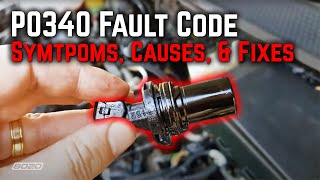
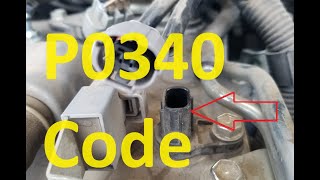
How to confirm: Test the sensor's resistance with a multimeter. For the 2.2L 5S-FE and 3.0L 1MZ-FE, it should be 835-1,400 ohms when cold. For the 2.4L 2AZ-FE, the spec is 1,630-2,740 ohms when cold. If the reading is out of spec or an oscilloscope shows no signal, the sensor has failed. 🎬 Watch: Common causes and fixes for the P0340 code.
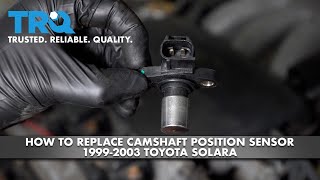
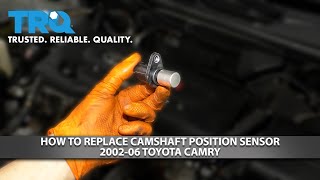
Typical fix: Replace the camshaft position sensor. The job is simple, usually requiring only the removal of a single 10mm bolt. 🎬 Watch: Step-by-step camshaft sensor replacement for your Solara.
Est. part cost: $30-$120 - Damaged Wiring or Connector 🟡 Medium Probability Engine heat and vibration can make the sensor's wiring brittle and cause the plastic connector to crack or break. Oil from a leaking valve cover gasket can also seep into the connector and disrupt the signal.
How to confirm: Visually inspect the wiring harness leading to the sensor for any cracks, fraying, or melted sections. Check that the connector is secure and free of oil and corrosion. A user on TacomaWorld with a similar V6 engine had to have a dealer trace a disconnect in the harness between the ECU and sensor after multiple other parts were replaced.
Typical fix: Repair the damaged section of wire or replace the connector pigtail. If the connector's locking tab breaks, a zip tie can be used as a temporary hold-down.
Est. part cost: $15-$40 - Low Battery Voltage 🟡 Medium Probability → Shop Vehicle Battery A Toyota TSB (#T-TT-0010-10 Rev) explicitly states that low battery voltage during cranking can cause inconsistent engine rotational speed, triggering a P0340 code.
How to confirm: Test the battery with a multimeter. It should have at least 12.4V with the engine off. While cranking, the voltage should not drop below 10.5V.
Typical fix: Recharge or replace the battery. Clear the codes and see if the problem returns.
Est. part cost: $0-$250 - Jumped or Broken Timing Belt (V6) / Chain (I4) ⚪ Low Probability → Shop Engine Timing Chain If the timing belt or chain jumps a tooth, the camshaft and crankshaft will be out of sync, causing the ECM to see a conflict between the two sensors' signals and set a P0340 code.
How to confirm: Remove the upper timing cover and rotate the engine by hand to align the crankshaft pulley to its TDC mark. Verify that the camshaft pulley marks also line up perfectly with their marks on the engine block/head.
Typical fix: If the timing has jumped, a full timing belt/chain service is required, including replacing the belt/chain, tensioner, and water pump.
Est. part cost: $150-$500
Rare But Worth Checking
- Debris Behind Timing Cover: In at least one documented case on CamryForums, a shredded serpentine (drive) belt sent debris behind the timing cover, which caused the timing belt to slip and trigger a P0340 code. The user confirmed the sensor itself tested within spec, proving the mechanical interference was the root cause. If the code appears immediately after a serpentine belt failure, this is a strong possibility.
- Loose Ground Wire (2.4L 2AZ-FE): On the 2.4L 2AZ-FE engine specifically, a loose ground wire on the cylinder head (often designated 'EB' or 'EG' in diagrams) has been documented by owners as a cause for an intermittent P0340 code due to signal loss.
- Failed Engine Control Module (ECM): → Shop Engine Control Module (ECM) This is extremely rare. The ECM is the last component to suspect and should only be considered after every other possibility, including the full wiring harness continuity, has been exhaustively checked by a professional.
Diagnosis Steps
- Check Battery Health: Using a multimeter, confirm the battery has at least 12.4 volts with the engine off. Check that the voltage does not drop below 10.5 volts during cranking. If it does, address the battery/alternator issue first.
- Inspect the Circuit: Visually inspect the camshaft position sensor's electrical connector for cracks, corrosion, or oil contamination from a leaky valve cover. Follow the wiring harness as far as you can, looking for any signs of damage, melting, or fraying. Ensure the connector is securely latched.
- Test the Sensor: Disconnect the sensor and measure the resistance between its terminals. For 2.2L/3.0L engines, expect 835-1,400 ohms (cold). For the 2.4L engine, expect 1,630-2,740 ohms (cold). If the reading is out of spec, the sensor is bad.
- Check for Mechanical Timing Issues: If the code persists, verify the engine's mechanical timing. Remove the upper timing cover(s) and rotate the crankshaft to align its timing mark. Check if the camshaft pulley(s) are also perfectly aligned with their respective marks. If they are off, the timing belt/chain has jumped.
- Replace the Sensor: If the battery, wiring, and timing are all good, the sensor itself is the most likely culprit. Replace it, preferably with an OEM Denso part purchased from a reputable vendor.
- Clear Codes: After the repair, use an OBD-II scanner to clear the trouble codes. Start the engine and confirm the Check Engine Light does not return.
Parts You'll Likely Need
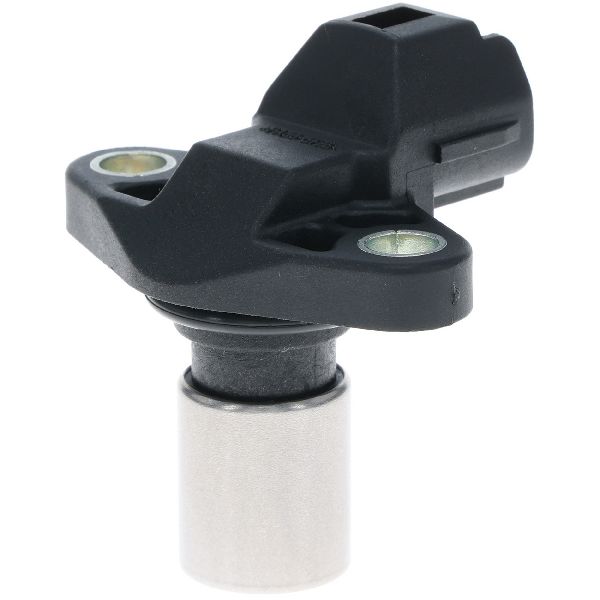
- Camshaft Position Sensor
(OEM #90919-05026 (for 3.0L 1MZ-FE), 90919-05024 (for 2.2L 5S-FE), 90919-05042 (for 2.4L 2AZ-FE))— This sensor is the most common component to fail in the circuit, directly causing the P0340 code.
Trusted brands: Denso (OEM), NGK/NTK, Hitachi
OEM price range: $70-$120
Aftermarket price range: $30-$80
Related Codes That Often Appear With This One
- P0335 — This is the code for the Crankshaft Position Sensor. The official Toyota TSB mentions that low battery voltage can cause both P0340 and P0335 to appear together due to inconsistent crank speed readings.
- P1350 — This is a manufacturer-specific code for the VVT (Variable Valve Timing) sensor circuit (Bank 2 on V6). It can appear alongside P0340 if there is a serious mechanical timing issue, such as a broken timing belt, that affects the entire valve train. A user on a Car Talk forum reported both codes appeared simultaneously when their timing belt broke on a 1MZ-FE engine.
Technical Service Bulletins (TSBs) & Recalls
- T-TT-0010-10 Rev: States that low battery voltage can contribute to a MIL "ON" condition for P0335 (Crankshaft Position Sensor Circuit) and/or P0340 (Camshaft Position Sensor Circuit) due to inconsistent rotational speed of the engine's crankshaft.
Platform-Specific Known Issues
- A known issue documented by Toyota in TSB #T-TT-0010-10 Rev is that low battery voltage can trigger code P0340. This should be the first diagnostic check.
- On the 2.4L 2AZ-FE engine, a loose ground wire on the cylinder head is a known, specific cause of intermittent P0340 codes.
- For the 3.0L 1MZ-FE V6, this code refers to the sensor on Bank 1, which is the cylinder bank located against the firewall, making it slightly harder to access than the Bank 2 sensor.
Mechanic-Grade Diagnostic Values
- Camshaft Position Sensor Resistance (2.4L 2AZ-FE, Hot) — expected: 2,065 - 3,225 Ω. Failure: Resistance is outside of this range.
- Sensor Power Supply Voltage (2.4L 2AZ-FE, 3-wire sensor) — expected: 4.5 - 5.5 Volts. Failure: Voltage is below 4.5V or absent. This indicates an issue with the ECM or the wiring between the ECM and sensor.
- Sensor Signal Waveform (All Engines) — expected: Using an oscilloscope, a consistent waveform should be present while cranking. For 2-wire VR sensors (5S-FE, 1MZ-FE), this is an AC sine wave. For 3-wire Hall-effect sensors (2AZ-FE), this is a digital square wave. The frequency of the wave should increase proportionally with engine RPM.. Failure: A flat line, erratic, or inconsistent waveform indicates a failed sensor or a problem with the reluctor wheel/timing.
Scan Tool Commands That Help
- Toyota Techstream: Live Data (Data List) — While there is no specific bidirectional command for the CMP sensor, Techstream's Data List can be used to monitor engine RPM and other related parameters. A technician would watch for erratic RPM readings or a failure to register RPMs during cranking, which can point to a lack of signal from the cam or crank sensors.
Wiring & Ground Locations
- EG (2.4L 2AZ-FE) — On the left side of the cylinder head.. This is a primary ground point for engine sensors. A loose or corroded connection at this specific point has been documented as a cause for intermittent P0340 codes on the 2AZ-FE engine.
- C17 (3.0L 1MZ-FE) — The electrical connector for the camshaft position sensor itself.. Knowing the factory identifier helps in locating the correct connector when referencing wiring diagrams for voltage and continuity tests.
- EB (2.4L 2AZ-FE) — On the right fender apron in the engine compartment.. This is a major chassis ground point for the engine wiring harness. While less likely to be the sole cause than a cylinder head ground, a poor connection here can cause multiple, difficult-to-diagnose electrical issues, including sensor circuit malfunctions.
Real Owner Repair Stories
- Car Talk Community Forum User (2001 Toyota Sienna with 3.0L 1MZ-FE engine (shared with Solara)) — Car stalled suddenly on the highway.
✅ What actually fixed it The initial diagnosis found the timing belt had broken, which simultaneously triggered codes P0340 (Camshaft Position Sensor 'A' Circuit Bank 1) and P1350 (VVT Sensor Circuit Malfunction Bank 2). The root cause of the codes was the catastrophic mechanical failure of the timing belt.
OEM Part Supersession History
90919-05026→90080-19014— Part consolidation and revision.
Heads up: When ordering the sensor for the 3.0L 1MZ-FE V6, you will likely receive part number 90080-19014, as 90919-05026 has been superseded by Toyota.
Model Year Variations Within This Range
- 1999-2003: The sensor technology changed with the engines. The 1999-2001 2.2L 5S-FE and 1999-2003 3.0L 1MZ-FE use a 2-wire Variable Reluctance (VR) sensor that generates its own AC voltage. The 2002-2003 2.4L 2AZ-FE uses a 3-wire Hall-effect sensor that requires a 5V reference and ground from the ECM to produce a digital square-wave signal. Diagnostic procedures differ significantly between the two types.
Helpful Videos
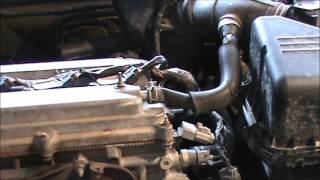
We Have This Part in Stock


The information in this article is provided for general reference and educational purposes only. Vehicle specifications, procedures, and part compatibility can vary by production date, trim level, and region. Always consult your vehicle's factory service manual and verify part numbers before purchasing or performing repairs. Safety-critical components such as airbags, seat belts, and braking systems should be installed by a qualified professional.
- Toyota CAMRY SOLARA:
- 🧭 Diagnostic Flowchart
- 🎬 Helpful Videos
- 🛍️ Shop This Part
- What's Unique About the 1999-2003 Toyota CAMRY SOLARA
- Symptoms You May Notice
- Most Likely Causes
- Rare But Worth Checking
- Diagnosis Steps
- Parts You'll Likely Need
- Related Codes That Often Appear With This One
- Technical Service Bulletins (TSBs) & Recalls
- Platform-Specific Known Issues
- Mechanic-Grade Diagnostic Values
- Scan Tool Commands That Help
- Wiring & Ground Locations
- Real Owner Repair Stories
- OEM Part Supersession History
- Model Year Variations Within This Range
- 🎟️ Get 5% Off