

P0340 on 1996-1999 Toyota Paseo: Camshaft Sensor Circuit Causes and Fixes
This code indicates a problem in the camshaft position sensor circuit. Before replacing the sensor or distributor, fully test the 12V battery and charging system. Low voltage is a well-documented cause for P0340 on this vehicle per a Toyota TSB. If the sensor is confirmed bad (it is located inside the distributor), a replacement distributor is required.
- Always test the battery and charging system before buying any parts for a P0340 on a 1996-1999 Paseo or Tercel.
- The camshaft position sensor is inside the distributor; if it's bad, the entire distributor assembly needs to be replaced.
- Check wiring and connectors for oil contamination from valve cover leaks, as this is a common failure point.
- If the timing belt service was recently performed, double-check the timing marks before replacing parts.
What's Unique About the 1996-1999 Toyota PASEO
For the 1996-1999 Toyota Paseo with the 5E-FE engine, this code has a specific documented link to electrical system health. A Toyota Technical Service Bulletin (TSB T-TT-0010-10 Rev) explicitly states that low battery voltage (below 11V during cranking) can trigger a P0340 code. This is a crucial detail, as owners might mistakenly replace a good distributor/sensor when the actual problem is a weak battery or failing alternator. Additionally, the camshaft position sensor is not a separate, standalone part; it is integrated within the distributor assembly.
Diagnostic Flowchart
Tap your situation to follow the diagnostic path that matches what you're seeing on this vehicle.
Symptoms You May Notice
- Check Engine Light is on
- Engine is hard to start or will not start
- Extended cranking time before engine starts
- Engine stalls, stumbles, or runs rough
- Hesitation or poor acceleration
- Noticeable loss of power
- Reduced fuel economy
- Replacing the distributor (camshaft sensor) without first checking the battery and charging system. The TSB for this vehicle makes it clear that low voltage is a primary suspect.
- Replacing the crankshaft position sensor (P0335). While related, P0340 specifically points to the camshaft sensor circuit. However, the same low voltage issue can also cause P0335 to appear simultaneously.
- Assuming the camshaft position sensor is a separate part. On the 5E-FE, it is integrated into the distributor.
Most Likely Causes
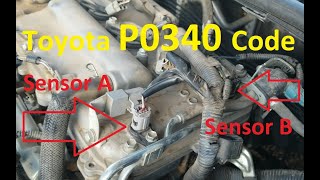
- Low Battery Voltage / Failing Alternator 🔴 High Probability → Shop Vehicle Battery A specific Toyota TSB (T-TT-0010-10 Rev) for this era explicitly states that low battery voltage can cause a P0340 code due to inconsistent engine rotational speed during startup. The ECU misinterprets this as a sensor fault. 🎬 Watch: Common causes and fixes for the Toyota P0340 code
How to confirm: Use a multimeter to test the battery voltage with the engine off (should be ~12.6V). While running, it should be ~13.7-14.7V. The TSB specifically advises checking the freeze-frame data with a scanner to see if battery voltage was below 11V when the code was set. Most auto parts stores can perform a free battery and charging system load test.
Typical fix: Charge or replace the battery. If the charging voltage is low, the alternator likely needs replacement.
Est. part cost: $100-$250 - Faulty Camshaft Position Sensor (within Distributor) 🟡 Medium Probability → Shop Engine Camshaft Position Sensor On the 5E-FE engine, the sensor is part of the distributor assembly. Over time, heat and vibration cause the internal electronics of the distributor (including the cam sensor coil) to fail. Oil leaks from the valve cover gasket or distributor O-ring can also seep inside and damage the components.
How to confirm: After confirming wiring and battery are good, the sensor itself can be tested. According to service manuals, the resistance between the sensor's terminals should be checked when cold and hot. A typical cold resistance is 835-1,400 Ohms, and hot is 1,060-1,645 Ohms. If readings are out of spec, the distributor is faulty. An oscilloscope is the most definitive way to confirm a missing or erratic signal.
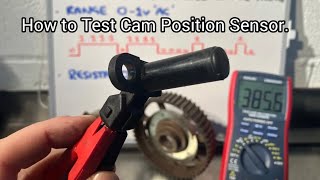
Typical fix: Replace the entire distributor assembly. The internal sensor is not typically sold separately. 🎬 See how to test a camshaft position sensor with a multimeter
Est. part cost: $160-$350 for a complete distributor assembly - Damaged Wiring or Loose Connector 🟡 Medium Probability
How to confirm: Visually inspect the wiring harness and connectors going to the distributor. Look for frayed wires, corrosion in the connector pins, or a loose connection. Oil contamination from a leaking valve cover is a common issue that can degrade the wiring insulation or foul the connector pins. Wiggle the connector while the engine is running to see if it affects the idle.
Typical fix: Repair the damaged section of wire or clean the connector terminals with electrical contact cleaner. If the connector itself is broken, it will need to be replaced.
Est. part cost: $10-$50
Rare But Worth Checking
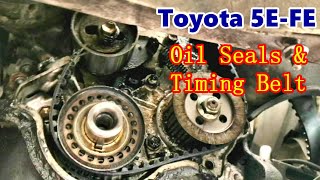
- Stretched or Slipped Timing Belt: → Shop Engine Timing Chain The 5E-FE is a non-interference engine, so a failed belt won't destroy the engine, but if it slips a tooth, the cam/crank correlation will be off and can trigger this code. This is less common than sensor or wiring failure but should be considered if the belt is old or was recently replaced 🎬 Watch: Step-by-step 5E-FE timing belt and seals replacement guide and the code appeared afterward.
- Faulty Engine Control Unit (ECU): This is very rare, but the ECU can fail and stop processing the signal from the sensor correctly. This should only be considered after all other possibilities, including wiring and the distributor itself, have been exhaustively tested and ruled out.
Diagnosis Steps
- Read the code with an OBD-II scanner to confirm P0340 is present. Check freeze-frame data if possible.
- Check Battery and Charging System: This is the most important first step. Test battery voltage engine-off (~12.6V) and engine-on (~13.7-14.7V). If your scanner has freeze-frame data, check if the 'BATT' voltage was below 11V when the DTC was set, as per TSB T-TT-0010-10 Rev. Address any voltage issues before proceeding.
- Inspect Wiring and Connector: Locate the distributor. Carefully inspect its electrical connectors and wiring harness for any signs of damage, corrosion, oil contamination, or looseness. Ensure the connectors are fully seated.
- Test the Sensor Circuit: If wiring looks good, test the sensor's internal coil. Disconnect the distributor connector. Using a multimeter, measure the resistance between the two terminals for the camshaft position sensor (G1 and G-). It should be within 835-1,400 Ohms (cold). If it's an open circuit or far out of spec, the distributor needs replacement.
- Check for Signal (Advanced): For a definitive diagnosis, use an oscilloscope to back-probe the signal wire at the ECU or distributor connector. While cranking, you should see a consistent pulse signal. A flat line or erratic signal confirms a bad sensor/distributor.
- Replace the Distributor Assembly: If the sensor is confirmed faulty, the entire distributor must be replaced. Mark the position of the old distributor relative to the engine block before removal to ensure correct ignition timing upon installation of the new one.
- Check Timing Belt: If a new distributor does not fix the code, inspect the timing belt for proper tension and alignment. A slipped tooth can cause this code, especially if the belt is old or was recently serviced.
- Consider ECU: As a final, rare possibility, the ECU may be at fault.
Parts You'll Likely Need
- Distributor Assembly
(OEM #19020-11340)— The camshaft position sensor is integrated into the distributor on the 5E-FE engine. If the sensor fails its resistance test, the entire unit must be replaced.
Trusted brands: Denso (OEM Supplier), Cardone (Remanufactured), Standard Motor Products (SMP)
OEM price range: $300-$450
Aftermarket price range: $150-$250 - 12V Battery — A weak or failing battery is a primary cause of P0340 on this vehicle, as noted in a Toyota TSB. This should always be tested first.
Trusted brands: Toyota TrueStart, Interstate, DieHard
OEM price range: $150-$250
Aftermarket price range: $100-$200
Related Codes That Often Appear With This One
- P0335 — The Crankshaft Position Sensor circuit. The TSB T-TT-0010-10 Rev explicitly mentions that low battery voltage can cause both P0340 and P0335 to appear together due to inconsistent crankshaft speed during startup.
Technical Service Bulletins (TSBs) & Recalls
- T-TT-0010-10 Rev: Notes that low battery voltage (specifically below 11V) can contribute to a MIL 'ON' condition for P0340 (Camshaft Position Sensor Circuit) due to inconsistent engine rotational speed during cranking.
Platform-Specific Known Issues
- A Toyota Technical Service Bulletin (T-TT-0010-10 Rev) confirms that low battery voltage is a known potential cause for code P0340 on this platform.
- The Camshaft Position Sensor is not a standalone part; it is an integral component of the distributor assembly. A sensor failure requires replacing the entire distributor.
Mechanic-Grade Diagnostic Values
- Camshaft Position Sensor (G-signal) Coil Resistance — expected: 835 - 1,400 Ohms (Cold), 1,060 - 1,645 Ohms (Hot). Failure: Resistance is infinite (open circuit), zero, or significantly outside the specified range.
- Crankshaft Position Sensor (Ne-signal) Coil Resistance — expected: 1,265 - 1,890 Ohms (Cold), 1,600 - 2,240 Ohms (Hot). Failure: Resistance is outside the specified range. This signal is generated in the same distributor assembly.
- Camshaft Position Sensor Signal Waveform — expected: A clean, consistent square wave or pulse signal when back-probing the G1 or G2 signal wire at the ECU while cranking the engine.. Failure: A flat line (no signal), a noisy/erratic signal, or a distorted waveform indicates a faulty sensor or mechanical issue with the distributor.
Scan Tool Commands That Help
- Toyota Techstream: Freeze Frame Data Viewer — This is a critical first step after reading the code. Use it to check the 'BATT' voltage parameter recorded at the exact moment the P0340 code was set. If the voltage was below 11V, it strongly points to the low battery voltage issue described in TSB T-TT-0010-10 Rev.
Wiring & Ground Locations
- Distributor Signals at ECU — At the Engine Control Unit (ECU), typically located behind the dashboard/center console area.. These are the final test points for the sensor signals before they enter the computer. The key pins are G1 (Cam Signal), G2 (Cam Signal), G- (Distributor Ground/Reference), and NE (Crank Signal). Testing here can differentiate between a wiring problem and a faulty ECU.
- Sensor Ground at ECU — At the ECU connector, typically labeled as pin E2 or E21.. A poor ground connection for the sensor circuit can cause a floating or noisy signal, triggering a P0340 code even if the sensor itself is good. This pin provides the ground path for multiple sensors.
- Engine Harness Ground Points — Bolted directly to the cylinder head or intake manifold.. The main grounds for the engine wiring harness must be clean and tight. A corroded or loose ground can cause widespread electrical issues, including erratic sensor readings that may trigger a P0340.
"I Checked Everything" — The Actual Cause
- A common scenario for this code is that the sensor's internal coil passes a resistance test, and the wiring shows good continuity. The actual cause is often mechanical wear within the distributor itself. A worn distributor shaft bearing can introduce a wobble, causing the gap between the sensor pickup and the reluctor wheel to vary inconsistently. This creates an erratic signal that the ECU flags as a fault, even though the individual components test as 'good' electrically when static.
When the Usual Fixes Don't Work
- In some cases, replacing the distributor assembly—the most common fix after ruling out the battery—does not resolve the code. A documented instance on a similar-era Toyota involved a mechanic replacing a 'defective' distributor, having the car run well for a week, and then the same symptoms and code returned. This suggests that either the replacement part (often a remanufactured unit) was also faulty, or an underlying issue like a wiring fault that is sensitive to heat/vibration or a problem with the distributor drive gear was missed.
Helpful Videos
We Have This Part in Stock


The information in this article is provided for general reference and educational purposes only. Vehicle specifications, procedures, and part compatibility can vary by production date, trim level, and region. Always consult your vehicle's factory service manual and verify part numbers before purchasing or performing repairs. Safety-critical components such as airbags, seat belts, and braking systems should be installed by a qualified professional.
- Toyota PASEO:
- 🧭 Diagnostic Flowchart
- 🎬 Helpful Videos
- 🛍️ Shop This Part
- What's Unique About the 1996-1999 Toyota PASEO
- Symptoms You May Notice
- Most Likely Causes
- Rare But Worth Checking
- Diagnosis Steps
- Parts You'll Likely Need
- Related Codes That Often Appear With This One
- Technical Service Bulletins (TSBs) & Recalls
- Platform-Specific Known Issues
- Mechanic-Grade Diagnostic Values
- Scan Tool Commands That Help
- Wiring & Ground Locations
- "I Checked Everything" — The Actual Cause
- When the Usual Fixes Don't Work
- 🎟️ Get 5% Off