

P0341 on 2017-2025 Chrysler Pacifica 3.6L: Cam Sensor Causes and Fixes
P0341 on a Pacifica most often means the Bank 1 intake camshaft position sensor is failing. It's a ~$50 part, but located on the difficult-to-access rear cylinder head. Before replacing, check wiring and be aware that underlying mechanical engine issues, particularly failing rocker arms or cam phasers common to the 3.6L Pentastar, can also trigger this code.
- P0341 on your Pacifica points to the intake camshaft sensor on the rear cylinder bank (Bank 1).
- While a faulty sensor is the most likely cause, do not rule out a wiring problem or a more serious mechanical issue with the cam phasers or valvetrain.
- This is not a simple repair for a DIY beginner due to the sensor's location, which requires significant disassembly (likely removing the upper intake manifold).
- Because of the risk of stalling, it is highly recommended to get this issue diagnosed and repaired promptly.
- If you hear a ticking or rattling noise along with this code, stop driving and have the engine inspected for mechanical damage immediately.
What's Unique About the 2017-2025 Chrysler Pacifica
While P0341 often points to a bad sensor, the 3.6L Pentastar engine has a well-documented reputation for this code being a potential early symptom of deeper mechanical issues. Unlike many engines where this is a straightforward electrical fault, on the Pacifica it can be triggered by failing VVT cam phasers or, more commonly, issues with the valvetrain's rocker arms, which are known to fail prematurely. A ticking noise accompanying the code strongly suggests a mechanical failure. Diagnosing this code correctly is crucial, as simply replacing the sensor will not fix the root cause if a mechanical problem exists.
Symptoms You May Notice
- Check Engine Light is on
- Engine is difficult to start or requires long cranking time
- Engine stalls unexpectedly, especially when idling or at low speeds
- Rough or unstable idle
- Hesitation or stumbling during acceleration
- Noticeable loss of engine power
- Reduced fuel economy
- Loud, rhythmic ticking noise from the top of the engine (indicates mechanical failure)
- Replacing the crankshaft position sensor instead of the camshaft position sensor.
- Replacing the wrong camshaft sensor (e.g., the easily accessible Bank 2 sensor instead of the required Bank 1 rear sensor).
- Repeatedly replacing the camshaft sensor without investigating potential underlying mechanical problems like a bad cam phaser or valvetrain issue.
- Confusing a rough idle from a P0341 fault with engine vibration from failed motor mounts, an issue addressed in TSB 09-002-17.
Most Likely Causes
- Faulty Bank 1 Intake Camshaft Position Sensor 🔴 High Probability → Shop Engine Camshaft Position Sensor Electronic sensors are subject to failure over time from heat cycles and vibration. It is the most common and straightforward cause for this code, especially on higher mileage vehicles.
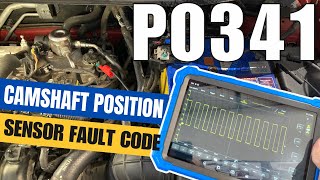
How to confirm: After checking the wiring, the most common confirmation is replacing the sensor. A more advanced method involves using an oscilloscope to check 🎬 See this walkthrough on testing and fixing P0341 fault codes. the sensor's square wave signal pattern against the crankshaft signal. A simple diagnostic trick is to swap the suspected bad sensor with the identical, easily accessible Bank 2 intake sensor and see if the code changes to P0346 (Bank 2).
Typical fix: Replace the Bank 1 intake camshaft position sensor. Bank 1 is the rear cylinder head, which is difficult to access and typically requires removal of the upper intake manifold.
Est. part cost: $30-$80 - Wiring Harness or Connector Issue 🟡 Medium Probability The wiring harness is exposed to engine heat and vibration, which can lead to chafed wires, loose connections, or corrosion at the connector pins over time. On some Pentastar applications, the harness is routed near hot exhaust components, increasing the risk of melting or damage.
How to confirm: Visually inspect the wiring harness leading to the Bank 1 camshaft sensor for any signs of damage, melting, or corrosion. Check that the connector is securely plugged in and that the pins are clean and straight. Use a multimeter to check for 5V reference, ground, and signal continuity.
Typical fix: Repair the damaged section of wiring or clean/replace the sensor connector.
Est. part cost: $5-$50 - Failing Camshaft Phaser (VVT Actuator) 🟡 Medium Probability → Shop Engine Camshaft The 3.6L Pentastar engine can experience issues with the VVT cam phasers, which use oil pressure to adjust cam timing. A phaser that is stuck, slow to respond, or has a failed locking pin can cause the camshaft's actual position to differ from what the PCM expects, triggering a performance code. This can be exacerbated by infrequent oil changes or low oil levels.
How to confirm: This is a mechanical issue that often requires professional diagnosis. A key symptom is a rattling noise on startup. A mechanic may listen for this or perform a physical inspection by removing the valve cover to check for excessive rotational play in the phaser. Advanced scan tools can also command the phaser to check its response.
Typical fix: Replace the failing camshaft phaser, which is a significant labor-intensive repair often involving removal of the timing cover and chain.
Est. part cost: $150-$400 for the part, significant labor
Rare But Worth Checking
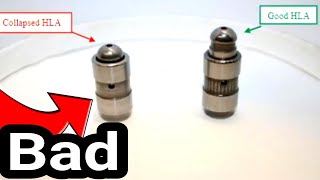
- Rocker Arm / Lifter Failure: The 3.6L Pentastar has a known weakness in the valvetrain, specifically the needle bearings in the rocker arms. A failed rocker arm can seize and damage the camshaft lobe, leading to erratic rotation and triggering timing codes like P0341. This is a severe mechanical failure often accompanied by a loud, persistent ticking noise known as the 'Pentastar tick'. This issue is prevalent enough to have prompted class-action lawsuits.
- Stretched Timing Chain: → Shop Engine Timing Chain While less common than other causes, a timing chain that has stretched over many miles can throw off the correlation between the camshaft and crankshaft, leading to this code. This is typically a high-mileage issue and would likely be accompanied by other timing correlation codes.
- Failing Powertrain Control Module (PCM): PCM failure is very rare but possible. Some TSBs for Pentastar engines have involved software updates to change the PCM's sensitivity to cam/crank signals, suggesting software glitches can be a factor. This should only be considered after all other possibilities, including all wiring and mechanical components, have been thoroughly tested and ruled out.
Diagnosis Steps
- Read the code with an OBD-II scanner and record any other codes present, especially P0016 or misfire codes.
- Check the engine oil level and condition. Low or dirty oil can affect the VVT system and is a common contributor to phaser issues.
- Listen for Engine Noises: Start the engine and listen carefully for a loud, rhythmic ticking from the top of the engine. A 'Pentastar tick' strongly points towards a rocker arm failure, a known issue on this engine.
- Visually inspect the wiring and connector for the Bank 1 (rear) intake camshaft position sensor. Look for any obvious damage, melting from exhaust heat, corrosion, or loose connections.
- If wiring looks good, consider swapping the Bank 1 intake sensor with the Bank 2 (front) intake sensor. Clear codes and drive. If the code returns as P0346 (Bank 2), the sensor is confirmed bad.
- If the code returns as P0341 after the swap, or if you heard a ticking noise, a deeper mechanical diagnosis is required. The problem is likely not the sensor itself.
- Professional diagnosis is recommended at this stage. A mechanic will use a scan tool to monitor cam/crank correlation and VVT phaser operation, or remove the valve cover for a physical inspection of the rocker arms, camshaft lobes, and cam phasers.
Parts You'll Likely Need
- Camshaft Position Sensor
(OEM #5149141AF)— This is the most frequent cause of P0341. The sensor's electronics fail over time, leading to an incorrect signal. The OEM Mopar part is strongly recommended by owners over aftermarket alternatives to avoid repeat failures.
Trusted brands: Mopar (OEM), Delphi, NGK/NTK, Hitachi
OEM price range: $60-$100
Aftermarket price range: $30-$70
Related Codes That Often Appear With This One
- P0340 — P0340 is a general circuit malfunction code for the same sensor. P0341 is a performance code, but they are closely related and can sometimes appear together if the sensor signal is completely lost or grossly incorrect.
- P0016 — P0016 (Crankshaft/Camshaft Position Correlation Bank 1 Sensor A) often appears with P0341 when there is a true mechanical timing issue, such as a failed cam phaser, stretched timing chain, or damaged rocker arm.
- P0300, P0301, P0303, P0305 — Misfire codes for cylinders on Bank 1 (P0301, P0303, P0305) or a random misfire (P0300) can occur because incorrect cam timing disrupts proper combustion.
Technical Service Bulletins (TSBs) & Recalls
- NHTSA ID #10248856 / S2309000012: 🎬 Watch: A mechanic explains possible causes for Pentastar camshaft codes. Specifically addresses DTC P0341 being set.
- TSB 09-002-17: While focused on misfires and engine vibration, this TSB is widely referenced in discussions
Platform-Specific Known Issues
- The Bank 1 camshaft sensors (rear, by firewall) are significantly harder to access than Bank 2 sensors (front, by radiator), often requiring removal of the upper intake manifold. This adds considerable labor time and cost.
- The 3.6L Pentastar engine family is subject to a class-action lawsuit concerning premature failure of valvetrain components like rocker arms, which can cause timing-related codes like P0341. A ticking noise is the primary symptom.
- Some 2017 models were recalled for a software issue that could cause stalling, with symptoms similar to a bad cam/crank sensor. (NHTSA Campaign: 18V524000).
- A specific TSB (NHTSA ID #10248856) was released on Nov 1, 2023, for Malfunction Indicator Lamp (MIL) Illumination with DTC P0341 set, indicating this is a recognized issue by the manufacturer.
Mechanic-Grade Diagnostic Values
- Camshaft Position Sensor 5-Volt Supply (KOEO) — expected: 4.8 - 5.2 Volts DC. Failure: Voltage below 4.8V or above 5.2V points to a wiring or PCM fault.
- Camshaft Position Sensor Ground Circuit Resistance — expected: Less than 3.0 Ohms. Failure: Resistance higher than 3.0 Ohms indicates a poor ground connection to the chassis.
- Camshaft Position Sensor Signal (Hall-Effect Static Test) — expected: With the sensor connected and ignition on, the signal wire voltage should switch between ~0V and ~5V when a magnet is passed over the sensor tip.. Failure: Voltage does not switch, indicating a faulty sensor.
- Camshaft Position Sensor Resistance (Sensor disconnected) — expected: 500 to 1,500 Ohms (typical, but varies by manufacturer). Failure: Reading outside this range, or an open/short circuit, indicates a failed sensor coil.
Scan Tool Commands That Help
- wiTECH (Dealer Tool) or advanced aftermarket scanner: Cam/Crank Relearn — After replacing a camshaft position sensor, some vehicles require a relearn procedure to synchronize the new sensor with the PCM. Failure to do so can cause the code to return even with a good part.
- Snap-on or other professional-grade scanner with oscilloscope: Camshaft Sensor Signature Test — To visually inspect the waveform pattern from the sensor. On Pentastar engines, metal debris can stick to the magnetic encoder wheels on the camshafts, distorting the signal and causing codes. A signature test can reveal this distortion without disassembly.
Wiring & Ground Locations
- Bank 1 Camshaft Position Sensor Connector — On the top of the rear (Bank 1) valve cover, closer to the firewall. The sensor is a 4-wire, dual-sensor unit housed in a single component.. This is the primary connection point for testing the power, ground, and signal circuits for the P0341 code. The 4-wire design contains two separate sensor elements (intake and exhaust), so a wiring diagram is crucial to test the correct pins for the intake ('A') sensor.
- Powertrain Wiring Harness — Runs across the top and back of the engine.. The harness is susceptible to heat damage from the engine and exhaust components. Wires can become brittle, and connectors can degrade, leading to intermittent opens or shorts in the sensor circuit.
Real Owner Repair Stories
- JK-Forum.com user (2018 Jeep JKU with 3.6L Pentastar engine) — Crank-no-start with four camshaft sensor codes active (P0340, P0345, P0365, P0390) after an engine rebuild.
❌ Tried (didn't work) Replacing both camshaft position sensors., Verifying 4.9V power supply and <3 Ohms ground at sensor connectors., Checking for shorts in the wiring harness., Disconnecting and reconnecting all related electrical connectors.
✅ What actually fixed it The problem was ultimately traced back to a mechanical timing issue from the engine rebuild. Despite all electrical checks passing, the camshafts were not correctly timed with the crankshaft, causing all four sensor signals to be out of range.
OEM Part Supersession History
5149141AE→5149141AF— Standard part revision and update by the manufacturer.
Heads up: 5149141AF is the current recommended OEM part for the 2017-2025 Pacifica. While older versions may fit, using the latest revision is advised for reliability.
Model Year Variations Within This Range
- 2017+: The 3.6L Pentastar engine in the 2017+ Pacifica is the 'Pentastar Upgrade' (PUG) version, which debuted in 2016. It features a two-stage valve lift system, increased compression ratio (11.3:1), and cooled EGR. While the fundamental design is the same, diagnostic approaches should consider these updated systems. The core P0341 causes (sensor, wiring, mechanical) remain consistent with the earlier Pentastar generation.
Diagnostic Flowchart
Other Known Issues on This Vehicle
Issues unrelated to this code that are worth knowing about as an owner of this generation:
- Transmission Shudder / Harsh Shifting 🔴 High — Very common on early models (2017-2018), but can occur on later models. Often manifests as harsh shifts between 1st-3rd gear or a lurch when stopping. (Ref: Multiple software update TSBs have been issued. In some cases, a full transmission replacement is required.)
- Engine Stalling (Gas and Hybrid) 🔴 High — Widespread enough to trigger multiple NHTSA investigations and recalls across different model years and powertrains. (Ref: NHTSA Recall 18V524000 for 2017 models due to a software sync issue. NHTSA Recall 23V-010 for Hybrids due to an internal transmission wiring short.)
- Engine Oil Cooler/Filter Housing Leak 🟠 Medium — A very common issue where the plastic oil filter housing, located in the valley of the engine, develops cracks or its gaskets fail, causing a significant oil leak onto the top of the transmission. Can occur at relatively low mileage (e.g., 26,000 miles).
- Start/Stop System Unavailable (Auxiliary Battery Failure) 🟡 Low — Extremely common. The small auxiliary battery that powers the Engine Start-Stop (ESS) system has a short lifespan (often 2-3 years) and its failure triggers a persistent 'Start/Stop Unavailable' warning on the dash. (Ref: No recall, but it is a widely known service item. The system must be reset by disconnecting both batteries after replacement.)
- Rocker Arm / Valvetrain Failure ('Pentastar Tick') 🔴 High — A well-documented weakness of the 3.6L Pentastar engine family. Needle bearings in the rocker arms fail, causing a distinct ticking noise, camshaft damage, and misfire codes. (Ref: Subject of class-action lawsuits. TSB 09-002-17 and others address valvetrain issues and misfires on Pentastar engines.)
Used vs. New Parts: Buying Guide for This Vehicle
When a used part is the smart pick: For this repair, a used part is generally not recommended. The primary cause is an electronic sensor, which is a wear item with a finite lifespan. The cost savings of a used sensor are minimal compared to the risk of premature failure and the significant labor involved in accessing the Bank 1 sensor.
Donor-vehicle mileage cap: roughly under 30000 miles for the part to have meaningful remaining life.
What to inspect on the donor part:
- Verify the donor vehicle's mileage.
- Inspect the part for any physical damage, cracks, or corrosion on the pins.
- If possible, get a sensor from a vehicle that was not involved in a front-end collision to minimize the risk of harness damage.
OEM-only on this vehicle (don't cheap out):
- Camshaft Position Sensor
Aftermarket brands forum-validated for this vehicle:
- Delphi
- NGK/NTK
Brands owners have reported issues with on this vehicle:
- Unbranded, 'white-box' parts from online marketplaces are frequently cited in forums as having high failure rates for this specific application.
Real Owner Stories
Aggregated from forums and TSBs cited above. Mileages and costs reflect what owners reported in those sources.
2018 Chrysler Pacifica 3.6L V6
Symptoms: The vehicle experienced start/stop system issues and general electrical instability, suggesting that one electrical failure (like a battery) can lead to multiple unrelated symptoms across the system.
What fixed it: Replacement of the auxiliary battery to resolve cascading electrical symptoms.
Source hint: Reddit r/MechanicAdvice thread titled '2018 Pacifica with start/stop issues'
2022 Jeep Gladiator 3.6L Pentastar (Platform Mate)
Symptoms: The vehicle threw codes P0340 and P0341.
What fixed it: The owner performed troubleshooting on the wiring and ultimately replaced the camshaft position sensor to resolve the codes.
Source hint: jeepgladiatorforum.com thread 'p0340-p0341-and-p1dd2'
Related OBD-II Codes
Frequently Asked Questions
Is there an official manufacturer notice for the P0341 code on my Chrysler Pacifica?
My 2017 Pacifica is stalling and showing sensor-related symptoms; could this be a known recall issue?
Why is the labor cost so high to replace the Bank 1 sensor on my 3.6L Pentastar?
I hear a rhythmic ticking noise from the top of my engine along with the P0341 code. What does this mean?
Can I test if the sensor is actually bad without buying a new one?
Could my Pacifica's 'Start/Stop Unavailable' message be related to the P0341 code?
Helpful Videos


The information in this article is provided for general reference and educational purposes only. Vehicle specifications, procedures, and part compatibility can vary by production date, trim level, and region. Always consult your vehicle's factory service manual and verify part numbers before purchasing or performing repairs. Safety-critical components such as airbags, seat belts, and braking systems should be installed by a qualified professional.
- Chrysler Pacifica:
- 🧭 Diagnostic Flowchart
- 🎬 Helpful Videos
- What's Unique About the 2017-2025 Chrysler Pacifica
- Symptoms You May Notice
- Most Likely Causes
- Rare But Worth Checking
- Diagnosis Steps
- Parts You'll Likely Need
- Related Codes That Often Appear With This One
- Technical Service Bulletins (TSBs) & Recalls
- Platform-Specific Known Issues
- Mechanic-Grade Diagnostic Values
- Scan Tool Commands That Help
- Wiring & Ground Locations
- Real Owner Repair Stories
- OEM Part Supersession History
- Model Year Variations Within This Range
- Other Known Issues on This Vehicle
- Used vs. New Parts: Buying Guide for This Vehicle
- Real Owner Stories
- 2018 Chrysler Pacifica 3.6L V6
- 2022 Jeep Gladiator 3.6L Pentastar (Platform Mate)
- Related OBD-II Codes
- Frequently Asked Questions
- 🎟️ Get 5% Off