

P0341 on 2017-2019 Jaguar XE: Cam Sensor Fault vs. Timing Chain Failure
On 2017-2019 Jaguar XE models, especially those with the pre-2019 2.0L Ingenium engine, P0341 often points to a stretched timing chain, a serious and expensive repair. While a faulty camshaft sensor is possible, a rattling noise on startup is a key sign of the more severe timing issue, which is a well-documented design flaw.
- P0341 on a 2017-2019 Jaguar XE is a serious code that should be diagnosed immediately.
- A rattling noise from the engine on cold starts is a strong indicator of a failing timing chain, the most likely cause on 2.0L Ingenium engines.
- Do not assume it is just a bad sensor. If you replace the sensor and the code returns, a major mechanical repair is likely needed.
- If you have a 2017 2.0L diesel, ask a dealer about TSB JTB00516NAS1, as a simple software update could be the fix.
- Due to the high risk of catastrophic engine damage from a failed timing chain, professional diagnosis is strongly recommended.
What's Unique About the 2017-2019 Jaguar XE

For the Jaguar XE, particularly models with the 2.0L Ingenium engine built before 2019, P0341 is a notorious code. Unlike many cars where the sensor is the most likely culprit, on these Jaguars, it is frequently an early warning of premature timing chain stretch. This is a well-documented issue attributed to several factors: the use of materials in the original chains/guides prone to stretching, oil dilution from incomplete DPF regeneration cycles in diesel models which degrades lubrication, and extended service intervals. The repair is unusually complex and costly on Ingenium engines because the timing chains are located at the rear of the engine, requiring transmission removal for service.
Diagnostic Flowchart

Tap your situation to follow the diagnostic path that matches what you're seeing on this vehicle.
Symptoms You May Notice

- Check Engine Light (Malfunction Indicator Lamp) illuminated.
- Rattling or metallic clatter from the engine, especially on cold starts, coming from the rear of the engine.
- Engine may be difficult to start or cranks longer than usual.
- Rough idling or engine misfires.
- Reduced engine power and hesitation during acceleration.
- Engine stalling.
- In some cases, only the Check Engine Light is on with no other noticeable driving issues. [Bulletin SSM74160]
- Replacing only the camshaft position sensor without investigating for timing chain noise or other correlation codes. If the code returns, the underlying issue is almost certainly mechanical timing.
Most Likely Causes

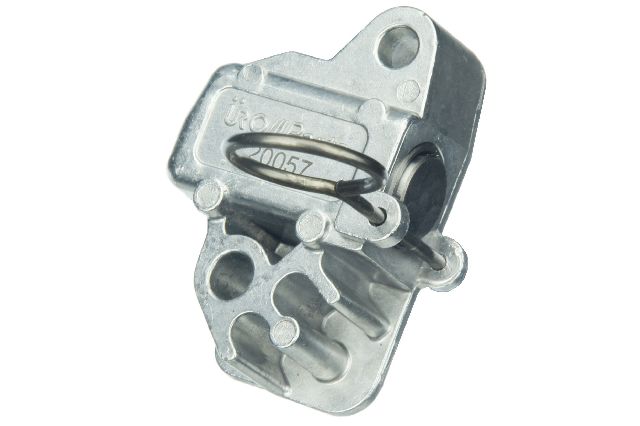
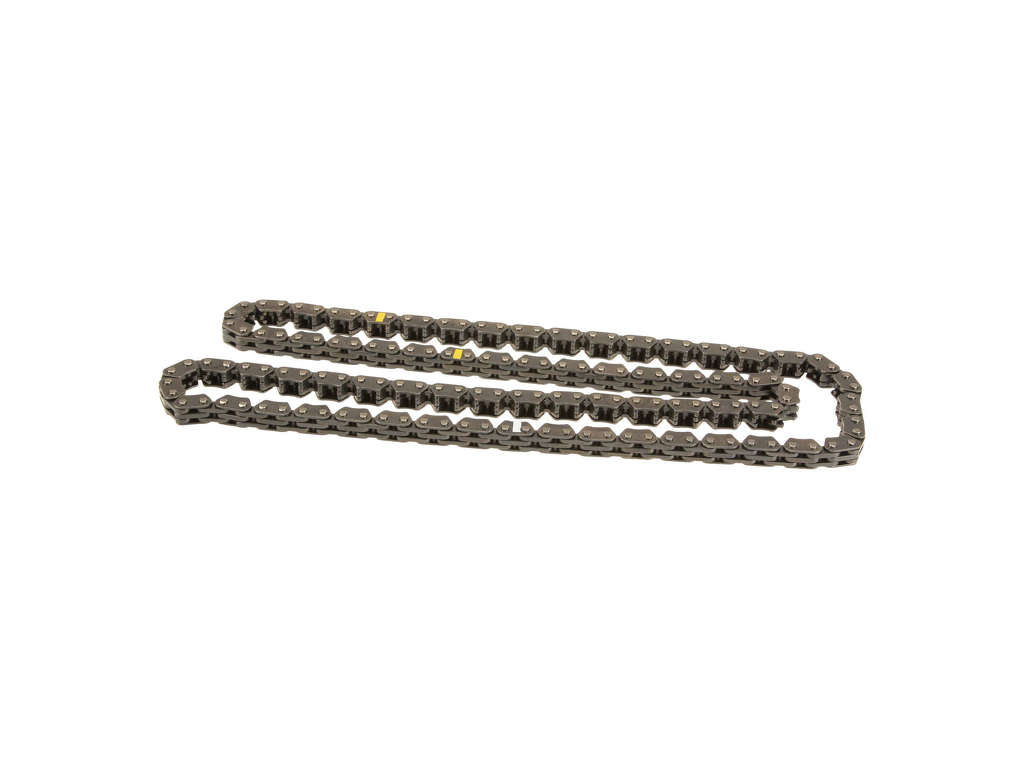
- Stretched Timing Chain and/or Worn Guides/Tensioners 🔴 High Probability → Shop Engine Timing Chain Pre-2019 2.0L Ingenium engines (both petrol and diesel) are known for premature timing chain stretch, often appearing between 60,000-80,000 miles. Oil dilution from DPF regeneration cycles on diesel models can accelerate wear. The plastic guides can also become brittle, break, and send debris into the oil system, potentially blocking the oil pickup and causing further damage.
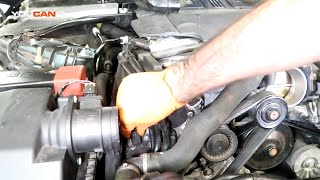
How to confirm: Listen for a distinct rattling noise from the rear of the engine on cold starts. 🎬 Watch: Listen to the specific rattle of a stretched chain. Scan for accompanying codes like P0016 (Crank/Cam Correlation), which strongly indicates a mechanical timing issue. A professional diagnosis involves using a borescope to inspect chain tension and guide wear, or checking cam/crank correlation with an advanced scan tool before committing to a teardown.
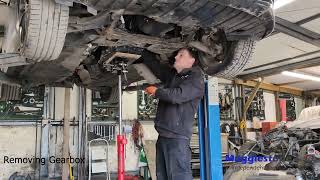
Typical fix: Complete replacement of the timing chains, guides, and tensioners with updated JLR parts. On Ingenium engines, this is a major repair requiring removal of the transmission and can cost over $8,000. 🎬 See this timelapse of the complex timing chain replacement process.
Est. part cost: $400-$1200 - Faulty Camshaft Position Sensor 🟡 Medium Probability → Shop Engine Camshaft Position Sensor
How to confirm: Swap the intake and exhaust camshaft sensors (if they are identical parts) and see if the code changes to P0366 (exhaust sensor). Test the sensor's voltage and resistance with a multimeter. Inspect the sensor for oil contamination or physical damage. A forum user confirmed replacing the sensor for P0341 did not fix their issue, which was later diagnosed as a stretched chain.
Typical fix: Replace the Bank 1 intake camshaft position sensor. The OEM part number is often cited as AJ813216 for the 2.0L engine.
Est. part cost: $50-$150 - PCM Software Issue ⚪ Low Probability TSB JTB00516NAS1 specifically notes that for 2017 2.0L Ingenium diesel engines, the parameters for triggering P0341-91 could be overly sensitive.
How to confirm: A Jaguar dealership or specialist with the correct diagnostic tool (SDD) can check if the vehicle's PCM software is up to date and if this TSB applies based on the VIN and symptom code.
Typical fix: Update the Powertrain Control Module (PCM) software.
Est. part cost: $0 - Damaged Wiring or Connector ⚪ Low Probability
How to confirm: Visually inspect the wiring harness and connector for the camshaft position sensor for any signs of damage, corrosion, or loose pins. Perform a continuity test on the wiring from the sensor to the PCM.
Typical fix: Repair or replace the damaged section of the wiring harness or the connector.
Est. part cost: $10-$100
Rare But Worth Checking
- Failing VVT Solenoid: TSB SSM74160 links P0341 with other codes to faulty VVT (Variable Valve Timing) solenoids on some 2017 models. If codes like P054A-00, P0014-71, or P000B-00 are also present, this becomes a more likely cause.
- Faulty Powertrain Control Module (PCM): Extremely rare, but a possibility if all other causes have been ruled out. A forum user reported that after extensive diagnostics, a replacement ECM was the only fix for a persistent P0341. This requires professional programming to immobilizer system.
Diagnosis Steps
- Scan the PCM for P0341 and any other stored codes. Pay close attention to correlation codes like P0016 and the specific sub-code (e.g., -91 for software, -92 for performance). 🎬 Watch: Diagnosing a P0341-92 code on an Ingenium engine.
- Check the engine oil level and condition. A low level or fuel smell (in diesels) points to conditions that accelerate chain wear.
- During a cold start, listen carefully for a metallic rattling sound from the engine. On 2.0L Ingenium engines, the sound will come from the rear (firewall side).
- Inspect the wiring and connector for the Bank 1 intake camshaft position sensor for damage, corrosion, or loose connections.
- If no noise is present and no other codes exist, consider replacing the camshaft position sensor as a diagnostic step. You can also swap it with the exhaust sensor to see if the code follows.
- If a rattle is present or if correlation codes exist, assume a mechanical timing issue. A professional should use a borescope to attempt visual inspection of the guides and chain before recommending a full teardown.
- If the vehicle is a 2017 2.0L diesel with code P0341-91, check with a dealer for eligibility for the PCM software update mentioned in TSB JTB00516NAS1.
Parts You'll Likely Need
- Timing Chain Kit (Updated)
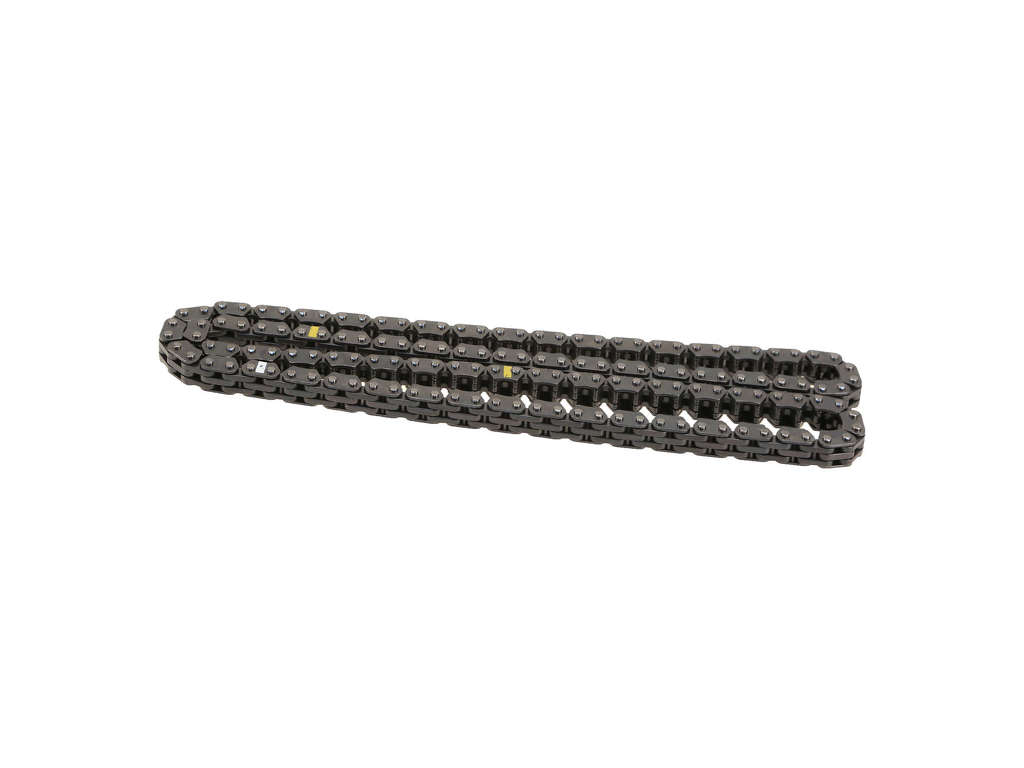
(OEM #Petrol: JDE38677, JDE38678 (chains). Diesel: LR139320, LR132676 (chains). Full kits contain numerous guides and tensioners.)— This is the most probable cause of P0341 on pre-2019 2.0L Ingenium engines. It is critical to use the latest revised parts from JLR to prevent a repeat failure.
Trusted brands: Jaguar (OEM), BGA, OE Supplier
OEM price range: $400-$800
Aftermarket price range: $250-$500 - Camshaft Position Sensor
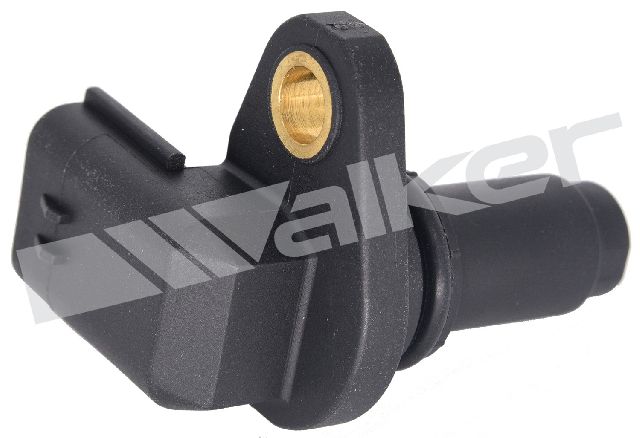
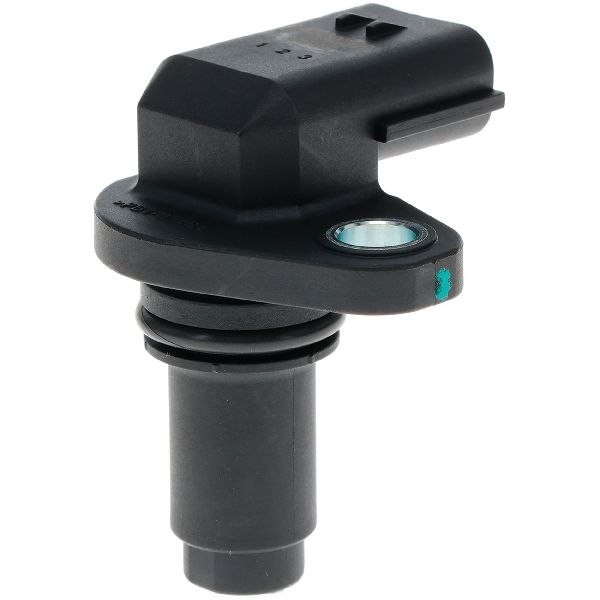
(OEM #AJ813216 (for 2.0L Ingenium))— This is the component directly referenced by the code and is a potential point of failure, though less common than timing issues on this platform. Often replaced as a first, but frequently unsuccessful, step.
Trusted brands: Jaguar (OEM), Bosch, Walker
OEM price range: $100-$180
Aftermarket price range: $50-$100
Related Codes That Often Appear With This One
- P0016 — Crankshaft/Camshaft Correlation error. Its presence alongside P0341 is a near-certain indicator of a mechanical timing issue like a stretched chain.
- P0017 — Crankshaft/Camshaft Correlation (Bank 1 Sensor B). Also points to a mechanical timing problem, often from the same root cause.
- P0300, P0301-P0304 — Random or specific cylinder misfire codes. Incorrect cam timing disrupts the engine's combustion cycle, leading to misfires.
- P054A-00, P0014-71, P000B-00 — These are other camshaft timing-related codes. TSB SSM74160 indicates they can appear with P0341 due to a faulty VVT solenoid.
Technical Service Bulletins (TSBs) & Recalls
- JTB00516NAS1: Notes that P0341-91 on 2017 2.0L diesel models may be caused by overly sensitive PCM parameters and fixed with a software update.
- SSM74160: Links P0341-00 with other codes (P054A-00, P0014-71, etc.) to potentially faulty VVT solenoids on 2017 models.
- JTB00480NAS2: Mentions that P0341 can be logged along with P0016/P0017 due to VVT actuator issues on some 2.0L engines.
Platform-Specific Known Issues
- Premature Timing Chain Stretch (2.0L Ingenium): Engines built before 2019 are highly susceptible to timing chain stretch, which causes a P0341 code. Jaguar issued updated parts for 2019+ models to resolve this.
- Degrading Plastic Chain Guides (2.0L Ingenium): The plastic timing chain guides can wear and break apart. Fragments can fall into the oil pan and clog the oil pump pickup tube, leading to oil starvation and catastrophic engine failure, separate from the chain just skipping time.
- Sensitive PCM Diagnostics (2.0L Diesel): TSB JTB00516NAS1 states that on some 2017 diesel models, the check engine light and P0341-91 may be triggered by overly sensitive software parameters, not a mechanical fault.
Mechanic-Grade Diagnostic Values
- Camshaft Position Sensor Power Supply Voltage — expected: Approximately 5.0V DC with key on, engine off, measured at the sensor connector.. Failure: Voltage significantly lower than 5.0V or 0V points to a wiring issue or a problem with the PCM's 5V reference circuit.
- Camshaft Position Sensor Ground Circuit Resistance — expected: Less than 1 ohm of resistance between the ground pin on the connector and a known good chassis ground.. Failure: A higher resistance reading indicates a poor ground connection, which can cause erratic sensor signals.
- VVT Solenoid Coil Resistance — expected: Generally between 8 to 12 ohms.. Failure: A reading outside this range, or an open loop (OL) reading, indicates a faulty solenoid coil.
- Engine Ground Strap Voltage Drop (while cranking) — expected: Well under 0.5V (500mV).. Failure: A reading higher than 0.5V indicates a poor engine-to-chassis ground connection, which can cause various electrical issues.
Hidden / Shadow Codes Worth Checking
- P0341-91: Indicates a 'Component Failure - Parametric' issue. As per TSB JTB00516NAS1, this specific sub-code on 2017 2.0L diesels may be triggered by overly sensitive software parameters rather than a hard mechanical fault. (see via Jaguar SDD (Symptom Driven Diagnostics) or a compatible high-level diagnostic scanner.)
- P0341-92: Indicates a 'Component Failure - Performance or Incorrect Operation' issue. This sub-code more strongly suggests a performance problem, such as the signal not matching the expected pattern due to a stretched timing chain. (see via Jaguar SDD (Symptom Driven Diagnostics) or a compatible high-level diagnostic scanner.)
Scan Tool Commands That Help
- JLR SDD (Symptom Driven Diagnostics): Read All Stored and Non-stored DTCs — To identify not only the primary P0341 code but also any associated sub-codes (-91, -92) and historical or pending codes that can provide context (e.g., P0016).
- JLR SDD (Symptom Driven Diagnostics): Live Data / Datalogger — To monitor and graph the camshaft and crankshaft position sensor signals simultaneously. This allows a technician to visually check for signal dropouts or a timing mismatch between the two sensors, which is indicative of a mechanical issue.
- JLR SDD (Symptom Driven Diagnostics): Service Functions - Camshaft Sensor Pattern Learning — After replacing a camshaft sensor or performing major timing work, this function may be required to allow the PCM to learn the new sensor's specific signal pattern.
Wiring & Ground Locations
- Engine-to-Chassis Ground Strap — An important ground strap runs from the engine block to the lower chassis rail, often on the left-hand side (US driver's side). It may connect first to the subframe and then to the chassis.. A poor engine ground can cause erratic voltage and reference signals for all engine sensors, including the camshaft position sensor, leading to range/performance codes.
- Firewall Ground Posts — There are typically ground posts on the firewall on both sides of the engine bay.. These are major grounding points for various vehicle systems. Corrosion or looseness here can cause widespread electrical issues that are difficult to trace.
- Camshaft Position Sensor Connector — On the engine, near the top of the valve cover, corresponding to the intake camshaft for Bank 1.. This is the primary point for testing voltage and ground signals directly at the sensor. A generic 3-pin connector will have a 5V power supply, a signal wire, and a ground wire.
Real Owner Repair Stories
- JaguarForums user (2017 Jaguar XE 2.0d (Ingenium engine)) — Engine rattle on startup, followed by Check Engine Light with P0341.
❌ Tried (didn't work) Initial diagnosis focused on replacing the camshaft position sensor.
✅ What actually fixed it The dealer confirmed a stretched timing chain. The final repair was a complete replacement of the timing chains, guides, and tensioners with updated parts, which required removing the engine and transmission. - JaguarForums user 'erickaks' (2015 Jaguar XE 2.0 diesel 180HP) — P0341 code present.
❌ Tried (didn't work) Replacing the camshaft position sensor.
✅ What actually fixed it The user reported that replacing the sensor did not help, strongly implying the root cause was mechanical (timing chain), a common outcome for this platform.
OEM Part Supersession History
N/A→Updated timing chain kits (e.g., for diesel: LR139320, LR132676)— The original timing chains and plastic guides used on pre-2019 Ingenium engines were prone to premature stretching and wear. Updated parts are made from more durable materials to resolve this design flaw.
Heads up: It is critical to use the latest revised parts from JLR when performing a timing chain service to prevent a repeat failure. Using old-stock original parts will likely lead to the same problem recurring.
Model Year Variations Within This Range
- 2017-2018: Models with the 2.0L Ingenium engine built before the 2019 model year are highly susceptible to the premature timing chain stretch issue that is a primary cause of P0341. JLR introduced updated timing chain components for the 2019 model year to address the design flaw.
Helpful Videos


Used OEM Parts in Stock
New Aftermarket Parts Available


The information in this article is provided for general reference and educational purposes only. Vehicle specifications, procedures, and part compatibility can vary by production date, trim level, and region. Always consult your vehicle's factory service manual and verify part numbers before purchasing or performing repairs. Safety-critical components such as airbags, seat belts, and braking systems should be installed by a qualified professional.
- Jaguar XE:
- 🧭 Diagnostic Flowchart
- 🎬 Helpful Videos
- 🛍️ Shop This Part
- What's Unique About the 2017-2019 Jaguar XE
- Symptoms You May Notice
- Most Likely Causes
- Rare But Worth Checking
- Diagnosis Steps
- Parts You'll Likely Need
- Related Codes That Often Appear With This One
- Technical Service Bulletins (TSBs) & Recalls
- Platform-Specific Known Issues
- Mechanic-Grade Diagnostic Values
- Hidden / Shadow Codes Worth Checking
- Scan Tool Commands That Help
- Wiring & Ground Locations
- Real Owner Repair Stories
- OEM Part Supersession History
- Model Year Variations Within This Range
- 🎟️ Get 5% Off