

P0345 on 2003-2008 Audi S4: Camshaft Sensor 'A' Bank 2 Causes and Fixes
P0345 on an Audi S4 4.2L V8 points to the driver's side (Bank 2) camshaft position sensor. The most common fix is replacing the sensor itself, which costs about $30-$185 for the part. However, this code can also be a critical early warning of failing timing chain guides, a very serious and expensive engine-out repair. A rattling noise from the rear of the engine on cold starts is a major red flag for the timing issue.
- P0345 refers to the camshaft position sensor on the driver's side (Bank 2) of the engine.
- The easiest first step is to swap the driver's side and passenger's side sensors to see if the fault code moves to the other bank (P0340).
- Be alert for any rattling noises from the engine, especially on cold starts. This could mean the P0345 code is a symptom of a much more serious timing chain failure.
- If the code returns after a sensor swap, a mechanical timing issue is highly likely and requires professional diagnosis, likely with VCDS to check camshaft phase angles.
What's Unique About the 2003-2008 Audi S4
The 2003-2008 Audi S4 (B6 and B7 generations) uses the 4.2L V8 BBK engine, which is notorious for timing chain issues. The timing components, including plastic guides and tensioners, are located at the rear of the engine against the firewall, making service an engine-out procedure. While P0345 is often just a failed sensor, it can be the first and only warning sign that the timing chain system is failing. A stretched chain or broken guide can cause the camshaft timing to deviate, triggering a sensor fault code long before the catastrophic 'death rattle' is heard. This makes it crucial to investigate beyond just replacing the sensor, especially if any startup noise is present.
Generation note: This guide covers the B6 (2003-2005) and B7 (2005.5-2008) generations of the Audi S4, both of which used the 4.2L V8 BBK engine. The causes, symptoms, and fixes for P0345 are identical across these generations as the core engine is the same. However, some early 2004 models used a specific timing guide that was later superseded.
Symptoms You May Notice
- Check Engine Light is on
- Difficulty starting the engine, requiring long cranking times
- Engine stalling or running rough
- Reduced engine power and sluggish acceleration
- Increased fuel consumption
- Engine misfires
- Rattling noise from the rear of the engine on cold start, lasting 1-3 seconds (indicates potential timing chain tensioner issue)
- Replacing the camshaft position sensor without considering the possibility of a mechanical timing issue. If the code returns after sensor replacement, a deeper mechanical issue is likely.
- Mistaking a clogged catalytic converter for a timing or ignition issue. A clogged cat on Bank 2 can cause misfires and poor performance on that bank, mimicking other problems.
Most Likely Causes
- Failed Camshaft Position Sensor (Bank 2) 🔴 High Probability → Shop Engine Camshaft Position Sensor Sensors fail over time due to extreme heat cycles in the V8 engine bay and exposure to oil. It's a common failure point on many modern engines.
How to confirm: Swap the Bank 2 (driver's side) sensor with the Bank 1 (passenger's side) sensor. Clear the codes and drive the vehicle. If the code changes to P0340 (Camshaft Position Sensor 'A' Circuit - Bank 1), the sensor is faulty. This is a widely accepted diagnostic step in owner forums.
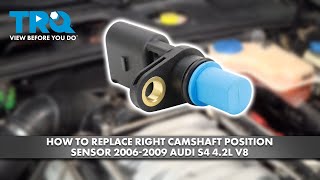
Typical fix: Replace the Bank 2 camshaft position sensor. The sensor is located on the rear of the driver's side cylinder head/valve cover, held by a single T30 Torx bolt. 🎬 Watch this step-by-step guide to replacing the camshaft position sensor.
Est. part cost: $30-$185 - Failing Timing Chain, Guides, or Tensioners 🟡 Medium Probability → Shop Engine Timing Chain The BBK 4.2L V8 is infamous for its plastic timing chain guides becoming brittle and breaking, and hydraulic tensioners failing to maintain pressure on startup. This is a well-documented, major design flaw, often accelerated by infrequent oil changes.
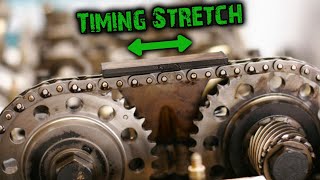
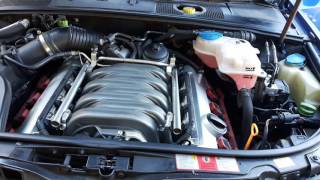
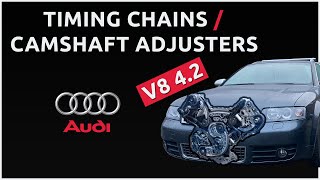
How to confirm: Listen for a 'rattle' noise from the back of the engine on cold starts, which sounds like a chain dragging for 1-3 seconds. 🎬 Listen to an example of the infamous timing chain rattle. A professional diagnosis can be done with a scan tool like VCDS by checking engine measuring value block 093 for camshaft adjustment phase angles. Values exceeding -8° to -10° often indicate excessive chain stretch. 🎬 See how to use VCDS to check for timing chain stretch. The ultimate confirmation is visual inspection, which requires engine removal.
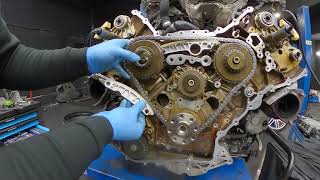
Typical fix: This is a major, engine-out service to replace all timing chains, tensioners, and guides. It is extremely labor-intensive and expensive, often costing thousands of dollars.
Est. part cost: $1000-$2500 - Damaged Wiring or Connector ⚪ Low Probability The engine bay heat can make wiring and plastic connectors brittle over time, leading to cracks or loose connections. Oil from leaking valve cover gaskets can also contaminate the connector pins.
How to confirm: Visually inspect the wiring harness and connector for the Bank 2 camshaft position sensor. Check for frayed wires, corrosion on the pins, or a loose-fitting connector. Use a multimeter to test for continuity, proper ground, and the 5V reference signal at the connector.
Typical fix: Repair the damaged section of wiring or replace the connector pigtail.
Est. part cost: $15-$50
Rare But Worth Checking
- Faulty Engine Control Module (ECM): This is extremely rare. The ECM should only be considered after all other possibilities, including sensors, wiring, and mechanical timing, have been exhaustively ruled out.
Diagnosis Steps
- Read the fault codes with an OBD-II scanner.
- Note the specific code (P0345) and any other codes present, especially correlation codes (P0018) or misfire codes.
- Listen carefully to the rear of the engine during a cold start. Any rattling noise lasting more than a second is a strong indicator of a timing chain guide/tensioner issue.
- Visually inspect the Bank 2 (driver's side) camshaft position sensor and its electrical connector for any obvious damage, oil contamination, corrosion, or loose connections.
- As a primary diagnostic step, swap the Bank 2 (driver's side) sensor with the Bank 1 (passenger's side) sensor. They are identical parts and easily accessible.
- Clear the codes and drive the vehicle. If the fault code changes to P0340 (Bank 1), the sensor you moved is faulty and needs to be replaced.
- If the P0345 code returns after the swap, the problem is not the sensor. The issue lies in the wiring to the Bank 2 sensor or, more likely, a mechanical timing problem on Bank 2.
- If a timing issue is suspected, use an advanced scan tool (like VCDS) to check camshaft phase deviation in measuring blocks 091-093. If values are significantly out of spec (e.g., beyond -8 degrees), it confirms a timing problem.
- If wiring is suspected, use a multimeter to check for 5V reference, ground, and a fluctuating signal voltage at the Bank 2 connector while cranking the engine.
Parts You'll Likely Need
- Camshaft Position Sensor (Hall Sender)
(OEM #06E905163 (Bank 2, Driver Side), 058905161B (Often used for Bank 1))— This is the most common cause of a P0345 code when there are no underlying mechanical timing issues.
Trusted brands: Bosch (OEM), HELLA, Dorman, URO Parts
OEM price range: $100-$185
Aftermarket price range: $30-$90
Related Codes That Often Appear With This One
- P0340 — If you swap the Bank 1 and Bank 2 sensors for diagnosis, you will trigger this code for Bank 1 if the original Bank 2 sensor was faulty.
- P0018 — This code indicates Crankshaft Position - Camshaft Position Correlation (Bank 2, Sensor A), which strongly points towards a mechanical timing issue (stretched chain/failed guide) rather than just a sensor failure.
- P0346 — This code relates to the other camshaft sensor ('B') on Bank 2. Seeing them together can indicate a broader timing issue on that bank or a wiring problem affecting multiple components.
- Multiple Misfire Codes (P0305, P0306, P0307, P0308) — If the cam timing on Bank 2 is incorrect, it can lead to misfires across all cylinders on that bank (Cylinders 5, 6, 7, and 8).
Technical Service Bulletins (TSBs) & Recalls
- TSB 2039995/1 (also cited as 15-15-26): Addresses a 1-3 second rattling noise from the timing chain area on cold starts. It identifies the cause as the upper chain tensioners and recommends replacing them with an optimized part. While it states the noise does not lead to damage, it's a documented symptom related to the system that triggers P0345 when wear becomes excessive.
Platform-Specific Known Issues
- The most critical issue for the BBK 4.2L V8 is the failure of the timing chain guides. A P0345 code can be an early symptom of this impending, catastrophic failure. Owners should be extremely vigilant for any rattling noises on startup.
- Due to the rear-mounted timing system, what would be a moderate repair on another engine becomes an engine-out service on the S4, drastically increasing labor costs for timing issues.
Mechanic-Grade Diagnostic Values
- Camshaft Phase Position (VCDS Measuring Block 093) — expected: 0 to -4 degrees at warm idle. Some sources state a tolerance of +/- 6 or up to 8 degrees total deviation per bank.. Failure: Consistent readings more negative than -8 degrees indicate significant timing chain stretch. Values of -10 or -11 are definitive indicators of a required timing service.
- Camshaft Position Sensor Connector Voltage — expected: With key on, engine off: One pin should have ~5V (reference voltage), one should have continuity to ground, and the third is the signal wire.. Failure: Absence of 5V reference, poor ground, or a signal wire that is stuck at 0V or battery voltage indicates a wiring or ECM issue, not a sensor failure.
Hidden / Shadow Codes Worth Checking
- 16729: This is the VAG-specific fault code that corresponds directly to the generic OBD-II code P0345. (see via Ross-Tech VCDS or other VAG-specific diagnostic tools.)
Wiring & Ground Locations
- G26 — Under the power steering fluid reservoir in the engine bay.. This ground point serves the cooling fan control module, and poor grounds in the engine bay can introduce electrical noise that may affect sensitive sensor readings.
- G32 / G44 — Located on the lower left A-pillar, near the driver's side pedals or behind the kick panel.. These are primary chassis ground points for the instrument panel and various modules. A corroded or loose connection here can cause widespread, intermittent electrical issues.
- Bank 2 CPS Connector — Rear of the driver's side (Bank 2) cylinder head. The connector has 3 pins.. This is the direct connection point for the sensor. Test for 5V reference, ground, and signal here to isolate a faulty sensor from a wiring problem.
Real Owner Repair Stories
- Reddit user in r/Audi (Audi B7 S4, mileage not specified) — Not specified, but undertook the full timing chain service, known as 'the job' for this car.
❌ Tried (didn't work) The user went straight for the full timing service, implying diagnosis pointed to mechanical timing failure.
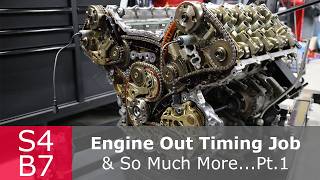
✅ What actually fixed it A complete timing chain service. The user sourced a timing kit from an independent supplier and other parts from FCPEuro and ECSTuning, with performance cam adjusters from JHM. Notably, after the massive job was completed, the alternator failed, requiring further significant disassembly to replace.
OEM Part Supersession History
079109469AC→079109469AD— Part optimization for the upper timing chain guide.
Heads up: The original part had a non-functional nub for assembly line purposes that the new part omits. The new part is the correct replacement.
Model Year Variations Within This Range
- 2003-2005 (B6) vs 2005.5-2008 (B7): While the core BBK engine and P0345 causes are the same, there are minor mechanical differences. For example, when performing major service, it's recommended to update the B6-style flywheel to the more robust B7 version if the transmission is removed.
Diagnostic Flowchart
Other Known Issues on This Vehicle
Issues unrelated to this code that are worth knowing about as an owner of this generation:
- Timing Chain Guide & Tensioner Failure 🔴 High → Shop Engine Timing Chain — Very common, especially on vehicles over 80,000-100,000 miles. Poor oil change history accelerates wear. (Ref: TSB 2039995/1 (15-15-26) addresses a 1-3 second rattle on cold start, recommending replacement of upper chain tensioners.)
- Excessive Oil Consumption 🟠 Medium — Common across the platform. Audi considers consumption of up to 0.5 quarts per 600 miles to be within spec, though owners find it excessive. Caused by worn piston rings, valve seals, or PCV system issues.
- Intake Manifold Flap / Linkage Arm Failure 🟠 Medium → Shop Engine Intake Manifold — The plastic linkage arms for the variable intake manifold can break, or the internal flaps can get stuck due to carbon buildup and a seized bearing. This results in a loss of low-end torque and potential fault codes.
- Clogged or Failed Catalytic Converters 🟠 Medium — With age and heat, the catalytic converters can become restricted or fail, leading to significant power loss and misfires isolated to one bank. This is often misdiagnosed as an ignition or timing issue.
- Leaking Auxiliary Radiators 🟡 Low — The two small radiators located on the sides of the main radiator are prone to corrosion at the bottom, causing them to bulge and leak coolant. This is a bumper-off job to replace.
- Valve Cover Gasket Leaks 🟡 Low → Shop Engine Valve Cover — Gaskets become brittle with age and heat, leading to oil leaks, often noticeable by a burning oil smell as it drips onto the exhaust manifolds.
Used vs. New Parts: Buying Guide for This Vehicle
When a used part is the smart pick: For a camshaft position sensor, buying used is not recommended as the cost savings are minimal and the part's remaining lifespan is unknown. A used sensor could be considered for temporary diagnostic purposes (e.g., to confirm a wiring fault) but should not be a permanent repair.
Donor-vehicle mileage cap: roughly under 50000 miles for the part to have meaningful remaining life.
What to inspect on the donor part:
- For a sensor, check for physical damage, cracks in the plastic housing, or corrosion on the pins.
- For any major engine component, verify the donor vehicle did not suffer from the 'death rattle' or have known timing issues.
OEM-only on this vehicle (don't cheap out):
- Timing Chain Tensioners
- Timing Chain Guides
Aftermarket brands forum-validated for this vehicle:
- For the camshaft position sensor: Bosch (OEM supplier).
- For a complete timing service kit: JHM (JH Motorsports) is a highly regarded performance aftermarket supplier offering comprehensive kits with upgraded components like mechanical adjusters.
Brands owners have reported issues with on this vehicle:
- Unnamed, low-cost timing chain kits from eBay or Amazon. Forum and mechanic consensus is that these kits use inferior quality guides and chains that can fail prematurely, leading to catastrophic engine damage.
Real Owner Stories
Aggregated from forums and TSBs cited above. Mileages and costs reflect what owners reported in those sources.
2005 Audi S4 4.2L V8 — ~100000 miles
Symptoms: Rattling noise from the rear of the engine on cold start, lasting 1-3 seconds.
What fixed it: Replacement of upper chain tensioners with optimized parts as recommended per TSB 2039995/1.
Source hint: TSB 2039995/1 (also cited as 15-15-26)
2004 Audi S4 4.2L V8
Symptoms: Startup rattle and fault codes; discussion regarding the relation between oil pressure and the duration of the rattle.
What fixed it: The source discusses the progression of the rattle to fault codes and the necessity of monitoring timing chain tensioner health.
Source hint: AudiSRS.com - 'S4 Chain Tensioner or Cold Start Up Rattle'
2006 Audi S4 4.2L V8
Symptoms: Rattle during semi-warm start and cold start.
What fixed it: Owners on the forum discuss the duration of the rattle as an indicator of timing component wear.
Source hint: Reddit r/AudiS4 - 'Getting the rattle during semi warm start and cold start...'
Related OBD-II Codes
Frequently Asked Questions
My 2004 S4 has a 1-3 second rattle on cold starts; does TSB 2039995/1 mean my timing chains are failing?
Can I test if the Bank 2 sensor is actually bad without buying a new part?
Is it true that fixing a timing issue on the BBK 4.2L V8 requires pulling the whole engine?
What are the specific VCDS measuring blocks I should check for timing stretch on my S4?
Could my P0345 code be caused by a simple wiring issue instead of the timing chains?
Does the Audi A6 with the 4.2L V8 share this same P0345 risk?
Helpful Videos
We Have This Part in Stock

The information in this article is provided for general reference and educational purposes only. Vehicle specifications, procedures, and part compatibility can vary by production date, trim level, and region. Always consult your vehicle's factory service manual and verify part numbers before purchasing or performing repairs. Safety-critical components such as airbags, seat belts, and braking systems should be installed by a qualified professional.
- Audi S4:
- 🧭 Diagnostic Flowchart
- 🎬 Helpful Videos
- 🛍️ Shop This Part
- What's Unique About the 2003-2008 Audi S4
- Symptoms You May Notice
- Most Likely Causes
- Rare But Worth Checking
- Diagnosis Steps
- Parts You'll Likely Need
- Related Codes That Often Appear With This One
- Technical Service Bulletins (TSBs) & Recalls
- Platform-Specific Known Issues
- Mechanic-Grade Diagnostic Values
- Hidden / Shadow Codes Worth Checking
- Wiring & Ground Locations
- Real Owner Repair Stories
- OEM Part Supersession History
- Model Year Variations Within This Range
- Other Known Issues on This Vehicle
- Used vs. New Parts: Buying Guide for This Vehicle
- Real Owner Stories
- 2005 Audi S4 4.2L V8 — ~100000 miles
- 2004 Audi S4 4.2L V8
- 2006 Audi S4 4.2L V8
- Related OBD-II Codes
- Frequently Asked Questions
- 🎟️ Get 5% Off