

P0345 on 2019-2025 Genesis G70 3.3T: Camshaft Sensor Bank 2 Causes and Fixes
On a 2019-2025 Genesis G70 3.3T, code P0345 is almost always caused by a failed driver's side (Bank 2) intake camshaft position sensor, often due to a leaking turbo oil line. The fix is typically a new sensor (part #39318-3L100), costing $40-$150, and is a 2/5 difficulty DIY job. Critically, check if your vehicle has had recall 019G performed to replace the faulty oil line.
- P0345 on the G70 3.3T points directly to the driver's side (Bank 2) intake camshaft position sensor.
- The most likely cause is the sensor itself failing, very often due to a known oil leak from the turbocharger feed line above it.
- Before buying parts, inspect the sensor for oil contamination and consider having the recall (019G) for the oil line performed.
- The easiest way to confirm a bad sensor is to swap it with the identical sensor on the passenger's side (Bank 1) and see if the code changes to P0340.
- This is a very manageable DIY repair for most owners, requiring basic tools and access to the top of the engine.
What's Unique About the 2019-2025 Genesis G70
The Genesis G70 3.3T has a specific vulnerability that directly leads to code P0345. The Bank 2 (driver's side) camshaft position sensor is located directly below a turbocharger oil feed line. This pipe is known to crack from heat fatigue, leaking oil directly onto the sensor and its electrical connector, causing it to fail. This issue is so prevalent that Genesis issued a safety recall (NHTSA 24V-191 / Recall 019G) for 2019-2022 models to replace the faulty oil line with an improved part made of stainless steel for better heat durability.
Generation note: The 2019-2025 year range covers the first generation of the Genesis G70 (IK), including its 2022 model year facelift. The Lambda II 3.3L V6 engine and the associated P0345 causes are consistent across this entire period. The turbo oil line recall (NHTSA 24V-191) specifically covers 2019-2022 G70 models produced from May 2, 2018, to September 1, 2021, but the sensor's location makes it vulnerable on all years if the recall has not been performed.
Symptoms You May Notice
- Check Engine Light is on
- Engine is difficult to start or takes longer to crank
- Rough or unstable idle
- Hesitation or stumbling during acceleration
- Reduced engine power or entering 'limp mode'
- Engine may stall, especially when coming to a stop
- Increased fuel consumption
- Noticeable smell of fuel from running rich
- Replacing the camshaft position sensor without addressing the oil leak from the turbo feed line, leading to repeat failure.
- Replacing the crankshaft position sensor (P0335) instead of the camshaft position sensor.
- Replacing the Bank 1 (passenger side) sensor instead of the Bank 2 (driver's side) sensor.
- Assuming a major timing chain issue before swapping the sensor, which is a simple and free diagnostic step.
Most Likely Causes
- Failed Bank 2 Intake Camshaft Position Sensor 🔴 High Probability → Shop Engine Camshaft Position Sensor The sensor is frequently saturated with oil from a leaking turbocharger oil feed line, a known issue covered by recall 019G (NHTSA 24V-191). The recall documents state the original pipe material was susceptible to cracking from heat. Even without a leak, standard heat cycles in the engine bay can cause the sensor to fail electronically over time.
How to confirm: Swap the Bank 2 (driver's side) intake sensor with the Bank 1 (passenger's side) intake sensor. They are the same part number (39318-3L100). Clear the codes and drive. If the code changes to P0340 (Bank 1), the sensor is confirmed faulty.
Typical fix: Replace the Bank 2 intake camshaft position sensor. Ensure the connector is clean and free of oil. If oil is present, the turbo oil feed line must be inspected and replaced with the updated part from the recall.
Est. part cost: $60-$150 - Wiring Harness or Connector Issue 🟡 Medium Probability The same oil leak from the turbo feed line that damages the sensor can also saturate the electrical connector, causing a poor connection or short circuit. The wiring is also exposed to high heat in this area, which can cause it to become brittle and crack over time.
How to confirm: Visually inspect the sensor's connector for oil saturation, corrosion, or pushed-out pins. Trace the wiring harness leading to the sensor for any signs of brittleness, fraying, or melting.
Typical fix: Clean the connector thoroughly with electrical contact cleaner. If the connector or wiring is damaged, it will need to be repaired or replaced. A pigtail connector may be available for this repair.
Est. part cost: $5-$50
Rare But Worth Checking
- Weak Battery or Charging System Issue: A weak battery can cause low voltage during engine cranking, which may lead to erratic signals from various sensors, including the camshaft sensor, triggering a false P0345 code.
- Stretched Timing Chain: → Shop Engine Timing Chain This is a much more serious mechanical issue and is very unlikely without other timing correlation codes (like P0018 or P0019) or an audible rattling noise from the front of the engine.
- Faulty Engine Control Module (ECM): This is extremely rare and should only be considered after all other possibilities (sensor, wiring, mechanical) have been exhaustively ruled out.
Diagnosis Steps
- Read the code with an OBD-II scanner to confirm P0345 is the active fault.
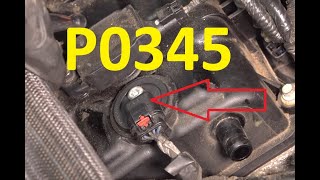
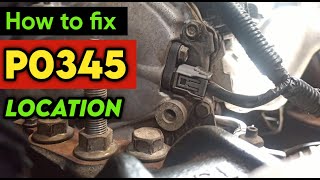
- Open the hood and locate the Bank 2 (driver's side) intake camshaft position sensor. It is near the top of the engine, towards the firewall, held in by a single 10mm bolt.
- Critically inspect the area directly above and around the sensor for any signs of fresh or caked-on engine oil. If oil is present, the source is almost certainly the turbo oil feed line directly above it, which is subject to recall 019G.
- If the area is clean, disconnect the sensor and inspect the connector pins for corrosion or damage. Check for oil inside the connector itself.
- To confirm a bad sensor, swap it with the identical sensor from Bank 1 (passenger side). All four cam sensors on the 3.3T engine are the same part (39318-3L100).
- Clear the diagnostic codes with the scanner and start the engine. Drive the vehicle until the check engine light returns.
- Re-scan the codes. If the code has changed to P0340 (Camshaft Position Sensor 'A' Circuit Malfunction Bank 1), the sensor you moved is faulty and needs to be replaced.
- If P0345 returns, the problem is in the wiring circuit for Bank 2, not the sensor itself. You will need to test the circuit for power, ground, and signal continuity back to the ECM using a digital multimeter.
- Check the vehicle's VIN for open recalls on the Genesis or NHTSA websites, specifically for recall 019G / 24V-191. If the recall is open, a dealer will replace the faulty oil line for free.
Parts You'll Likely Need
- Camshaft Position Sensor
(OEM #39318-3L100)— This is the most common failure part for P0345, often failing due to oil contamination from a known turbo line leak or simple electronic failure over time. All four cam sensors on the engine are this same part number.
Trusted brands: Hyundai/Genesis Genuine, Bosch, Delphi, NGK/NTK
OEM price range: $60-$150
Aftermarket price range: $30-$70 - LH Turbocharger Oil Feed Pipe Service Kit
(OEM #28240-3L122QQH)— This is the official remedy part for the recall (019G). If P0345 is caused by an oil leak from above the sensor, this part is required to permanently fix the issue. The new pipe is made of stainless steel to resist heat cracking.
Trusted brands: Hyundai/Genesis Genuine
OEM price range: $80-$120
Aftermarket price range: N/A
Related Codes That Often Appear With This One
- P0340 — This code for Bank 1 will appear if you swap a faulty Bank 2 sensor to the Bank 1 position during diagnosis, confirming the sensor is the problem.
- P0018 / P0019 — These are timing correlation codes for Bank 2. While P0345 is an electrical circuit code, seeing it alongside these may point to a more serious mechanical timing issue, like a stretched chain or a problem with the CVVT system.
Technical Service Bulletins (TSBs) & Recalls
- TSB 24-01-032G / Recall 019G (NHTSA ID: 24V-191): Addresses the cracking Bank 2 turbo oil feed pipe that leaks oil onto the camshaft position sensor. The remedy involves replacing the original pipe with a full stainless steel assembly (Part Kit 28240-3L122QQH).
Platform-Specific Known Issues
- A safety recall (NHTSA 24V-191 / Genesis Recall 019G / TSB 24-01-032G) was issued for 2019-2022 models to replace the Bank 2 (driver's side) turbocharger oil feed line. This pipe can crack from heat and vibration, leaking oil directly onto the camshaft position sensor, causing it to fail and trigger code P0345. This recall supersedes a previous, less effective recall (19V-538), and vehicles repaired under the old recall still need the new remedy.
Mechanic-Grade Diagnostic Values
- Camshaft Position Sensor (CMP) Connector Voltage (Key On, Engine Off) — expected: Pin 3 (Power): ~5V, Pin 2 (Ground): Good continuity to chassis ground, Pin 1 (Signal): ~5V.. Failure: Missing 5V power or a bad ground points to a wiring or ECM issue, not necessarily a failed sensor.
- Oil Control Valve (OCV) / VVT Solenoid Resistance — expected: 6.9 - 7.9 Ohms at 68°F (20°C).. Failure: A reading of infinity (open circuit) or near zero (short circuit) indicates a failed solenoid coil. This is a relevant test if mechanical timing codes (e.g., P0018) are also present.
- Scan Tool Live Data: Desired vs. Actual Camshaft Angle (Bank 2 Intake) — expected: At idle, the 'Actual' angle PID should closely track the 'Desired' angle PID, with a difference near 0 degrees.. Failure: A large, persistent gap between desired and actual angles suggests a mechanical or hydraulic issue (e.g., bad OCV, low oil pressure, failed phaser), not just a sensor circuit fault.
Scan Tool Commands That Help
- Genesis GDS (Global Diagnostic System): Active Test: CVVT Oil Control Valve — When P0345 appears with correlation codes like P0018. This command manually cycles the Oil Control Valve (OCV) to verify it is mechanically functioning, helping to differentiate between a sensor circuit fault (P0345) and a mechanical/hydraulic timing issue.
- Genesis GDS (Global Diagnostic System): Resetting Adaptive Values — After replacing the sensor or performing any timing-related repairs. This function clears the engine's learned fuel and timing trims, forcing the ECM to re-adapt to the new components, which can resolve rough running issues that persist after a fix.
- Genesis GDS (Global Diagnostic System): Flight Logger / Data Analysis — For intermittent P0345 faults. This function records sensor data over a complete drive cycle, allowing a technician to graph the camshaft sensor signal and spot dropouts or glitches that may not be present at idle in the bay.
Wiring & Ground Locations
- Bank 2 Intake CMP Sensor Connector — On the driver's side (Bank 2) valve cover, towards the firewall, connecting to the intake camshaft position sensor.. This is the primary connection point for the fault circuit. It is physically located directly beneath the turbo oil feed line that is subject to recall, making it highly susceptible to oil contamination which causes short circuits or poor connections.
- Sensor Connector Pinout — At the Bank 2 Intake CMP Sensor.. Pin 1 is the Signal wire, Pin 2 is Ground, and Pin 3 is the 5V Power supply. Knowing this allows for precise multimeter testing of the circuit without a wiring diagram.
Real Owner Repair Stories
- ? ()
OEM Part Supersession History
39350-4A400→39318-3L100— Part number consolidation and design update.
Heads up: One parts supplier lists 39350-4A400 as being superseded by 39318-3L100. However, these are physically different sensors. For the G70 3.3T, 39318-3L100 is the correct and consistently specified part for all four camshaft positions. Avoid using other part numbers unless explicitly cross-referenced by a dealer with your VIN.
Model Year Variations Within This Range
- 2019-2022: These model years are specifically covered by safety recall NHTSA 24V-191 (Genesis Recall 019G) to replace the original Bank 2 turbocharger oil feed line. The original part was prone to cracking and leaking oil onto the P0345 sensor. Models from 2023-2025 were factory-equipped with the improved part.
Diagnostic Flowchart
Other Known Issues on This Vehicle
Issues unrelated to this code that are worth knowing about as an owner of this generation:
- Electronic Wastegate Actuator Rattle/Squeak 🟠 Medium — Very common. Often presents as a distinct squeak or rattle from the engine bay (typically passenger side for Bank 1) when the engine is shut off. Can occur at any mileage. (Ref: No TSB, but it is a widely discussed issue. Dealers often replace the entire turbo under warranty, though some owners report temporary fixes by lubricating the actuator arm.)
- High-Pressure Fuel Pump (HPFP) Failure 🔴 High — Common enough to warrant a recall. Can cause hesitation, rough idle, loss of power, and stalling at low speeds. (Ref: Recall 262 / 023G (NHTSA 24V-528) for 2019-2023 G70 models. The fix involves replacing the fuel control valve plunger and updating ECM software.)
- Harsh Automatic Transmission Downshifts 🟡 Low — Frequently reported by owners, especially in stop-and-go traffic or when braking in Sport mode. The transmission can feel jerky or lurch when shifting from 3-2 and 2-1. (Ref: No TSB, but it is a common owner complaint. Some have noted that a transmission fluid change or software reset can sometimes help.)
- ABS Module Malfunction / Fire Risk 🔴 High — Affects 2019-2021 models. Less common than other issues but with high severity, prompting a recall. (Ref: Recall 007G (NHTSA 21V-303). The ABS module can malfunction and cause an electrical short, increasing the risk of an engine compartment fire even when the car is off. Owners were advised to park outside until the fix (replacing a fuse) was completed.)
- Peeling Clear Coat on Wheels 🟡 Low — A cosmetic but common complaint on models with certain wheel finishes. The clear coat begins to peel or flake off. (Ref: No recall, but often covered under the vehicle's 3-year/36,000-mile basic warranty on a case-by-case basis.)
Used vs. New Parts: Buying Guide for This Vehicle
When a used part is the smart pick: For this repair, buying a used part is not recommended. The primary failure parts are a relatively inexpensive electronic sensor and a recalled oil pipe that was updated.
What to inspect on the donor part:
- Not applicable as used parts are not advised.
OEM-only on this vehicle (don't cheap out):
- LH Turbocharger Oil Feed Pipe: This part MUST be the new, updated OEM service kit (28240-3L122QQH) to permanently fix the oil leak issue. A used part would have the same defect as the original.
Aftermarket brands forum-validated for this vehicle:
- For the Camshaft Position Sensor, Hyundai/Genesis Genuine (OEM) is the safest choice. Reputable Tier 1 suppliers like Bosch, Delphi, and NGK/NTK are generally considered reliable alternatives.
Brands owners have reported issues with on this vehicle:
- Avoid unbranded, 'white-box' electronic sensors from online marketplaces. While cheaper, they have a high rate of premature failure and can cause diagnostic confusion.
Real Owner Stories
Aggregated from forums and TSBs cited above. Mileages and costs reflect what owners reported in those sources.
2019-2022 Genesis G70 3.3L V6
Symptoms: Owners on Reddit and dedicated forums report the check engine light coming on, often accompanied by oil leaking from a cracked turbocharger oil feed line directly onto the camshaft position sensor.
What fixed it: Replacement of the Bank 2 turbocharger oil feed pipe with the updated stainless steel assembly (Part Kit 28240-3L122QQH) and a new camshaft position sensor (39318-3L100).
Source hint: TSB 24-01-032G / Recall 019G (NHTSA ID: 24V-191)
2018-2023 Kia Stinger GT 3.3L V6
Symptoms: The vehicle shares the same engine layout where the Bank 2 turbo oil feed line is positioned directly above the camshaft position sensor, leading to sensor failure when the line cracks.
What fixed it: Kia recall SC300 / NHTSA 24V-169, which involves replacing the cracking oil line that triggers code P0345.
Source hint: 2018-2023 Kia Stinger GT (3.3L V6) platform mate description
Related OBD-II Codes
Frequently Asked Questions
Does Genesis Recall 019G apply to my 2019-2022 G70 3.3T?
I already had a recall repair for an oil leak (19V-538); do I need to do anything for P0345?
Can I use the same sensor from the other side of the engine to test the P0345 code?
Is the P0345 code related to the high-pressure fuel pump recall on my G70?
What part is used to fix the oil leak causing my P0345 code under the TSB?
Why is my G70 entering 'limp mode' with this code?
Helpful Videos
![How to Fix P0345 Engine Code in 3 Minutes [2 DIY Methods / Only $9.45]](https://img.youtube.com/vi/n2SF4lGzH58/mqdefault.jpg)
We Have This Part in Stock

The information in this article is provided for general reference and educational purposes only. Vehicle specifications, procedures, and part compatibility can vary by production date, trim level, and region. Always consult your vehicle's factory service manual and verify part numbers before purchasing or performing repairs. Safety-critical components such as airbags, seat belts, and braking systems should be installed by a qualified professional.
- Genesis G70:
- 🧭 Diagnostic Flowchart
- 🎬 Helpful Videos
- 🛍️ Shop This Part
- What's Unique About the 2019-2025 Genesis G70
- Symptoms You May Notice
- Most Likely Causes
- Rare But Worth Checking
- Diagnosis Steps
- Parts You'll Likely Need
- Related Codes That Often Appear With This One
- Technical Service Bulletins (TSBs) & Recalls
- Platform-Specific Known Issues
- Mechanic-Grade Diagnostic Values
- Scan Tool Commands That Help
- Wiring & Ground Locations
- Real Owner Repair Stories
- OEM Part Supersession History
- Model Year Variations Within This Range
- Other Known Issues on This Vehicle
- Used vs. New Parts: Buying Guide for This Vehicle
- Real Owner Stories
- 2019-2022 Genesis G70 3.3L V6
- 2018-2023 Kia Stinger GT 3.3L V6
- Related OBD-II Codes
- Frequently Asked Questions
- 🎟️ Get 5% Off