

P0353 on 2012-2018 Ford Focus ST: Ignition Coil 'C' Circuit Causes and Fixes
P0353 on a Ford Focus ST almost always means the ignition coil on cylinder #3 has failed. It's a simple and affordable DIY fix, typically costing $30-$70 for a new coil. Swapping the coil with another cylinder is the easiest way to confirm the diagnosis. While replacing, it's wise to also replace the spark plug.
- P0353 specifically points to a problem with the ignition system for cylinder #3.
- The most likely cause is a bad ignition coil, which is a simple and inexpensive part to replace yourself.
- A quick diagnostic is to swap the coil from cylinder #3 with another cylinder and see if the trouble code follows the coil.
- Always inspect and consider replacing the spark plug in the affected cylinder at the same time you replace the coil.
- If the check engine light is flashing, avoid driving the vehicle to prevent costly damage to the catalytic converter.
What's Unique About the 2012-2018 Ford Focus
The 2.0L EcoBoost engine in the Focus ST uses a coil-on-plug ignition system, which is common today. There are no widespread, unique design flaws on this specific platform that make the P0353 code exceptionally common or difficult to diagnose. The causes are typical for most modern Ford 4-cylinder engines, with coil failure being the primary culprit due to heat and vibration over time. However, it's worth noting that some other Ford vehicles with 2.0L EcoBoost engines have a known issue with coolant intrusion into the cylinders which can cause misfire codes, but this is less commonly reported for the Focus ST variant.
Symptoms You May Notice
- Check Engine Light is on
- Engine running rough or shaking, especially at idle
- Noticeable loss of power and poor acceleration
- Engine misfiring, which may feel like a stumble or hesitation
- Flashing Check Engine Light under heavy acceleration
- Reduced fuel economy
- Replacing only the spark plug without testing the ignition coil.
- Replacing the PCM before thoroughly checking the ignition coil and its wiring circuit.
- Replacing the ignition coil without checking for oil in the spark plug well from a leaking valve cover gasket, which will cause the new coil to fail prematurely.
Most Likely Causes
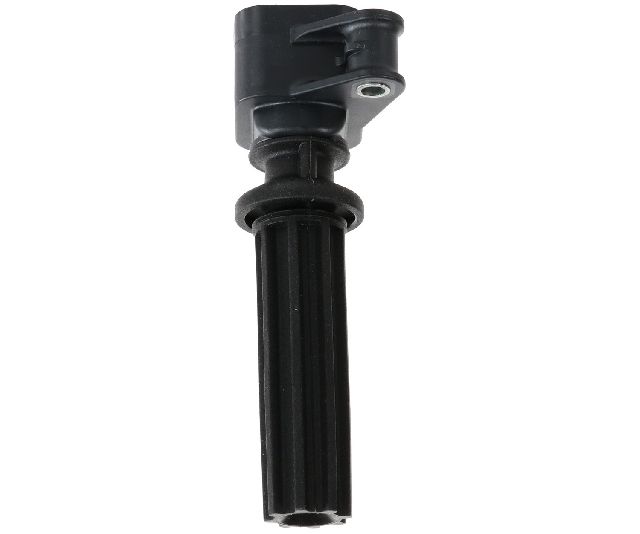
- Failed Ignition Coil on Cylinder #3 🔴 High Probability → Shop Ignition Coil Ignition coils are wear-and-tear items that fail from constant high-temperature heat cycles and engine vibration. After 60,000+ miles, the internal windings can break down, leading to a failure.
How to confirm: Swap the ignition coil from cylinder #3 with another cylinder (e.g., cylinder #2). Clear the codes and drive the vehicle. If the code changes to P0352, the coil is confirmed to be faulty.
Typical fix: Replace the failed ignition coil. It is held in by a single 8mm bolt and is easily accessible after removing the plastic engine cover.
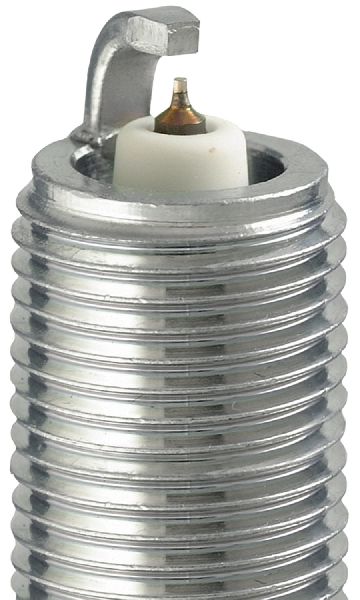
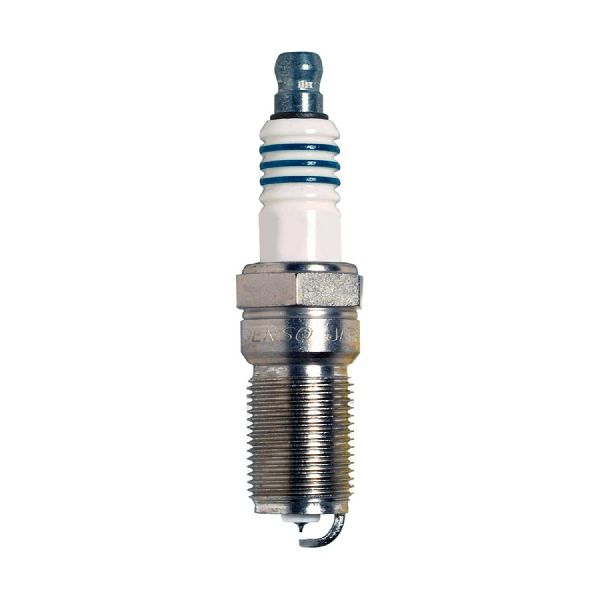
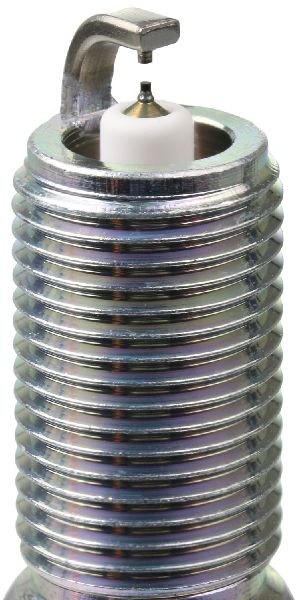
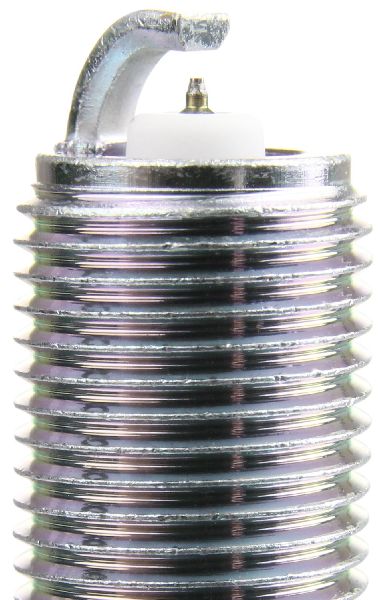
Est. part cost: $30-$70 - Worn or Fouled Spark Plug in Cylinder #3 🟡 Medium Probability → Shop Spark Plug A worn spark plug with an excessive gap creates higher resistance, which strains the ignition coil, causing it to overheat and fail. It's often a contributing factor to or the root cause of coil failure.
How to confirm: After removing the ignition coil, remove the spark plug and inspect it. Look for a worn electrode, carbon fouling, oil contamination from a leaking valve cover gasket, or signs of coolant contamination (white, chalky residue).
Typical fix: Replace the spark plug. It is highly recommended to replace the spark plug whenever replacing an ignition coil to ensure the longevity of the new coil.
Est. part cost: $10-$25 - Damaged Wiring or Connector for Coil #3 ⚪ Low Probability The plastic connector or wiring can become brittle over time from engine heat. The locking tab on the connector can break, leading to a poor or intermittent connection that triggers the circuit code. Rodent damage to the harness is also a possibility.
How to confirm: Visually inspect the electrical connector and wiring going to the ignition coil on cylinder #3. Wiggle the connector with the engine running to see if it affects the misfire. Check for broken plastic, corroded pins, or loose wires.
Typical fix: Repair the wiring or replace the connector pigtail. Ensure the new connector is securely seated.
Est. part cost: $15-$30
Rare But Worth Checking
- Failed Powertrain Control Module (PCM): → Shop Engine Control Module (ECM) This is very rare. The internal driver circuit within the PCM that controls the #3 coil can fail. This should only be considered after a new coil, plug, and verified wiring do not fix the issue. Professional diagnosis is required to confirm a bad PCM.
- Leaking Valve Cover Gasket: → Shop Engine Valve Cover Oil can leak from the valve cover gasket and pool in the spark plug tube. This oil will saturate the ignition coil boot, causing it to degrade and eventually short out, leading to coil failure and a P0353 code. If oil is present when you remove the coil, the valve cover gasket should be replaced.
Diagnosis Steps
- Read the trouble codes with an OBD-II scanner to confirm P0353 is present. Note any other codes, such as P0303.
- Locate cylinder #3 on the 2.0L engine. It is the third cylinder from the left (passenger side/belt side) when facing the engine.
- Visually inspect the wiring harness and electrical connector for coil #3. Check for obvious damage, corrosion, or a broken locking tab.
- Swap the ignition coil from cylinder #3 with the coil from cylinder #2.
- Clear the fault codes using the scanner.
- Start the engine and drive the vehicle until the Check Engine Light returns.
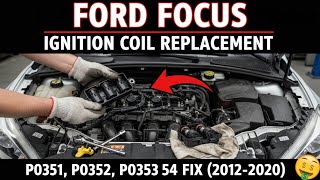
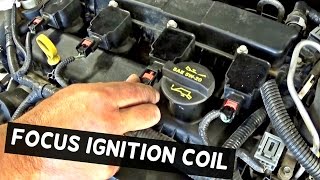
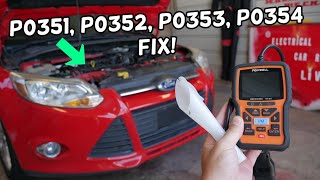
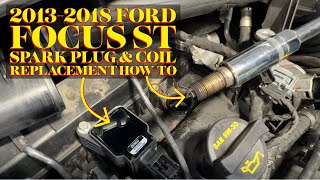
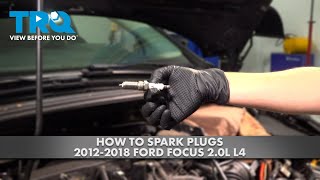
- Re-scan for codes. If the code is now P0352, the ignition coil you moved is faulty and needs to be replaced. 🎬 Watch: How to replace a faulty ignition coil
- If the code P0353 returns, the problem is not the coil. Turn off the engine.
- Remove the coil and spark plug from cylinder #3. Inspect the spark plug for wear, fouling, or damage. Check the spark plug tube for any oil, which would indicate a leaking valve cover gasket.
- If the plug and connector look good, use a multimeter to check for battery voltage at the coil connector's power wire and for a proper ground signal with the key on, engine off. A wiring diagram is needed for this step.
- If all other components and wiring check out, the issue may be a rare PCM failure, which requires professional diagnosis.
Parts You'll Likely Need
- Ignition Coil
(OEM #CM5Z-12029-F)— This is the most common failure point for a P0353 code.
Trusted brands: Motorcraft, NGK, Bosch, Delphi
OEM price range: $50-$97
Aftermarket price range: $30-$60 - Spark Plug
(OEM #CYFS-12Y-T3)— It is best practice to replace the spark plug when replacing a coil, as a worn plug can cause the new coil to fail prematurely.
Trusted brands: Motorcraft, NGK
OEM price range: $15-$25
Aftermarket price range: $10-$20
Related Codes That Often Appear With This One
- P0303 — P0303 means 'Cylinder 3 Misfire Detected.' Since P0353 indicates a fault in the ignition circuit for cylinder 3, a misfire is the direct result. Fixing P0353 will almost always resolve P0303.
Technical Service Bulletins (TSBs) & Recalls
- TSB 19-2346: While not directly for the Focus ST, this TSB addresses coolant intrusion into cylinders on other Ford models with 2.0L EcoBoost engines, which can cause misfire codes. It's a severe issue to be aware of if simple fixes don't work and coolant loss is observed.
Mechanic-Grade Diagnostic Values
- Ignition Coil Primary Winding Resistance — expected: 0.41 - 2.0 Ohms (Ω). Failure: A reading of OL (infinite resistance) or near zero ohms indicates a failed coil.
- Ignition Coil Secondary Winding Resistance — expected: 7,300 - 9,800 Ohms (7.3kΩ - 9.8kΩ). Failure: A reading significantly outside this range, especially OL, points to a faulty secondary winding.
- Voltage at Coil Connector Power Wire (Key On, Engine Off) — expected: 10 - 12.5 Volts (Should be equal to battery voltage). Failure: Low or no voltage indicates a problem in the power supply circuit from the PCM power relay or fuse.
- Signal at Coil Connector Control Wire (Engine Cranking/Running) — expected: 5 - 20 Hz signal. Failure: Absence of a fluctuating Hz signal indicates the PCM is not sending the trigger signal to the coil. This requires a multimeter with a frequency (Hz) function to test.
Hidden / Shadow Codes Worth Checking
- Mode $06, TID $A2-$A5: These are not trouble codes but onboard monitor test results for misfire counts for each cylinder. TID $A4 would correspond to cylinder 3. Viewing this data can show intermittent misfires on a specific cylinder before a P0303 code is officially set. (see via A professional-grade OBD-II scanner with Mode $06 capabilities.)
Scan Tool Commands That Help
- Ford IDS (Integrated Diagnostic System): Power Balance Test — This bidirectional test allows a technician to disable individual cylinders one at a time to observe the RPM drop. If disabling cylinder #3 results in little or no change in engine RPM, it confirms that cylinder is not contributing, which is the expected result with a P0353 fault. This is useful to confirm the misfire location before swapping parts.
Wiring & Ground Locations
- Ignition Coil #3 Connector — On top of the valve cover, plugged into the third ignition coil from the passenger (belt) side of the engine.. This is the primary point for visual inspection and electrical testing (power, ground, and signal) for the P0353 circuit.
- PCM Connector (EGAK) — The Powertrain Control Module (PCM) is typically located in the engine bay, often near the battery or firewall. The 2.0L EcoBoost uses multiple connectors.. The control signal wire for the cylinder 3 ignition coil originates here. A damaged pin or wire at this connector can cause the code. Based on wiring diagrams for similar engines, the control line for coil #3 is often at Pin 91.
- Engine Block Grounds — There are several main ground straps and connection points from the wiring harness to the engine block and chassis, often near the battery tray and on the side of the cylinder head.. A poor engine ground can cause a host of electrical issues, including erratic ignition system behavior. While not a direct cause of a single-cylinder code, it should be checked if multiple electrical codes are present.
Real Owner Repair Stories
- Reddit r/FocusST user comment (Ford Focus ST (year not specified)) — Engine misfire.
❌ Tried (didn't work) Replacing spark plugs
✅ What actually fixed it The user replaced the ignition coils, which resolved the misfire problem after the new spark plugs did not.
OEM Part Supersession History
CM5Z-12029-A→CM5Z-12029-F, CM5Z-12029-K— Standard part revision for improved reliability, internal insulation, and performance consistency.
Heads up: The newer revisions (F and K) are fully compatible and recommended for replacement.
Diagnostic Flowchart
Other Known Issues on This Vehicle
Issues unrelated to this code that are worth knowing about as an owner of this generation:
- Canister Purge Valve (CPV) Failure 🔴 High — Extremely common. Can occur at various mileages. (Ref: Ford Safety Recall 18S32 / NHTSA 18V735.)
- Low-Speed Pre-Ignition (LSPI) 🔴 High — A risk inherent to many early direct-injection turbo engines. Can cause catastrophic engine failure. Avoided by not applying heavy throttle at low RPM in high gears (lugging the engine).
- Weak Rear Motor Mount 🟠 Medium — The stock rear motor mount is soft and prone to failure, causing excessive engine movement, wheel hop, and poor shifting feel. (Ref: A TSB exists for earlier, non-ST Focus models for similar issues (TSB 11-3-24), but for the ST, owners typically upgrade to an aftermarket part.)
- Wiring Harness Faults (Pre-facelift models) 🟠 Medium — Pre-facelift (2012-2014) models were prone to wiring loom faults that could cause fluctuating revs or stalling. (Ref: A recall was issued in the US, and some cars were repaired under warranty in other regions.)
- Carbon Buildup on Intake Valves 🟡 Low — Common to all direct-injection engines. Over time (typically 60k-100k miles), carbon deposits can build up on the back of intake valves, potentially affecting performance.
Used vs. New Parts: Buying Guide for This Vehicle
When a used part is the smart pick: For this repair, buying a used ignition coil is generally not recommended. They are a common wear-and-tear item and a used part has an unknown remaining lifespan. Given the low cost of a new aftermarket coil ($30-$60), it is not a cost-effective risk.
Donor-vehicle mileage cap: roughly under 30000 miles for the part to have meaningful remaining life.
What to inspect on the donor part:
- Check for cracks in the plastic housing.
- Ensure the electrical connector pins are clean and not corroded.
- Inspect the rubber boot for tears, swelling, or signs of oil saturation.
OEM-only on this vehicle (don't cheap out):
- While not strictly OEM-only, many owners report that Motorcraft coils offer the best reliability and longevity compared to cheaper, unbranded aftermarket options.
Aftermarket brands forum-validated for this vehicle:
- NGK
- Bosch
- Delphi
Brands owners have reported issues with on this vehicle:
- Generic, unbranded 'performance' coils from online marketplaces have mixed reviews and may not offer the same durability as OEM or reputable aftermarket brands. Some owners have reported premature failure with store brands like Duralast, though others have had success.
Real Owner Stories
Aggregated from forums and TSBs cited above. Mileages and costs reflect what owners reported in those sources.
2012-2018 Ford Focus ST 2.0L EcoBoost — ~60000 miles
Symptoms: Engine running rough or shaking, especially at idle; noticeable loss of power and poor acceleration.
What fixed it: Swapping the ignition coil from cylinder #3 to another cylinder confirmed the failure; replaced the failed ignition coil with a new one.
Source hint: r/FocusST on Reddit
2012-2014 Ford Focus ST 2.0L EcoBoost
Symptoms: Fluctuating revs and stalling.
What fixed it: Repairing the wiring loom faults as part of the regional recall/warranty service for pre-facelift models.
Source hint: Wiring Harness Faults (Pre-facelift models) section
2012-2018 Ford Focus ST 2.0L EcoBoost
Symptoms: Misfiring, which may feel like a stumble or hesitation; flashing Check Engine Light under heavy acceleration.
What fixed it: Replaced the spark plugs as a set and replaced the faulty ignition coil.
Source hint: FocusST.org
Related OBD-II Codes
Frequently Asked Questions
Where is cylinder #3 located on my Focus ST 2.0L EcoBoost engine?
Does TSB 19-2346 apply to my Focus ST if I can't fix the P0353 code with a new coil?
Is there a recall for the wiring issues that might cause engine stalling or fluctuating revs on my 2013 Focus ST?
Should I use any specific brand of ignition coil for my Focus ST?
Can I just replace the spark plug on cylinder #3 to fix P0353?
How can I tell if my P0353 code is caused by a bad connector instead of a bad coil?
Helpful Videos
We Have This Part in Stock


The information in this article is provided for general reference and educational purposes only. Vehicle specifications, procedures, and part compatibility can vary by production date, trim level, and region. Always consult your vehicle's factory service manual and verify part numbers before purchasing or performing repairs. Safety-critical components such as airbags, seat belts, and braking systems should be installed by a qualified professional.
- Ford Focus:
- 🧭 Diagnostic Flowchart
- 🎬 Helpful Videos
- 🛍️ Shop This Part
- What's Unique About the 2012-2018 Ford Focus
- Symptoms You May Notice
- Most Likely Causes
- Rare But Worth Checking
- Diagnosis Steps
- Parts You'll Likely Need
- Related Codes That Often Appear With This One
- Technical Service Bulletins (TSBs) & Recalls
- Mechanic-Grade Diagnostic Values
- Hidden / Shadow Codes Worth Checking
- Scan Tool Commands That Help
- Wiring & Ground Locations
- Real Owner Repair Stories
- OEM Part Supersession History
- Other Known Issues on This Vehicle
- Used vs. New Parts: Buying Guide for This Vehicle
- Real Owner Stories
- 2012-2018 Ford Focus ST 2.0L EcoBoost — ~60000 miles
- 2012-2014 Ford Focus ST 2.0L EcoBoost
- 2012-2018 Ford Focus ST 2.0L EcoBoost
- Related OBD-II Codes
- Frequently Asked Questions
- 🎟️ Get 5% Off