

P0354 on 2013-2018 Ford C-Max Hybrid: Ignition Coil 'D' Circuit Causes and Fixes
On a 2013-2018 Ford C-Max, the P0354 code almost always means the ignition coil on cylinder #4 has failed. This is a simple, 15-minute DIY fix, and a new Motorcraft coil costs approximately $40-$60.
- P0354 on your C-Max means there's an issue with the ignition coil circuit for cylinder #4 (the one on the far left/driver's side).
- The most likely cause by far is a bad ignition coil, which is an easy and inexpensive DIY replacement.
- Swap the coil from cylinder #4 to another cylinder (like #3) to confirm the coil is bad. If the code moves to P0353, you've found the problem.
- If the code persists after swapping coils and checking the spark plug, the issue is likely in the wiring or connector, which can be more difficult to diagnose.
- Address this code promptly to avoid potential damage to the expensive catalytic converter or, in rare cases, the PCM.
What's Unique About the 2013-2018 Ford C-Max
The 2.0L Atkinson-Cycle Hybrid engine in the C-Max uses a standard coil-on-plug ignition system shared with other Ford models like the Fusion, Escape, and non-hybrid Focus. For this specific trouble code, the hybrid system does not introduce any unique complexities, and the diagnostic process is straightforward. The entire 2013-2018 North American Ford C-Max lineup is a single generation, so the information here applies uniformly across all years.
Symptoms You May Notice
- Check Engine Light is on (solid or flashing)
- Engine misfire, which feels like a stumble, hesitation, or jerking, especially under acceleration
- Rough or unstable idle
- Noticeable loss of engine power
- Reduced fuel economy
- Engine may have trouble starting or may stall
- Replacing the fuel injector for cylinder #4. A P0354 code is specifically an ignition circuit electrical fault, not a fuel delivery problem.
- Replacing the battery. While low system voltage can cause various electrical issues, it is unlikely to trigger a fault for a single ignition coil circuit.
Most Likely Causes
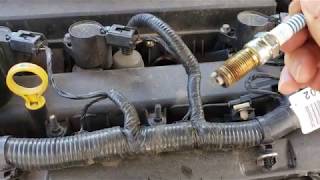
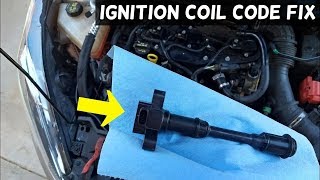
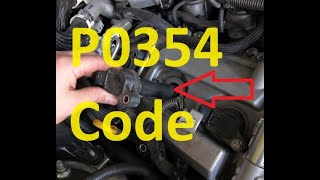
- Failed Ignition Coil on Cylinder #4 🔴 High Probability → Shop Ignition Coil Ignition coils are common wear-and-tear items that fail over time due to constant exposure to high heat and vibration in the engine bay. This is the most frequent cause for any P035x code. 🎬 Watch: How to diagnose and fix P0351-P0354 codes Some owners have noted that aftermarket coils may be less reliable than OEM Motorcraft parts.
How to confirm: Swap the ignition coil from cylinder #4 with an adjacent coil (e.g., cylinder #3). Clear the codes and run the engine. If the code changes to P0353, the coil is faulty. An inline spark tester may also show a visibly weaker or non-existent spark on the affected cylinder compared to a known good one.
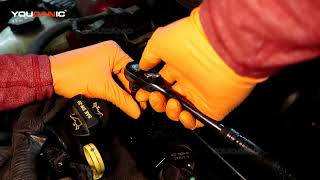
Typical fix: Replace the failed ignition coil. It is held in by a single 8mm bolt.
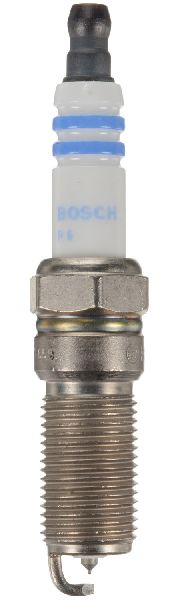
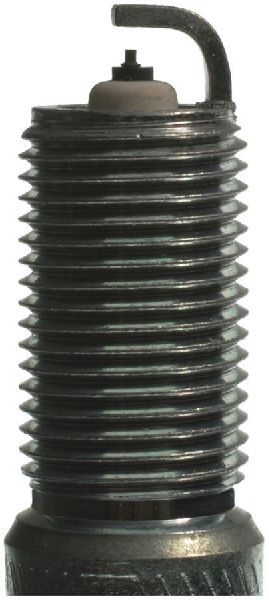
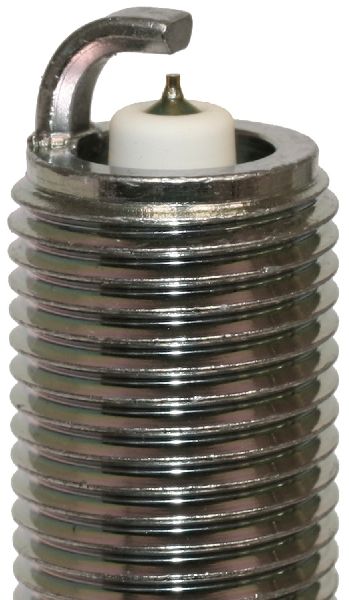
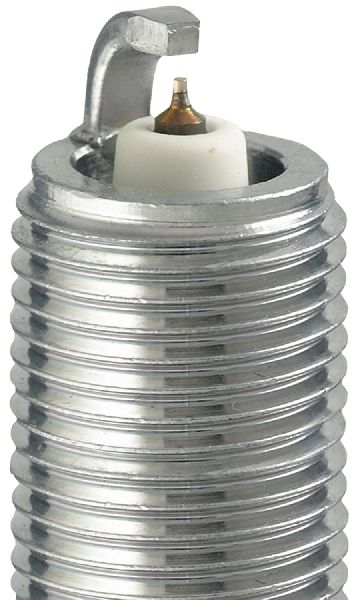
Est. part cost: $40-$80 - Worn or Fouled Spark Plug in Cylinder #4 🟡 Medium Probability → Shop Spark Plug A worn-out spark plug creates a larger gap, increasing the electrical resistance. This forces the ignition coil to work harder, which can lead to premature coil failure or be the source of the misfire itself.
How to confirm: After confirming the coil is good, remove and inspect the spark plug from cylinder #4. Look for heavy carbon buildup, oil fouling, or a worn/eroded electrode.
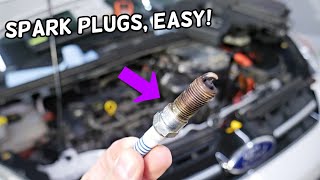
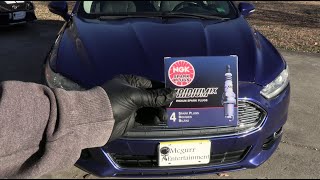
Typical fix: Replace the spark plug. It is good practice to replace all four spark plugs at the same time 🎬 See this step-by-step C-Max spark plug replacement guide if they are near the end of their service life (approx. 100,000 miles).
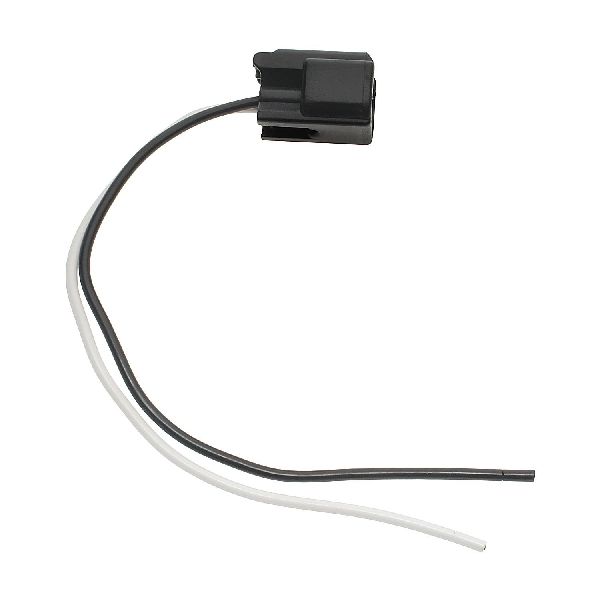
Est. part cost: $10-$20 per plug - Damaged Wiring or Connector to Coil #4 ⚪ Low Probability While less common, the wiring harness or the plastic connector at the ignition coil can become damaged from engine vibration and heat, leading to a poor connection or a break in the circuit. The pins inside the connector can also become spread or corroded, creating high resistance.
How to confirm: If the P0354 code returns after swapping coils and replacing the plug, visually inspect the wiring harness and connector for cylinder #4. Check for cracked plastic, corroded pins, or frayed wires. A 'wiggle test' on the harness while the engine is running may induce a misfire. A multimeter should be used to confirm battery voltage on one pin and a pulsing ground signal from the PCM on the other. A user on Blue Oval Forums chased persistent P035x codes for months, replacing coils, plugs, and even the PCM, before suspecting a fault in the engine harness or a main connector (C175T), demonstrating how elusive wiring faults can be.
Typical fix: Repair the damaged section of wire or replace the pigtail connector.
Est. part cost: $15-$30 for a new pigtail connector
Rare But Worth Checking
- Faulty Powertrain Control Module (PCM): → Shop Engine Control Module (ECM) This is a rare cause and should only be considered after all other possibilities (coil, plug, wiring) have been thoroughly ruled out. A failing ignition coil can short out and send a voltage spike back to the PCM, damaging the internal driver circuit for that cylinder. If this happens, the P0354 code will persist even with a new coil and good wiring. One owner replaced the PCM as part of a difficult diagnosis, but it did not solve their issue, reinforcing that this should be the last component to suspect.
Diagnosis Steps
- Read the codes with an OBD-II scanner to confirm P0354 and check for any other related codes like P0304.
- Locate cylinder #4. On the 2.0L I4 engine, the cylinders are numbered 1-2-3-4, from the passenger side (transaxle side) to the driver side (timing cover side). Cylinder #4 is on the far left when you are facing the engine.
- Swap the ignition coil from cylinder #4 with the coil from cylinder #3.
- Clear the diagnostic trouble codes using the scanner.
- Start the engine and let it run for a minute. The misfire may be immediately obvious.
- Re-scan for codes. If the code has changed to P0353 ('Ignition Coil 'C' Circuit'), the ignition coil you moved is faulty and must be replaced.
- If the P0354 code returns, the problem is not the coil. Proceed to inspect the spark plug in cylinder #4. Replace it if it appears worn, fouled, or is past its service life.
- If the plug is good, carefully inspect the wiring and connector for cylinder #4. Look for any signs of damage, corrosion, or loose pins. Perform a wiggle test on the harness.
- If no visible issues are found with the wiring, use a multimeter to check for power (battery voltage), ground, and the command signal from the PCM at the coil connector.
- If all of the above checks out, the issue may be a rare failure of the PCM driver circuit.
Parts You'll Likely Need
- Ignition Coil
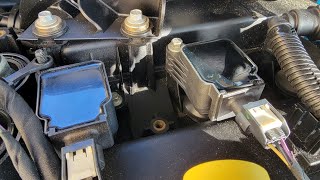
(OEM #DG549)— This is the most common failure point for a P0354 code. The coil is responsible for generating the high voltage 🎬 Watch: How to replace a faulty ignition coil for the spark plug and fails from heat and age. This part is widely used across many Ford 2.0L and 2.5L applications.
Trusted brands: Motorcraft, Delphi, NGK, Bosch
OEM price range: $50-$70
Aftermarket price range: $30-$60 - Iridium Spark Plug
(OEM #SP-530 / SP-530-X)— A worn spark plug can cause this code or be the result of a failing coil. It's recommended to replace them if they are old while servicing the ignition system.
Trusted brands: Motorcraft, NGK, Bosch
OEM price range: $12-$20
Aftermarket price range: $8-$15
Related Codes That Often Appear With This One
- P0304 — P0304 means 'Cylinder 4 Misfire Detected'. This is a direct mechanical symptom of the electrical fault described by P0354. The coil circuit fails (P0354), so the cylinder can't fire properly, resulting in a misfire (P0304).
Technical Service Bulletins (TSBs) & Recalls
- TSB 14-0024: Addresses a metal-on-metal scraping sound from the HF35 transmission in 2013-2014 C-Max and Fusion models.
- TSB 25-2081: Provides a software update procedure for various modules to correct a 12V battery drain condition.
- Recall 22S43: Pertains to the degradation of the shift cable bushing, which can lead to a rollaway risk.
- TSB Bulletin #SSM 52455: Notes that various Ford gas engines may exhibit an illuminated MIL with ignition system DTCs including P0354 set in the powertrain control module.
- TSB Bulletin #TSB 24-2406: Indicates that Ford EcoBoost engines may exhibit an illuminated MIL with ignition system DTCs P0352, P0353, P0354, and P0355 set in the PCM.
Platform-Specific Known Issues
- While not unique to the C-Max, it's important to address P035x codes promptly. A continuously failing ignition coil can send a voltage spike back to the Powertrain Control Module (PCM), potentially damaging the coil driver circuit inside the computer, which is a much more expensive repair than replacing the coil itself.
Mechanic-Grade Diagnostic Values
- Ignition Coil Primary Winding Resistance — expected: 0.4 to 2.0 Ohms. Failure: A reading significantly outside this range or an open loop (OL) reading indicates a faulty primary winding.
- Ignition Coil Secondary Winding Resistance — expected: 6,000 to 10,000 Ohms (6kΩ - 10kΩ). Failure: A reading outside this range suggests a fault in the secondary winding. Note that heat-related, intermittent failures may not be caught with a simple resistance test on a cold coil.
- Voltage at Ignition Coil Connector (Key On, Engine Off) — expected: One pin should have 12V (battery voltage), and another pin should show a good ground.. Failure: Absence of 12V power points to a fuse or power supply issue. Absence of ground points to a wiring or PCM ground circuit fault.
- PCM Driver Signal at Ignition Coil Connector (Engine Cranking/Running) — expected: A pulsing ground signal, best observed with an oscilloscope or a noid light.. Failure: A constant ground or no signal indicates a problem with the wiring or the PCM's coil driver circuit.
Scan Tool Commands That Help
- Ford IDS (Integrated Diagnostic System): Driver on Coil Ignition Test — This advanced test uses an oscilloscope with the scan tool to graphically display the PCM driver signal and the coil's primary current waveform. It is the definitive way to determine if the fault lies with the PCM driver, the wiring, or the coil itself by analyzing the waveform patterns for known-good versus faulted conditions.
- Ford IDS (or high-end generic scanner): Power Balance Test — This test allows the technician to sequentially disable one cylinder at a time to observe the corresponding drop in RPM. If disabling cylinder #4 causes little or no change in RPM, it confirms that cylinder is not contributing, which supports the P0354 diagnosis.
Wiring & Ground Locations
- G105 — Located on the left side of the engine compartment.. This is a major engine ground point. A loose or corroded connection at G105 can cause a variety of electrical issues, including intermittent faults in the ignition system that could trigger a P0354 code.
- C175b — This is a large, multi-pin connector located at the Battery Junction Box (BJB) on the left side of the engine compartment.. Power and signal wires for various engine components, including potentially the ignition coils, pass through this connector. Corrosion or a loose pin in this connector could cause an open or high-resistance fault in the coil's power supply or driver circuit.
- Ignition Coil #4 Connector — Directly on top of the ignition coil for the fourth cylinder (far left when facing the engine).. This is the final connection point. The pins for power (12V), ground, and the PCM driver signal are located here. Testing for voltage and signal at this connector is a critical diagnostic step.
Real Owner Repair Stories
- Ford Truck Enthusiasts Forums (Ford vehicle (model not specified, but diagnosis is universal)) — Engine misfire, P0354 code present.
❌ Tried (didn't work) Visual inspection of wiring harness near A/C hose showed no obvious damage.
✅ What actually fixed it The ignition coil for cylinder #4 was faulty and replacing it solved the problem.
Documented NHTSA Reports
- An owner reported in NHTSA ODI #10713413 that their vehicle started shaking violently and displayed codes P0351, P0352, and P0354, requiring a pinpoint test on all coils and the fuel system.
- According to NHTSA ODI #11429061, a vehicle shut down on the interstate and would not restart after setting codes P0351 through P0356.
- NHTSA ODI #11131030 describes an incident where a shop diagnosed P0354, P0351, P0355, and P0352, leading to ignition coil and PCM failure, which caused an inability to control the vehicle.
OEM Part Supersession History
BL3Z12029C→DG549— Standard part evolution and consolidation across multiple vehicle platforms.
Diagnostic Flowchart
Other Known Issues on This Vehicle
Issues unrelated to this code that are worth knowing about as an owner of this generation:
- HF35 eCVT Transmission Failure 🔴 High — Can occur around 70,000-130,000 miles. Symptoms include whining, grinding, or a metallic scraping noise during operation. Often requires a full transmission replacement. (Ref: TSB-14-0024 notes a 'metal on metal scraping sound' on 2013-2014 models. TSB 17-0039 also notes a thumping/rubbing noise.)
- 12V Battery Parasitic Drain 🟠 Medium — Common across all model years, especially early ones (2013-2014). Owners report a dead 12V battery after the car sits for a short period. Often linked to the SYNC/infotainment module failing to shut down properly. (Ref: Ford issued TSB 25-2081 to reprogram various modules to address this drain. Some owners on forums resort to pulling a specific fuse (e.g., fuse 79) to reset the system as a temporary fix.)
- Shift Cable Bushing Failure 🔴 High — Widespread enough to trigger a major recall. The bushing degrades, preventing the vehicle from engaging the selected gear or remaining in Park. (Ref: NHTSA Recall 22S43. Dealers will replace the under-hood shift bushing and add a protective cap.)
- Electronic Power Steering (EPAS) Failure 🔴 High — Numerous owner complaints of sudden and complete loss of power steering assist, sometimes intermittent at first. The failure often requires a costly replacement of the entire steering gear assembly. (Ref: Recall 14S18 was issued for a small batch of 2014 models for an assembly defect, but widespread failures exist outside this recall. Another action involved a software update to prevent assist loss while driving.)
Used vs. New Parts: Buying Guide for This Vehicle
When a used part is the smart pick: A used ignition coil is generally not recommended as they are a common wear item with a finite lifespan. However, if sourcing a used part, it should only be from a very low-mileage donor vehicle as a temporary fix.
Donor-vehicle mileage cap: roughly under 30000 miles for the part to have meaningful remaining life.
What to inspect on the donor part:
- Check for any cracks, discoloration, or signs of oil contamination on the coil housing and boot.
- Ensure the electrical connector pins are clean and free of corrosion.
- Ask for the donor vehicle's VIN to verify mileage if possible.
OEM-only on this vehicle (don't cheap out):
- Ignition Coil
Aftermarket brands forum-validated for this vehicle:
- NGK
- Bosch
- Delphi
Brands owners have reported issues with on this vehicle:
- Unbranded, no-name coils from online marketplaces are frequently reported to fail prematurely or be out-of-spec from the start. Some forum users and mechanics strongly advise against performance brands like MSD or Accel for daily drivers, citing reliability issues compared to OEM.
Real Owner Stories
Aggregated from forums and TSBs cited above. Mileages and costs reflect what owners reported in those sources.
2018 Ford C-Max Hybrid 2.0L
Symptoms: Persistent P035x codes that could not be resolved by standard part replacement.
What fixed it: The owner suspected a fault in the engine harness or a main connector (C175T) after replacing coils, plugs, injectors, and the PCM failed to solve the issue.
Source hint: Blue Oval Forums - '2018 Ford C-Max Hybrid 2.0L gas, can't seem to resolve P035XX codes'
2013 Ford C-Max Hybrid — 130000 miles
Symptoms: Horrible whining noise from the transmission.
What fixed it: Full transmission replacement.
Cost: $7,200-$7,200
Source hint: CleanMPG Forums - '2013 C-Max Transmission Failure'
Related OBD-II Codes
Frequently Asked Questions
Where is cylinder #4 located on the 2013-2018 Ford C-Max 2.0L engine?
Should I use aftermarket ignition coils to fix P0354 in my C-Max?
Does TSB 25-2081 relate to my P0354 ignition code?
Can I just replace the spark plug to fix P0354?
Is there a risk to my C-Max's computer if I ignore the P0354 code?
When should I replace the spark plugs on my C-Max Hybrid to prevent coil stress?
Helpful Videos
Used OEM Parts in Stock
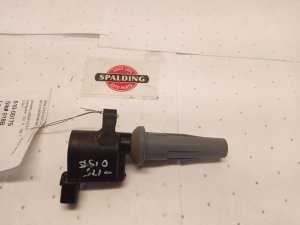
New Aftermarket Parts Available


The information in this article is provided for general reference and educational purposes only. Vehicle specifications, procedures, and part compatibility can vary by production date, trim level, and region. Always consult your vehicle's factory service manual and verify part numbers before purchasing or performing repairs. Safety-critical components such as airbags, seat belts, and braking systems should be installed by a qualified professional.
- Ford C-Max:
- 🧭 Diagnostic Flowchart
- 🎬 Helpful Videos
- 🛍️ Shop This Part
- What's Unique About the 2013-2018 Ford C-Max
- Symptoms You May Notice
- Most Likely Causes
- Rare But Worth Checking
- Diagnosis Steps
- Parts You'll Likely Need
- Related Codes That Often Appear With This One
- Technical Service Bulletins (TSBs) & Recalls
- Platform-Specific Known Issues
- Mechanic-Grade Diagnostic Values
- Scan Tool Commands That Help
- Wiring & Ground Locations
- Real Owner Repair Stories
- Documented NHTSA Reports
- OEM Part Supersession History
- Other Known Issues on This Vehicle
- Used vs. New Parts: Buying Guide for This Vehicle
- Real Owner Stories
- 2018 Ford C-Max Hybrid 2.0L
- 2013 Ford C-Max Hybrid — 130000 miles
- Related OBD-II Codes
- Frequently Asked Questions
- 🎟️ Get 5% Off