

P0355 on 2007-2008 Ford Edge 3.5L: Ignition Coil 'E' Circuit Fault Causes and Fixes
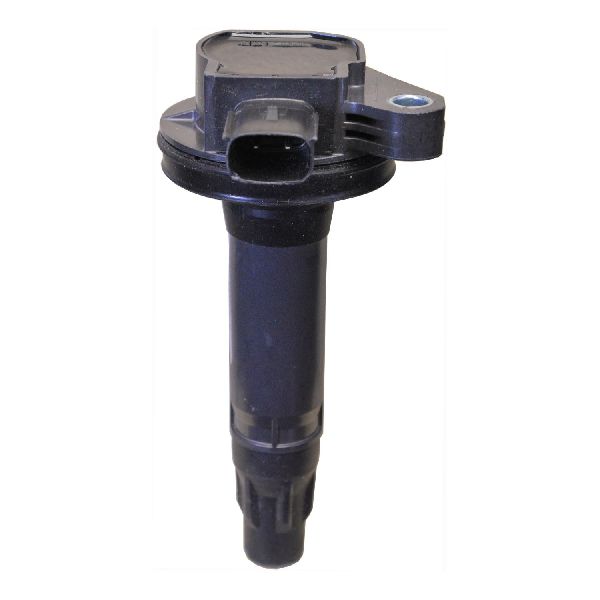
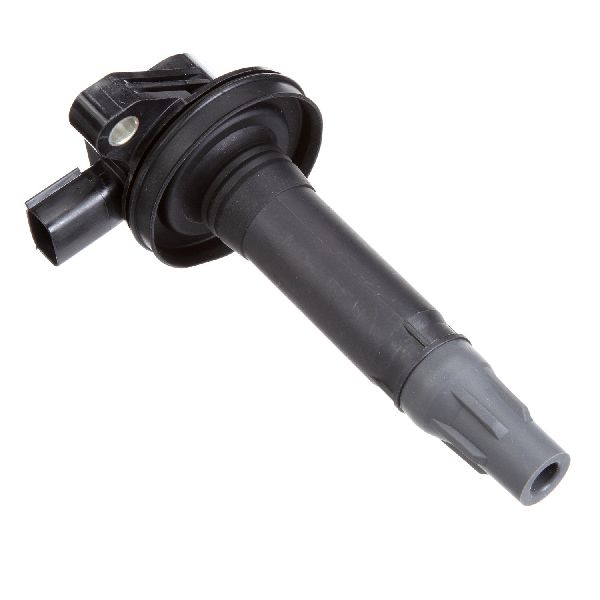
P0355 indicates an electrical fault with the ignition coil for cylinder #5. On this Ford Edge, cylinder 5 is on the easily accessible front bank of the engine. The most common fix is replacing the bad ignition coil (Motorcraft DG521), a simple DIY task costing around $40-$70. If a new coil doesn't work and the code returns immediately, the PCM is very likely damaged, a well-documented issue for this platform. This requires a more complex repair or replacement of the PCM.
- P0355 means there is an electrical fault with the ignition coil on cylinder #5.
- On the 2007-2008 Edge, cylinder #5 is the middle cylinder on the front bank (near the radiator), making it easy to access.
- The most effective first step is to swap the cylinder 5 coil with a neighbor (like cylinder 4) to see if the code follows. If it does, the coil is bad.
- If a new coil does not fix the P0355 code, the Powertrain Control Module (PCM) is likely damaged and needs repair or replacement, a known issue with these vehicles.
- Do not drive if the Check Engine Light is flashing, as this can quickly ruin your expensive catalytic converters.
What's Unique About the 2007-2008 Ford Edge
On the 2007-2008 Ford Edge, the 3.5L V6 is mounted transversely, which places cylinder #5 on the front bank of cylinders near the radiator. This makes it surprisingly easy to access for diagnosis and replacement, unlike the rear cylinders which require removing the intake manifold. However, this platform is also known for a specific and notorious failure pattern where a shorted ignition coil can back-feed voltage and destroy the corresponding driver circuit inside the main engine computer (PCM). This turns a simple coil replacement into a much more complex and expensive repair. Ford has issued Technical Service Bulletins (TSBs) like 13-4-17 and 14-0059 acknowledging this issue across several vehicles that share this engine. Similar ignition system DTCs, including P0355, have been noted in other Ford platforms as well, such as in Bulletin #SSM 52455 and Bulletin #TSB 24-2406, which address ignition circuit faults across various gas engine configurations.
Symptoms You May Notice
- Check Engine Light is on
- Flashing Check Engine Light under load
- Engine shuddering or running rough, especially at idle
- Noticeable loss of power and poor acceleration
- Engine hesitates or stumbles
- Vehicle stalls unexpectedly
- Replacing the spark plug for cylinder 5 without testing the ignition coil. A P0355 is an electrical circuit code, which points more directly to the coil or wiring, not the plug itself.
- Replacing other ignition or fuel system parts before performing the simple coil-swap diagnostic test.
- Replacing the PCM without first replacing the faulty ignition coil and all spark plugs. A bad coil will destroy the new PCM again.
Most Likely Causes
- Failed Ignition Coil (Cylinder 5) 🔴 High Probability → Shop Ignition Coil Coil-on-plug systems are common failure points due to constant exposure to high heat and vibration. While not uniquely prone, it's the most frequent cause for this specific code.
How to confirm: Swap the ignition coil from cylinder 5 with an adjacent one (e.g., cylinder 4 or 6). Clear the codes. If the fault code changes to P0354 or P0356, the coil is bad. This is the most definitive and simple test.
Typical fix: Replace the faulty ignition coil. It is often recommended to replace all coils and spark plugs if they are old, to prevent a cascading failure where another old coil fails and damages the PCM.
Est. part cost: $40-$70 - Damaged Connector or Wiring 🟡 Medium Probability The plastic connector and its locking tab can become brittle from engine heat and break, leading to a poor connection at the coil. Wires can also chafe against the engine or other components, or corrode over time. In some Ford models, wiring issues can be persistent; NHTSA ODI #11130559 describes a case where a P0355 code was temporarily fixed by installing new wires, only for the code to return two weeks later.
How to confirm: Visually inspect the ignition coil connector for cylinder 5. Check for cracks, corrosion, backed-out pins, or a broken locking tab. Wiggle the connector with the engine running to see if it affects the misfire. Use a multimeter to check for 12V power at the connector with the key on.
Typical fix: Repair the wiring or replace the connector pigtail. A common pigtail part number is Dorman 645-155.
Est. part cost: $15-$30 - Failed Powertrain Control Module (PCM) ⚪ Low Probability → Shop Engine Control Module (ECM) A significant and well-documented weakness on this platform is that a shorted ignition coil can damage the internal PCM driver circuit for that cylinder. Ford TSBs (e.g., 13-4-17) address this exact failure mode. NHTSA ODI #11131030 reports a similar failure where a shop diagnosed multiple ignition coil codes and a PCM failure, leaving the driver struggling to control the vehicle.
How to confirm: This is diagnosed by exclusion. If a new, known-good ignition coil is installed on cylinder 5 and the P0355 code immediately returns (without being able to be cleared), the PCM driver is the most likely cause. Advanced diagnostics involve using a noid light to check for a pulse signal from the PCM to the coil connector.
Typical fix: The PCM must be repaired by a specialist service or replaced and programmed by a dealer or qualified shop. Sending the original PCM for repair is often preferred as it avoids the need for key reprogramming.
Est. part cost: $200-$800
Rare But Worth Checking
- Worn or Defective Spark Plug: → Shop Spark Plug While a bad spark plug typically causes a misfire code (P0305), a plug with an extremely wide gap or internal fault can overwork and eventually damage the ignition coil, leading to the P0355 circuit code. TSBs often recommend replacing plugs and coils together.
Diagnosis Steps
- Retrieve the stored trouble codes with an OBD-II scanner. Confirm P0355 is present, and note any other codes like P0305.
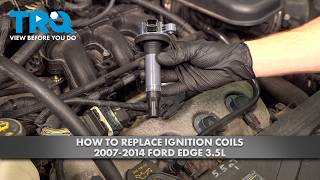
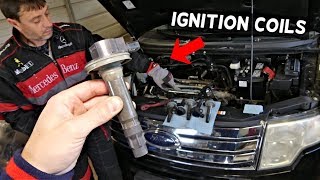
- Locate cylinder 5. On the 3.5L V6 Edge, the engine is transverse. The cylinders against the firewall are 1-2-3 (passenger to driver side). The cylinders near the radiator are 4-5-6 (passenger to driver side). Cylinder 5 is the middle one on the front, between 4 and 6. 🎬 Watch: Step-by-step guide to replacing your ignition coils
- Disconnect the electrical connector from the cylinder 5 ignition coil. Inspect the connector and coil for any signs of damage, corrosion, moisture, or melting.
- Perform a 'swap test'. Remove the 8mm bolt holding the cylinder 5 coil. Remove the coil. Swap it with the coil from cylinder 4 (to the right) or cylinder 6 (to the left).
- Reconnect the connectors and secure the bolts. Clear the trouble codes with the scanner.
- Start the engine and let it run for a minute. Re-scan for codes.
- If the code has changed to P0354 or P0356, the ignition coil you moved is faulty and must be replaced.
- If the code P0355 returns immediately, the problem is not the coil. The issue is in the wiring to cylinder 5's coil or, most likely, the PCM driver circuit for that coil has failed.
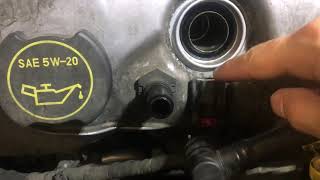
- (Advanced) Use a multimeter to check for 12-volt power at the coil connector with the key on. Use a noid light or oscilloscope to check for a trigger signal from the PCM while cranking the engine. 🎬 See how to test for a faulty PCM or broken wire Absence of a signal points to a wiring or PCM issue.
- If the PCM is suspected, it is highly recommended to replace ALL six ignition coils and spark plugs along with repairing or replacing the PCM to prevent a repeat failure. The PCM must be sent to a specialist for testing and repair or replaced by a professional.
Parts You'll Likely Need
- Ignition Coil
(OEM #7T4Z-12029-E (Motorcraft DG521))— This is the most common component to fail and cause a P0355 code. The Motorcraft DG521 is the OEM part.
Trusted brands: Motorcraft, NGK, Denso, Delphi
OEM price range: $60-$90
Aftermarket price range: $35-$60 - Powertrain Control Module (PCM) Repair Service — Required if the original coil failure damaged the PCM's internal driver circuit, a known issue on this vehicle. Repair services are a cost-effective alternative to a new PCM from the dealer.
Trusted brands: Circuit Board Medics, FS1 (Flagship One), SIA Electronics
OEM price range: $800-$1200 (for replacement)
Aftermarket price range: $150-$300 (for repair service) - Ignition Coil Connector Pigtail
(OEM #Dorman 645-155 or Motorcraft WPT-1284)— Needed if the connector housing is cracked, the locking tab is broken, or the terminals are corroded, preventing a secure connection.
Trusted brands: Dorman, Motorcraft
OEM price range: $25-$40
Aftermarket price range: $10-$20
Related Codes That Often Appear With This One
- P0305 — P0305 means 'Cylinder 5 Misfire Detected.' Since P0355 indicates an electrical fault that prevents the coil from firing, a misfire on that cylinder is the direct result. A P0355 will almost always be accompanied by a P0305.
- P0316 — This code means 'Misfire Detected on Startup (First 1000 Revolutions).' It often appears with a specific cylinder misfire code when the component has failed completely.
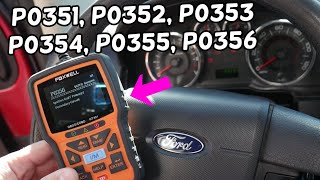
- P0351, P0352, P0353, P0354, P0356 — If multiple P035x codes appear simultaneously, it can point to a widespread issue like a faulty ground, wiring harness problem, or a more severe PCM failure as described in TSB 05-11-1. NHTSA ODI #11429061 describes a situation where a vehicle threw codes P0351 through P0356 and shut down on the interstate, failing to restart due to a PCM MOSFET failure.
Technical Service Bulletins (TSBs) & Recalls
- TSB 13-4-17 (supersedes 12-8-17): Directly addresses P035x codes on 2007-2008 Edge (and other models) with the 3.5L engine. The procedure involves inspecting coils for damage and, if found, replacing the PCM, all six coils, and all six spark plugs.
- TSB 14-0059: A later revision of the same TSB, confirming the issue and repair procedure.
- TSB 05-11-1: An earlier TSB for a similar issue on 3.0L engines, noting that RF interference from incorrect spark plugs could damage the PCM and coils, establishing a history of this failure pattern.
- Bulletin #SSM 52455: Notes that various Ford vehicles may exhibit an illuminated MIL with ignition system DTCs including P0355 set in the powertrain control module.
- Bulletin #TSB 24-2406: Confirms that several Ford models equipped with EcoBoost engines may exhibit an illuminated MIL with ignition system DTCs such as P0355.
Platform-Specific Known Issues
- A significant known issue on 2007-2010 Ford Edge models is that a short-circuiting ignition coil can back-feed voltage and destroy the corresponding driver circuit in the Powertrain Control Module (PCM). If replacing the coil does not resolve the P0355 code, the PCM itself has likely failed and will require repair or replacement. Ford acknowledged this in TSBs like 13-4-17 and 14-0059.
Mechanic-Grade Diagnostic Values
- Ignition Coil Primary Winding Resistance — expected: 0.4 to 2.0 ohms. Failure: A reading of infinity (OL) indicates an open circuit. A reading of zero indicates a short. Any reading far outside the expected range suggests a faulty coil.
- Ignition Coil Secondary Winding Resistance — expected: 6,000 to 10,000 ohms (6kΩ to 10kΩ). Failure: A reading of infinity (OL) indicates an open secondary winding. Readings significantly outside this range point to a failing coil.
- Ignition Coil Connector Power Supply — expected: Battery Voltage (approx. 12.6V with key on, engine off). Failure: Zero or very low voltage indicates a problem with the power supply wire, fuse, or relay for the ignition coils.
- Spark Plug Gap — expected: 0.051 to 0.057 inches, with 0.054 inches being the ideal target (1.35mm).. Failure: An incorrect gap can cause poor spark, leading to misfires and potentially overworking the ignition coil.
Scan Tool Commands That Help
- Ford IDS (Integrated Diagnostic System) or equivalent high-end scanner: Power Balance Test — This function graphically displays the power contribution of each cylinder in real-time. For a P0355, the graph will show a significant drop or zero contribution from cylinder #5, confirming the misfire location even if the engine is only running slightly rough. It's a definitive way to see the effect of the circuit fault.
- Ford IDS or capable professional scan tool: PATS (Passive Anti-Theft System) Parameter Reset / Immobilizer Relearn — This is a mandatory procedure after replacing the PCM. The new or repaired PCM must be programmed to recognize the vehicle's existing keys. Failure to do this will result in a no-start condition with immobilizer fault codes.
Wiring & Ground Locations
- Ignition Coil Connector (Cylinder 5) — On top of the valve cover, connected to the cylinder 5 ignition coil (middle cylinder on the front bank, near the radiator).. This is the primary point for testing. It has two pins: one is a 12V+ power feed (often a shared color across all coils) and the other is the control (trigger) wire from the PCM, which is pulsed to ground to fire the coil.
- PCM Connector C175e — This is the center of the three large connectors on the PCM, which is located under the cowl panel on the driver's side of the engine bay.. This connector contains the control wire for the cylinder 5 ignition coil. Advanced diagnosis involves checking for continuity of the control wire from the pin at this connector to the pin at the coil connector to rule out a broken wire.
- Main Chassis Grounds — There are several key grounds in the engine bay. Two easily accessible grounds are located on the frame rails behind the front bumper cover, one on each side.. While a bad ground here is less likely to cause a single coil code (it would likely cause multiple issues), a poor engine-to-chassis ground can create electrical noise and voltage problems that can affect sensitive components like the PCM and ignition system.
Real Owner Repair Stories
- Ford Edge Forum user 'onyxbfly' (2010 Ford Edge Limited AWD, 156,000 miles) — P0355 (Ignition Coil 'E' primary/secondary malfunction), rough idle.
❌ Tried (didn't work) Replaced only the ignition coil on cylinder 5. The code returned after 1,200 miles., Replaced the spark plug and the ignition coil on cylinder 5 again. The code and symptoms persisted.
✅ What actually fixed it The user concluded the PCM was faulty, which is the common next step in this failure pattern. They ordered a replacement PCM and were preparing to have it programmed to the vehicle, which is the correct final repair for a confirmed bad PCM driver. - Ford Truck Enthusiasts Forum user 'pdqford' (2001 Ford Expedition 5.4L (different vehicle, but same diagnostic principle)) — P0355 code appears, and the PCM shuts off the fuel injector to cylinder 5 after 10 seconds of running.
❌ Tried (didn't work) Swapping coils, plugs, and injectors to other cylinders; the problem remained on cylinder #5.
✅ What actually fixed it The expert advice given was to diagnose a bad PCM driver by checking the continuity of the control wire (light-green w/yellow stripe on that model) from the PCM connector (pin #27) to the coil connector. This isolates the fault to either the wiring or the PCM itself, which is the correct advanced diagnostic step after a coil swap fails. - NHTSA ODI #11130559 — An owner reported that their vehicle started to shake and developed a "death rattle" accompanied by code P0355. While new wires initially fixed the issue, the code returned after two weeks.
OEM Part Supersession History
8L3Z-12029-A→7T4Z-12029-E (Motorcraft DG521)— Part number consolidation and potential design updates over time.
Heads up: The DG521 is the correct service part for this application. Using other coils, like the DG-508 which is for a different 4.6L engine, will not work.
Model Year Variations Within This Range
- 2007-2008: No significant variations in the ignition system, PCM, or wiring related to a P0355 fault have been documented between the 2007 and 2008 model years. The diagnostic and repair procedures are identical.
Diagnostic Flowchart
Other Known Issues on This Vehicle
Issues unrelated to this code that are worth knowing about as an owner of this generation:
- Internal Water Pump Failure 🔴 High — A widely documented design flaw. Failure can occur without warning, often between 80,000 and 150,000 miles. When it fails, it leaks coolant directly into the engine oil, leading to catastrophic engine damage if not caught immediately.
- Brake Booster Failure 🟠 Medium — Common issue where the booster diaphragm tears, causing a hissing noise when the brake pedal is pressed and increased pedal effort. Ford issued Customer Satisfaction Program 13N02, extending the warranty for this part to 10 years/150,000 miles. (Ref: Customer Satisfaction Program 13N02)
- Transmission Speed Sensor Failure 🟠 Medium — The Turbine Speed Sensor (TSS) and Output Shaft Speed (OSS) sensors inside the transmission can fail, causing abrupt downshifts, loss of power, and inaccurate speedometer readings. Ford issued TSB 07-21-11 for this issue. (Ref: TSB 07-21-11)
- Corroding Fuel Tank 🔴 High — In salt-belt states, the fuel tank mounting brackets can corrode, potentially causing a fuel leak. This led to a safety recall. (Ref: NHTSA Recall 14V-526)
- Faulty Airbag Inflators 🔴 High — Part of the massive Takata airbag recall. The inflators could rupture, sending metal fragments into the cabin. (Ref: Multiple Recalls (e.g., 21V158000))
Used vs. New Parts: Buying Guide for This Vehicle
When a used part is the smart pick: A used Powertrain Control Module (PCM) can be a cost-effective option if purchased from a reputable rebuilder who tests the unit and offers a warranty. A junkyard PCM is a gamble, as it may have the same internal fault or other issues. Used ignition coils are not recommended.
Donor-vehicle mileage cap: roughly under 80000 miles for the part to have meaningful remaining life.
What to inspect on the donor part:
- For a used PCM, ensure the seller guarantees it has been tested, specifically for ignition driver function.
- Check the part number on the donor PCM to ensure it is an exact match or a known compatible replacement for your vehicle.
- Avoid any electronic parts from vehicles with signs of flood or fire damage.
OEM-only on this vehicle (don't cheap out):
- Powertrain Control Module (PCM): While repair services are a good alternative, if replacing the entire unit, a new or remanufactured OEM unit is the safest bet to avoid compatibility issues. Aftermarket 'cloned' PCMs can be problematic.
Aftermarket brands forum-validated for this vehicle:
- Ignition Coils: Motorcraft (OEM) is strongly recommended. Owners and mechanics generally have good results with reputable brands like NGK, Denso, and Delphi.
Brands owners have reported issues with on this vehicle:
- Unbranded, low-cost ignition coil sets sold on platforms like eBay or Amazon. These have a high failure rate and can cause repeat damage to the PCM, turning a cheap fix into a very expensive one.
Real Owner Stories
Aggregated from forums and TSBs cited above. Mileages and costs reflect what owners reported in those sources.
2007-2010 Ford Edge
Symptoms: A bad coil went backwards and killed the PCM/ECM.
What fixed it: The owner detailed a fix involving addressing the bad coil that destroyed the PCM driver circuit.
Source hint: FordEdgeForum.com - 'Bad Coil Went Backwards and Killed PCM/ECM FIX'
NHTSA Documented Reports
NHTSA ODI #11131030: An owner reported a sudden failure where the vehicle became difficult to control and had to be towed. The shop diagnosed failures in the PCM and multiple ignition coils, including P0355.
NHTSA ODI #11429061: A driver experienced a complete vehicle shutdown on the interstate due to a PCM MOSFET failure, with the diagnostic tool showing a sweep of ignition codes from P0351 through P0356.
Related OBD-II Codes
Frequently Asked Questions
Does TSB 13-4-17 apply to my 2007 Ford Edge with the 3.5L engine?
Where is cylinder 5 located on my 2008 Ford Edge 3.5L V6?
If I replace the cylinder 5 coil and P0355 returns immediately, what is the likely problem?
Is there a specific replacement part for a damaged coil connector on the Edge?
Why does Ford recommend replacing all six coils and plugs if only one failed?
Are there any other major issues I should watch for on my 2007-2008 Edge besides the P0355 code?
Helpful Videos
Used OEM Parts in Stock
New Aftermarket Parts Available


The information in this article is provided for general reference and educational purposes only. Vehicle specifications, procedures, and part compatibility can vary by production date, trim level, and region. Always consult your vehicle's factory service manual and verify part numbers before purchasing or performing repairs. Safety-critical components such as airbags, seat belts, and braking systems should be installed by a qualified professional.
- Ford Edge:
- 🧭 Diagnostic Flowchart
- 🎬 Helpful Videos
- 🛍️ Shop This Part
- What's Unique About the 2007-2008 Ford Edge
- Symptoms You May Notice
- Most Likely Causes
- Rare But Worth Checking
- Diagnosis Steps
- Parts You'll Likely Need
- Related Codes That Often Appear With This One
- Technical Service Bulletins (TSBs) & Recalls
- Platform-Specific Known Issues
- Mechanic-Grade Diagnostic Values
- Scan Tool Commands That Help
- Wiring & Ground Locations
- Real Owner Repair Stories
- OEM Part Supersession History
- Model Year Variations Within This Range
- Other Known Issues on This Vehicle
- Used vs. New Parts: Buying Guide for This Vehicle
- Real Owner Stories
- 2007-2010 Ford Edge
- NHTSA Documented Reports
- Related OBD-II Codes
- Frequently Asked Questions
- 🎟️ Get 5% Off