

P0356 on 2008-2009 Ford Taurus X: Ignition Coil 'F' Circuit Causes and Fixes
P0356 on a Ford Taurus X most often means the ignition coil on cylinder #6 has failed. On 2008 models built on or before March 1, 2008, this is frequently caused by a faulty engine computer (PCM), which requires replacing the PCM, all six coils, and all six spark plugs together. A single coil costs about $40-$80.
- P0356 points to an electrical fault in the ignition coil circuit for cylinder #6.
- The most common fix is replacing the ignition coil on cylinder #6, which is located on the front (radiator side) of the engine, on the driver's side.
- For 2008 models, be aware of TSB 13-4-17. A faulty PCM can destroy coils. If a coil is physically burnt or cracked, the PCM is the likely culprit and must be replaced along with all coils and plugs.
- A flashing check engine light is serious. Pull over safely to prevent expensive damage to your catalytic converter.
- When replacing one coil, it's wise to replace all six, along with the spark plugs, to prevent future failures, especially since accessing the rear three coils requires significant labor.
What's Unique About the 2008-2009 Ford Taurus X
For the 2008 Taurus X specifically, this code is often more than just a bad coil. Ford issued a Technical Service Bulletin (TSB 13-4-17) for a known issue where the original PCM can fail and electrically destroy the ignition coils. This TSB applies to 2008 models built on or before March 1, 2008. A failing coil can short-circuit, sending a voltage spike back to the PCM and destroying the internal driver circuit for that coil. Conversely, a failing PCM driver can get stuck 'on', sending continuous voltage to the coil and melting it. Simply replacing the single failed coil will likely result in the new coil being quickly destroyed by the faulty PCM.
Symptoms You May Notice
- Engine shaking, stumbling, or running rough, especially at idle
- Noticeable loss of power during acceleration
- Solid or flashing Check Engine Light
- Decreased fuel economy
- Engine hesitation
- Replacing only the single failed ignition coil on a 2008 model without checking for PCM failure. The new coil will be destroyed by the faulty PCM, leading to a repeat failure.
Most Likely Causes
- Failed Ignition Coil on Cylinder #6 🔴 High Probability → Shop Ignition Coil Ignition coils are a common wear item. On this platform, an original factory coil can also short out and damage the PCM, or be damaged by a pre-existing PCM fault.
How to confirm: Swap the ignition coil from cylinder #6 with an adjacent one (like cylinder #5). Clear the codes. If the code changes to P0355, the coil is bad. Cylinder #6 is on the front bank (near the radiator), on the driver's side.
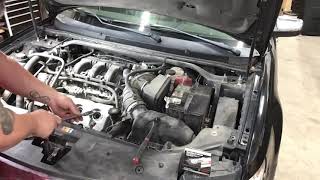
Typical fix: Replace the faulty ignition coil. It is highly recommended to replace all six coils and spark plugs at the same time 🎬 Watch this step-by-step Taurus X tune-up video, especially if they are original or if a PCM failure is suspected.
Est. part cost: $40 - $80 for one coil - Failed Powertrain Control Module (PCM) 🟡 Medium Probability → Shop Engine Control Module (ECM) A known defect covered by TSB 13-4-17 affects 2008 models built on or before March 1, 2008. The PCM's internal coil driver circuit fails, sending continuous voltage that burns out the coil, or a failing coil can short and destroy the PCM driver.
How to confirm: This is the likely cause on affected 2008 models if the ignition coil is physically damaged (cracked, melted, or has burn marks). Multiple P035x codes (e.g., P0351, P0356) are also a strong indicator of PCM failure. Confirmation involves sending the PCM to a specialist for testing.
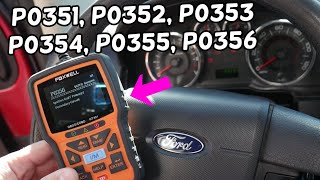
Typical fix: Replace the PCM, all six ignition coils, and all six spark plugs at the same time. Failure to replace all components will lead to repeat coil failure. Using a repair service for the original PCM is a common option that avoids dealer programming. 🎬 See how to fix these Ford ignition codes
Est. part cost: $250 - $700 for a repaired or new PCM, plus the cost of coils and plugs - Worn or Fouled Spark Plug ⚪ Low Probability → Shop Spark Plug
How to confirm: After removing the ignition coil, remove the spark plug from cylinder #6 and inspect it for wear, carbon buildup, or oil fouling. A worn plug with a large gap increases the electrical load on the coil, which can contribute to its failure.
Typical fix: Replace the spark plug. It is best practice to replace all six spark plugs as a set, especially when replacing coils.
Est. part cost: $8 - $20 per plug for OEM-spec Iridium plugs - Damaged Wiring or Connector ⚪ Low Probability
How to confirm: Visually inspect the wiring harness and electrical connector going to the ignition coil on cylinder #6. Look for broken wires, corrosion on the pins, or a broken locking tab on the connector. Use a multimeter to check for continuity and proper voltage at the connector. As noted in TSB Bulletin #TSB18-2047 for other Ford platforms, an open circuit in the coil-on-plug connectors for cylinders 5 and/or 6 can sometimes be caused by interference with engine components like the intake air expansion resonator.
Typical fix: Repair the damaged section of wire or replace the pigtail connector.
Est. part cost: $15 - $30 for a new connector pigtail
Diagnosis Steps
- Read the trouble codes with an OBD-II scanner to confirm P0356 is present.
- Identify cylinder #6. On the Taurus X 3.5L V6, the cylinders near the radiator are 4-5-6, from passenger to driver side. Cylinder #6 is on the front bank, closest to the driver.
- CRITICAL STEP FOR 2008 MODELS: Check the vehicle build date. If it was on or before March 1, 2008, be highly suspicious of PCM failure per TSB 13-4-17.
- Remove the ignition coil from cylinder #6. Carefully inspect the coil and its boot for cracks, burn marks, melting, or white residue, which are signs of overheating often caused by a faulty PCM.
- If no physical damage is seen on the coil, swap it with the coil from cylinder #5. Clear the codes.
- Start the engine and let it run for a minute. Re-scan for codes.
- If code P0355 appears, the ignition coil you moved is faulty and needs to be replaced.
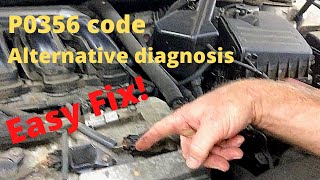
- If code P0356 returns, the problem is not the coil. Proceed to inspect the wiring and spark plug. 🎬 Watch this quick guide on checking code P0356
- Inspect the electrical connector and wiring going to the cylinder #6 coil for any signs of damage, corrosion, or loose pins.
- If the wiring appears good, remove the spark plug from cylinder #6 and inspect its condition. Replace if it is worn, fouled, or damaged.
- If physical damage to the coil was found in step 4, or if multiple P035x codes are present, the PCM is the most likely root cause. The official Ford procedure is to replace the PCM, all six ignition coils, and all six spark plugs.
Parts You'll Likely Need
- Ignition Coil
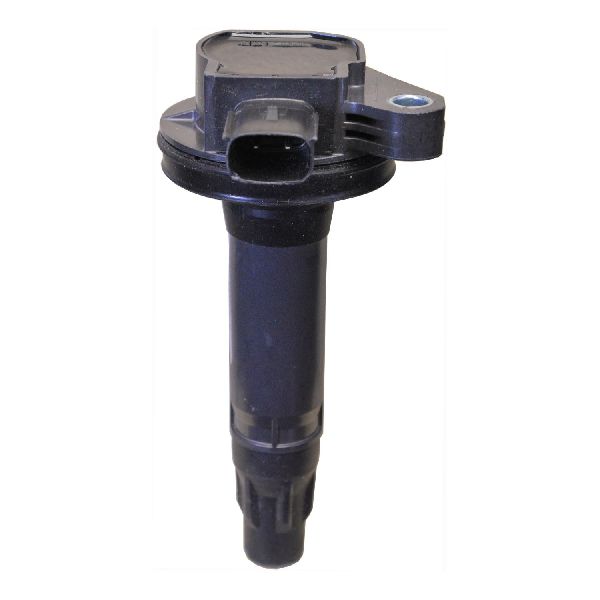
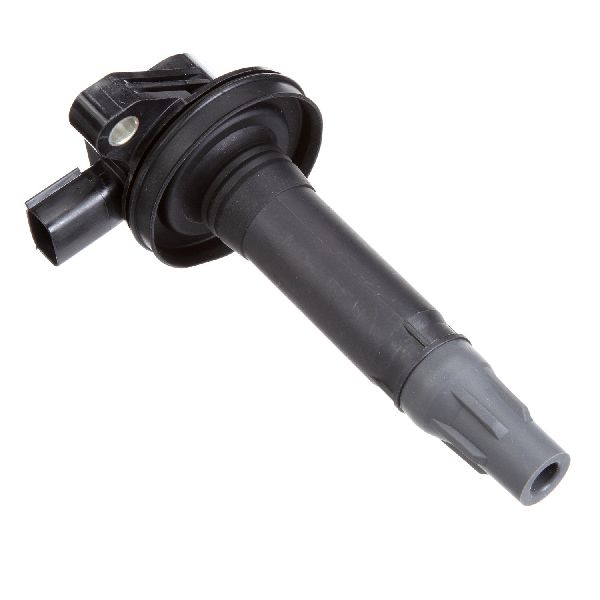
(OEM #DG520 (Motorcraft))— This is the most common component to fail for this code.
Trusted brands: Motorcraft, Denso
OEM price range: $60-$90
Aftermarket price range: $40-$70 - Powertrain Control Module (PCM) Repair Service or Replacement
(OEM #8L8Z-12A650-BGA (example, requires catalog lookup by VIN))— A known defect on 2008 models causes the PCM to destroy ignition coils. If this is the root cause, the PCM must be repaired or replaced.
Trusted brands: Circuit Board Medics (Repair Service), FS1 (Remanufactured)
OEM price range: $500-$700+
Aftermarket price range: $250-$400 for a repair service - Spark Plugs
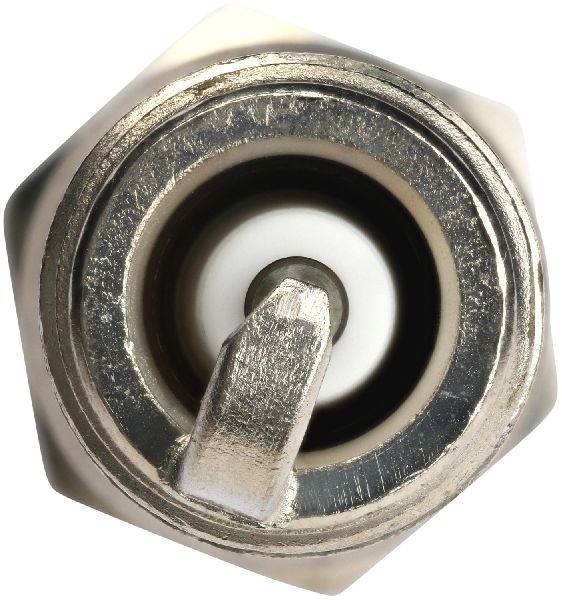
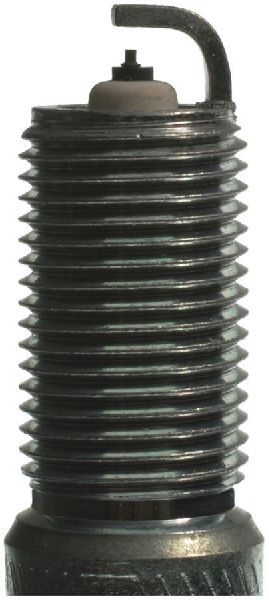
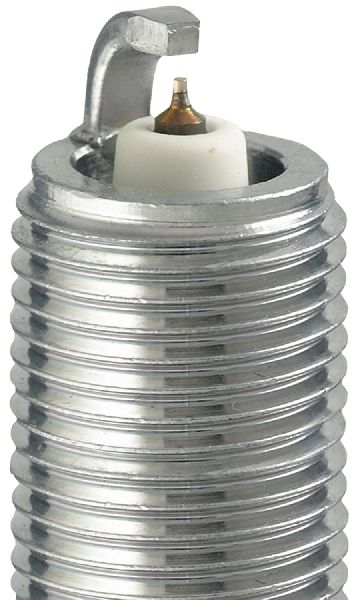
(OEM #SP-537 (Motorcraft, Finewire Iridium))— Should always be replaced when replacing ignition coils, especially if the PCM is being replaced.
Trusted brands: Motorcraft, NGK, Bosch
OEM price range: $8-$20 per plug
Aftermarket price range: $5-$15 per plug
Related Codes That Often Appear With This One
- P0306 — P0306 means 'Cylinder 6 Misfire Detected.' P0356 indicates the electrical cause (the coil circuit), while P0306 reports the mechanical effect (the misfire).
- P0351, P0352, P0353, P0354, P0355 — If multiple P035x codes are present, it is a very strong indicator that the PCM has failed and is damaging multiple coil circuits, a known issue on 2008 and similar models. NHTSA ODI #11429061 describes a situation where a vehicle threw codes P0351 through P0356 and shut down on the interstate, likely due to PCM failure.
Technical Service Bulletins (TSBs) & Recalls
- TSB 13-4-17: MIL ON WITH DTCS - P0351, P0352, P0353, P0354, P0355, AND/OR P0356-BUILT ON OR BEFORE 3/1/2008.
- TSB 12-8-17: An earlier version of the same TSB, later superseded by 13-4-17.
- TSB Bulletin #TSB18-2047: While for different Ford models, this bulletin notes that DTC P0355 and/or P0356 can be caused by open circuits in the coil-on-plug connectors due to mechanical interference.
Platform-Specific Known Issues
- TSB 13-4-17: Pertains to 2008 Taurus X models built on or before March 1, 2008. A faulty PCM can cause catastrophic failure of one or more ignition coils. The official fix requires replacing the PCM, all six coils, and all six spark plugs.
- Radio Frequency Interference: NHTSA ODI #10444492 notes that two or more DTCs for coil primary circuit faults (P0351-P0356) may be due to the coils and PCM reacting to radio frequency interference from the spark plugs.
Mechanic-Grade Diagnostic Values
- Ignition Coil Primary Resistance — expected: 0.3 to 2.0 Ohms. Failure: A reading of OL (infinity) indicates an open circuit; a reading near zero indicates a short.
- Ignition Coil Secondary Resistance — expected: 5,500 to 11,500 Ohms (5.5kΩ - 11.5kΩ). Failure: A reading significantly outside this range or OL (infinity) indicates a failure in the secondary windings.
- Voltage at Coil Connector Power Wire (Key On, Engine Off) — expected: ~12.6 Volts (Battery Voltage). Failure: Low or no voltage points to a problem with the power supply circuit, fuse, or wiring harness.
- Coil Control Signal (Engine Cranking/Running) — expected: A pulsing ground signal.. Failure: A constant ground or no signal (flat line) indicates a break in the signal wire or a failed PCM driver. This is best tested with a noid light or an oscilloscope.
- Continuity on Signal Wire (PCM to Coil Connector) — expected: Less than 0.5 Ohms. Failure: A reading of 'OL' (Open Line) confirms a broken wire in the harness.
- Spark Plug Gap — expected: 0.049 - 0.053 inches (1.25 mm - 1.35 mm). Failure: An incorrect gap can strain the ignition coil and contribute to premature failure.
Hidden / Shadow Codes Worth Checking
- Mode $06, TID $53: Ford uses Mode $06 data for non-continuous monitor test results. Test ID (TID) $53 is often associated with misfire counts per cylinder. While not a 'hidden code' in the traditional sense, elevated misfire counts for cylinder 6 in Mode $06 can point to the issue before a hard P0306 code is set. (see via Advanced OBD-II scanner with Mode $06 functionality.)
Scan Tool Commands That Help
- Ford IDS (Integrated Diagnostic System): Power Balance Test — This bidirectional test allows the technician to individually disable each cylinder and observe the RPM drop. If disabling cylinder #6 causes no change in RPM, it confirms that cylinder is not contributing. This is a powerful tool to verify the misfire location before disassembly.
- Ford IDS (Integrated Diagnostic System): Coil on Plug Stress Test — This function commands the PCM to repeatedly fire the ignition coils in a specific sequence to test the integrity of the coil and its circuit under load, which can help identify intermittent failures.
- High-end Professional Scanners (e.g., Snap-on, Autel): Ignition Coil Current Ramp Test — Using a low-amp probe connected to an oscilloscope or graphing multimeter, this test shows the electrical signature of the coil firing. A healthy coil has a distinct ramp pattern. A bad coil or faulty PCM driver will show a malformed or missing pattern, allowing precise diagnosis of the electrical fault.
Wiring & Ground Locations
- Ignition Coil Connector (Cylinder #6) — On the 3.5L V6, cylinder #6 is on the front bank (near the radiator), driver's side.. This is the primary connection point. The power wire is common across all coils (often a Violet wire on Fords), while the other wire is the unique control signal from the PCM for that specific cylinder. Checking for 12V+ on the power wire and a pulsing ground on the signal wire are key diagnostic steps.
- G102 / G104 — G102 is on the right rear side of the engine compartment. G104 is on the right rear of the engine block.. These are primary engine and PCM ground points. A loose or corroded ground at these locations can cause a weak or unstable ground reference for the PCM and ignition system, leading to erratic behavior, misfires, and codes like P0356 that mimic component failure.
- PCM (Powertrain Control Module) — Located at the rear of the engine compartment, typically on the firewall.. This is the source of the control signal for the ignition coil. The wiring harness from the PCM to the coil is a potential failure point. Knowing the PCM location is necessary for testing continuity of the signal wire back from the coil connector.
- Main Engine Ground Strap — Typically located on the transmission case, below the brake booster.. This is the main ground connection between the engine/transmission assembly and the vehicle chassis. A poor connection here can cause a wide range of electrical issues, including ignition problems, as the PCM and its sensors may not have a stable ground path.
OEM Part Supersession History
7T4Z-12029-E→DG520 (Motorcraft Service Number)— Standard part number update and transition to service part number.
Heads up: DG520 is the correct replacement for the original coil.8L8Z-12A650-BGA→8L8Z-12A650-BEARM— Original part number superseded by a remanufactured part number from Ford.
Heads up: The 'BEARM' suffix indicates a Ford-authorized remanufactured component, which is a common replacement strategy for ECUs.
Model Year Variations Within This Range
- 2008 only: Models built on or before March 1, 2008, are subject to TSB 13-4-17 for PCM-induced ignition coil failure. Models built after this date, and all 2009 models, have an updated PCM that is less prone to this specific failure mode.
- 2008 vs 2009: The 2008 model was a relaunch of the Ford Freestyle under the Taurus X name, featuring a new 3.5L V6 and 6-speed automatic transmission. The 2009 model was largely a carryover, with minor changes like the addition of an optional SOS Post-Crash Alert system. No significant mechanical changes affecting this code were made between the two years, other than the PCM update.
Diagnostic Flowchart
Other Known Issues on This Vehicle
Issues unrelated to this code that are worth knowing about as an owner of this generation:
- Internal Timing-Chain-Driven Water Pump Failure 🔴 High — Commonly occurs between 60,000 and 150,000 miles. Failure can be catastrophic if coolant leaks internally into the engine oil, leading to complete engine failure.
- Electronic Throttle Body (ETB) Failure 🟠 Medium — Can occur at various mileages, causing the vehicle to enter a 'limp mode' with sudden loss of power, which can be a safety hazard. Cleaning the throttle body is sometimes a temporary fix, but replacement is often necessary. (Ref: Customer Satisfaction Program 13N03 was issued for some other Ford models, but not officially for the Taurus X. TSB 16-0139 also addresses this on other platforms.)
- Transmission Shifting Concerns 🟡 Low — Some owners report hesitation during gear changes or difficulty engaging reverse, particularly when the vehicle is cold. PCM reprogramming under TSBs like 11-12-10 addressed similar issues on platform mates.
- Rust on Rear Wheel Wells and Undercarriage 🟡 Low — Commonly reported by owners, especially in regions that use road salt.
Used vs. New Parts: Buying Guide for This Vehicle
When a used part is the smart pick: A used ignition coil from a reputable junkyard can be a cost-effective diagnostic tool. If swapping a used coil to cylinder #6 resolves the P0356 (and moves the fault code if the original coil is installed elsewhere), it confirms the coil was the issue. However, for a permanent repair, a new part is recommended due to the unknown history and remaining lifespan of a used coil.
Donor-vehicle mileage cap: roughly under 80000 miles for the part to have meaningful remaining life.
What to inspect on the donor part:
- For ignition coils, inspect the plastic housing for any cracks, melting, or white/burnt residue.
- Check the coil boot for tears, brittleness, or carbon tracking.
- Avoid parts from vehicles that show signs of flood damage, fire, or major engine trauma.
OEM-only on this vehicle (don't cheap out):
- Powertrain Control Module (PCM) - NEVER install a used PCM from a junkyard. It is programmed to a different vehicle's VIN and features, and may carry the same defect that caused the original failure. A professional repair service for your original module or a properly programmed remanufactured unit are the only reliable options.
Aftermarket brands forum-validated for this vehicle:
- Ignition Coils: Motorcraft (OEM), Denso, NGK
- Spark Plugs: Motorcraft (OEM), NGK Iridium IX
- PCM Repair Services: Circuit Board Medics, FS1 (Flagship One)
Brands owners have reported issues with on this vehicle:
- Unnamed, no-brand 'value' ignition coils from online marketplaces. These often have poor winding quality and can fail quickly, sometimes causing damage to the PCM, repeating the original failure cycle.
Real Owner Stories
Aggregated from forums and TSBs cited above. Mileages and costs reflect what owners reported in those sources.
2008 Ford Taurus 3.5L V6
Symptoms: The owner experienced issues requiring a new battery and ignition coil, eventually tracing the root cause to the PCM.
What fixed it: A new battery, a new ignition coil, and a repaired PCM.
Cost: $552-$2,500
Source hint: Cars.com Consumer Review
2008 Ford Taurus X 3.5L V6
Symptoms: Cylinder misfire symptoms; upon inspection, the spark plug was found to be blackened.
What fixed it: Standard diagnostic flow involving swapping coils and inspecting/replacing spark plugs.
Source hint: Car Talk Community - '08 Taurus X 3.5L Cylinder Misfire'
2007 Ford Edge 3.5L V6
Symptoms: A failed PCM caused the catastrophic failure of three ignition coils simultaneously.
What fixed it: Replacement of the PCM and affected coils, with the owner seeking reimbursement per TSB 13-04-17.
Source hint: Ford Edge Forum - 'Coil/PCM issues and reimbursement for TSB 13-04-17'
Related OBD-II Codes
Frequently Asked Questions
Does TSB 13-4-17 apply to my 2008 Ford Taurus X?
Where is cylinder #6 located on the 3.5L V6 engine in my Taurus X?
Can I just replace the single failed ignition coil on my 2008 Taurus X?
My coil is physically melted; does this mean I need a new PCM?
Is there a way to fix the P0356 code without paying for dealer programming?
Are there other Ford vehicles that have this same P0356 and PCM failure issue?
Helpful Videos

Used OEM Parts in Stock
New Aftermarket Parts Available


The information in this article is provided for general reference and educational purposes only. Vehicle specifications, procedures, and part compatibility can vary by production date, trim level, and region. Always consult your vehicle's factory service manual and verify part numbers before purchasing or performing repairs. Safety-critical components such as airbags, seat belts, and braking systems should be installed by a qualified professional.
- Ford Taurus X:
- 🧭 Diagnostic Flowchart
- 🎬 Helpful Videos
- 🛍️ Shop This Part
- What's Unique About the 2008-2009 Ford Taurus X
- Symptoms You May Notice
- Most Likely Causes
- Diagnosis Steps
- Parts You'll Likely Need
- Related Codes That Often Appear With This One
- Technical Service Bulletins (TSBs) & Recalls
- Platform-Specific Known Issues
- Mechanic-Grade Diagnostic Values
- Hidden / Shadow Codes Worth Checking
- Scan Tool Commands That Help
- Wiring & Ground Locations
- OEM Part Supersession History
- Model Year Variations Within This Range
- Other Known Issues on This Vehicle
- Used vs. New Parts: Buying Guide for This Vehicle
- Real Owner Stories
- 2008 Ford Taurus 3.5L V6
- 2008 Ford Taurus X 3.5L V6
- 2007 Ford Edge 3.5L V6
- Related OBD-II Codes
- Frequently Asked Questions
- 🎟️ Get 5% Off