

P0363 on 2012-2018 Jeep Wrangler 3.6L: Misfire, Fuel Cutoff, and Likely Causes
P0363 means your Jeep's computer has disabled a fuel injector because of a severe misfire. On the 3.6L Pentastar, this is often caused by a serious mechanical issue like a failed rocker arm or, on 2012-2013 models, a faulty cylinder head, not just a bad spark plug. Expect a diagnostic-heavy repair that can cost from a few hundred to over $2,000.
- P0363 is a response to a severe misfire; you must find and fix the underlying P030x code.
- On this specific engine, DO NOT assume a misfire is a simple tune-up. Listen for a ticking noise, which strongly points to rocker arm failure.
- If you have a 2012-2013 model, a compression test is mandatory to rule out the common cylinder head defect before replacing other parts.
- Ignoring a misfire, especially with a ticking noise, can quickly lead to catastrophic and very expensive engine damage.
- Due to the high probability of mechanical failure, diagnosis by a professional technician familiar with the Pentastar engine is highly recommended.
What's Unique About the 2012-2018 Jeep Wrangler
For the 3.6L Pentastar engine in the 2012-2018 Jeep Wrangler (JK), a misfire is frequently more than a simple tune-up issue. This engine has two well-documented mechanical weaknesses that are common sources of misfires. Early models (2012-2013) are known for a left cylinder head defect that causes valve seat issues and compression loss, a problem so widespread Chrysler issued an extended warranty (X56). Across the entire 2012-2018 range, the engine is prone to rocker arm bearing failure, which creates a distinct ticking noise and quickly leads to a damaged camshaft and misfires. An owner hearing a misfire and a tick should immediately suspect a significant internal engine problem rather than just a bad coil or plug.
Symptoms You May Notice
- Flashing Check Engine Light, followed by a solid light
- Engine running rough, shaking, or vibrating, especially at idle
- Noticeable loss of power and poor acceleration.
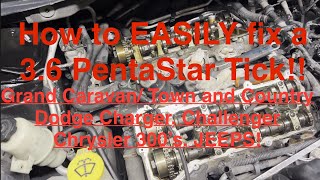
- Audible ticking or tapping sound from the top of the engine, which may increase with RPM. This is often called the 'Pentastar Tick'.
- Engine may stall or be difficult to restart.
- Replacing only the spark plugs and ignition coils without listening for ticking noises or performing a compression test. This often results in the code returning because the underlying mechanical failure (rocker arms or cylinder head) was not addressed.
Most Likely Causes
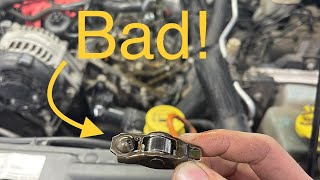
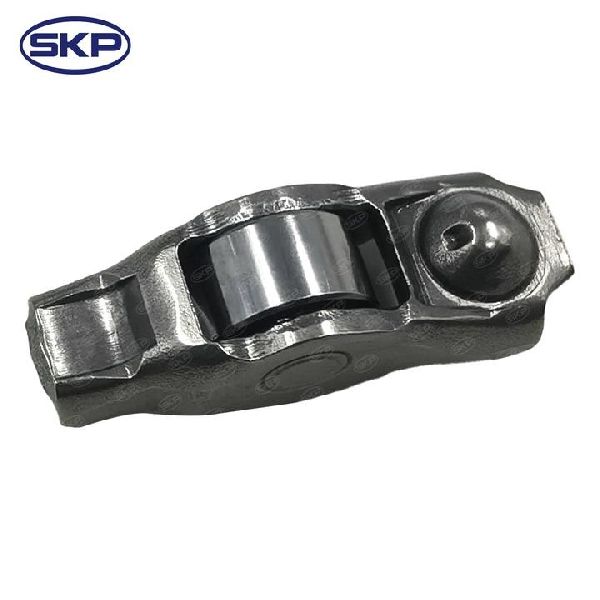
- Failed Rocker Arm(s) and Damaged Camshaft(s) 🔴 High Probability The needle bearings in the rocker arm rollers are a known failure point on the 3.6L Pentastar. The failure causes the rocker to seize and grind against the camshaft lobe, leading to a misfire and sending metal particles through the oil system. The updated Mopar part is 5184296AH.
How to confirm: Listen for a loud, distinct ticking/tapping noise from the valve cover of the affected cylinder bank. A borescope inspection through the oil fill cap may reveal a damaged rocker. The definitive diagnosis requires removing the valve cover to visually inspect the rocker arms and camshaft lobes for scoring and damage.
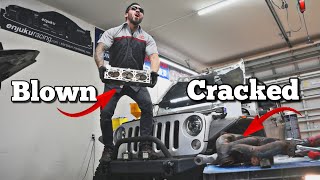
Typical fix: Replacement of all rocker arms and lifters on the affected cylinder head (12 per head). The corresponding camshaft(s) must also be replaced if they show any signs of wear or damage. This is a labor-intensive repair. 🎬 Watch: Full walkthrough on replacing rocker arms and camshafts.
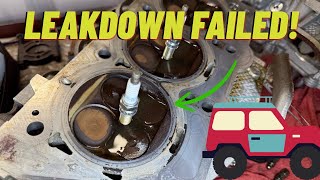
Est. part cost: $300-$800 - Left Cylinder Head Failure (2012-2013 models) 🔴 High Probability Early 3.6L Pentastar engines had a manufacturing defect with the valve guides and seats on the left cylinder head (cylinders 2, 4, 6), causing them to wear prematurely and lose compression. Chrysler issued a 10-year/150,000-mile extended warranty (X56) detailed in TSB 09-002-14 Rev. B to address this. 🎬 See a real-world example of this cylinder head failure.
How to confirm: Perform a cylinder leak-down test on the misfiring cylinder (most commonly cylinder #2, #4, or #6). Per TSB 09-002-14, leakage of 25% or greater confirms the failure.
Typical fix: Replacement of the entire left cylinder head with the updated, revised part. The latest Mopar part number is 68141353AC, which supersedes previous versions like RL141353AC.
Est. part cost: $500-$1200 - Failed Ignition Coil or Worn Spark Plug 🟡 Medium Probability → Shop Ignition Coil
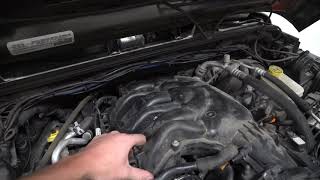
How to confirm: After ruling out mechanical failure, swap the ignition coil from the misfiring cylinder with a coil from a known good cylinder. Clear the codes and drive. If the misfire code moves to the new cylinder (e.g., P0304 becomes P0302), the coil is bad. If it stays, repeat the process with the spark plug. Accessing the driver's side bank (2, 4, 6) requires removing the upper intake manifold.
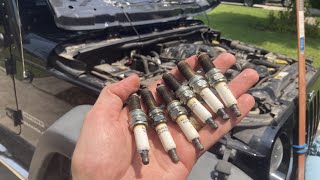
Typical fix: Replace the faulty ignition coil or all six spark plugs. It is recommended to replace spark plugs as a set. 🎬 Watch: Step-by-step guide to a full spark plug tune-up.
Est. part cost: $40-$80 for a coil, $30-$60 for a set of spark plugs. - Faulty Fuel Injector ⚪ Low Probability → Shop Fuel Injector
How to confirm: If the misfire does not move after swapping the coil and plug, the injector is a likely suspect. An advanced scan tool can perform an injector balance test. Alternatively, you can swap the injector with another cylinder, but this is more labor-intensive.
Typical fix: Replace the faulty fuel injector. It's often recommended to replace them as a set if the vehicle has high mileage.
Est. part cost: $50-$150
Rare But Worth Checking
- Powertrain Control Module (PCM) Failure: → Shop Engine Control Module (ECM) While rare, a failed injector driver in the PCM can mimic the symptoms of a bad injector or coil, causing a persistent misfire on one cylinder. This should only be considered after all other causes have been exhaustively ruled out.
- Wiring Harness Issue: A chafed or broken wire in the harness leading to the ignition coil or fuel injector can cause an intermittent or constant misfire. This can be difficult to track down and often requires a visual inspection of the entire harness.
Diagnosis Steps
- Read all stored fault codes with an OBD-II scanner to identify the specific misfiring cylinder (e.g., P0304).
- With the engine running, listen carefully to the valve covers for any distinct ticking or tapping sounds. A mechanic's stethoscope can help isolate the noise. This is a key indicator of rocker arm failure.
- If a tick is present, the next step is to remove the valve cover on the noisy side for visual inspection of the rocker arms and camshafts for scoring or wear.
- If no tick is present, especially on a 2012-2013 model with a misfire on cylinder 2, 4, or 6, perform a cylinder compression test and a leak-down test. Per TSB 09-002-14, leakage over 25% confirms a failed cylinder head.
- If compression and leak-down tests are good, proceed with basic misfire diagnosis. Swap the ignition coil from the misfiring cylinder to a known good cylinder. Clear codes and test drive. If the misfire code follows the coil, replace the coil.
- If the misfire does not follow the coil, swap the spark plug. If the misfire follows the plug, replace the spark plugs.
- If the misfire remains on the original cylinder after swapping the coil and plug, the fuel injector or its wiring is the next most likely cause. Test the injector circuit and consider performing a balance test.
Parts You'll Likely Need
- Rocker Arm and Lifter Kit
(OEM #5184296AH (Rocker Arm, latest revision))— This is the most common cause of misfires accompanied by a ticking noise on the 3.6L Pentastar. They should be replaced as a full set for the affected head (12 rocker arms).
Trusted brands: Mopar, Mahle, Sealed Power
OEM price range: $250-$400
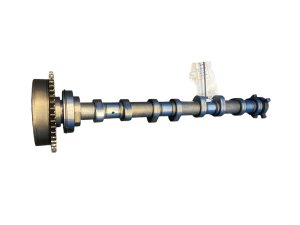
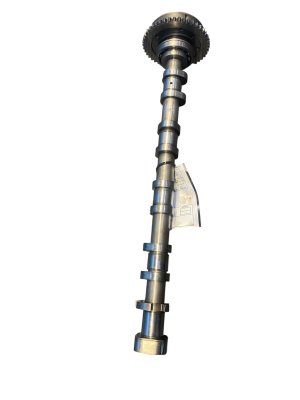
Aftermarket price range: $150-$250 - Camshaft — Must be replaced if a failed rocker arm has scored or damaged the lobes. It is critical to inspect the camshafts thoroughly whenever replacing rocker arms.
Trusted brands: Mopar
OEM price range: $200-$350 per shaft
Aftermarket price range: $150-$250 per shaft - Left Cylinder Head Assembly
(OEM #68141353AC (latest revision, supersedes RL141353AC))— The definitive fix for the premature valve seat wear on 2012-2013 models that causes compression loss and misfires on cylinders 2, 4, and 6.
Trusted brands: Mopar
OEM price range: $1000-$1200
Aftermarket price range: N/A (OEM part is strongly recommended) - Ignition Coil — A possible, though less common, cause of a persistent misfire after mechanical issues are ruled out.
Trusted brands: Mopar, NGK, Denso
OEM price range: $50-$90
Aftermarket price range: $30-$60
Related Codes That Often Appear With This One
- P0300 — Indicates a random or multiple cylinder misfire, which can happen if rocker arm failure is advanced or the cylinder head issue is severe.
- P0301, P0302, P0303, P0304, P0305, or P0306 — These are the primary codes that identify which specific cylinder is misfiring. P0363 is a direct result of one of these codes being severe enough to warrant a fuel cut. P0302, P0304, and P0306 are specifically linked to the 2012-2013 cylinder head issue.
- P06DD — This oil pressure code can sometimes appear if metal debris from a failed rocker arm clogs oil passages or damages the dual-stage oil pump.
Technical Service Bulletins (TSBs) & Recalls
- The primary TSB for the 2011-2013 left cylinder head defect. It outlines the diagnostic procedure (cylinder leak-down test) for misfire codes P0302, P0304, and P0306 and authorizes head replacement under the X56 extended warranty if leakage is 25% or more.
- This bulletin officially announced the X56 Extended Warranty, extending coverage for the left cylinder head on affected 3.6L Pentastar vehicles to 10 years or 150,000 miles from the in-service date.
Platform-Specific Known Issues
- Extended Warranty (X56) for Left Cylinder Head: Chrysler extended the warranty on the left cylinder head for 2011-2013 models to 10 years or 150,000 miles due to a known defect causing misfires on cylinders 2, 4, and 6.
- Widespread Rocker Arm Failure: The valvetrain rocker arms are a known weak point across all years of this engine, with needle bearings failing and causing a ticking noise that evolves into a misfire and camshaft damage.
Mechanic-Grade Diagnostic Values
- Fuel Injector Resistance — expected: 12-14 Ohms. Failure: A reading of 'O.L.' (open loop) or a value significantly different from other injectors.
- Ignition Coil Primary Resistance — expected: 0.5 - 0.7 Ohms. Failure: A reading outside of this range indicates a faulty coil.
- Ignition Coil Secondary Resistance — expected: 8.5 - 10.5 kΩ. Failure: A reading outside of this range indicates a faulty coil.
- Fuel Pressure — expected: ~60 psi. Failure: Significantly lower pressure indicates a weak fuel pump or clogged filter, which can cause misfires.
Scan Tool Commands That Help
- wiTECH or advanced aftermarket scanner: Cylinder Contribution Test — To identify a misfiring cylinder without having to swap components. The tool measures the speed variation of the crankshaft as each cylinder fires to determine which one is not contributing power.
- wiTECH or advanced aftermarket scanner: Injector Kill / Disable — To manually disable one injector at a time while the engine is running. If disabling a specific injector causes no change in the engine's idle quality, that cylinder was already not firing, confirming the location of the misfire.
Wiring & Ground Locations
- G100 — On the right side of the engine bay, near the battery.. This is a primary engine bay ground. A poor connection here can cause a wide range of electrical issues, including erratic sensor readings and weak spark that could contribute to misfires.
- G101 — On the left side of the engine bay, near the Power Distribution Center (fuse box).. Another critical engine bay ground point. Ensuring it is clean and tight is essential for stable electrical system performance.
- G104 — On the lower right side of the engine block.. This is a direct engine block ground. A faulty connection here could directly impact the grounding path for components mounted to the engine, such as ignition coils, potentially causing misfire issues.
- Ignition Coil Connector — Atop each spark plug, under the valve cover.. The control wire for each ignition coil runs from a specific pin at the PCM connector. For example, on some models, cylinder 1 coil control is pin 57 at the PCM. A break or short in this wire will cause a persistent misfire on that single cylinder.
Real Owner Repair Stories
- Bob Is The Oil Guy forum user 'wwillson' (2014 Dodge Durango with 3.6L Pentastar at 85,000 miles) — No audible tick or drivability issue, but found a large amount of metal flakes in the oil filter during a routine oil change.
❌ Tried (didn't work) The owner proactively investigated based on the metal shavings, suspecting a known issue before performance symptoms appeared.
✅ What actually fixed it Upon removing the valve covers, the owner found one bad rocker arm on the cylinder 6 exhaust. The roller bearings had failed, but it was caught before the rocker body contacted and damaged the camshaft. The owner replaced all 24 rocker arms and all 24 lifters (slack adjusters) as a preventative measure, which resolved the source of the metal shavings. - Reddit user on r/MechanicAdvice (Jeep with 3.6L Pentastar) — Ticking noise, misfire codes.
❌ Tried (didn't work) Initial diagnosis at the dealership.
✅ What actually fixed it The failure was a stuck rocker arm which then damaged the camshaft lobe. The repair required replacing the affected camshaft and rocker arms. The user noted that the metal shavings from the failure contaminated the brand new oil, and the dealership insisted on a paid oil change as part of the warranty repair.
OEM Part Supersession History
5184296AD, 5184296AE, 5184296AF, 5184296AG→5184296AH— Design improvement to address premature failure of the needle bearings in the rocker arm roller.
Heads up: The latest revision (AH) should be used for all repairs. Using older stock or aftermarket parts that mimic the original design may lead to a repeat failure.
Model Year Variations Within This Range
- 2012-2013: These model years are susceptible to the left cylinder head failure due to improper valve seat hardening. This was addressed in later models.
- 2014+: Starting in 2014, the 3.6L Pentastar engine received a redesigned oil filter housing and cooler assembly. While not a direct cause of P0363, this housing is made of plastic and is known to crack and leak oil or coolant, which can lead to engine overheating or low oil pressure, indirectly causing other engine problems.
- 2012-2018: In 2012, the 3.6L Pentastar V6 engine replaced the previous 3.8L V6, and it was paired with a new five-speed WA580 automatic transmission, a significant upgrade from the previous four-speed. This powertrain combination remained through 2018.
Diagnostic Flowchart
Other Known Issues on This Vehicle
Issues unrelated to this code that are worth knowing about as an owner of this generation:
- Cracked Oil Filter / Cooler Housing 🔴 High — Extremely common across all 3.6L Pentastar engines from 2012-2018. The plastic housing becomes brittle from heat cycles and often cracks, leading to significant oil and/or coolant leaks. Over-torquing the oil filter cap (spec is 18 ft-lbs or 25 Nm) is a frequent cause of failure.
- Cooling System Sludge from Casting Sand 🟠 Medium — Widespread on 2012-2017 models. Residual sand from the engine block casting process can clog the heater core and radiator, leading to poor or no heat on the driver's side and potential overheating. Often requires multiple flushes or replacement of the heater core and radiator.
- Totally Integrated Power Module (TIPM) Failure 🔴 High — Common on 2007-2014 models. The TIPM is the central electrical hub and its failure can cause a wide array of bizarre electrical issues, such as the fuel pump not shutting off, engine stalling, horn going off randomly, or wipers/lights acting erratically. (Ref: While no specific recall exists for all models, numerous complaints led to class-action lawsuits.)
- Water Leaks into Cabin 🟡 Low — A very common complaint on Jeep Wranglers of this generation due to the modular design of the roof and doors. Leaks are frequent around the A-pillars, door seals, and Freedom Top panels.
- Steering Wobble ('Death Wobble') 🔴 High — A notorious issue for solid front axle vehicles like the Wrangler. Caused by worn or loose front-end components (track bar, ball joints, tie rod ends), it results in violent, uncontrollable shaking after hitting a bump at speed.
Used vs. New Parts: Buying Guide for This Vehicle
When a used part is the smart pick: For this repair, sourcing a complete, low-mileage used engine from a reputable salvage yard can be a viable alternative to a costly internal repair, especially if a camshaft and cylinder head are both damaged. Minor external components like brackets or sensors are also good candidates for used parts.
Donor-vehicle mileage cap: roughly under 80000 miles for the part to have meaningful remaining life.
What to inspect on the donor part:
- Check the oil fill cap and dipstick for signs of milky sludge, indicating a head gasket failure on the donor.
- Ask the salvage yard for a video of the engine running before it was pulled, if possible.
- Drain a small amount of oil from the donor engine's pan to check for excessive metal shavings or coolant contamination.
- Inspect the wiring harness for any cuts, burns, or brittle connectors.
OEM-only on this vehicle (don't cheap out):
- Cylinder Head Assembly: Due to the specific manufacturing defect in early models, only the latest revised Mopar OEM part (68141353AC or newer) should be used to guarantee a permanent fix.
- Rocker Arms: While some aftermarket brands are available, the high failure rate of this component makes using the latest Mopar OEM revision (5184296AH) the safest choice to avoid repeat repairs.
Aftermarket brands forum-validated for this vehicle:
- Ignition Coils: NGK, Denso
- Spark Plugs: NGK, Champion (often the OEM supplier)
- Gaskets: Fel-Pro, Mahle
Brands owners have reported issues with on this vehicle:
- Unbranded 'no-name' rocker arm and lifter kits from online marketplaces are frequently cited in forums as failing quickly after installation.
Real Owner Stories
Aggregated from forums and TSBs cited above. Mileages and costs reflect what owners reported in those sources.
2012 Jeep Wrangler 3.6L Pentastar V6
Symptoms: P0302 and P0363 codes with a misfire on cylinder 2.
What fixed it: Replacement of the left cylinder head under the X56 extended warranty after a leak-down test confirmed the failure.
Source hint: WranglerForum.com thread titled '2012 JK P0302 P0363 Misfire Codes'
2014 Jeep Wrangler 3.6L Pentastar V6
Symptoms: P0304 and P0363 codes; engine running rough with a noticeable misfire.
What fixed it: Visual inspection after removing the valve cover revealed a failed rocker arm and damaged camshaft lobe.
Source hint: JK-Forum.com thread titled 'P0304 P0363 Misfire'
2012-2018 Jeep Wrangler 3.6L Pentastar V6
Symptoms: Audible ticking or tapping sound from the top of the engine that increases with RPM.
What fixed it: Replacement of rocker arms and lifters to prevent further camshaft damage.
Source hint: YouTube video 'diagnosing Pentastar tick leading to misfire'
Related OBD-II Codes
Frequently Asked Questions
Does TSB 09-002-14 Rev. B apply to my 2012 Jeep Wrangler with a misfire?
Is there an extended warranty for the cylinder head issue on my 2013 Wrangler?
What is the 'Pentastar Tick' I hear on my 2015 Wrangler, and can it cause P0363?
What part number should be used to fix the rocker arm failure on my 3.6L Pentastar?
How do I confirm if my 2012 Wrangler needs a new cylinder head under the X56 warranty?
Why do I need to remove the upper intake manifold to diagnose a misfire on my Jeep?
Helpful Videos
Used OEM Parts in Stock
New Aftermarket Parts Available


The information in this article is provided for general reference and educational purposes only. Vehicle specifications, procedures, and part compatibility can vary by production date, trim level, and region. Always consult your vehicle's factory service manual and verify part numbers before purchasing or performing repairs. Safety-critical components such as airbags, seat belts, and braking systems should be installed by a qualified professional.
- Jeep Wrangler:
- 🧭 Diagnostic Flowchart
- 🎬 Helpful Videos
- 🛍️ Shop This Part
- What's Unique About the 2012-2018 Jeep Wrangler
- Symptoms You May Notice
- Most Likely Causes
- Rare But Worth Checking
- Diagnosis Steps
- Parts You'll Likely Need
- Related Codes That Often Appear With This One
- Technical Service Bulletins (TSBs) & Recalls
- Platform-Specific Known Issues
- Mechanic-Grade Diagnostic Values
- Scan Tool Commands That Help
- Wiring & Ground Locations
- Real Owner Repair Stories
- OEM Part Supersession History
- Model Year Variations Within This Range
- Other Known Issues on This Vehicle
- Used vs. New Parts: Buying Guide for This Vehicle
- Real Owner Stories
- 2012 Jeep Wrangler 3.6L Pentastar V6
- 2014 Jeep Wrangler 3.6L Pentastar V6
- 2012-2018 Jeep Wrangler 3.6L Pentastar V6
- Related OBD-II Codes
- Frequently Asked Questions
- 🎟️ Get 5% Off