

P0365 on 2017-2018 Chevrolet Trax: Exhaust Cam Sensor Causes & Fixes
P0365 on a 2017-2018 Chevy Trax indicates a fault with the exhaust camshaft position sensor circuit. Before replacing the sensor (a common fix), test the vehicle's battery, as a weak battery is a known cause for this code on this platform per GM Technical Service Bulletin #PIP5482B. This issue is common on vehicles that have sat for extended periods or have very low mileage.
- P0365 on a 2017-2018 Trax points to the exhaust camshaft position sensor circuit.
- **Always test the battery first.** A GM service bulletin confirms a weak battery can trigger this code.
- If the battery is good, the most likely fix is replacing the exhaust camshaft position sensor.
- The sensor is located on the front of the engine and is a DIY-friendly repair, typically requiring only basic tools.
- Do not ignore this code, as it can lead to stalling, no-start conditions, and poor engine performance.
What's Unique About the 2017-2018 Chevrolet TRAX
For this specific generation of Chevrolet Trax and its platform mates (like the Buick Encore), a key factor is an unusual root cause identified by General Motors. Technical Service Bulletin #PIP5482B explicitly advises technicians to perform a battery inspection and test when diagnosing P0365, often seen with P0335 and P0340. The TSB notes this cluster of codes is common on low-mileage vehicles or those parked for extended periods, suggesting that a low state of charge in the battery during consecutive engine starts can cause false sensor readings. This makes battery testing a critical first diagnostic step before replacing any parts.
Diagnostic Flowchart
Tap your situation to follow the diagnostic path that matches what you're seeing on this vehicle.
Symptoms You May Notice
- Check Engine Light is on
- Engine is difficult to start or has an extended crank time
- Rough idle or engine misfires
- Reduced engine power and hesitation during acceleration
- Decreased fuel economy
- Engine may stall unexpectedly at stops
- Immediately replacing the camshaft position sensor without first testing the battery and charging system. The TSB for this vehicle makes it clear that a weak battery can set this code.
- Mistaking the VVT solenoids (actuators) for the camshaft position sensors. The sensors are typically located on the side/rear of the cylinder head, while the solenoids are on the top front.
Most Likely Causes
- Weak or Failing Battery 🔴 High Probability → Shop Vehicle Battery GM TSB #PIP5482B specifically calls out battery testing as a primary diagnostic step for this code, indicating that electrical system instability is a known issue that can mimic sensor failures, especially on vehicles that have been sitting or have low miles.
How to confirm: Perform a comprehensive battery and charging system test using a professional tester like a GR8 / EL-50313 as recommended by GM. Voltage should be approximately 12.6V with the engine off and 13.5-14.5V with the engine running. A simple voltage check may not be sufficient; a load test is recommended.
Typical fix: Replace the vehicle's battery and ensure the charging system (alternator) is functioning correctly. Clear codes and perform two consecutive engine starts to see if codes return.
Est. part cost: $150-$300 - Faulty Exhaust Camshaft Position Sensor 🔴 High Probability → Shop Engine Camshaft Position Sensor Camshaft position sensors are common failure points on many modern engines due to constant exposure to heat and vibration. Oil leaks from the valve cover can also contaminate the sensor and connector, causing failure.
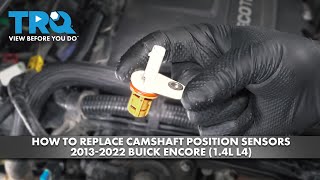
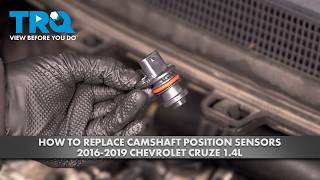
How to confirm: After confirming the battery is good, the easiest way is to swap the exhaust sensor with the identical intake sensor. They are the same part number. 🎬 See how to access and swap both sensors on this platform. Clear the codes and run the engine. If the code changes to P0340 (Intake Cam Sensor), the sensor is bad. If the code P0365 remains, the problem is in the wiring or PCM.
Typical fix: Replace the exhaust camshaft position sensor. 🎬 Watch: This video shows the exact sensor replacement on a Trax. The sensor is held by a single E10 external Torx bolt.
Est. part cost: $25-$70 - Wiring or Connector Issues 🟡 Medium Probability The engine bay is a harsh environment. Wires near the exhaust manifold can become brittle from heat, and connectors can be damaged by oil leaks or vibration.
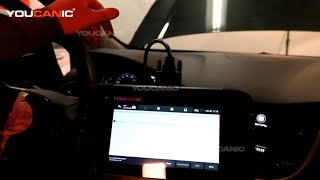
How to confirm: Visually inspect the wiring harness and connector leading to the exhaust camshaft position sensor for any signs of damage, melting, corrosion, or loose pins. The connector has a grey retaining clip that must be pulled out before unplugging. Use a multimeter to check for continuity and proper voltage (typically 5V reference) at the connector. 🎬 Watch: A helpful breakdown of P0365 circuit causes and fixes.
Typical fix: Repair the damaged section of the wiring harness or clean/replace the connector pigtail.
Est. part cost: $5-$50
Rare But Worth Checking
- Misaligned Camshaft Reluctor Wheel: → Shop Engine Camshaft GM issued TSB #PIP5598D for some 1.4L engines, noting that the reluctor ring on the exhaust camshaft can shift out of phase, causing codes like P0365 and P0366, often with a crank/no-start condition. This is a serious mechanical issue that requires camshaft replacement.
- Faulty Powertrain Control Module (PCM): This is extremely rare and should only be considered after all other possibilities (battery, sensor, wiring, timing) have been exhaustively ruled out.
- Stretched or Slipped Timing Chain: → Shop Engine Timing Chain While less common than sensor or battery issues, if the timing chain has stretched or jumped a tooth, the correlation between the camshaft and crankshaft will be incorrect, triggering sensor codes. This would typically be accompanied by other timing correlation codes and significant performance problems.
Diagnosis Steps
- Read the trouble codes with an OBD-II scanner and note any other codes present, especially P0335 and P0340.
- CRITICAL FIRST STEP: Perform a full battery and charging system test, as recommended by TSB #PIP5482B. Check for a healthy battery (approx. 12.6V engine off) and proper alternator output (13.5-14.5V engine on). A load test is crucial. Resolve any battery issues, clear codes, and perform two start cycles to see if codes return before proceeding.
- Inspect the wiring harness and electrical connector for the exhaust camshaft position sensor. Look for any signs of damage, oil contamination, or corrosion. The connector has a small grey locking tab.
- The exhaust sensor ('B') is located on the front (exhaust manifold side) of the engine, below the charge air pipe. The intake sensor ('A') is on the opposite side (rear of the engine).
- If the wiring appears intact, and the intake and exhaust sensors are identical parts (which they are on the 1.4L LUV), swap their positions. Clear the codes and run the engine. If the code changes to P0340 (intake sensor fault), the original exhaust sensor has failed and must be replaced.
- If the code P0365 returns after the swap, the problem lies in the wiring circuit or the PCM. Test the circuit for the correct reference voltage (typically 5V) and ground using a multimeter.
- If all circuit tests pass, the issue may be mechanical, such as a slipped timing chain or a damaged reluctor wheel as described in TSB #PIP5598D. This requires more advanced diagnosis, likely involving an oscilloscope or engine teardown.
Parts You'll Likely Need
- Exhaust Camshaft Position Sensor
(OEM #55565709)— This sensor is a common failure point and the most likely part to need replacement after ruling out battery and wiring issues. The intake and exhaust sensors are the same part. The ACDelco part number is 213-4691.
Trusted brands: ACDelco (OEM), Delphi, Dorman, Standard Motor Products (PC907)
OEM price range: $50-$80
Aftermarket price range: $25-$50 - Car Battery — A weak or failing battery is a documented cause of code P0365 on this vehicle, as noted in GM TSB #PIP5482B.
Trusted brands: ACDelco, DieHard, Interstate
OEM price range: $200-$300
Aftermarket price range: $150-$250
Related Codes That Often Appear With This One
- P0335 — Crankshaft Position Sensor code. Per TSB #PIP5482B, these codes are often triggered together by the same underlying electrical issue, like a weak battery on a low-mileage or stored vehicle.
- P0340 — Intake Camshaft Position Sensor code. This can appear with P0365 if there is a systemic issue like a bad battery or a timing problem affecting both camshafts. TSB #PIP5482B also lists this as a companion code.
- P0366 — Camshaft Position Sensor 'B' Circuit Range/Performance. This code is more specific to performance or timing issues rather than a simple circuit fault and can be caused by a slipped reluctor ring as noted in TSB #PIP5598D.
Technical Service Bulletins (TSBs) & Recalls
- PIP5482B: Advises technicians to perform a battery inspection and test when diagnosing DTCs P0335, P0340, and P0365. Notes this is common on vehicles with very low miles or that sat for extended periods.
- PIP5598D: Describes a potential issue with the exhaust camshaft reluctor being out of phase, causing codes P0365 and P0366.
Platform-Specific Known Issues
- TSB #PIP5482B indicates that a weak battery can cause DTCs P0335, P0340, and P0365 to set, particularly on vehicles with low mileage or that have been parked for a long time. A battery test is a mandatory first step in diagnosis.
- TSB #PIP5598D points to a rare but possible issue where the exhaust camshaft reluctor wheel is out of position, requiring camshaft replacement. This may be the cause if a new sensor and good wiring do not resolve the code.
Mechanic-Grade Diagnostic Values
- Camshaft Position Sensor Connector Voltage — expected: Pin 2: 5V reference; Pin 1: Good ground (low resistance to chassis ground).. Failure: Voltage missing or significantly lower than 5V on the reference pin, or high resistance on the ground pin, indicates a wiring or ECM issue.
- Camshaft Position Sensor Signal Waveform — expected: A square wave pattern when viewed on an oscilloscope with settings around 5V/division and 20ms/division.. Failure: A missing, erratic, or distorted waveform indicates a faulty sensor or a problem with the reluctor wheel.
Scan Tool Commands That Help
- GDS2 / Tech2: Crankshaft Position Variation Learn (CASE Learn) — Required after replacing the crankshaft position sensor, ECM, or flexplate. Since P0365 often appears with crankshaft code P0335, performing this relearn is critical to prevent the ECM from inaccurately detecting cam/crank correlation faults or misfires.
- Professional Scan Tool (e.g., GDS2): Cam Sensor Relearn — Some GM vehicles may require a relearn procedure after replacing a camshaft position sensor for the ECM to learn the small variances in the new sensor. This is less common than the crank relearn but should be checked for if issues persist after sensor replacement.
Wiring & Ground Locations
- Camshaft Position Sensor Connector Pinout — At the sensor on the front (exhaust side) of the engine.. Knowing the pinout is essential for testing. Pin 1 is the Low Reference (ground), Pin 2 is the 5V Reference from the ECM, and Pin 3 is the Signal wire back to the ECM. Testing for 5V at Pin 2 and good ground at Pin 1 verifies the circuit's integrity from the ECM.
- G103 — On the cowl in the engine compartment, typically above the brake booster.. This ground point serves the Body Control Module (BCM) and the Data Link Connector (DLC). A poor connection here can cause a wide range of bizarre electrical issues and communication problems, potentially mimicking sensor faults.
- Main Engine Ground — Part of the main negative battery cable harness, bolted to the left front of the engine block.. This is the primary ground for the engine block itself. A loose or corroded connection here can create a floating ground for all engine-mounted sensors, including the camshaft and crankshaft sensors, leading to erratic signals and multiple fault codes.
Real Owner Repair Stories
- Reddit user on r/ChevyTrax (2015 Chevrolet Trax) — Intermittent no-start (all electronics work, but engine won't turn over), with codes P0335, P0340, and P0365 present. The car would work for 2-3 days after a battery disconnect, then fail again.
❌ Tried (didn't work) Replacing the Camshaft Position 'B' sensor, Replacing the starter motor
✅ What actually fixed it Replacing the battery in the main key fob. The car's immobilizer system was failing to get a good signal from the weak fob, preventing the start sequence. The spare key worked flawlessly, confirming the issue. - Reddit user on r/cruze (2015 Chevrolet Cruze 1.4L (Gen 1)) — Car went into limp mode with 21 codes, which narrowed down to P0335, P0340, and P0365 after clearing. Check engine light was intermittent.
❌ Tried (didn't work) Replacing the MAF sensor, Resetting codes, One mechanic suggested replacing the PCM, A GM dealer found no fault
✅ What actually fixed it An aftermarket GPS tracking unit had been wired in between the starter and the ECM. The GPS unit had failed, causing the circuit interruptions that triggered the sensor codes. Removing the faulty unit resolved the issue. - Reddit user on r/ChevySonic (2018 Chevrolet Sonic RS Turbo (1.4L) with 49k miles) — Stabilitrak light came on, rough idle, and visible sparks arcing between the ignition coil pack and the cylinder head. Codes P0304, P0335, P0340, and P0365 were all present.
❌ Tried (didn't work) Initial code clearing
✅ What actually fixed it The dealership replaced the ignition coil pack and spark plugs. This resolved the electrical arcing and cleared all fault codes, including the cam and crank sensor codes.
"I Checked Everything" — The Actual Cause
- In a case involving a 2015 Trax with P0365 and related codes, standard diagnosis focusing on sensors and starters failed to find a cause. The actual root cause was a weak battery in the key fob, which prevented the immobilizer system from allowing the engine to start, leading to a cascade of what appeared to be engine sensor circuit faults.
When the Usual Fixes Don't Work
- While the most common fixes for P0365 are the battery or the sensor itself, there are documented cases where the root cause was completely unrelated to the camshaft sensor circuit. One owner of a 2015 Trax found that a weak battery in their key fob was triggering P0365 along with crank and intake cam sensor codes by interfering with the immobilizer system. In another case involving a similar GM engine, a failed aftermarket GPS unit spliced into the vehicle's wiring was the ultimate cause. These instances highlight the need to consider outside electrical interference, including the security system and any non-factory modifications, when direct circuit testing does not reveal a fault.
OEM Part Supersession History
55565709→N/A— This is the current and widely referenced OEM part number.
Heads up: This part number is cross-referenced by many aftermarket brands including ACDelco (213-4691), Standard Motor Products (PC907), and others. Ensure the cross-referenced part explicitly covers the 2017-2018 Trax 1.4L engine.
Helpful Videos


We Have This Part in Stock


The information in this article is provided for general reference and educational purposes only. Vehicle specifications, procedures, and part compatibility can vary by production date, trim level, and region. Always consult your vehicle's factory service manual and verify part numbers before purchasing or performing repairs. Safety-critical components such as airbags, seat belts, and braking systems should be installed by a qualified professional.
- Chevrolet TRAX:
- 🧭 Diagnostic Flowchart
- 🎬 Helpful Videos
- 🛍️ Shop This Part
- What's Unique About the 2017-2018 Chevrolet TRAX
- Symptoms You May Notice
- Most Likely Causes
- Rare But Worth Checking
- Diagnosis Steps
- Parts You'll Likely Need
- Related Codes That Often Appear With This One
- Technical Service Bulletins (TSBs) & Recalls
- Platform-Specific Known Issues
- Mechanic-Grade Diagnostic Values
- Scan Tool Commands That Help
- Wiring & Ground Locations
- Real Owner Repair Stories
- "I Checked Everything" — The Actual Cause
- When the Usual Fixes Don't Work
- OEM Part Supersession History
- 🎟️ Get 5% Off