

OBD-II Code P0400: Exhaust Gas Recirculation (EGR) Flow Malfunction
The Ultimate Guide to What P0400 Means, Why It Triggers, and How to Fix It for Good
- Code P0400 triggers when the Powertrain Control Module (PCM) detects incorrect exhaust gas flow through the EGR system.
- Carbon buildup blocking the EGR valve or intake manifold passages causes over 70% of P0400 codes, requiring manual cleaning rather than parts replacement.
- Always inspect for cracked vacuum hoses and clean the EGR ports with carburetor cleaner before spending $200+ on a replacement valve.
- Driving with an active P0400 code increases combustion temperatures, leading to engine knock and potential catalytic converter failure costing upwards of $1,500.
What Does P0400 Mean?
The P0400 code means the Powertrain Control Module (PCM) detects incorrect Exhaust Gas Recirculation (EGR) system flow. The EGR system sends a precise amount of exhaust gas back into the cylinders to re-burn, lowering combustion temperatures and reducing harmful nitrogen oxide (NOx) emissions.
Technical definition: The official SAE/OBD-II definition is "Exhaust Gas Recirculation (EGR) 'A' Flow Malfunction." The PCM commanded the EGR valve to open but did not see the expected change in manifold pressure or temperature. Measured flow is either insufficient, excessive, or erratic.
Can I Drive With P0400?
Yes, but not recommended Yes, but limit driving to short trips under 100 miles to a repair shop. Ignoring P0400 causes failed emissions tests, poor fuel economy, and severe engine damage. The lack of EGR flow increases combustion temperatures, causing engine knock (detonation) that damages pistons and valves. This also overheats the catalytic converter, adding $800 to $2,500 to repair costs.
Common Causes
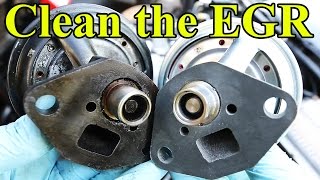
- Clogged EGR Passages or Valve (Very Common) — Carbon (soot) from the exhaust builds up over time and completely blocks the small passages, the EGR valve itself, and associated tubes. This is the 🎬 See how to perform this EGR repair with basic hand tools most frequent cause of a P0400 code across all vehicles.
- Cracked or Disconnected Vacuum Lines (Common) — On vacuum-controlled EGR systems, old rubber hoses crack, split, or disconnect. This creates a vacuum leak that prevents the valve from opening.
- Faulty EGR Valve (Common) — The EGR valve gets stuck open or closed due to carbon buildup or mechanical failure. A valve stuck 🎬 Watch: How to clean and replace a faulty EGR valve closed prevents exhaust gas from flowing, directly causing this code.
- Defective DPFE or EGR Temperature Sensor (Less Common) — The system uses sensors like a DPFE (Delta Pressure Feedback EGR) or an EGR temperature sensor to confirm flow. If a sensor fails, it sends incorrect data to the computer, triggering the code even if flow is normal.
- Faulty EGR Control Solenoid (Less Common) — An electronic solenoid controls the vacuum supply to the EGR valve. If this solenoid fails, it cannot open the EGR valve when commanded by the computer.
- Clogged EGR Cooler (Less Common) — On vehicles equipped with an EGR cooler (common on diesels), the internal passages become severely clogged with soot, restricting flow.
- PCM Software Glitch (Rare) — In specific models, particularly 2015-2020 Subarus, overly sensitive diagnostic logic in the PCM triggers P0400 in cold weather. A dealer software update is the only fix.
Symptoms
- Check Engine Light is On — This is the first and often the only symptom you notice.
- Engine Knocking or Pinging — A lack of EGR flow increases combustion temperatures, causing a pinging or knocking sound (detonation) during acceleration or uphill driving.
- Failed Emissions Test — The vehicle produces excessive NOx emissions due to high combustion temperatures, causing an automatic smog check failure.
- Reduced Power and Fuel Economy — The car feels sluggish, hesitates during acceleration, and gets fewer miles per gallon as engine efficiency drops.
- Rough Idle or Stalling — If the EGR valve is stuck open, it allows exhaust into the engine at idle, causing a fluctuating idle or stalling.
Diagnostic Flowchart
Tap your situation to follow the diagnostic path that matches what you're seeing on this code.
Common Fixes & Costs
- Cleaning EGR Valve and Passages — Parts: $10-$25, Labor: $150-$350, ~1.5 hr book time (DIY)
- Replacing the EGR Valve
— Parts: $100-$400, Labor: $100-$200, ~1.2 hr book time
(Intermediate)
: OEM 14710AA780 (Alt: Standard Motor Products EGV1274, Wells 4F2107)
: OEM 18011-R70-A00 (Alt: Standard Motor Products EGV1134, Delphi EG10662) - Replacing a Faulty DPFE Sensor
— Parts: $40-$120, Labor: $60-$120, ~0.5 hr book time
(DIY)
: OEM DPFE-15, 4U7Z-9J460-AA (Alt: Motorcraft DPFE-15, Standard Motor Products VP16) - Replacing a Faulty EGR Vacuum Solenoid — Parts: $30-$90, Labor: $75-$150, ~0.6 hr book time (DIY)
DIY vs Professional
- Cleaning EGR Valve and Passages — Beginner: yes
Tools: Basic socket/wrench set, flashlight, gasket scraper, wire brushes, carburetor cleaner, new gasket. - Replacing the EGR Valve — Beginner: yes
Tools: Basic socket/wrench set, gasket scraper, new EGR valve and gasket. - Replacing a Faulty DPFE Sensor — Beginner: yes
Tools: Small socket or wrench set.
Used vs. New Parts: Buying Guide
When a used part is worth it: A used EGR valve from a low-mileage salvage yard is a budget-friendly option for older, high-mileage vehicles where a new OEM part exceeds $300. Only buy if you can verify the donor car was not scrapped for engine problems.
Donor-vehicle mileage cap: roughly under 80000 miles for the part to have meaningful remaining life.
Donor quality checklist:
- Verify the part number matches exactly; electronic valves are not interchangeable.
- Inspect the part for heavy carbon buildup; if it's dirty, reject it.
- Prefer parts from regions without heavy rust.
Decision logic:
- If The fix is cleaning passages, not replacing the valve → No part purchase is needed.
- If A quality aftermarket new part is available for under $150 → Buy new; the savings from a used part are minimal and not worth the risk.
- If The vehicle is over 150,000 miles and the OEM part is over $300 → A used part is a reasonable gamble, but expect a shorter lifespan.
Warranty tradeoff: Used parts typically have a 30-day warranty covering only the part. New aftermarket parts offer 1-year to limited lifetime warranties.
Worst-case if a used part fails: $200-$500 if a used valve fails shortly after installation, requiring repeat labor costs.
What Happens If You Wait — Timeline
- 0-2 weeks: Code P0400 is set and the Check Engine Light is on. There are no other noticeable symptoms. (MPG impact: 0-3%% · Added cost: $0)
- 2 weeks - 4 months: Fuel economy drops. The driver experiences slight engine hesitation or light engine pinging when going uphill. (MPG impact: 5-10%% · Added cost: $50-$150 in wasted fuel)
- 4-12 months: Engine knocking becomes severe. High combustion temperatures stress the catalytic converter, causing its internal substrate to overheat. (MPG impact: 10-15%% · Added cost: $800-$2500 if the catalytic converter fails.)
- 12+ months: Chronic detonation causes direct mechanical damage to engine internals, such as burned exhaust valves or damaged piston crowns. (MPG impact: 15-25%% · Added cost: $2500-$7000 for major engine repair.)
Cost of Not Fixing It
- 0-3 months: Failed emissions test, a 5-10% drop in fuel economy, and engine pinging under load. (Added cost: Negligible, besides increased fuel cost and inspection re-test fees.)
- 3-12 months: Persistently high combustion temperatures overheat and damage the catalytic converter. (Added cost: $1200-$2800 for catalytic converter replacement.)
- 12+ months: Chronic engine knocking (detonation) causes severe internal engine damage, including burned exhaust valves and damaged pistons. (Added cost: $2500-$7000 for major engine repairs or replacement.)
Diagnosis Steps
- Scan for Codes and Review Freeze Frame Data
Use an OBD-II scanner to confirm P0400 and check for related DTCs. Codes for a MAP sensor (P0107), DPFE sensor (P1400, P1401), or EGR control circuit (P0403) dictate your diagnostic path. Review freeze frame data to see engine conditions when the code set.
Tools: OBD-II Scanner (Beginner) - Visually Inspect Vacuum Lines and Wiring
Thoroughly inspect all vacuum lines connected to the EGR valve and control solenoid. Look for cracks, splits, or loose connections. Check electrical connectors on the EGR valve and sensors for corrosion or damage.
Tools: Flashlight (Beginner) - [PRO TIP] Perform Bi-Directional Control Test
Use a bi-directional scan tool to command the EGR valve open 10-20% while the engine idles. You must see an immediate, noticeable drop in RPMs or a rough idle. If the idle doesn't change, there is zero flow, confirming a blockage or dead valve.
Tools: Bi-directional Scan Tool (Advanced) - Inspect and Clean the EGR Valve and Passages
Remove the EGR valve. Inspect the valve's pintle area and the intake manifold passages. Use carburetor cleaner, wire brushes, and picks to remove hard carbon buildup. This step resolves over 70% of P0400 codes.
Tools: Wrench/Socket Set, Gasket Scraper, Wire Brushes, Carburetor Cleaner, Safety Glasses (Intermediate) - Test the EGR Valve's Mechanical Function
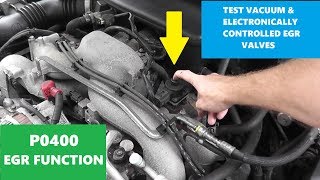
For a vacuum-operated valve, connect a hand-held vacuum pump and apply vacuum. The valve's pintle must move smoothly and hold vacuum without leaking down. If it leaks, replace the valve.
Tools: Hand-held Vacuum Pump (Intermediate) - Test DPFE or EGR Temperature Sensors
On Ford/Mazda vehicles, back-probe the DPFE sensor signal wire. Key on, engine off voltage is 0.5-1.0V. Apply vacuum to the EGR valve; voltage must rise smoothly to 4.0-5.0V. For temperature sensors (Toyota/Nissan), verify resistance drops significantly as the sensor heats up.
Tools: Multimeter, T-pins, Heat Gun, Repair Manual (Advanced) - Test the EGR Control Solenoid
Disconnect the electrical connector and measure resistance across the solenoid pins. A good solenoid reads between 20 and 100 ohms (check manual for exact specs). Infinite resistance means the solenoid is dead.
Tools: Multimeter, Repair Manual (Advanced)
When This Code Triggers (Freeze-Frame Conditions)
- Engine Coolant Temp: 180-210°F (90°C) (The engine must be fully warmed up; the EGR system is disabled when the engine is cold.)
- RPM: 1500-3000 RPM (The EGR test runs during steady-state cruising, not at idle or during heavy acceleration.)
- Engine Load: 20-60% (The system is tested under light to moderate engine load, typical of highway cruising.)
- Vehicle Speed: 40-65 mph (A constant speed is required for the PCM to run the diagnostic monitor for the EGR system.)
Related Codes
- P0401 — P0401 means 'EGR Flow Insufficient Detected.' P0400 is a general malfunction, while P0401 confirms flow is below the minimum threshold. The diagnostic process is identical.
- P0402 — P0402 means 'EGR Flow Excessive Detected.' This is caused by an EGR valve stuck open. A key symptom is a very rough idle or stalling, which is rare with P0400.
- P0403 — P0403 means 'EGR Control Circuit Malfunction.' This points to an electrical problem, such as a bad solenoid or broken wire. Diagnose P0403 before chasing flow blockages.
- P0107 — P0107 (MAP Sensor Circuit Low) triggers if the PCM uses the MAP sensor to cross-check EGR operation. A stuck-closed EGR valve prevents the expected pressure change, falsely flagging the MAP sensor.
Climate & Environmental Factors
- Cold Weather: Temperatures below freezing cause moisture in the EGR system to freeze, temporarily sticking the valve. In some Subarus, cold weather triggers a false P0400 code due to overly sensitive PCM logic.
- High Altitude: Changes in air density at high altitudes affect the pressure gradients the EGR system relies on, occasionally contributing to flow calculation errors.
How to Talk to a Mechanic About This Code
Say this: "I have a P0400 EGR flow malfunction code. Since the most common cause is a blockage, please start by inspecting the EGR valve and cleaning the passages before recommending a valve replacement."
This signals you understand that clogged passages are the most common and cheapest fix. It directs the mechanic to perform a proper cleaning first, preventing an unnecessary $300 part upsell.
Avoid saying:
- 'My check engine light is on, can you look at it?'
- 'Just fix whatever is wrong.'
- 'My car is running rough, I think I need a new EGR valve.'
Questions to ask before authorizing the repair:
- Did you find the carbon blockage? Was it in the valve, the tube, or the intake manifold passages?
- Did you test the EGR valve itself to see if it holds vacuum or responds to commands from a scan tool?
- If you are recommending a new valve, can you show me why the old one has failed?
- Is there a software update or TSB for this issue on my vehicle?
Where to Take It: Dealer vs Independent vs Chain
- Dealer:
Recommended only if your vehicle is under warranty or is a specific make (like Subaru) with a known software fix.
Best for: Vehicles under warranty, 2015-2020 Subaru models known for software-related P0400 TSBs, Complex EGR systems on high-end European or diesel vehicles
Downsides: Highest labor rates, May replace the entire EGR assembly rather than cleaning it (Typical cost: +50% vs. baseline) - Independent Shop:
Best fit for the majority of P0400 repairs. Independent technicians are often more willing to perform the necessary cleaning to provide a cost-effective repair.
Best for: Most out-of-warranty vehicles, Common domestic and Asian vehicles (Ford, Honda, Toyota, etc.), Customers seeking the best value
Downsides: Quality varies, so check reviews and ASE certifications, May not have the latest dealer-specific software for TSBs (Typical cost: +0% vs. baseline) - Chain Shop:
Use with caution. Acceptable for a straightforward part swap if you've already diagnosed the specific failed sensor. AVOID for initial diagnosis.
Best for: Simple, clear-cut part replacements like a known-bad DPFE sensor on a Ford
Downsides: Technician skill and diagnostic ability vary dramatically, High pressure to sell parts leads to a new valve being installed when only a cleaning was needed (Typical cost: -10% vs. baseline)
When to Walk Away From the Repair
If the estimated repair cost exceeds 40-50% of the car's private-party value, seriously consider selling or trading it in.
- Car worth $3000, fix is $600: Fix it. The repair cost is well below the threshold and restores the car's value to pass emissions.
- Car worth $4000, fix is $1800: Walk away. The repair is approaching half the car's value. This is only worth it if the rest of the car is in perfect condition.
- Car worth $2000, fix is $1500: Walk away. The repair cost is 75% of the car's value. Put that money toward a more reliable vehicle.
What Scan Tool You Need for This Code
Minimum: A scanner with live data streaming to monitor RPM, MAP sensor readings, and EGR temperature.
A $20 code reader only tells you the code exists. It cannot determine if the cause is a stuck valve, a bad sensor, or a clogged passage. You need live data to see the system's response.
Budget: Ancel BD310 or similar Bluetooth scanner (~$70) — Provides live data on your smartphone to see if engine RPMs or MAP sensor values change when you manually test the EGR valve.
Mid-range: Foxwell NT510 Elite or XTOOL A30M (~$150) — Adds bi-directional control. This allows you to command the EGR valve to open and close from the scan tool, instantly confirming if the valve and circuit work.
Professional: Autel MaxiCOM MK808 / MK906BT or Launch X431 Series (~$450-1200) — Full bi-directional control, OEM-level diagnostics, and special functions like performing an 'EGR Adaptation' required on VW/Audi.
Rent vs buy: AutoZone offers free loaner tools, but these are basic code readers. Buy a scanner with live data capability if you plan to DIY this code.
How to Clear the Code After You Fix It
- Use an OBD-II scan tool to clear the P0400 code from the PCM's memory.
- Perform a complete drive cycle to allow the vehicle's readiness monitors to run and reset.
- Do not disconnect the battery, as it clears all learned adaptations and readiness monitors.
Drive cycle (~20 minutes): A standard OBD-II drive cycle requires a cold start, 3 minutes of idling, mixed city driving, and 10 minutes of steady-state highway driving at 55 mph to run the EGR monitor.
Readiness monitors affected: EGR System, Catalyst Monitor, O2 Sensor Monitor
Before emissions retest: drive at least 50 miles to fully set monitors.
Watch out for:
- Clearing the code without performing a drive cycle results in an automatic emissions test failure due to 'Not Ready' monitors.
- The code returns quickly if carbon blockages in the intake manifold were not fully cleaned.
Will This Fail Emissions / State Inspection?
Yes — this code typically fails an OBD-II emissions inspection.
- California: An illuminated Check Engine Light is an automatic failure. All required OBD readiness monitors must be set to 'Ready.' Driving 100-200 miles after a repair is often necessary before a retest.
- New York: The NYS DMV inspection includes an OBD-II scan. A P0400 code and illuminated MIL causes an automatic failure.
- Texas: In emissions-testing counties, an active P0400 code is an automatic failure. After repair, you can have at most one monitor 'Not Ready' to pass.
Most Commonly Affected Vehicles
- Subaru Impreza, Legacy, Outback, Forester, Crosstrek (2015-2020) — Notorious for triggering P0400 due to a software glitch in cold weather. A dealer ECM update (TSB #11-200-20R) fixes the issue. Do this before replacing parts.
- Ford F-150, Explorer, Ranger, Taurus (1990-2010) — Ford's DPFE (Delta Pressure Feedback EGR) sensors are a massive failure point, leading to P0400. Original plastic-cased sensors fail from heat and are superseded by metal-cased parts.
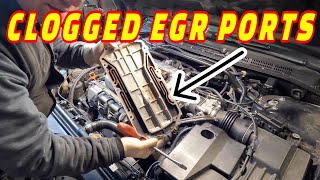
- Honda Accord, Odyssey, Pilot (V6 models) (2003-2012) — P0400 is frequently caused by carbon completely blocking the EGR distribution passage inside the intake manifold. The intake plenum must be removed and manually cleaned.
- Nissan Altima, Maxima, Frontier, Xterra (1995-2004) — Carbon buildup blocks the EGR tube and insulates the EGR temperature sensor, preventing it from detecting flow. Cleaning the sensor and tubes is the fix.
- Toyota RAV4, Hilux, Avensis (D-4D diesels) (2000-2010) — Commonly caused by a sticking EGR valve or a clogged EGR cooler on diesel engines. A sticking valve causes excessive black smoke during acceleration.
- Volkswagen / Audi Jetta, Golf, Passat (TDI engines) (2000-2015) — TDI engines are highly susceptible to heavy carbon buildup in the EGR cooler. An 'EGR adaptation' using a diagnostic tool is required after replacing components.
- Mazda Protegé, 626, MPV (1995-2005) — Similar to Ford, P0400 is frequently caused by a failed DPFE sensor or carbon-clogged EGR passages located within the throttle body assembly.
- Chevrolet Silverado, Tahoe, Suburban (Vortec V8) (2000-2008) — Often points to a carbon-fouled EGR valve. The metal tube connecting the exhaust manifold to the EGR valve develops cracks, causing an exhaust leak and loss of flow.
Manufacturer-Specific Notes
- Subaru: On 2015-2020 models, check for an ECM software update (TSB 11-200-20R) first. A simple re-program at the dealership fixes the false code, saving hundreds on unnecessary parts.
- Ford: The DPFE sensor fails more often than the EGR valve itself. Mechanics test this sensor immediately on 90s and 2000s Fords.
- Honda: For J-series V6 engines, the root cause is severe carbon blockage inside the intake manifold. Replacing the EGR valve does not fix the code; the manifold requires manual cleaning.
- Volkswagen (TDI): The EGR cooler is a frequent point of failure and clogging. An 'EGR Adaptation' using a capable scan tool is required after replacing EGR components to reset learned values.
Real Owner Stories
1998 Nissan 200sx - The Classic Misdiagnosis
Owner failed emissions test due to P0400. No other major symptoms were noted.
What they tried:
- Replaced the EGR valve, assuming it was faulty. The code returned.
Outcome: The problem was clogged EGR passages downstream from the valve, which were not cleaned during the repair.
Lesson: Never replace an EGR valve without thoroughly cleaning the carbon buildup from the mounting passages and tubes. A new valve cannot fix a clogged system.
2009 Ford Escape - Post-Repair Fault
Check Engine Light with code P0400 appeared the day after a DIY spark plug replacement requiring intake manifold removal.
What they tried:
- The owner correctly suspected the recent repair was related.
Outcome: A vacuum line was left disconnected during reassembly.
Lesson: If a code appears immediately after a repair, re-inspect your work. Check all connectors, vacuum lines, and gaskets associated with the removed parts.
2017 Subaru Impreza - The Software Glitch
At 91,000 miles, the Check Engine Light came on. The dealer diagnosed a clogged EGR valve and cooler, quoting $940.
What they tried:
- Took it to the dealer for diagnosis.
Outcome: The owner discovered TSB #11-200-20R. A simple software update fixed the overly sensitive diagnostic logic, resolving the code.
Lesson: Always check for manufacturer TSBs before starting expensive repairs. A $150 dealer re-program fixes what seems like a major hardware failure.
How to Prevent This Code From Triggering
- Use Top Tier certified gasoline (Every fill-up) — Top Tier fuels contain higher detergent concentrations, preventing carbon deposits on intake valves and reducing soot sent to the EGR system.
- Perform periodic highway driving (At least 20-30 minutes monthly) — Sustained highway speeds allow the engine to reach full operating temperature, burning off soft carbon deposits from the EGR system.
- Perform a preventative EGR system cleaning (Every 40,000-60,000 miles) — Manually removing and cleaning the EGR valve and passages prevents the system from clogging enough to trigger a P0400 code.
- Avoid extended idling (Daily habit) — Long periods of idling do not produce enough heat to keep the EGR system clean, promoting soot accumulation.
Frequently Asked Questions
Can I fix a P0400 code myself?
Yes. The most common cause is carbon buildup, which a DIY-er cleans with basic tools and carburetor cleaner. Replacing a vacuum hose or the EGR valve is also a manageable job.
What is the most common misdiagnosis for a P0400?
The biggest mistake is replacing the EGR valve without cleaning the EGR passages in the intake manifold. A new valve cannot fix the code if the pathways remain clogged with carbon.
What's the difference between P0400 and P0401?
P0400 is a general code for a flow malfunction. P0401 is specific, meaning the computer confirmed flow is insufficient. Treat P0400 as the initial warning and P0401 as the confirmation.
Will a fuel additive or EGR cleaner spray fix the P0400 code?
No. Carbon buildup in the EGR system is too heavy and baked-on for additives to dissolve. It requires manual, mechanical cleaning with wire brushes and scrapers.
My check engine light went off. Is the P0400 problem fixed?
Not necessarily. The code clears if the fault is intermittent, but the underlying carbon buildup remains. Scan the computer for history codes, as the light will return.
Can a bad O2 sensor cause a P0400 code?
It is highly unlikely. While a faulty oxygen sensor causes incorrect fuel trims, it is not a direct cause of P0400. You would have specific O2 sensor codes present.
Can a dirty MAF sensor cause P0400?
Yes, on specific systems. The PCM expects a drop in fresh air measured by the MAF when the EGR valve opens. A dirty MAF misses this drop, incorrectly setting a P0400 code.
What is an EGR delete and is it a good idea?
An EGR delete physically removes the system to prevent carbon buildup. It is illegal for on-road vehicles, causes automatic emissions failures, and leads to engine knocking if the computer isn't retuned.
My car has an EGR cooler. Could that cause a P0400?
Yes. Common on diesel engines, the EGR cooler restricts flow when its internal passages become severely clogged with soot. This is a known cause for the P0400 code.
Is it safe to drive long-term with a P0400 code?
No. The lack of EGR flow causes higher combustion temperatures. Over time, this leads to engine knock and severe damage to pistons, rings, and valves.
Key Takeaways
- Code P0400 triggers when the Powertrain Control Module (PCM) detects incorrect exhaust gas flow through the EGR system.
- Carbon buildup blocking the EGR valve or intake manifold passages causes over 70% of P0400 codes, requiring manual cleaning rather than parts replacement.
- Always inspect for cracked vacuum hoses and clean the EGR ports with carburetor cleaner before spending $200+ on a replacement valve.
- Driving with an active P0400 code increases combustion temperatures, leading to engine knock and potential catalytic converter failure costing upwards of $1,500.
Helpful Videos
Shop the Parts Behind P0400
Below are the parts most often responsible for code P0400, ranked by how frequently each one is the actual culprit (per the diagnosis above). Tap any to see what we have for your vehicle.



The information in this article is provided for general reference and educational purposes only. Vehicle specifications, procedures, and part compatibility can vary by production date, trim level, and region. Always consult your vehicle's factory service manual and verify part numbers before purchasing or performing repairs. Safety-critical components such as airbags, seat belts, and braking systems should be installed by a qualified professional.
- 🧭 Diagnostic Flowchart
- 🎬 Helpful Videos
- 🛍️ Shop This Part
- What Does P0400 Mean?
- Can I Drive With P0400?
- Common Causes
- Symptoms
- Common Fixes & Costs
- DIY vs Professional
- Used vs. New Parts: Buying Guide
- What Happens If You Wait — Timeline
- Cost of Not Fixing It
- Diagnosis Steps
- When This Code Triggers (Freeze-Frame Conditions)
- Related Codes
- Climate & Environmental Factors
- How to Talk to a Mechanic About This Code
- Where to Take It: Dealer vs Independent vs Chain
- When to Walk Away From the Repair
- What Scan Tool You Need for This Code
- How to Clear the Code After You Fix It
- Will This Fail Emissions / State Inspection?
- Most Commonly Affected Vehicles
- Manufacturer-Specific Notes
- Real Owner Stories
- 1998 Nissan 200sx - The Classic Misdiagnosis
- 2009 Ford Escape - Post-Repair Fault
- 2017 Subaru Impreza - The Software Glitch
- How to Prevent This Code From Triggering
- Frequently Asked Questions
- Can I fix a P0400 code myself?
- What is the most common misdiagnosis for a P0400?
- What's the difference between P0400 and P0401?
- Will a fuel additive or EGR cleaner spray fix the P0400 code?
- My check engine light went off. Is the P0400 problem fixed?
- Can a bad O2 sensor cause a P0400 code?
- Can a dirty MAF sensor cause P0400?
- What is an EGR delete and is it a good idea?
- My car has an EGR cooler. Could that cause a P0400?
- Is it safe to drive long-term with a P0400 code?
- Key Takeaways
- 🎟️ Get 5% Off