

P0400 on 2016-2020 Subaru Forester: EGR Flow Causes and Fixes
On a 2016-2020 Subaru Forester, code P0400 is most often caused by a software glitch, especially in cold weather. A simple ECM reprogram at the dealer often fixes it. If not, the cause is likely a carbon-clogged or faulty EGR valve.
- For a 2016-2020 Forester, your first step for a P0400 code should be to check with a dealer about a software update, especially if the code appeared in cold weather.
- If a software update doesn't apply or fix the issue, the next step is to remove and thoroughly clean the EGR valve and its passages of carbon buildup.
- If cleaning fails, the EGR valve itself is likely faulty and requires replacement. Always use a new gasket when reinstalling.
What's Unique About the 2016-2020 Subaru FORESTER
For this specific generation of Subaru Forester, the P0400 code is frequently not a sign of a bad part. Subaru has issued Technical Service Bulletins (TSBs) acknowledging that the ECM's software can mistakenly trigger a P0400 code when testing the EGR system in below-freezing temperatures. This makes a software update a primary and crucial first diagnostic step before replacing any hardware, a unique quirk for this platform and its platform-mates.
Diagnostic Flowchart
Tap your situation to follow the diagnostic path that matches what you're seeing on this vehicle.
Generation note: This range covers the late fourth generation (SJ; 2016-2018) and early fifth generation (SK; 2019-2020) Forester. The software-related cause for P0400 is documented by Subaru for both generations, indicating a persistent issue across the platform change.
Symptoms You May Notice
- Check Engine Light is on
- Surging or vibration at highway speeds, especially in high-altitude areas (specifically noted for Forester models).
- Reduced fuel economy
- Rough idling or engine hesitation.
- Engine knocking or pinging sounds.
- Stalling or near-stalling immediately after a cold start, which quickly resolves itself.
- Replacing the EGR valve immediately without checking for TSBs. Many owners could fix the issue with a simple, and sometimes free or low-cost, software update from the dealer.
- Replacing the EGR valve without performing the 'Compulsory EGR learning' procedure, which can cause the code to return even with a new part.
Most Likely Causes
- Engine Control Module (ECM) Software Error 🔴 High Probability Subaru issued TSBs #11-197-20 and #11-200-20R confirming the ECM may incorrectly test the EGR system in freezing temperatures, falsely triggering P0400. The same software update also addresses hard starting and high-altitude surging.
How to confirm: Check with a Subaru dealer to see if your vehicle's VIN has an open campaign or is eligible for the TSB reprogramming. This is especially likely if the code appears during cold weather or is accompanied by surging on the highway at altitude.
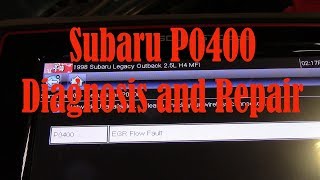
Typical fix: The dealer reprograms the ECM with updated software logic using a Subaru Select Monitor (SSM) and a battery charger/power supply to ensure stable voltage. This is not a DIY fix. 🎬 Watch: A professional walkthrough of the P0400 diagnosis and repair process.
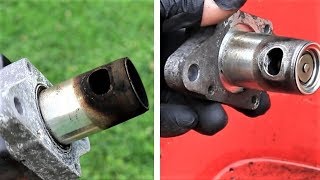
Est. part cost: $0-$0 - Clogged EGR Valve or Passages 🟡 Medium Probability → Shop Exhaust Gas Recirculation (EGR) Valve Like all EGR systems, the passages can become restricted with carbon deposits over time from exhaust gases, impeding flow. The small metal tube leading to the EGR valve is a common point of restriction.
How to confirm: Remove the EGR valve and inspect it and the connecting ports on the engine for heavy carbon buildup. A pipe cleaner or flexible wire can be used to check the connecting tubes for blockages.
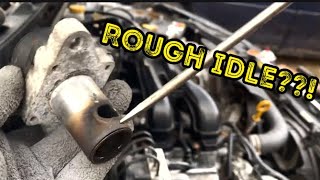
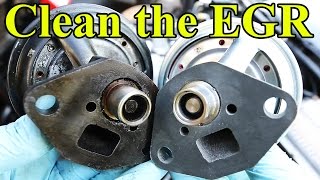
Typical fix: Remove the EGR valve and thoroughly clean it and the associated passages with a wire brush and appropriate carb/intake cleaner. 🎬 See how to clean the electronic EGR valve to fix idling. Pay special attention to cleaning out the feeder tube. Replace gaskets upon reinstallation.
Est. part cost: $5-$20 (for gaskets and cleaner) - Faulty EGR Valve ⚪ Low Probability → Shop Exhaust Gas Recirculation (EGR) Valve The valve can fail mechanically (stuck open or closed) or its electronic actuator can stop responding. This can happen from internal corrosion or carbon buildup causing the pintle to seize.
How to confirm: With a capable scan tool, command the EGR valve to open and close, observing sensor data for a response. A physical inspection can also reveal if the valve's pintle is seized; it should move with some pressure from a screwdriver.
Typical fix: Replace the EGR valve and gasket.
Est. part cost: $150-$400
Rare But Worth Checking
- Damaged or Leaking Vacuum Lines: While the 2016+ Forester uses an electronic EGR valve, older Subarus relied on vacuum-operated systems. On these older models, cracked or disconnected rubber vacuum hoses connected to the EGR solenoid or Back Pressure Transducer (BPT) were a very common cause for P0400.
- Faulty EGR-related Sensor: On older vacuum-based systems, a failed Back Pressure Transducer (BPT) was a frequent culprit for a P0400 code, even when the EGR valve itself was functional. On modern electronic systems, a faulty sensor providing incorrect temperature or pressure data to the ECM could also trigger the code, though this would often be accompanied by another sensor-specific DTC.
Diagnosis Steps
- Scan the vehicle for any other trouble codes. Address other codes first if they are present.
- Contact a Subaru dealer with your VIN to check for eligibility for TSB #11-197-20 (for 2016-2018 models) or #11-200-20R (for 2019-2020 models) regarding the ECM reprogram for P0400. This is the most likely fix, especially if the light appeared in cold weather or you've experienced high-altitude surging.
- If no TSB applies or the reprogram doesn't fix it, perform a visual inspection of the EGR valve and its wiring harness for obvious damage, cracks, or loose connections.
- Remove the EGR valve. Inspect the valve and the intake/exhaust ports for heavy carbon buildup. Use a thin wire or pipe cleaner to check the EGR tube for restrictions.
- If clogged, thoroughly clean the EGR valve and passages using a wire brush and intake cleaner. Manually actuate the valve pintle with a screwdriver while cleaning to dislodge deposits. Reinstall with a new gasket.
- If the valve is clean but suspected to be faulty, it can be tested with a scan tool that can actuate the valve. If it fails to respond, it needs replacement. A 'Compulsory EGR learning' procedure with a dealer tool may be required after replacement.
- Clear the trouble code and perform a drive cycle, including cold starts and highway driving, to see if the code returns.
Parts You'll Likely Need
- EGR Valve
(OEM #14710AA830)— If cleaning doesn't resolve the issue or the valve is mechanically/electrically failed, it must be replaced.
Trusted brands: Subaru (OEM), Denso
OEM price range: $250-$400
Aftermarket price range: $150-$250 - EGR Valve Gasket — This is a required replacement anytime the EGR valve is removed to ensure a proper seal and prevent exhaust leaks. It is often sold separately from the valve.
Trusted brands: Subaru (OEM), Fel-Pro
OEM price range: $10-$20
Aftermarket price range: $5-$15
Technical Service Bulletins (TSBs) & Recalls
- 11-197-20: Addresses P0400 being set in error during freezing temperatures on 2016-2018 2.5L Forester models and provides an ECM reprogramming fix.
- 11-200-20R: Announces ECM reprogramming files to fix P0400, hard starting, and high-altitude surging on 2019-2020 Forester models, as well as other Subaru models.
Platform-Specific Known Issues
- A known software issue can cause the P0400 code to set incorrectly in sub-freezing temperatures. Subaru TSB #11-197-20 states, "The DTC can set if the ECM tests the EGR system when ambient / intake air temperatures are below freezing."
- Subaru TSB #11-200-20R announces the availability of reprogramming files to address DTC P0400, hard starting, and a surging/vibration condition when using cruise control in high-altitude areas that is specific to the Forester.
Mechanic-Grade Diagnostic Values
- EGR Valve Internal Coil Resistance — expected: Approximately 22-23 Ohms. Failure: Significantly higher (open) or lower (short) resistance readings.
- EGR Position Sensor Reference Voltage — expected: 4.8 - 5.2 Volts. Failure: Voltage outside this range indicates a problem with the ECM or wiring.
- EGR Position Sensor Signal Voltage (Pull-up Circuit) — expected: 5 Volts. Failure: No voltage may indicate an open in the signal wire.
- EGR Position Sensor Low Reference (Ground) Circuit — expected: Battery Voltage (when testing between battery positive and the low reference pin). Failure: No voltage indicates an open in the low reference circuit back to the ECM.
Hidden / Shadow Codes Worth Checking
- Mode $06: Test of EGR system: This is not a trouble code, but a monitor within the OBD-II system that reports the status of the EGR self-test. The P0400 code is set based on the results of this test. A technician can view this to see if the monitor has completed its test. (see via Using a Subaru Select Monitor or an advanced OBD-II scan tool that can display Mode $06 data.)
Scan Tool Commands That Help
- Subaru Select Monitor (SSM): Active Test: EGR Valve Check — This function is used to manually command the EGR valve to open and close while the engine is running. A technician can observe engine RPM or other data PIDs to determine if the valve is physically operating and if there is flow.
- Subaru Select Monitor (SSM): Compulsory EGR learning — This is a critical function to be used after replacing the EGR valve. It resets the ECU's learned value for the valve's closed position voltage. Failure to perform this can result in a persistent EGR-related code (like P0409) even with a new part.
- Subaru Select Monitor (SSM): FlashWrite — This is the program used to perform the ECM reprogramming as specified in TSBs #11-197-20 and #11-200-20R to correct the software logic that falsely triggers P0400 in cold weather.
Wiring & Ground Locations
- EGR Valve Location — On the 2.5L engine, the electronic EGR valve is located underneath the intake manifold, slightly to the rear, near where the manifold runners split.. Physical access is required for inspection, cleaning, testing, and replacement. While the service manual may suggest removing the intake manifold, it is often possible to access the two 12mm bolts from underneath.
- EGR Valve Connector — A 6-pin electrical connector attached directly to the electronic portion of the EGR valve assembly.. This is the primary point for all electrical testing of the valve's motor and position sensor circuits. A wiring diagram shows pins 1, 2, and 3 connecting to ECU terminals 72, 51, and 80 respectively, carrying sensor ground, 5V reference, and signal voltage.
Real Owner Repair Stories
- uklegacy.com forum user, detailed in a how-to guide (Subaru 2.0L Diesel (demonstrates a principle applicable to modern electronic EGR valves)) — Persistent P0409 code (EGR Sensor 'A' Circuit).
❌ Tried (didn't work) Replacing the EGR valve with a new one., Clearing the code with a standard OBD-II scanner.
✅ What actually fixed it The code was only resolved after performing a "Compulsory EGR learning" procedure using a Subaru Select Monitor (dealer scan tool). The ECU had stored the closed-position voltage of the old, faulty valve and was flagging the new valve's slightly different voltage as an error. The relearn procedure reset this stored value.
When the Usual Fixes Don't Work
- While replacing a faulty or clogged EGR valve is a common fix, it is not always sufficient. In cases involving modern electronic EGR valves, the ECU learns and stores the operating parameters, such as the closed-position voltage, of the specific valve installed. A real-world repair on a Subaru showed that after replacing the EGR valve, a related code persisted because the new valve's baseline voltage was slightly different from the old one. The ultimate solution was not another hardware replacement, but a software function called 'Compulsory EGR learning' performed with a dealer-level scan tool to force the ECU to adapt to the new part. This demonstrates that for this platform, a hardware fix may require a subsequent software/adaptation step to be successful.
Model Year Variations Within This Range
- 2016-2018: These Forester models with the 2.5L engine are covered by TSB #11-197-20 for the P0400 software fix. The issue is specifically described as the ECM incorrectly testing the EGR system in freezing temperatures.
- 2019-2020: These Forester models are covered by TSB #11-200-20R. The ECM reprogram for this range addresses not only the P0400 code in freezing temperatures but also concerns of hard starting and a surging/vibration condition at high altitudes.
Helpful Videos
We Have This Part in Stock


The information in this article is provided for general reference and educational purposes only. Vehicle specifications, procedures, and part compatibility can vary by production date, trim level, and region. Always consult your vehicle's factory service manual and verify part numbers before purchasing or performing repairs. Safety-critical components such as airbags, seat belts, and braking systems should be installed by a qualified professional.
- Subaru FORESTER:
- 🧭 Diagnostic Flowchart
- 🎬 Helpful Videos
- 🛍️ Shop This Part
- What's Unique About the 2016-2020 Subaru FORESTER
- Symptoms You May Notice
- Most Likely Causes
- Rare But Worth Checking
- Diagnosis Steps
- Parts You'll Likely Need
- Technical Service Bulletins (TSBs) & Recalls
- Platform-Specific Known Issues
- Mechanic-Grade Diagnostic Values
- Hidden / Shadow Codes Worth Checking
- Scan Tool Commands That Help
- Wiring & Ground Locations
- Real Owner Repair Stories
- When the Usual Fixes Don't Work
- Model Year Variations Within This Range
- 🎟️ Get 5% Off