

P0401 on 2009-2010 Dodge Challenger 3.5L: EGR Insufficient Flow Causes and Fixes
On the 2009-2010 Challenger 3.5L, P0401 is most often caused by carbon buildup clogging the EGR passages or a faulty EGR valve. The fix usually involves cleaning the passages or replacing the EGR valve, which requires removing the upper intake manifold for access. An aftermarket valve costs around $60-$90, while an OEM part is $280+.
- The most likely cause of P0401 on this engine is not a bad part, but a blockage. Always inspect and clean the EGR passages in the intake manifold.
- Accessing the EGR valve and passages requires removing the upper intake manifold, making the job moderately difficult (3/5) and taking 2-3 hours.
- To avoid having to do the job twice, consider replacing the EGR valve while you have everything apart, even if it hasn't completely failed.
- An aftermarket EGR valve is significantly cheaper ($60-$100) than the OEM Mopar part ($280+), and is a viable option for this repair.
What's Unique About the 2009-2010 Dodge Challenger
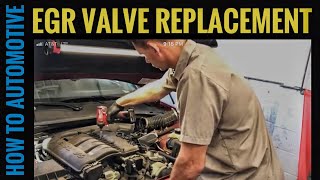
The 3.5L V6 engine used across several Chrysler/Dodge platforms of this era (Challenger, Charger, 300, Magnum) is known for developing carbon deposits. For the P0401 code, this often means the problem isn't the EGR valve itself, but rather the passages within the intake manifold getting clogged with soot. Technicians and experienced owners often find that simply replacing the valve without cleaning these passages will not resolve the issue. A video guide for the platform confirms the need to remove the upper intake manifold 🎬 Watch: Step-by-step guide to removing the manifold and EGR valve. for access to both the valve and the passages.
Symptoms You May Notice
- Check Engine Light is on
- Engine pinging or knocking, especially during acceleration or under load
- Rough idle or stalling
- Reduced engine power and acceleration
- Decreased fuel economy
- Failure to pass an emissions test
- Replacing the EGR valve without cleaning the intake manifold passages. This is the most common mistake. The new valve will not be able to flow exhaust gas if the path is blocked, and the P0401 code will return quickly.
Most Likely Causes
- Clogged EGR Passages in Intake Manifold 🔴 High Probability → Shop Engine Intake Manifold The design of the 3.5L V6 intake can allow carbon from exhaust gases to build up over time, eventually restricting or completely blocking the small ports the EGR system uses. This is a well-documented issue across the entire platform.
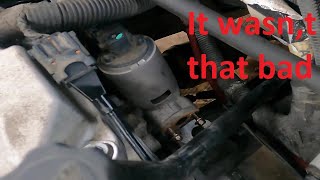
How to confirm: After removing the upper intake manifold and EGR valve, visually inspect the EGR port inside the intake manifold. It will likely be packed with hard, black carbon deposits. 🎬 See what a clogged EGR passage looks like in person. You can use a small pick or wire to probe the passage and confirm the blockage.
Typical fix: The upper intake manifold must be removed to gain access to the passages for thorough cleaning. Use carburetor cleaner, small brushes, and picks to scrape 🎬 Watch: A clever trick for cleaning out stubborn carbon buildup. and dissolve all carbon buildup until the passages are clear. This is a mandatory step when servicing the EGR system on this engine.
Est. part cost: $10-$20 for cleaning supplies and new gaskets. - Faulty or Sticking EGR Valve 🟡 Medium Probability → Shop Exhaust Gas Recirculation (EGR) Valve The EGR valve itself can become clogged with carbon, causing the internal pintle to stick closed. The electronic solenoid that controls the valve can also fail internally, which is a common failure mode for this part.
How to confirm: With a capable scan tool, command the EGR valve to open while the engine is idling; the engine should stumble or run rough. If there is no change in idle quality, it points to a blockage or a failed valve. If the passages are confirmed to be clean but the test still fails, the valve is likely bad.
Typical fix: Replace the EGR valve. This requires removing the upper intake manifold for access. It is highly recommended to clean the EGR passages at the same time. Some owners have attempted to replace the valve from underneath the car without removing the intake, but this is extremely difficult and not recommended.
Est. part cost: $60-$100 for an aftermarket valve, $280-$330 for an OEM Mopar valve.
Rare But Worth Checking
- Cracked or Clogged EGR Tube: The metal tube that connects the exhaust manifold to the EGR valve can become clogged or, less commonly, crack. Inspect it for blockages and integrity when you have the EGR valve removed.
- PCM Software Issue: Chrysler issued TSB #18-008-10 for 2010 Challengers (built before 02/20/2010) with the 3.5L engine for readiness monitor issues and other codes. While P0401 is not listed directly, a PCM reflash could solve unusual diagnostic problems if all mechanical parts check out.
Diagnosis Steps
- Scan for Codes: Use an OBD-II scanner to confirm P0401 is the only code present. If other codes exist, address them first.
- Initial Inspection: Visually inspect the EGR valve area (located under the intake manifold on the rear of the engine) for any obvious issues like disconnected vacuum lines (if applicable) or damaged wiring.
- Test EGR Valve with Scan Tool (Optional): If you have a bidirectional scan tool, command the EGR valve to open at idle. A functioning system with clear passages will cause the engine to stumble or stall. If there's no change, you have a blockage or a bad valve.
- Remove Upper Intake Manifold: To access the EGR system for further diagnosis, you must remove the plastic upper intake manifold plenum. Several video guides detail this process, which involves removing the throttle body (without unplugging), loosening support brackets, and disconnecting various hoses and sensors.
- Inspect EGR Passages: Once the intake is off, you will have a clear view of the EGR port. Inspect it for carbon buildup. This is the most likely culprit.
- Clean Passages: If clogged, thoroughly clean the EGR passages using carburetor cleaner, gaskets scrapers, and small brushes until they are completely clear.
- Inspect/Clean EGR Valve and Tube: Remove the EGR valve and the tube connecting it to the exhaust. Clean them of any carbon deposits. If the valve's pintle seems stuck or the solenoid is suspect, it's best to replace it.
- Reassembly: Reassemble everything with new gaskets for the intake manifold and EGR valve. Torque the intake manifold bolts to 105 in-lbs (12 N·m).
- Clear Codes and Test Drive: Clear the P0401 code with your scanner and perform a test drive, ensuring you meet the conditions for the EGR monitor to run (usually steady-state cruising), to confirm the fix. A specific drive cycle for some Chrysler products involves a long deceleration from 50 to 20 MPH to trigger the EGR monitor.
Parts You'll Likely Need
- EGR Valve
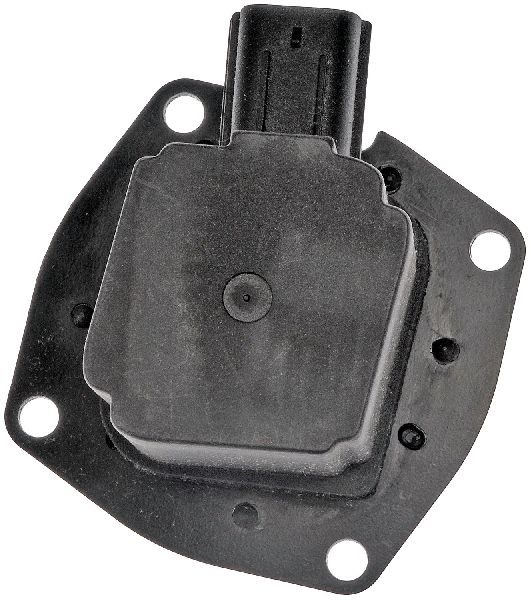
(OEM #4593892AA)— This is the second most common failure point after clogged passages. The valve can get stuck closed or the electronic solenoid can fail. It's often replaced as a preventative measure when cleaning the passages due to the high labor involved.
Trusted brands: Mopar, Dorman, Standard Motor Products, Delphi
OEM price range: $280-$330
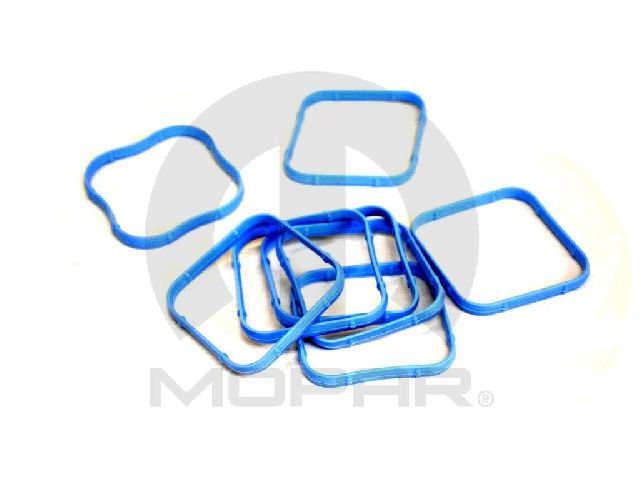
Aftermarket price range: $60-$100 - Upper and Lower Intake Manifold Gasket Set — The upper intake manifold must be removed to access the EGR valve and passages. The gaskets are single-use and must be replaced to prevent vacuum leaks.
Trusted brands: Fel-Pro, Mahle, Victor Reinz
OEM price range: $30-$50
Aftermarket price range: $15-$30 - EGR Valve Gasket — A new gasket is required when replacing or reinstalling the EGR valve to ensure a proper seal. Most new EGR valves include one.
Trusted brands: Fel-Pro, Mopar
OEM price range: $5-$10
Aftermarket price range: $2-$5
Technical Service Bulletins (TSBs) & Recalls
- TSB #18-008-10: Applies to 2010 models built before 02/20/2010. Addresses a PCM reflash for readiness monitor failures and certain EVAP/sensor codes. While not directly for P0401, it's a relevant software update for the emissions system on this vehicle.
- TSB Bulletin #18-092-16: While issued for other Dodge models like the Nitro, this bulletin specifically links P0401 (EGR System Performance) to symptoms including hard starting, long crank times, or a no-start condition.
- TSB Bulletin #68142905A: A manufacturer service bulletin for the 3.6L Pentastar engine (found in Durango/Grand Cherokee) advises technicians to contact engineering before replacing components for P0401, highlighting the complexity of diagnosing this code across the Dodge lineup.
Mechanic-Grade Diagnostic Values
- EGR Valve Connector Pin 2 (5-Volt Supply) — expected: Approximately 5.0 volts with key on, engine off.. Failure: 0V or significantly low voltage points to a wiring or PCM fault. A voltage drop over 0.5V when the valve is operating suggests high resistance.
- EGR Valve Connector Pin 1 (Position Sensor Signal) — expected: Approximately 0.5V to 0.9V with the valve closed (at idle). Voltage should rise towards 3.5V-4.5V as a scan tool commands the valve to open.. Failure: Voltage stuck high, low, or not changing when the valve is commanded open indicates a faulty position sensor inside the EGR valve or a wiring issue.
Scan Tool Commands That Help
- wiTECH or equivalent bidirectional scanner: EGR System Test / Actuator Test — Use this command with the engine at idle to manually open the EGR valve. If the passages are clear and the valve is working, the engine's idle will become rough, stumble, or stall. If there is no change in idle quality, it confirms either a complete blockage or a non-functional EGR valve.
Wiring & Ground Locations
- EGR Valve Connector — At the EGR valve, located on the rear of the passenger-side cylinder head, under the upper intake manifold.. This 6-pin connector is the central point for all electrical signals to the valve. Corrosion or damage to the pins can cause P0401 or other EGR codes. The pinout is: Pin 1 (EGR Signal), Pin 2 (5V Supply), Pin 3 (Sensor Ground), Pin 4 (Ground), Pin 5 (Not Used), Pin 6 (EGR Solenoid Control).
- G105 — A primary ground point located on the rear of the engine.. Wiring diagrams for the 3.5L platform indicate the EGR valve's main ground circuit (from Pin 4) terminates at G105. A loose or corroded connection at this ground point can cause erratic EGR operation and trigger codes even if the valve itself is good.
Real Owner Repair Stories
- YouTube video comment/narrative (2005 Chevrolet Malibu 3.5L (similar engine design and issue)) — Check Engine Light with code P0401.
❌ Tried (didn't work) Replacing the EGR valve, Replacing the EGR tube
✅ What actually fixed it The code returned after replacing parts. The final fix was removing the upper intake manifold and finding the EGR passage was completely packed with hard carbon. Cleaning the passage resolved the P0401 code.
OEM Part Supersession History
4593834AC→4593892AA— Part consolidation and potential design improvement by the manufacturer.
Model Year Variations Within This Range
- 2010 (built before 02/20/2010): A PCM software update (TSB #18-008-10) was issued for these vehicles to address emissions readiness monitor issues. While not directly for P0401, it indicates a software change that could affect emissions system diagnostics compared to 2009 models or later 2010 builds.
Diagnostic Flowchart
Other Known Issues on This Vehicle
Issues unrelated to this code that are worth knowing about as an owner of this generation:
- Timing Belt Failure 🔴 High — The belt has a service interval of approximately 100,000-105,000 miles or 7-8.5 years. Failure is common on vehicles that exceed this interval.
- Rocker Arm Shaft / Ticking Noise 🟠 Medium — Common issue that can develop around 100,000 miles, causing a loud ticking or tapping noise from the engine.
- Shifter Stuck in Park ('Pink Thingy' Failure) 🟡 Low — Very common across the Chrysler LX platform (Challenger, Charger, 300, Magnum) with the 5-speed automatic transmission.
- Front Suspension Clunks (Tension Struts) 🟠 Medium — Common as the vehicle ages, typically over 100,000 miles. Owners report clunking or rattling from the front end over bumps at low speeds.
- Totally Integrated Power Module (TIPM) Failure 🔴 High — A well-known issue across many Chrysler/Dodge/Jeep vehicles of this era, though frequency varies.
Used vs. New Parts: Buying Guide for This Vehicle
When a used part is the smart pick: A used part is generally NOT recommended for the EGR valve due to the high labor cost of access and the electronic/wear nature of the part. A used upper intake manifold is a viable option only if the original is physically cracked, which is uncommon.
Donor-vehicle mileage cap: roughly under 80000 miles for the part to have meaningful remaining life.
What to inspect on the donor part:
- For a used intake manifold, inspect thoroughly for any hairline cracks, especially around bolt holes and seams.
- Ensure all threaded inserts are intact and not stripped.
- Avoid any parts showing signs of previous epoxy or plastic weld repairs.
OEM-only on this vehicle (don't cheap out):
- EGR Valve: Due to the significant labor required for replacement, using an OEM Mopar valve (4593892AA) is strongly recommended to avoid premature failure and repeat repairs.
Aftermarket brands forum-validated for this vehicle:
- Gaskets: Fel-Pro, Mahle, Victor Reinz are reputable brands for intake and EGR gaskets.
- EGR Valve: Standard Motor Products (SMP) / BWD and Delphi are generally considered reliable aftermarket alternatives to OEM.
Brands owners have reported issues with on this vehicle:
- Dorman: Some owners on related platforms have reported sporadic issues and shorter lifespan with Dorman-branded EGR valves compared to OEM or other premium aftermarket brands.
Real Owner Stories
Aggregated from forums and TSBs cited above. Mileages and costs reflect what owners reported in those sources.
2009 Dodge Challenger 3.5L V6
Symptoms: Owner experienced a clunking noise in the front suspension when driving over bumps at low speeds.
What fixed it: Diagnosis and replacement of a failed tension strut.
Source hint: Car Talk Community - '2009 Dodge Challenger tension strut'
2006 Dodge Charger R/T (LX Platform)
Symptoms: The shifter became stuck in Park and could not be moved.
What fixed it: Replacement of the broken plastic shift interlock piece (the 'pink thingy') with a metal aftermarket part.
Source hint: Reddit r/Dodge - 'So my 06 Charger R/T's pink thingy broke'
3.5L V6 Challenger — ~105000 miles
Symptoms: The engine was destroyed due to a mechanical failure of the timing system.
What fixed it: Engine replacement was required because the 3.5L is an interference engine.
Source hint: Reddit r/MechanicAdvice - 'When to change the timing belt'
Related OBD-II Codes
Frequently Asked Questions
Does TSB #18-008-10 apply to my 2010 Dodge Challenger 3.5L V6?
Can I replace the EGR valve on my 3.5L Challenger without removing the intake manifold?
Why is my 3.5L V6 engine pinging or knocking during acceleration along with the P0401 code?
Is it enough to just replace the EGR valve to fix P0401 on this vehicle?
What is the torque specification for the intake manifold bolts when reassembling after an EGR cleaning?
Are there other common issues on the Challenger LX platform I should look out for while fixing this?
Helpful Videos


We Have This Part in Stock


The information in this article is provided for general reference and educational purposes only. Vehicle specifications, procedures, and part compatibility can vary by production date, trim level, and region. Always consult your vehicle's factory service manual and verify part numbers before purchasing or performing repairs. Safety-critical components such as airbags, seat belts, and braking systems should be installed by a qualified professional.
- Dodge Challenger:
- 🧭 Diagnostic Flowchart
- 🎬 Helpful Videos
- 🛍️ Shop This Part
- What's Unique About the 2009-2010 Dodge Challenger
- Symptoms You May Notice
- Most Likely Causes
- Rare But Worth Checking
- Diagnosis Steps
- Parts You'll Likely Need
- Technical Service Bulletins (TSBs) & Recalls
- Mechanic-Grade Diagnostic Values
- Scan Tool Commands That Help
- Wiring & Ground Locations
- Real Owner Repair Stories
- OEM Part Supersession History
- Model Year Variations Within This Range
- Other Known Issues on This Vehicle
- Used vs. New Parts: Buying Guide for This Vehicle
- Real Owner Stories
- 2009 Dodge Challenger 3.5L V6
- 2006 Dodge Charger R/T (LX Platform)
- 3.5L V6 Challenger — ~105000 miles
- Related OBD-II Codes
- Frequently Asked Questions
- 🎟️ Get 5% Off