

P0401 on 2010-2012 Ford Escape 3.0L V6: EGR Flow Insufficient Causes and Fixes
On a 2010-2012 Escape 3.0L, code P0401 is most often caused by a clogged EGR tube passage or a failed DPFE sensor. Cleaning the tube is often a no-cost fix, while a new DPFE sensor costs around $40-$80. Always check these two items before considering replacing the more expensive EGR valve.
- For a P0401 code on this Escape, do not immediately buy a new EGR valve.
- The most likely causes are a clogged EGR tube or a failed DPFE sensor, both of which are cheaper and easier to fix.
- Start your diagnosis by checking the DPFE sensor's voltage with the key on, engine off. A reading above 1.5V strongly points to a bad sensor.
- If the sensor voltage is normal, remove the EGR valve and inspect the transfer tube for a complete carbon blockage. This is a very common problem.
- Cleaning the EGR tube costs almost nothing in parts and often resolves the code.
What's Unique About the 2010-2012 Ford Escape
The 3.0L V6 in this generation of Ford Escape uses an electronic EGR valve but relies on a separate sensor to measure gas flow—the Differential Pressure Feedback EGR (DPFE) sensor. This DPFE sensor and the small tube connecting the EGR valve to the intake manifold are well-documented weak points. Owners frequently find the EGR tube completely blocked with carbon, or the DPFE sensor fails electronically, leading them to mistakenly replace the more expensive EGR valve when the true cause is a clog or a bad sensor reading.
Symptoms You May Notice
- Check Engine Light is on
- Engine pinging or knocking, especially when accelerating or going uphill
- Rough or unstable idle
- Hesitation or stumbling during acceleration
- Reduced fuel economy
- Failure to pass an emissions/smog test
- Bucking and hesitation when driving in overdrive up a hill.
- Replacing the EGR valve when the actual fault is a clogged EGR tube or a failed DPFE sensor. Always diagnose the cheaper and more common failures first.
Most Likely Causes
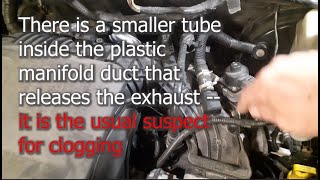
- Clogged EGR Tube/Passage 🔴 High Probability The design of the EGR system on the 3.0L V6 includes a small tube that connects the EGR valve to the intake manifold. This tube is highly susceptible to becoming completely blocked with hard carbon deposits over time, which is the most common cause of P0401.
How to confirm: Remove the EGR valve and the connecting tube. Visually inspect the tube for blockage. Often, the small opening will be completely plugged with carbon. A pipe cleaner or small wire should not be able to pass through.
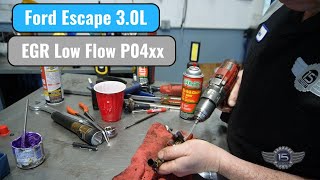
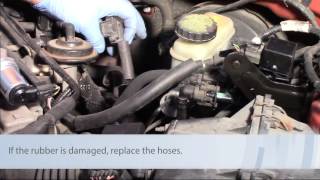
Typical fix: Thoroughly clean the carbon out of the tube using a small pick, wire brush, and carburetor cleaner until the passage is clear. Replace the associated gaskets 🎬 See this walkthrough on cleaning carbon from the EGR tube. upon reassembly.
Est. part cost: $5-$15 for gaskets - Faulty DPFE Sensor 🔴 High Probability The DPFE (Differential Pressure Feedback EGR) sensor is a known high-failure item on many Ford vehicles of this era. It lives in a harsh environment and its internal electronics fail, causing it to send incorrect voltage signals to the PCM. A failed sensor can send a constant low or high voltage, tricking the PCM into thinking there is no EGR flow even when there is.
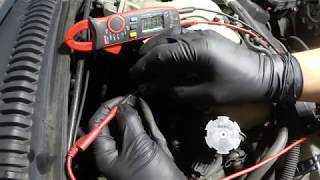
How to confirm: With the key in the 'on' position but the engine off, use a multimeter to back-probe the sensor's signal wire (typically the middle wire). 🎬 Watch: How to diagnose and fix a faulty DPFE sensor. The reading should be between 0.5 and 1.2 volts. A reading significantly higher (e.g., 1.9V or more) or lower (e.g., 0.12V) indicates a failed sensor.
Typical fix: Replace the DPFE sensor. It is typically held on by two 8mm or 10mm bolts and is easy to access. Be gentle when removing the old silicone hoses as they can be brittle.
Est. part cost: $40-$80 - Faulty EGR Valve 🟡 Medium Probability → Shop Exhaust Gas Recirculation (EGR) Valve The valve can become clogged with carbon and get stuck closed, or the integrated electronic solenoid can fail. While less common than a clogged tube or bad DPFE, it is still a frequent cause.
How to confirm: After confirming the passages are clear and the DPFE sensor is good, the valve is the next suspect. With a capable scan tool, you can command the EGR valve to open at idle; if it's working, the engine should stumble or stall. If there is no change in idle, the valve is not opening. You can also manually apply vacuum to the valve with the engine running to see if the idle drops.
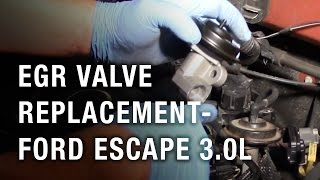
Typical fix: Replace the EGR valve and gasket. Cleaning is sometimes possible for carbon issues but will not fix an electronic failure. A 1 1/16-inch crow's foot wrench is often needed to remove the large tube nut.
Est. part cost: $80-$200 - Cracked or Burnt DPFE Sensor Hoses ⚪ Low Probability The two small rubber hoses connecting the DPFE sensor to the EGR tube are exposed to intense heat and can become brittle, cracked, or burnt over time, causing a pressure leak.
How to confirm: Visually inspect the hoses for any signs of cracking, melting, or splitting. Ensure they are securely attached at both ends. Squeeze them to check for brittleness.
Typical fix: Replace the hoses with new, heat-resistant silicone hoses. It is good practice to replace these whenever replacing the DPFE sensor.
Est. part cost: $10-$20
Rare But Worth Checking
- Damaged wiring to EGR Valve or DPFE Sensor: → Shop Exhaust Gas Recirculation (EGR) Valve A wire can break inside the insulation right at the connector due to engine vibration. This can cause an electrical fault code (like P1409) but can sometimes contribute to a P0401 if the valve isn't being commanded correctly or the DPFE signal is lost.
- Faulty Powertrain Control Module (PCM): → Shop Engine Control Module (ECM) In very rare cases, the PCM itself can be the source of the problem, failing to correctly interpret sensor signals or command the EGR valve. This should only be considered after all other possibilities have been exhaustively ruled out.
Technical Service Bulletins (TSBs) & Recalls
While the 2010-2012 Escape is primarily known for carbon clogs and DPFE failures, manufacturer records for related Ford platforms highlight other potential P0401 triggers. Manufacturer Bulletin #SSM 48345 notes that an illuminated MIL with DTC P0401 may be due to an EGR Cooler leaking coolant into the engine intake and exhaust systems, which may also cause white smoke from the tailpipe or over-temperature warnings. Similarly, Bulletin #21M04 describes instances where the EGR cooler becomes plugged, specifically triggering P0401. For some Ford vehicles, Bulletin #TSB 19-2343 indicates that P0401 may be due to various strategies within the powertrain control module (PCM) software, requiring a software update to correct the condition. Additionally, cross-manufacturer reference Bulletin #TSB 24-2263 mentions that P0401 can be accompanied by engine cooling system symptoms including internal or external leaks.
Diagnosis Steps
- Read the trouble codes with an OBD-II scanner.
- Check the DPFE sensor voltage. With the key on and engine off, back-probe the sensor's signal wire. If the voltage is significantly outside the 0.5V-1.2V range, the sensor has likely failed and should be replaced.
- Inspect the two small hoses running to the DPFE sensor for cracks, melting, or loose connections.
- If the sensor and hoses are good, the next step is to inspect for a blockage. Allow the engine to cool completely.
- Remove the electronic EGR valve. This typically involves removing two bolts and a large nut on the exhaust tube. A 1 1/16-inch crow's foot wrench is highly recommended for the tube nut.
- Once the valve is off, remove and inspect the EGR transfer tube that goes into the intake manifold. This is the most likely place to find a complete carbon blockage.
- If the tube is blocked, clean it thoroughly with picks and cleaner. Also inspect the ports on the intake manifold and EGR valve itself for carbon buildup.
- If all passages are clear, the EGR valve itself may be faulty. Test it by commanding it open with a scan tool or by manually applying vacuum to its port while the engine is idling; the engine should stumble or stall. If there's no change, the valve is not opening.
- After the repair, clear the codes and perform a drive cycle, typically involving steady cruising around 50 mph, to allow the PCM to verify the fix.
Parts You'll Likely Need
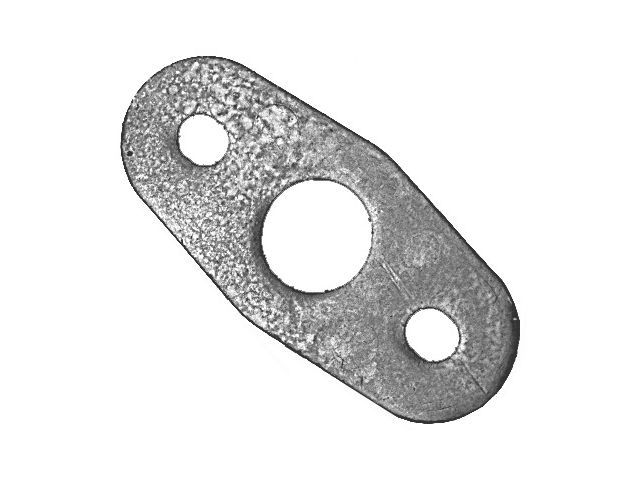
- EGR Tube Gasket
(OEM #9L8Z-9E936-A)— Required whenever the EGR tube or valve is removed for cleaning or inspection to prevent exhaust leaks.
Trusted brands: Fel-Pro, Motorcraft
OEM price range: $5-$10
Aftermarket price range: $2-$5 - DPFE Sensor
(OEM #DPFE4 (Motorcraft Service Part))— This is a very common failure point that directly causes a P0401 code by sending incorrect flow data to the computer.
Trusted brands: Motorcraft, Standard Motor Products, Dorman
OEM price range: $70-$100
Aftermarket price range: $40-$80 - EGR Valve
(OEM #9L8Z-9D475-B)— This is the third most likely cause, failing either by getting stuck with carbon or an internal electronic fault.
Trusted brands: Motorcraft, Delphi, Walker Products, SKP
OEM price range: $150-$200
Aftermarket price range: $80-$160
Related Codes That Often Appear With This One
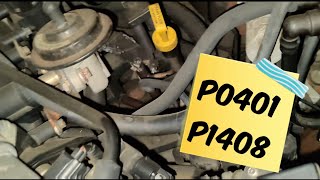
- P1408 — This is a Ford-specific code for 'EGR Flow Out of Self-Test Range,' which is often triggered during a key-on-engine-running (KOER) self-test when a P0401 condition exists.
- P0400 — This is a more general code for 'EGR Flow Malfunction.' P0401 is a more specific version, and they share the exact same causes on this vehicle.
- P1401 — This Ford-specific code indicates 'DPFE Sensor Circuit High Input,' which directly points to a common failure mode of the DPFE sensor that can also trigger P0401.
Mechanic-Grade Diagnostic Values
- DPFE Sensor Signal Voltage (Key On, Engine Off) — expected: 0.5V to 1.2V. Failure: A reading near 0V or above 1.5V (e.g., 1.97V) indicates a failed sensor.
- DPFE Sensor Reference Voltage — expected: ~5.0V. Failure: If reference voltage is missing, suspect a wiring or PCM issue, not a sensor failure.
- DPFE Sensor Signal Voltage (Forcing EGR open at 1500 RPM) — expected: Voltage should rise to approximately 4.0V. Failure: If the engine stumbles but the voltage does not rise, the DPFE sensor is faulty.
- EGR Vacuum Regulator (EVR) Solenoid Coil Resistance (on related Ford systems) — expected: Approximately 26 to 40 Ohms. Failure: An infinite reading (open circuit) or near-zero reading (short circuit) indicates a failed solenoid.
Hidden / Shadow Codes Worth Checking
- P1408: EGR Flow Out Of Self-Test Range. This code is often set specifically when running the Key-On-Engine-Running (KOER) self-test and a P0401 fault condition is present. (see via Ford IDS, FORScan, or other advanced scan tools capable of initiating a KOER self-test.)
Scan Tool Commands That Help
- Ford IDS, FORScan, Autel/Snap-on: EGR Valve Duty Cycle / EGRVR Command — Use this bidirectional control at idle to command the EGR valve open. The engine RPM should drop significantly or stall. If there is no change in idle, it confirms either a stuck/failed EGR valve or a completely blocked passage.
- Ford IDS, FORScan, Autel/Snap-on: KOER (Key-On-Engine-Running) Self-Test — This comprehensive test runs the vehicle's onboard diagnostics through their paces. For a P0401 issue, it will often fail the EGR monitor portion and flag the companion code P1408, confirming the PCM is actively detecting the flow fault during its own test sequence.
Real Owner Repair Stories
- F150online Forums (2002 Ford F-150 4.6L (similar DPFE system)) — P0401 code, then months later a sudden crank-no-start condition.
❌ Tried (didn't work) Replaced fuel pump, Replaced computer (PCM/ECM)
✅ What actually fixed it A cheap, generic aftermarket DPFE sensor purchased from Amazon had internally short-circuited, preventing the PCM from communicating and causing the no-start. Replacing the failed aftermarket sensor with a quality part resolved all issues. - Ford Forum (2003 Ford Escape 3.0L V6, 160,000 miles) — P0401, hesitation at idle, severe bucking and hesitation in overdrive going uphill. Symptoms were much better in cold weather (<50°F).
❌ Tried (didn't work) The user was diagnosing before replacing parts.
✅ What actually fixed it The user confirmed clear EGR passages by manually applying vacuum to the EGR valve at idle, which caused the engine to stumble correctly. They also measured the DPFE sensor voltage at 0.9V KOEO, which is within the normal range. The forum thread did not have a final resolution post, but the diagnostic steps correctly ruled out a clogged passage and pointed towards further diagnosis of the DPFE under load or the EGR valve itself.
OEM Part Supersession History
9L8Z-9D475-A→9L8Z-9D475-B (also listed as CX2442)— Standard part revision by the manufacturer.
Heads up: The parts are interchangeable for the 2009-2012 3.0L V6. Part 9L8Z-9D475-B is specified for use up to 12/21/2011.
Model Year Variations Within This Range
- 2009-2012: The 2009 model year 3.0L V6 had some issues with VCT solenoids, but this is unrelated to the P0401 code. For the EGR system specifically, there are no significant documented changes or part differences between 2010, 2011, and 2012 models.
Diagnostic Flowchart
Other Known Issues on This Vehicle
Issues unrelated to this code that are worth knowing about as an owner of this generation:
- Rusted Rear Shock Towers 🔴 High — Very common, especially in regions that use road salt. The passenger side (right rear) tends to rust through first. Can occur under 100,000 miles. (Ref: No TSB or recall, but aftermarket repair panels (e.g., Dorman 924-358) are widely available due to the issue's prevalence.)
- 6F35 Transmission Failure/Harsh Shifting 🔴 High — Widespread issue affecting this generation. Symptoms include shuddering, slipping, delayed engagement, and complete failure, often before 100,000-150,000 miles. (Ref: No recall, but the subject of multiple class-action lawsuits. Ford has issued various TSBs over the years for software updates and specific component failures.)
- Electronic Throttle Body (ETB) Failure 🟠 Medium → Shop Fuel Injection Throttle Body — Common failure causing the vehicle to suddenly enter a low-power 'limp mode,' often with codes P2111 or P2112. Can happen at any mileage. (Ref: No recall, but Ford issued Customer Satisfaction Program 13N03, extending the ETB warranty to 10 years/150,000 miles. This program has expired but confirms the high failure rate.)
- Cracked Fuel Delivery Module (FDM) Flange 🔴 High — Affects 2010-2012 models with the 3.0L engine, leading to a fuel leak and strong fuel smell. (Ref: NHTSA Recall 16V777000 (Ford recall 16S41). Dealers were instructed to replace the FDM flange.)
Used vs. New Parts: Buying Guide for This Vehicle
When a used part is the smart pick: A used EGR valve from a documented low-mileage donor vehicle can be a cost-effective option, provided it is thoroughly cleaned and inspected for free movement before installation. Structural parts like the EGR tube can also be sourced from a junkyard.
Donor-vehicle mileage cap: roughly under 75000 miles for the part to have meaningful remaining life.
What to inspect on the donor part:
- For an EGR valve, check that the pintle moves freely and is not seized.
- Inspect EGR tubes for heavy rust or corrosion that could compromise integrity.
- Verify the donor vehicle was not in a severe front-end collision that could have damaged the component.
OEM-only on this vehicle (don't cheap out):
- DPFE Sensor: It is strongly recommended to use an OEM Motorcraft DPFE sensor. Aftermarket sensors, especially cheap unbranded ones, are notorious for failing prematurely, having incorrect voltage outputs out of the box, or even causing severe issues like no-start conditions due to internal short circuits.
Aftermarket brands forum-validated for this vehicle:
- EGR Valve: Delphi, Standard Motor Products (SMP), and Walker are generally considered reliable aftermarket alternatives to Motorcraft.
- DPFE Sensor: If Motorcraft is unavailable, Standard Motor Products or Ultra-Power are cited as better-quality aftermarket options.
Brands owners have reported issues with on this vehicle:
- Unbranded 'generic' or 'no-name' DPFE sensors from online marketplaces like Amazon or eBay should be avoided. Forum users have reported these parts failing within months and causing complex diagnostic problems that lead to much higher repair costs.
Real Owner Stories
Aggregated from forums and TSBs cited above. Mileages and costs reflect what owners reported in those sources.
2003 Ford Escape 3.0L V6
Symptoms: Bucking and hesitation going up a hill in overdrive; symptoms seemed to improve in colder weather.
What fixed it: The owner performed a diagnostic check of the DPFE voltage (0.9V KOEO) and manually applied vacuum to the EGR valve, which caused the engine to stumble, indicating the passages were clear and the valve was functional.
Source hint: ford-forum.com: A user with a 2003 Escape 3.0L V6 described classic P0401 symptoms including bucking and hesitation going up a hill in overdrive
2010-2011 Mazda Tribute 3.0L V6
Symptoms: P0401 code triggered on this platform-mate; owners discussed the need to verify sensor and hose integrity.
What fixed it: Checking the DPFE sensor and hoses first, then inspecting for clogged EGR passages before replacing the valve.
Source hint: mazdaforum.com: Multiple threads discuss P0401 on the Mazda Tribute 3.0L V6
Related OBD-II Codes
Frequently Asked Questions
Is there a specific tool needed to remove the EGR valve on my 3.0L V6 Escape?
I'm seeing P0401 and my Escape bucks when driving uphill in overdrive. Is this related?
Can I just clean the EGR components instead of buying new parts?
How can I test if my DPFE sensor is bad using a multimeter?
Does the 2010-2012 Ford Escape have a warranty extension for the throttle body issues that might cause similar symptoms?
Are there any other common mechanical failures I should look out for on this generation of Escape?
Helpful Videos
We Have This Part in Stock


The information in this article is provided for general reference and educational purposes only. Vehicle specifications, procedures, and part compatibility can vary by production date, trim level, and region. Always consult your vehicle's factory service manual and verify part numbers before purchasing or performing repairs. Safety-critical components such as airbags, seat belts, and braking systems should be installed by a qualified professional.
- Ford Escape:
- 🧭 Diagnostic Flowchart
- 🎬 Helpful Videos
- 🛍️ Shop This Part
- What's Unique About the 2010-2012 Ford Escape
- Symptoms You May Notice
- Most Likely Causes
- Rare But Worth Checking
- Technical Service Bulletins (TSBs) & Recalls
- Diagnosis Steps
- Parts You'll Likely Need
- Related Codes That Often Appear With This One
- Mechanic-Grade Diagnostic Values
- Hidden / Shadow Codes Worth Checking
- Scan Tool Commands That Help
- Real Owner Repair Stories
- OEM Part Supersession History
- Model Year Variations Within This Range
- Other Known Issues on This Vehicle
- Used vs. New Parts: Buying Guide for This Vehicle
- Real Owner Stories
- 2003 Ford Escape 3.0L V6
- 2010-2011 Mazda Tribute 3.0L V6
- Related OBD-II Codes
- Frequently Asked Questions
- 🎟️ Get 5% Off