

P0401 on 2002-2005 Ford Explorer 4.0L: EGR Insufficient Flow Causes and Fixes
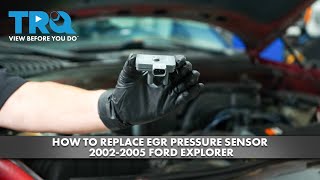
On a 2002-2005 Explorer with the 4.0L V6, code P0401 is most often caused by a failed DPFE sensor. This is a common failure item that is relatively easy to replace. The original metal-cased sensors are notoriously failure-prone and were superseded by a more reliable plastic-cased design. Expect to pay $40-$80 for a quality aftermarket or OEM sensor and replace it yourself in under 30 minutes.
- For a P0401 on a 2002-2005 Explorer 4.0L, suspect the DPFE sensor first; it's the most common cause.
- Always inspect the two small hoses connected to the DPFE sensor for cracks, holes, or blockages.
- If a new DPFE sensor doesn't fix the code, the next step is to check for and clean out carbon-clogged EGR passages in the intake manifold.
- Do not replace the EGR valve itself unless you have specifically tested it and confirmed it is faulty.
What's Unique About the 2002-2005 Ford Explorer
The 2002-2005 Ford Explorer with the 4.0L SOHC engine uses a DPFE (Differential Pressure Feedback EGR) sensor to measure EGR flow, and this specific part is a notoriously common point of failure. Unlike some systems that infer flow from other sensors, this Ford design directly measures pressure changes in the EGR tube. Because the DPFE sensor is constantly exposed to hot, corrosive exhaust gases and condensation, its internal components (especially the original metal-cased versions) degrade over time, making it a maintenance item rather than a part that lasts the life of the vehicle. Owners often find themselves replacing this sensor at least once during the vehicle's life to resolve the P0401 code.
Symptoms You May Notice
- Check Engine Light is on
- Engine hesitation or stumbling during acceleration or at cruising speeds
- Rough or erratic idle
- Reduced fuel economy
- Engine pinging or knocking sounds, especially during acceleration
- Failure to pass an emissions/smog test
- In some cases, no noticeable drivability symptoms other than the Check Engine Light.
- Replacing the EGR valve first. Many people replace the EGR valve when the actual problem is a much cheaper and more common failure of the DPFE sensor, its hoses, or clogged passages.
- Using a cheap, low-quality aftermarket DPFE sensor. Some owners report on forums that after replacing the sensor with a cheap part, the code returned within a week, and was only resolved by using a Motorcraft or other high-quality branded sensor.
Most Likely Causes
- Faulty DPFE Sensor 🔴 High Probability The DPFE sensor is exposed to extreme heat and corrosive exhaust gases, causing it to fail frequently on this platform. Moisture and condensation from the exhaust are known to collect inside the sensor, causing corrosion and incorrect voltage readings, which is a very common complaint in owner forums. The original metal-cased sensors were particularly susceptible.
How to confirm: With the key on and engine off, back-probe the signal wire (often brown/light green) on the DPFE sensor connector. A good sensor should read between 0.5 and 1.2 volts. A reading that is too high (e.g., over 1.5V) or too low (e.g., under 0.2V) at idle/key-on indicates a faulty sensor. A scan tool can also be used to monitor the DPFE PID directly.
Typical fix: Replace the DPFE sensor. It is highly recommended to use a high-quality OEM (Motorcraft) or reputable aftermarket brand, as some owners report cheap aftermarket sensors failing quickly.
Est. part cost: $40-$80 - Clogged EGR Passages 🟡 Medium Probability Over time, carbon deposits from the exhaust can build up and completely block the small ports where the EGR gases enter the intake manifold, typically located behind the throttle body.
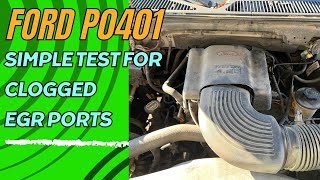
How to confirm: Remove the throttle body and EGR valve to visually inspect the entry ports into the intake manifold. They will be visibly clogged with black carbon buildup. A functional test involves applying vacuum to the EGR valve at idle; if the engine does not stumble or stall, the passages are likely blocked. 🎬 See this simple test for clogged EGR ports.
Typical fix: Clean the carbon out of the EGR passages using carburetor cleaner, small brushes, picks, and a shop vacuum to remove the debris. Be careful not to let carbon chunks fall into the intake manifold.
Est. part cost: $5-$15 for cleaning supplies - Cracked, Clogged, or Burnt DPFE Hoses 🟡 Medium Probability The two rubber hoses connecting the DPFE sensor to the EGR tube are made of a special high-temperature silicone material, but they can still crack, collapse internally, get clogged with carbon, or get holes burned through them from intense heat cycling.
How to confirm: Visually inspect the entire length of both hoses for cracks, brittleness, holes, or soft/collapsed sections. Remove them and check if they are plugged with carbon. Ensure they are not reversed; the hoses and their corresponding nipples on the EGR tube are often slightly different sizes to prevent this.
Typical fix: Replace both hoses. It is critical to use the correct high-temperature silicone hose, as standard vacuum lines will quickly fail. It's good practice to replace them whenever the DPFE sensor is replaced.
Est. part cost: $10-$25 - Faulty EGR Valve ⚪ Low Probability → Shop Exhaust Gas Recirculation (EGR) Valve The EGR valve itself can fail, but it is less common than sensor or passage issues. The valve can get stuck closed due to carbon buildup or a failed internal diaphragm, preventing it from opening when commanded.
How to confirm: With the engine idling, apply 10-15 in-Hg of vacuum to the EGR valve with a hand-held vacuum pump. The engine should stumble, run very rough, or stall. If the engine's RPM does not change, the valve is not opening or the passage is completely blocked.
Typical fix: Replace the EGR valve and the gasket. Some owners have had success cleaning the valve with carburetor cleaner, but replacement is often more reliable.
Est. part cost: $50-$120
Rare But Worth Checking
- Faulty EGR Vacuum Regulator (EVR) Solenoid: This solenoid controls the vacuum that opens the EGR valve. If it fails, it won't supply vacuum to the valve, preventing it from opening. This can cause a P0401 but is less common than other causes.
- Wiring Harness Issue: An open or short in the wiring to the DPFE sensor (signal, reference voltage, or ground) or the EVR solenoid can prevent the system from working correctly, though this is rare.
- Clogged Catalytic Converter: In rare cases, a clogged catalytic converter can create enough backpressure to affect the pressure differential in the EGR system, leading to a P0401 code. This would typically be accompanied by other symptoms like a severe lack of power.
Diagnosis Steps
- Read the code with an OBD-II scanner to confirm P0401 is present. Check for any other codes like P0402 or P1400.
- Perform a thorough visual inspection. Look for obvious issues like cracked, disconnected, or burnt rubber hoses going to the DPFE sensor. Ensure the hoses are connected to the correct ports on the sensor and EGR tube (they are often different sizes, 'REF' and 'HI').
- Test the DPFE Sensor. With a scan tool or a multimeter, monitor the DPFE PID or voltage on the signal wire with the key on, engine off. The voltage should be between 0.5V and 1.2V. If it's outside this range, the sensor is very likely faulty.
- Test the EGR Valve and Passages. With the engine idling, apply 10-15 in-hg of vacuum to the EGR valve's vacuum port with a hand pump. The engine should stumble, run very rough, or stall. If there is no change in idle quality, either the valve is stuck closed or the passages are completely blocked.
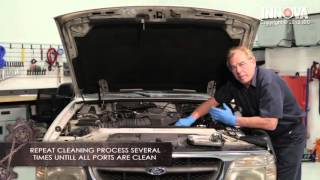
- Inspect EGR Passages. If the EGR valve test shows no change in idle, remove the throttle body and/or EGR valve to inspect the passages leading into the intake manifold. Clean them thoroughly if they are clogged with carbon. 🎬 Watch: How to clean the EGR valve and ports.
- If all other components test good, suspect the EGR Vacuum Regulator (EVR) solenoid. Check that it is receiving vacuum from the source and that it opens to pass vacuum to the EGR valve when commanded by the PCM (this can be tested by grounding its control wire).
Parts You'll Likely Need
- EGR Pressure Feedback (DPFE) Sensor
(OEM #4U7Z-9J460-AA)— This is the most frequent failure point for the P0401 code on this specific vehicle and engine combination. The OEM part number 4U7Z-9J460-AA (also labeled DPFE-4) supersedes several older, less reliable part numbers.
Trusted brands: Motorcraft, Standard Motor Products (SMP), Delphi
OEM price range: $60-$90
Aftermarket price range: $40-$70 - DPFE Sensor Hoses — The original hoses become brittle and crack from constant heat exposure, causing pressure leaks that mimic a bad sensor or clogged passage. They are often replaced as a set with the DPFE sensor.
Trusted brands: Motorcraft, Dorman
OEM price range: $15-$30
Aftermarket price range: $10-$25
Related Codes That Often Appear With This One
- P1400 — This Ford-specific code indicates 'DPFE Circuit Low Voltage'. It often appears alongside P0401 because a failing DPFE sensor is sending an abnormally low voltage signal to the PCM, which is the root cause of both codes.
- P0402 — This code for 'EGR Flow Excessive' can sometimes appear intermittently with P0401 if the DPFE sensor is failing erratically, sending both high and low incorrect signals to the PCM. It can also be caused by reversing the DPFE hoses.
Technical Service Bulletins (TSBs) & Recalls
- While no TSB is specifically for P0401 on the 2002-2005 Explorer 4.0L, TSBs for other Ford models with similar EGR systems exist. For example, TSB 05-3-1 mentions that on vehicles with an EGR System Module (ESM), BARO readings are not a reliable way to diagnose a skewed MAF, which is relevant diagnostic context for 2004+ models. TSBs are official documents from the manufacturer to help technicians diagnose and repair common problems.
- Manufacturer Bulletin #21M04 notes that on certain Super Duty vehicles, customers may experience an illuminated MIL with DTC P0401 due to the EGR cooler becoming plugged.
- Manufacturer Bulletin #TSB 19-2343 indicates that an illuminated MIL with DTC P0401 may be due to various strategies within the powertrain control module (PCM) software, requiring a software update to correct.
- Manufacturer Bulletin #SSM 48345 describes instances where DTC P0401 is stored in the PCM due to an EGR Cooler leaking coolant into the engine intake and exhaust systems.
- Manufacturer Bulletin #TSB 24-2263 notes that vehicles may experience an illuminated malfunction indicator with DTC P0401 alongside cooling system symptoms like internal or external leaks.
Platform-Specific Known Issues
- The original factory DPFE sensors on these vehicles were often metal-cased and were highly prone to failure from internal corrosion and moisture. Most replacements, including the OEM Motorcraft 4U7Z-9J460-AA, are a revised plastic-cased design which is more durable.
- On 2004 and later models, Ford began integrating the DPFE sensor, EGR valve, and vacuum regulator into a single component called the EGR System Module. While the individual components still fail, diagnosis may require replacing the entire assembly.
Mechanic-Grade Diagnostic Values
- DPFE Sensor KOEO Voltage (Original Aluminum Body) — expected: 0.55V +/- 0.25V. Failure: Voltage significantly outside this range, especially below 0.2V or above 1.0V, indicates a faulty sensor.
- DPFE Sensor KOEO Voltage (Superseded Plastic Body) — expected: 1.0V +/- 0.25V. Failure: Ford expanded the acceptable specification to 0.2V to 1.3V to accommodate the new sensor design. A reading outside this broader range points to a failure.
- EGR Vacuum Regulator (EVR) Solenoid Resistance — expected: 20 to 70 ohms. Failure: A resistance reading outside this range indicates a failed solenoid coil.
- DPFE Sensor Signal Voltage (Forced EGR Flow) — expected: Rises to approximately 4.0V. Failure: If vacuum is applied to the EGR valve at 1500 RPM and the DPFE voltage does not rise significantly, it confirms a lack of flow (clogged passages/tube) or a failed sensor that cannot respond.
Scan Tool Commands That Help
- Ford IDS / High-End Scan Tool: EVR Solenoid Output State Control / Active Command — This bidirectional command allows a technician to manually command the EVR solenoid on and off while the engine is running. This can be used to verify the solenoid clicks, passes vacuum, and causes a change in engine idle, helping to isolate a faulty EVR from a vacuum supply or EGR valve issue.
Wiring & Ground Locations
- DPFE Sensor Signal Wire at PCM — Pin 65 (Brown/Light Green wire) on the 104-pin PCM connector.. This is the primary input the PCM uses to measure EGR flow. Testing for voltage here can confirm if the signal from the sensor is reaching the computer correctly, helping to diagnose a wiring issue between the sensor and the PCM.
- EVR Solenoid Control Wire at PCM — Pin 47 (Brown/Pink wire) on the 104-pin PCM connector.. The PCM grounds this pin to energize the EVR solenoid and allow vacuum to flow to the EGR valve. Checking for a ground signal here during an active command test can verify if the PCM driver is functioning.
- Sensor Signal Return (Ground) at PCM — Pin 91 (Gray/Red wire) on the 104-pin PCM connector.. This is the dedicated ground reference for many sensors, including the DPFE. A poor connection at this pin or its associated ground point can cause incorrect sensor readings across multiple systems.
- G101 / G104 — G101 is on the LH front of the engine compartment, near the radiator. G104 is on the RH side of the engine compartment, at the rear.. These are primary engine bay ground points. The PCM and its associated sensor grounds ultimately terminate at these locations. Corrosion or looseness at these points can cause erratic sensor behavior and intermittent codes like P0401.
Real Owner Repair Stories
- ExplorerForum.com user post (2002 Ford Explorer 4.0L SOHC) — P0401 code, failed emissions test.
❌ Tried (didn't work) Replaced DPFE sensor with a new Motorcraft part, Replaced EGR valve, Cleaned EGR ports in the intake manifold behind the throttle body
✅ What actually fixed it The two small orifices inside the metal EGR tube itself, where the DPFE hoses attach, were completely clogged with carbon. The user had to remove the entire EGR tube from the engine and use a drill bit (by hand) and brake cleaner to ream out the carbon plugs from the small nipples. After cleaning the tube and reinstalling, the code was resolved.
OEM Part Supersession History
Multiple, including 2F1Z-9J460-AA, YF1Z-9J460-AB, YF1Z-9J460-AC→4U7Z-9J460-AA (Motorcraft DPFE-4)— The original aluminum-cased sensors were highly prone to internal corrosion and failure from moisture in the exhaust. The superseded part uses a more durable plastic housing design.
Heads up: The original aluminum sensor had a Key-On-Engine-Off (KOEO) voltage of ~0.55V, while the new plastic sensor has a KOEO voltage of ~1.0V. While Ford states the PCM can adapt, this can cause confusion during diagnosis if the technician is expecting the older voltage spec.4U7Z-9J460-AA (DPFE-4)→DPFE-15 (for some applications)— Further design revisions for durability and material changes.
Heads up: While DPFE-15 is a common replacement, for the 2002-2005 Explorer 4.0L, the 4U7Z-9J460-AA (DPFE-4) is the direct, verified replacement for the original part numbers.
Model Year Variations Within This Range
- 2004-2005: Some 2004 and later models began using an integrated EGR System Module which combined the valve and sensor components. While the function and failure modes (clogging, sensor failure) are similar, the replacement part is a single, more expensive assembly rather than a separate DPFE sensor.
Diagnostic Flowchart
Real Owner Stories
Aggregated from forums and TSBs cited above. Mileages and costs reflect what owners reported in those sources.
Ford Explorer 4.0L V6
Symptoms: Replaced the DPFE sensor three times with aftermarket parts, but the P0401 code returned each time. Found moisture inside the sensor.
What fixed it: Highlighted the necessity of avoiding poor-quality aftermarket parts due to moisture collection and internal corrosion.
Source hint: Ford Truck Enthusiasts Forums (ford-trucks.com) - Thread 'P0401 code problem with Explorer'
2002 Ford Explorer
Symptoms: Mechanic replaced the DPFE sensor, but the P0401 code returned just 15 miles later.
What fixed it: Investigated and cleaned clogged EGR passages to restore proper exhaust gas flow.
Source hint: Ford Truck Enthusiasts Forums (ford-trucks.com) - Thread '2002 Explorer: P0401: Insufficient Flow Detected'
2004 Ford Explorer
Symptoms: Check Engine Light on with a persistent P0401 code.
What fixed it: Removed and thoroughly cleaned the EGR valve itself, which resolved the code.
Source hint: ExplorerForum.com - Multiple threads discuss P0401
Ford Ranger 4.0L V6 SOHC
Symptoms: Replaced both the DPFE sensor and the EGR valve, but the P0401 error code persisted.
What fixed it: Diagnosed less common causes in the system, specifically pointing toward a faulty EGR control solenoid (EVR) or wiring issues.
Source hint: Ranger-Forums.com - Thread 'Error code P0401?'
Related OBD-II Codes
Frequently Asked Questions
Should I buy an aftermarket DPFE sensor to fix the P0401 code on my 2002-2005 Explorer?
My 2004 Explorer has a P0401 code, but I can't find a separate DPFE sensor. Where is it located?
Does TSB 05-3-1 apply to the P0401 code on my vehicle?
I replaced the DPFE sensor on my 4.0L V6, but the P0401 code came back. What should I check next?
Are the two rubber hoses connecting the DPFE sensor to the EGR tube interchangeable?
Helpful Videos

The information in this article is provided for general reference and educational purposes only. Vehicle specifications, procedures, and part compatibility can vary by production date, trim level, and region. Always consult your vehicle's factory service manual and verify part numbers before purchasing or performing repairs. Safety-critical components such as airbags, seat belts, and braking systems should be installed by a qualified professional.
- Ford Explorer:
- 🧭 Diagnostic Flowchart
- 🎬 Helpful Videos
- What's Unique About the 2002-2005 Ford Explorer
- Symptoms You May Notice
- Most Likely Causes
- Rare But Worth Checking
- Diagnosis Steps
- Parts You'll Likely Need
- Related Codes That Often Appear With This One
- Technical Service Bulletins (TSBs) & Recalls
- Platform-Specific Known Issues
- Mechanic-Grade Diagnostic Values
- Scan Tool Commands That Help
- Wiring & Ground Locations
- Real Owner Repair Stories
- OEM Part Supersession History
- Model Year Variations Within This Range
- Real Owner Stories
- Ford Explorer 4.0L V6
- 2002 Ford Explorer
- 2004 Ford Explorer
- Ford Ranger 4.0L V6 SOHC
- Related OBD-II Codes
- Frequently Asked Questions
- 🎟️ Get 5% Off