

P0401 on 2008-2017 Opel Insignia 2.0 CDTI: EGR Flow Insufficient Causes and Fixes
On the Opel Insignia 2.0 CDTI, code P0401 almost always points to a problem with the Exhaust Gas Recirculation (EGR) system, most commonly a clogged or failed EGR valve from soot buildup. Expect to pay between $60-$200 for a replacement valve, with DIY replacement being moderately difficult. Cleaning the EGR cooler and intake passages at the same time is critical to prevent the code from returning.
- P0401 on the Insignia 2.0 CDTI is almost always caused by physical blockages from soot, not complex electronic failures.
- Simply replacing the EGR valve is often not a complete fix; the EGR cooler and associated pipes must also be cleaned or replaced.
- Be aware of the symptoms of a leaking EGR cooler (coolant loss, white smoke) as it requires a different part and repair.
- This engine has other serious, well-documented issues (oil pickup seal, swirl flaps) that owners should be aware of, especially when purchasing a used model.
What's Unique About the 2008-2017 Opel Insignia
The 2.0 CDTI engine in the Insignia A is a diesel engine, which by nature produces more soot than a gasoline engine. This soot is the primary culprit for P0401 on this platform. Over time, the soot clogs the EGR valve, the EGR cooler, and the intake manifold itself. While the code points to 'insufficient flow,' the root cause is almost always a physical blockage from carbon buildup, rather than a sophisticated electronic failure. This issue is so common it's considered an inevitable maintenance item on these engines.
Symptoms You May Notice
- Check Engine Light illuminated
- Reduced engine power and sluggish acceleration
- Rough or unstable idle
- Increased harmful emissions, leading to a failed emissions test
- Engine knocking sounds, especially under load.
- White smoke or steam from the exhaust, particularly on acceleration after idling (indicates a leaking EGR cooler).
- Replacing the EGR valve but not cleaning the associated passages. The code will often return because the restriction still exists in the cooler or pipework.
Most Likely Causes
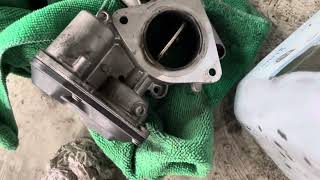
- Clogged or Failed EGR Valve 🔴 High Probability → Shop Exhaust Gas Recirculation (EGR) Valve Diesel engines produce significant soot, which builds up on the EGR valve's plunger and seat, causing it to stick closed or operate slowly. The valve's internal electronics can also fail, though mechanical seizure from carbon is more common.
How to confirm: Use a diagnostic scanner to command the EGR valve to open and close. Observe the live data for EGR position; if the actual position doesn't match the commanded position, the valve is stuck. A physical inspection after removal will show heavy carbon deposits.
Typical fix: Replace the EGR valve. While cleaning is sometimes possible, replacement is recommended for long-term reliability as the internal electronic components can also fail.
Est. part cost: $60-$200 - Blocked EGR Passages and Cooler 🟡 Medium Probability The same soot that clogs the valve also builds up in the pipework and the EGR cooler. The cooler's small passages are particularly susceptible to complete blockage. Additionally, the cooler can develop internal leaks, allowing coolant into the exhaust stream.
How to confirm: When the EGR valve is removed, visually inspect the connecting pipes and the inlet/outlet of the EGR cooler for heavy carbon buildup. If losing coolant with no visible external leak and seeing white exhaust smoke, the cooler is likely leaking internally.
Typical fix: Remove the EGR cooler and associated pipes and manually clean them. Chemical soaks and mechanical scraping are common methods. This should be done whenever the EGR valve is replaced. If the cooler is leaking internally, it must be replaced. A repair kit with part number 55590953 is available for this.
Est. part cost: $10-$20 for gaskets and cleaning supplies, or $100-$250 for a new cooler. - Clogged Intake Manifold ⚪ Low Probability → Shop Engine Intake Manifold This is the end-stage of chronic EGR soot buildup. The mixture of EGR gases and oil vapor from the crankcase ventilation system creates a thick sludge that can severely restrict the intake manifold runners, sometimes causing the swirl flaps to fail.
How to confirm: Visually inspect the inside of the intake manifold with a borescope or by removing the throttle body or MAP sensor. Significant, thick carbon deposits that restrict the port diameter confirm the issue.
Typical fix: Remove the intake manifold for a thorough cleaning (often called a 'de-coke' or 'carbon clean'). This is a labor-intensive job, often taking 4-6 hours. 🎬 See these helpful tips for removing the intake manifold. All gaskets should be replaced. Some owners opt to delete the swirl flaps during this process.
Est. part cost: $50-$100 for gaskets
Rare But Worth Checking
- Clogged or Faulty MAP Sensor: → Shop Manifold Absolute Pressure Sensor The Manifold Absolute Pressure (MAP) sensor can get covered in the same soot and oil mixture, causing it to read incorrectly. While it may not be the primary cause of P0401, a clogged MAP sensor can contribute to performance issues and should be cleaned during the repair.
- Leaking Vacuum Hoses: On some EGR systems, vacuum hoses are used to actuate the valve. Small cracks or leaks in these hoses can prevent the valve from opening fully, leading to insufficient flow. A thorough visual inspection of all vacuum lines connected to the EGR components is recommended.
Diagnosis Steps
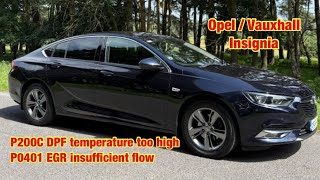
- Connect an OBD-II scanner and confirm P0401 is the active code. 🎬 Watch: Diagnosing P0401 and P200C codes on the Insignia. Check for any other related codes like P0402, P040E, or DPF codes.
- Use the scanner's live data function. While idling, command the EGR valve to open (e.g., to 95%) and watch the Mass Air Flow (MAF) sensor reading. A functioning EGR system will cause the MAF reading to drop significantly. If the MAF value does not change, there is no flow.
- Use the scanner's bidirectional controls to command the EGR valve's position from 0% to 100%. If the 'actual position' PID does not match the 'commanded position' PID, the valve is seized or electronically faulty.
- Perform a visual inspection. Locate the EGR valve at the rear of the engine. Check the electrical connector and wiring for any visible damage.
- Remove the EGR valve. Be prepared for some coolant loss. Inspect the valve and the ports for heavy carbon buildup. If it's heavily caked, it is a primary suspect.
- If the valve is the culprit, it is critical to also remove and inspect the EGR cooler and connecting pipes for blockages. If symptoms included coolant loss or white smoke, the cooler itself is likely faulty.
- Inspect the intake manifold port where the EGR pipe connects. If it is heavily restricted, the manifold itself requires cleaning.
- Clean the MAP sensor as a preventative measure.
- Install the new or cleaned parts with new gaskets. Clear the trouble code with the scanner.
- Perform a test drive, ensuring the engine reaches operating temperature to allow the ECM to verify the repair. An oil and filter change is recommended if the DPF has been attempting frequent regenerations, as diesel can contaminate the oil.
Parts You'll Likely Need
- EGR Valve
(OEM #55566052 (Pierburg 7.24809.78.0), may be superseded by 55573784)— This is the most common failure point due to carbon buildup causing it to stick or fail electronically.
Trusted brands: Pierburg (often the OEM supplier), Delphi, Wahler, NRF
OEM price range: $150-$250
Aftermarket price range: $60-$180 - EGR Valve Gasket Kit — Gaskets are single-use and must be replaced to prevent exhaust and coolant leaks.
Trusted brands: Elring, Victor Reinz
OEM price range: $15-$30
Aftermarket price range: $5-$15 - EGR Cooler
(OEM #55590953, 851123)— Necessary if the original is leaking coolant internally (causing white smoke) or is too clogged to be cleaned effectively.
Trusted brands: GM (Genuine), NRF, Mahle
OEM price range: $250-$400
Aftermarket price range: $100-$250
Related Codes That Often Appear With This One
- P0402 — P0402 means 'EGR Flow Excessive'. It can sometimes appear intermittently if the EGR valve is sticking, sometimes staying open too long and other times not opening at all.
- P200C — This code relates to particulate filter temperature. A malfunctioning EGR system can affect the entire emissions system, including the Diesel Particulate Filter (DPF), potentially leading to related codes as the DPF becomes overloaded with soot.
- P040E — This code for 'EGR Coolant Temperature Range/Performance' often appears alongside P0401 when the EGR cooler has failed and is leaking coolant internally.
Platform-Specific Known Issues
- Due to the design of the 2.0 CDTI, the EGR valve is located at the rear of the engine bay, which can make access slightly difficult.
- The EGR valve is cooled by engine coolant. When removing the valve, some coolant will spill. It's important to be prepared for this and to top off the coolant after the repair.
- CRITICAL NOTE: This engine, particularly before 2013, is infamous for oil pickup seal failure, which leads to catastrophic engine seizure. If performing any major engine work like an intake manifold cleaning, it is strongly advised to proactively replace this inexpensive seal at the same time, as it requires dropping the oil sump.
Mechanic-Grade Diagnostic Values
- EGR Valve Electrical Connector — expected: 5-pin D-shaped connector, operating at 12V.. Failure: An open circuit reading with a multimeter across certain pins can indicate a broken internal coil winding.
Scan Tool Commands That Help
- GDS2 / Op-Com / High-End Generic: EGR Valve Active Test / Actuation Test — To command the EGR valve to open and close while observing live data. This confirms if the valve is physically stuck or responding to commands. The 'desired position' should match the 'actual position'. If they don't, the valve is faulty.
- GDS2 / Op-Com / High-End Generic: EGR Valve Learn / Reset Function — After installing a new EGR valve, this function should be performed to teach the ECU the new valve's position and operating range. Some sources claim disconnecting the battery during the swap can achieve a similar reset, but using the scan tool function is the correct procedure.
Real Owner Repair Stories
- Reddit user rsocon on r/Vauxhall (2013 Insignia 2.0 CDTI) — P0402 (Excessive Flow) error, which is closely related to P0401 and often caused by a sticking valve.
❌ Tried (didn't work) Cleaning the original EGR valve (error returned after a few months)., Installing a new, non-OEM EGR valve from a major parts store (error returned almost instantly, suggesting the car did not 'like' the part).
✅ What actually fixed it The user removed the faulty new part, performed a much more thorough cleaning of the original EGR valve and cooler pipe with 2/3 of a can of cleaner, and reinstalled the original, now-clean valve. This resolved the immediate error, indicating the aftermarket part was incompatible or faulty and that a very thorough cleaning was required. - AliExpress Product Review / Guide (2010 Vauxhall Insignia 2.0 CDTI, 140,000 miles) — P0401 and P040E codes, coolant loss (~1 liter every two weeks) with no external leaks, and thick white smoke/steam from exhaust after idling.
❌ Tried (didn't work) Initial suspicion was a cracked cylinder head, but a block test was negative and there was no milkiness in the oil.
✅ What actually fixed it The cause was an internal leak in the EGR cooler. The mechanic confirmed this by finding wet residue inside the intake pipe behind the throttle body. The owner fixed it by using an aftermarket EGR cooler repair kit (for part 55590953) which replaces only the failed internal core, rather than the entire assembly, saving significant cost.
OEM Part Supersession History
55566052→55573784— Standard part revision and update by the manufacturer.
Model Year Variations Within This Range
- Post mid-2013: Later Euro VI engines may have different EGR valve designs or part numbers compared to the earlier Euro V engines (like the A20DTH). Compatibility should be carefully checked via VIN before ordering parts.
Diagnostic Flowchart
Other Known Issues on This Vehicle
Issues unrelated to this code that are worth knowing about as an owner of this generation:
- Oil Pickup Seal Failure 🔴 High — Very common on pre-2013 A20DTH engines, typically over 100,000 miles. The original rubber seal hardens, allowing air to be sucked into the oil pump, leading to oil starvation and catastrophic engine failure. A warning message 'Oil Pressure Low - Stop Engine' is often the only symptom, by which point damage may already be done. (Ref: No official recall, but it is a widely known design flaw within the owner and mechanic community. An updated seal is available.)
- Intake Manifold Swirl Flap Failure 🔴 High → Shop Engine Intake Manifold — Common on higher mileage engines. Carbon buildup causes the plastic swirl flaps to stick or break. In the worst-case scenario, broken flap fragments can be ingested by the engine, causing piston and valve damage. (Ref: Vauxhall/Opel introduced an improved manifold design, but no formal recall was issued. Many owners opt for a 'swirl flap delete' service as a permanent preventative measure.)
- DPF System Blockage & Regeneration Failure 🟠 Medium — Frequent, especially for vehicles used primarily for short, urban journeys. A malfunctioning EGR system directly contributes to excessive soot, overwhelming the DPF. Failure of supporting components like glow plugs or temperature/pressure sensors can also prevent DPF regeneration.
- M32 Manual Gearbox Bearing Wear 🟠 Medium — Affects 6-speed manual models. A well-known weakness in the 5th and 6th gear bearings leads to a characteristic whining noise during motorway driving, which can progress to total gearbox failure if ignored.
Used vs. New Parts: Buying Guide for This Vehicle
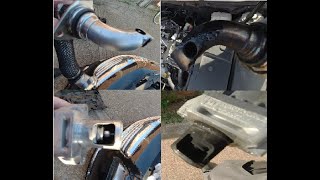
When a used part is the smart pick: A used EGR valve is a viable, low-cost option if it comes from a reputable seller who has tested it. A YouTube repair video shows a successful fix using a £15 tested, used EGR valve. However, given the high likelihood of carbon clogging, a used part is a gamble unless its cleanliness and functionality can be verified.
Donor-vehicle mileage cap: roughly under 80000 miles for the part to have meaningful remaining life.
What to inspect on the donor part:
- Ask for photos of the valve's pintle and the ports to check for excessive carbon buildup.
- Ensure the seller confirms it was tested with a diagnostic tool to verify the position sensor and motor work correctly.
- Check for any physical damage, cracks, or corrosion on the housing and electrical connector.
OEM-only on this vehicle (don't cheap out):
- While not strictly 'OEM-only', forum and repair stories suggest that very cheap, unbranded aftermarket EGR valves can be faulty out of the box and cause immediate check engine lights. It is safer to stick with OEM (GM), the original equipment supplier (Pierburg), or well-regarded aftermarket brands.
Aftermarket brands forum-validated for this vehicle:
- Pierburg (often the OEM supplier)
- Delphi
- Hella
- NGK
- Valeo
Brands owners have reported issues with on this vehicle:
- Unbranded, 'white-box' parts from online marketplaces or parts stores that are significantly cheaper than known brands have a higher risk of being incompatible or failing quickly.
Real Owner Stories
Aggregated from forums and TSBs cited above. Mileages and costs reflect what owners reported in those sources.
2008-2017 Opel Insignia 2.0 CDTI
Symptoms: The owner replaced the EGR valve to clear the P0401 code, but the Check Engine Light returned shortly after.
What fixed it: A thorough cleaning of the EGR cooler and the intake manifold in addition to the valve replacement.
Source hint: vauxhallownersnetwork.co.uk - Multiple threads discuss P0401
2010-2012 Saab 9-5 (YS3G) 2.0 TiD/TTiD
Symptoms: P0401 code due to carbon buildup in the EGR valve and passages.
What fixed it: Cleaning or replacing the EGR valve and clearing the associated passages.
Source hint: Platform mate comparison - Saab 2.0 TiD engine
2011-2015 Chevrolet Cruze 2.0 VCDi
Symptoms: Clogged EGR system causing P0401 issues.
What fixed it: Addressing the engine-specific soot buildup in the EGR system.
Source hint: Platform mate comparison - Chevrolet Cruze 2.0L diesel
Related OBD-II Codes
Frequently Asked Questions
I replaced my EGR valve but the P0401 code came back on my 2.0 CDTI. What did I miss?
Is there a specific repair kit for the EGR cooler on the Opel Insignia?
Why does my 2.0 CDTI have white smoke coming from the exhaust after idling?
I'm cleaning my intake manifold to fix the P0401 code; is there anything else I should do while the engine is apart?
Can I just clean the EGR valve instead of buying a new one for $60-$200?
Will a clogged EGR system affect my Insignia's DPF?
Helpful Videos


The information in this article is provided for general reference and educational purposes only. Vehicle specifications, procedures, and part compatibility can vary by production date, trim level, and region. Always consult your vehicle's factory service manual and verify part numbers before purchasing or performing repairs. Safety-critical components such as airbags, seat belts, and braking systems should be installed by a qualified professional.
- Opel Insignia:
- 🧭 Diagnostic Flowchart
- 🎬 Helpful Videos
- What's Unique About the 2008-2017 Opel Insignia
- Symptoms You May Notice
- Most Likely Causes
- Rare But Worth Checking
- Diagnosis Steps
- Parts You'll Likely Need
- Related Codes That Often Appear With This One
- Platform-Specific Known Issues
- Mechanic-Grade Diagnostic Values
- Scan Tool Commands That Help
- Real Owner Repair Stories
- OEM Part Supersession History
- Model Year Variations Within This Range
- Other Known Issues on This Vehicle
- Used vs. New Parts: Buying Guide for This Vehicle
- Real Owner Stories
- 2008-2017 Opel Insignia 2.0 CDTI
- 2010-2012 Saab 9-5 (YS3G) 2.0 TiD/TTiD
- 2011-2015 Chevrolet Cruze 2.0 VCDi
- Related OBD-II Codes
- Frequently Asked Questions
- 🎟️ Get 5% Off