

P0401 on 2009-2012 SEAT Leon 2.0L TDI: Insufficient EGR Flow Causes and Fixes
On the 2.0L TDI (CBEA/CJAA) engine, P0401 almost always means the Diesel Particulate Filter (DPF) has cracked, allowing soot to clog the downstream low-pressure EGR filter. This filter's purpose is to clean post-DPF exhaust gases before they are recirculated into the turbo inlet. The definitive fix is replacing both the DPF and the low-pressure EGR filter pipe, a repair that may be covered by an extended emissions warranty in some regions.
- For the 2.0L TDI (CBEA/CJAA) engine, P0401 is not a simple EGR valve issue; it's a symptom of a cracked Diesel Particulate Filter (DPF).
- The easiest and most definitive diagnosis is checking for black soot inside the exhaust tailpipe. Soot means the DPF has failed.
- A permanent fix requires replacing both the DPF and the low-pressure EGR filter pipe (1K0253120B) at the same time.
- Before authorizing any repairs, check with a dealer to see if your vehicle is covered by an extended emissions warranty, as this is a very expensive job.
- Ignoring the code will prevent DPF regeneration and can lead to further, more costly engine and emissions system damage.
What's Unique About the 2009-2012 SEAT Leon
For the 2.0L TDI common-rail engines (CBEA, CJAA), P0401 has a very specific and well-documented cause that differs from most other vehicles. Unlike a typical clogged EGR valve, the root cause is almost always a cracked Diesel Particulate Filter (DPF). This crack allows soot to bypass the filter and clog a small, mesh filter in the low-pressure EGR circuit downstream. Therefore, P0401 on this platform is a symptom of a failed DPF, not just a simple EGR valve or cooler issue. 🎬 Watch: A mechanic explains these common EGR system failures. This exact diagnostic path is outlined in VW's own technical service bulletin.
Symptoms You May Notice
- Check Engine Light (Malfunction Indicator Lamp - MIL) is on.
- Failed emissions test.
- In most cases, there are no other noticeable drivability symptoms; the car runs fine.
- Possible engine surging or unusual exhaust gas temperature spikes during regeneration attempts before the filter becomes completely clogged.
- Replacing only the EGR valve. On this engine, the P0401 code is rarely caused by the EGR valve itself.
- Cleaning or replacing only the low-pressure EGR filter. Without replacing the cracked DPF that is causing the clog, the new filter will quickly become blocked again, and the code will return.
- Replacing the EGR cooler. The official VW TSB for this issue explicitly states it is NOT necessary to replace the EGR cooler for this fault.
Most Likely Causes
- Cracked Diesel Particulate Filter (DPF) Causing a Clogged Low-Pressure EGR Filter 🔴 High Probability → Shop Diesel Particulate Filter (DPF) This is a well-documented failure pattern for the CBEA and CJAA 2.0L TDI engines. High soot loads and thermal stress from regeneration cycles can cause the ceramic monolith inside the DPF to crack, allowing soot to pass through and clog the downstream low-pressure EGR filter.
How to confirm: The definitive diagnostic test is to check for black, greasy soot inside the exhaust tailpipe. With the engine off and cool, wipe the inside of the tailpipe with a clean cloth or finger. If soot is present, the DPF has failed. 🎬 See how to diagnose P2002 and P0401 codes together. You can also visually inspect the low-pressure EGR filter pipe for heavy soot blockage; it will be nearly impossible to blow air through it when clogged.
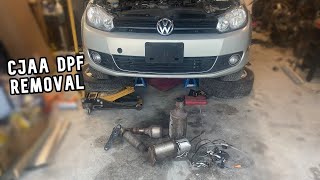
Typical fix: Replace both the Diesel Particulate Filter (DPF) and the low-pressure EGR filter pipe simultaneously. Simply cleaning or replacing the EGR filter is a temporary fix at best; the code will return quickly if the cracked DPF is not also replaced.
Est. part cost: $800-$2000 - Clogged EGR Cooler or Passages ⚪ Low Probability → Shop Exhaust Gas Recirculation (EGR) Valve While less common for causing P0401 specifically (as the DPF is the usual culprit), all TDI engines are prone to carbon and soot buildup in the EGR cooler and intake passages over time, which can restrict flow. However, for this code, the issue is almost always in the low-pressure circuit.
How to confirm: Requires removal and visual inspection of the EGR cooler and associated pipes. This should only be investigated if the DPF 'soot test' is negative (tailpipe is clean).
Typical fix: Remove and manually clean the EGR cooler and passages. If cleaning is not possible due to internal blockage or damage, the component must be replaced.
Est. part cost: $250-$500
Rare But Worth Checking
- Faulty EGR Valve: → Shop Exhaust Gas Recirculation (EGR) Valve While the EGR valve itself can fail, it is an uncommon cause for P0401 on this specific engine. The issue is almost always a blockage elsewhere in the system. A failure here would likely be mechanical (stuck) or an electrical fault in the actuator and might present with other codes.
- Faulty Sensor (e.g., EGR Temperature, Differential Pressure): A sensor providing incorrect data to the ECM could theoretically trigger the code, but this is rare. This should only be considered after the primary causes (DPF/clogging) have been ruled out. The system's logic relies heavily on the DPF differential pressure sensor readings to diagnose both P2002 and P0401.
Diagnosis Steps
- Scan the ECM for fault codes and review freeze frame data. Note the presence of P0401 and/or P2002.
- Perform the 'Soot Test': With the engine off and cool, wipe the inside of the exhaust tailpipe. Black, greasy soot indicates a cracked DPF, which is the root cause. If the tailpipe is clean, proceed with further diagnosis.
- If soot is found, the diagnosis is complete. The DPF and low-pressure EGR filter must be replaced together.
- If no soot is found, inspect the low-pressure EGR filter pipe (Part No. 1K0253120B) for blockages. It may be clogged for other reasons, though this is less likely.
- Inspect the EGR cooler and intake manifold passages for carbon buildup.
- Using a diagnostic scan tool, actuate the EGR valve and monitor sensor data (e.g., MAP, EGR temperature) to confirm the valve is responding to commands. This helps rule out a faulty valve actuator.
Parts You'll Likely Need
- Diesel Particulate Filter (DPF)
(OEM #1K0254708GX (replaces 1K0254706LX))— This is the root cause of the P0401 code on this engine. It cracks internally, allowing soot to clog the downstream EGR filter.
Trusted brands: Bosch, Walker Exhaust, Genuine VW/Audi (Remanufactured)
OEM price range: $1200-$2000
Aftermarket price range: $700-$1500 - Low-Pressure EGR Filter Pipe
(OEM #1K0253120B)— This filter becomes clogged with soot from the cracked DPF, directly causing the insufficient flow condition. It must be replaced along with the DPF.
Trusted brands: Genuine VW/Audi
OEM price range: $150-$250
Aftermarket price range: $80-$150
Related Codes That Often Appear With This One
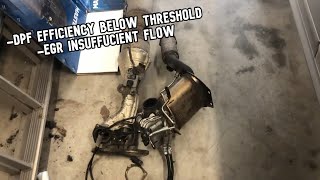
- P2002 — P2002 indicates 'Particulate Trap Efficiency Below Threshold'. This code often appears with P0401 because a cracked DPF is the root cause for both issues—it's inefficient at trapping soot (P2002) and it's allowing that soot to clog the EGR filter (P0401).
- P2463 — P2463 signifies 'Diesel Particulate Filter Restriction - Soot Accumulation'. This can be triggered alongside P0401 as part of the overall DPF system failure.
Technical Service Bulletins (TSBs) & Recalls
- TSB 01-18-13 (VW Ref: 2034898): Details the diagnostic procedure for P0401 on 2.0L TDI engines. It explicitly states: 'If your finger or the cloth comes out with black soot, replace the DPF & EGR filter together. If there is no soot... continue with GFF diagnostics, this bulletin does not apply.' It also notes not to replace other components like the EGR cooler for this fault.
Platform-Specific Known Issues
- The 'Dieselgate' emissions scandal resulted in extended warranties for emissions components on many of these vehicles, particularly in the North American market for VW and Audi models. This specific repair (cracked DPF and clogged EGR filter causing P0401) was often explicitly covered. Owners should always check with a dealer to see if any warranty coverage is still applicable before paying out of pocket.
- Volkswagen Group issued Technical Service Bulletins (TSB 26-13-03 / TPI 2031583) that detail this exact failure pattern, instructing technicians to check for soot in the tailpipe as the primary diagnostic step for P0401 and to replace both parts if soot is found.
Mechanic-Grade Diagnostic Values
- EGR Valve Adaptation Status (VCDS) — expected: The status in Measuring Value Block 074, field 4 should change from 'Run' to 'ADP OK' after initiating the basic setting.. Failure: If the adaptation fails to complete or status does not show 'ADP OK', it can indicate a mechanical or electrical fault with the EGR valve or related components.
- EGR Valve Potentiometer Voltage (VCDS) — expected: Within the specified Min/Max range shown in Measuring Value Block 074, fields 1 and 2.. Failure: A voltage reading outside the specified range indicates a fault in the EGR valve's position sensor.
Scan Tool Commands That Help
- VCDS (VAG-COM): Engine -> Output Tests (03) -> EGR Valve (N18) — To electronically actuate the EGR valve and visually confirm if it is opening and closing. This requires partial disassembly to see the valve move but confirms if the motor and electrical circuit are functional, helping to distinguish a stuck valve from an electrical failure.
- VCDS (VAG-COM): Engine -> Basic Settings (04) -> Group 074 (EGR Valve Adaptation) — After replacing the EGR valve or cleaning the system, this procedure adapts the new/cleaned valve's closed and open positions to the Engine Control Module (ECM). This is necessary for the system to learn the new component's operational range.
- VCDS (VAG-COM): Engine -> Login (11) -> Code 12233 — This login code is required to enable access to adaptation channels for the EGR system on some controllers, allowing for changes or resets.
- VCDS (VAG-COM): Engine -> Output Tests -> IDE00242 (EGR Valve Output Test) — This is a built-in test that cycles the EGR valve through its range of motion while logging the requested vs. actual position. It's a powerful diagnostic for identifying a valve that is sticking, slow to respond, or not reaching its fully open/closed positions, without full removal.
Wiring & Ground Locations
- Main Engine Ground — Typically a large braided strap from the vehicle chassis to a bracket on the engine block or transmission.. A poor engine ground can cause a host of intermittent electrical issues and incorrect sensor readings for all engine management components, including the EGR valve and its sensors. While not a direct cause of P0401, it should be checked for corrosion and tightness during any electrical diagnosis.
- G12 Ground Connection — On a similar platform (2014 Jetta), G12 is located on the lower left side of the A-pillar, inside the cabin.. This ground point serves various components. While a direct link to the EGR system isn't confirmed for the Leon, checking major chassis ground points is a standard diagnostic step for unexplained electronic faults.
Real Owner Repair Stories
- Ross-Tech Forums User (2012 Jetta TDI (CJAA engine)) — P0401 code preventing state inspection, engine surging, exhaust gas temperature spikes up to 1350°F.
✅ What actually fixed it As a temporary fix to pass inspection, the owner replaced the clogged low-pressure EGR filter (1K0253120B) with a clean used one from eBay for $40. This cleared the code and restored normal driving characteristics. The owner acknowledged this was not a permanent solution as the DPF was still cracked (confirmed by soot in tailpipe) and would eventually clog the new filter. - Reddit user /u/uninspired_enginerd (TDI (assumed CJAA/CBEA)) — P0401 code.
✅ What actually fixed it The user correctly identified the cause as a cracked DPF leading to a clogged low-pressure EGR filter. The recommended fix was stated as a DPF delete (if local regulations permit) or a new DPF. This user had experienced the failure twice.
OEM Part Supersession History
1K0254706LX→1K0254708GX— Standard part number revision by the manufacturer. The new part is a direct replacement.
Model Year Variations Within This Range
- 2009-2012: The CBEA engine (more common in 2009 Audi A3 and some Jettas) uses a balance shaft module in the oil pan, which the CJAA (more common in 2010+ Golf/Jetta) does not. This is a major internal difference but does not significantly affect the P0401 diagnosis. There are also minor differences in thermostat housings, coolant pipes, and wiring harness lengths for some sensors between the two engine codes, but the EGR and DPF systems function identically regarding this fault.
Diagnostic Flowchart
Other Known Issues on This Vehicle
Issues unrelated to this code that are worth knowing about as an owner of this generation:
- High-Pressure Fuel Pump (HPFP) Failure 🔴 High — A well-known, catastrophic failure point for the CP4-style pump used on CBEA/CJAA engines. Can occur without warning, often between 80,000-150,000 km. Failure sends metal debris throughout the entire fuel system, requiring replacement of the pump, injectors, lines, and fuel tank cleaning. (Ref: Covered under the 'Dieselgate' extended emissions warranty in some regions, but not a formal recall.)
- Dual Mass Flywheel (DMF) Failure (Manual Transmission) 🟠 Medium — Common on higher-mileage vehicles. Symptoms include a distinct rattling or chattering noise at idle that disappears when the clutch pedal is depressed, vibrations through the floor/pedals, and knocking sounds when shutting the engine off.
- Intercooler Icing 🟠 Medium — Occurs in cold, humid climates. Moisture from the low-pressure EGR system condenses and freezes inside the intercooler when the vehicle is parked. Upon startup, the engine may ingest ice/water, causing rough running, stalling, or in rare, severe cases, hydrolock and catastrophic engine damage. (Ref: VW issued TSB 2025464 / Service Action 21H3 to address this by installing a revised intercooler or a 'cold weather kit', which was often covered by warranty.)
- EGR Cooler Clogging/Failure 🟡 Low → Shop Exhaust Gas Recirculation (EGR) Valve — Separate from the P0401 issue, the EGR cooler itself can become internally clogged with soot and carbon over time, leading to coolant loss (internal leaks) or different EGR-related codes. This is a common issue for many modern diesel engines.
Used vs. New Parts: Buying Guide for This Vehicle
When a used part is the smart pick: A used Low-Pressure EGR Filter Pipe (1K0253120B) can be a cost-effective temporary fix, especially if cleaned thoroughly before installation. However, this only makes sense if you are planning a more permanent repair (like DPF replacement) soon, or need to clear the code to pass an inspection.
Donor-vehicle mileage cap: roughly under 50000 miles for the part to have meaningful remaining life.
What to inspect on the donor part:
- For a DPF: Ask for VCDS logs showing ash load (grams) before removal; a low value (e.g., under 40g) is better. Visually inspect the ceramic filter element from both ends for any visible cracks, melting, or missing chunks. A perfectly clean, steam-cleaned appearance can be a red flag for a failing DPF that was just washed to be sold.
- For a Low-Pressure EGR Filter Pipe: It should be professionally cleaned or come from a very low-mileage vehicle. You should be able to easily blow air through it with minimal restriction. Check for any cracks or damage to the pipe and mesh filter.
- Scrap value for a used DPF from a CJAA engine can be several hundred dollars, so be wary of deals that seem too good to be true.
OEM-only on this vehicle (don't cheap out):
- Diesel Particulate Filter (DPF). While aftermarket options exist, their longevity and efficiency can be questionable. Given the cost of labor, using a Genuine VW/Audi remanufactured part is the safest bet to ensure the problem is fixed correctly the first time. Many owners who opt for aftermarket DPFs report recurring issues.
Brands owners have reported issues with on this vehicle:
- Unbranded, cheap DPF units from online marketplaces. These often lack the correct precious metal loading and filter quality, leading to premature failure and recurring codes.
Real Owner Stories
Aggregated from forums and TSBs cited above. Mileages and costs reflect what owners reported in those sources.
2010-2014 Volkswagen Jetta 2.0L TDI (CJAA)
Symptoms: P0401 code present and the tailpipe was found to be sooty. Upon inspection, the low-pressure EGR filter was completely blocked with soot.
What fixed it: The owner purchased a clean used EGR filter on eBay for $40 as a temporary measure to pass a state inspection. They cut open the old filter to confirm it was packed with soot, though they acknowledged the DPF would eventually clog the replacement filter again.
Cost: $40-$40
Source hint: Ross-Tech Forums - P0401 TDI Code Temporary Fix
2009-2014 Volkswagen/Audi 2.0L TDI (CBEA/CJAA)
Symptoms: Check Engine Light with P0401 and/or P2002. Black soot found inside the tailpipe during a finger-wipe test.
What fixed it: Replacement of both the Diesel Particulate Filter (DPF) and the low-pressure EGR filter pipe together as per TSB instructions.
Source hint: TSB 01-18-13 (VW Ref: 2034898)
Related OBD-II Codes
Frequently Asked Questions
Is there a specific test I can do on my 2.0L TDI to confirm if the DPF is the cause of the P0401 code?
Can I just clean the low-pressure EGR filter (Part No. 1K0253120B) to fix the P0401 code?
Does the 'Dieselgate' extended warranty cover P0401 repairs on the CBEA/CJAA engines?
Are there official technical bulletins for this issue on the SEAT Leon's platform mates?
What if my tailpipe is clean but I still have a P0401 code?
Could my P0401 code be related to the intercooler icing issue mentioned for this engine?
Helpful Videos
We Have This Part in Stock


The information in this article is provided for general reference and educational purposes only. Vehicle specifications, procedures, and part compatibility can vary by production date, trim level, and region. Always consult your vehicle's factory service manual and verify part numbers before purchasing or performing repairs. Safety-critical components such as airbags, seat belts, and braking systems should be installed by a qualified professional.
- SEAT Leon:
- 🧭 Diagnostic Flowchart
- 🎬 Helpful Videos
- 🛍️ Shop This Part
- What's Unique About the 2009-2012 SEAT Leon
- Symptoms You May Notice
- Most Likely Causes
- Rare But Worth Checking
- Diagnosis Steps
- Parts You'll Likely Need
- Related Codes That Often Appear With This One
- Technical Service Bulletins (TSBs) & Recalls
- Platform-Specific Known Issues
- Mechanic-Grade Diagnostic Values
- Scan Tool Commands That Help
- Wiring & Ground Locations
- Real Owner Repair Stories
- OEM Part Supersession History
- Model Year Variations Within This Range
- Other Known Issues on This Vehicle
- Used vs. New Parts: Buying Guide for This Vehicle
- Real Owner Stories
- 2010-2014 Volkswagen Jetta 2.0L TDI (CJAA)
- 2009-2014 Volkswagen/Audi 2.0L TDI (CBEA/CJAA)
- Related OBD-II Codes
- Frequently Asked Questions
- 🎟️ Get 5% Off