

P0402 on 1995-2001 Ford Explorer 4.0L V6: EGR Excessive Flow Causes and Fixes
On a 1995-2001 Ford Explorer with the 4.0L V6, code P0402 is most often caused by a failed DPFE sensor. This is a relatively inexpensive part and easy to replace, making it the first component to check. The original metal sensor was updated to a plastic version (Motorcraft DPFE-15), but both are known to fail. Expect to pay around $25-$60 for a new aftermarket sensor.
- P0402 on a 1995-2001 Explorer almost always points to a problem in the EGR system, specifically excessive flow.
- Before buying any parts, test the DPFE sensor's voltage at idle. It is the most likely cause of this code on this truck and a common misdiagnosis trap.
- Inspect for simple issues first: check for carbon buildup in the EGR ports and look for cracked or disconnected vacuum lines.
- The repair is generally DIY-friendly and involves basic hand tools. The most common fix, replacing the DPFE sensor, can be done in under 30 minutes.
What's Unique About the 1995-2001 Ford Explorer
Ford Explorers from this era, along with their Ranger and Mountaineer platform mates, use a Differential Pressure Feedback EGR (DPFE) sensor to measure EGR flow. This sensor is notoriously prone to failure from heat and internal corrosion from exhaust moisture. The PCM expects to see a low voltage signal (around 0.5-1.0V) from the DPFE at idle; a failed sensor often sends a constant high voltage signal (4-5V), tricking the PCM into thinking the EGR valve is wide open, thus triggering P0402. This specific failure mode is why replacing the DPFE sensor is the most common fix.
Symptoms You May Notice
- Rough idle, especially when the engine is cold or when stopping.
- Engine stalling or surging, particularly when coming to a stop or at low speeds.
- Hesitation or poor acceleration.
- Illuminated Check Engine Light.
- Slightly reduced fuel economy.
- In some cases, engine misfires may be present.
- Replacing the EGR valve when the DPFE sensor is the actual problem. Always test the DPFE sensor's voltage first, as it is the most likely cause and often cheaper and easier to replace.
Most Likely Causes
- Faulty DPFE Sensor 🔴 High Probability The original metal-cased DPFE sensors were known to fail from internal corrosion and heat. Ford replaced them with a plastic-cased design (e.g., Motorcraft DPFE-15), but these are also a very common failure item. It's the most frequently cited point of failure for P0402 on this vehicle.
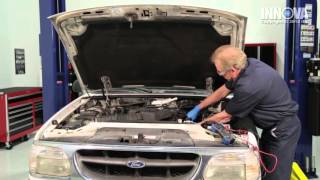
How to confirm: With the engine off and key on, back-probe the DPFE sensor's signal wire. A healthy sensor should read between 0.5V and 1.0V. If the voltage is high (often 4.5V or higher) at idle, the sensor has failed and is sending an incorrect 'excessive flow' signal. A diagnostic video by Innova Electronics on a '98 Explorer demonstrates this test. 🎬 Watch this step-by-step guide on diagnosing a faulty DPFE sensor.
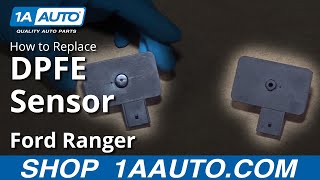
Typical fix: Replace the DPFE sensor and the two small silicone hoses connected to it, as they often degrade, crack, or become loose. Ensure the metal tubes the hoses connect to are clear of carbon buildup.
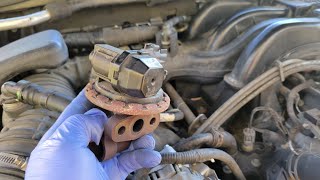
Est. part cost: $25-$60 - EGR Valve Stuck Open 🟡 Medium Probability → Shop Exhaust Gas Recirculation (EGR) Valve Carbon deposits from the exhaust can build up on the EGR valve's pintle or seat, preventing it from closing completely and causing a constant flow of exhaust gas.
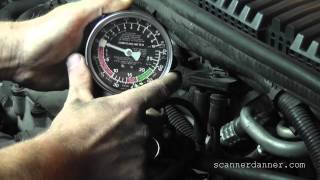
How to confirm: With the engine off and cool, try to manually move the EGR valve diaphragm with a hand vacuum pump. It should move smoothly and hold vacuum. If it feels gritty, doesn't move, or you can't pull a vacuum, it's likely sticking or has a ruptured diaphragm. Visually inspecting for carbon buildup after removal is also effective.
Typical fix: Clean the carbon from the EGR valve and its mounting passages using carburetor cleaner and a small brush. If cleaning doesn't work or the diaphragm is ruptured, replace the EGR valve.
Est. part cost: $40-$90 - Clogged EGR Passages or Hoses ⚪ Low Probability While carbon buildup is common, a complete blockage of the passages or the small metal tubes to the DPFE sensor typically results in a P0401 (Insufficient Flow) code, not P0402. However, partial or intermittent blockages could theoretically contribute to erratic readings.
How to confirm: Remove the two hoses from the DPFE sensor and inspect the metal tubes they connect to. Use a small wire or drill bit (turned by hand) to gently clean out any blockages.
Typical fix: Clean the passages thoroughly. In severe cases, the entire EGR tube may need to be removed for cleaning or replacement.
Est. part cost: $0-$20 (for cleaning tools or hoses) - Leaking or Damaged Vacuum Lines ⚪ Low Probability
How to confirm: Visually inspect all vacuum lines running to the EGR valve and the EGR vacuum control solenoid for cracks, brittleness, or loose connections. A smoke machine can find hard-to-see leaks. Check for vacuum at the EGR valve at idle; there should be none.
Typical fix: Replace any damaged sections of vacuum hose.
Est. part cost: $5-$15
Rare But Worth Checking
- Faulty EGR Vacuum Control Solenoid (EVR): This solenoid controls the vacuum supply to the EGR valve. If it fails in a way that applies vacuum at idle, it can force the EGR valve open and cause excessive flow. This can be tested by checking for vacuum at the EGR valve's supply hose when the engine is idling; there should be no vacuum.
- PCM Software or Hardware Issue: While extremely rare for this specific code, a faulty Powertrain Control Module (PCM) can misinterpret sensor data. TSBs for newer Ford models (e.g., TSB 19-2343, 23-2059) have addressed P0402 with software updates, indicating it's a possibility on a broader level, though no specific TSB exists for this generation Explorer.
Diagnosis Steps
- Verify the code P0402 is present using an OBD-II scanner. Check for related codes like P0401 or P1401.
- Visually inspect the EGR valve, DPFE sensor, and all associated vacuum and electrical lines for obvious damage, cracks, or loose connections.
- With the ignition on and engine off, back-probe the DPFE sensor signal wire with a multimeter. Voltage should be between 0.5V and 1.0V. If voltage is significantly higher (e.g., above 4.5V), the DPFE sensor is faulty and should be replaced.
- If DPFE voltage is normal, check the sensor's feed tubes. Remove the two silicone hoses from the DPFE sensor and check the metal ports on the EGR tube for carbon blockage. Clean them out with a small wire.
- Inspect the EGR valve. Ensure it is fully closed at idle. Apply vacuum with a hand pump to see if the pintle moves freely and holds vacuum. If it sticks or leaks, it needs cleaning or replacement.
- Check the vacuum line to the EGR valve at idle. There should be no vacuum present. If there is, the EGR Vacuum Regulator (EVR) solenoid may be faulty and stuck open.
- If all other components check out, consider a restriction in the exhaust system (like a clogged catalytic converter), which can cause excessive backpressure and trigger the code, though this is rare.
Parts You'll Likely Need
- Differential Pressure Feedback EGR (DPFE) Sensor
(OEM #DPFE-15 (F7UZ-9J460-AA))— This is the most common point of failure for code P0402 on this specific vehicle. The original metal sensor was superseded by this plastic version.
Trusted brands: Motorcraft, Standard Motor Products, Delphi
OEM price range: $50-$80
Aftermarket price range: $25-$60 - EGR Valve
(OEM #F77Z-9D475-FA (for SOHC), F77E9D475F2A (cross-reference))— The second most likely cause, typically due to being stuck open with carbon buildup. Part numbers can differ between SOHC and OHV engines.
Trusted brands: Motorcraft, Delphi, SKP
OEM price range: $70-$120
Aftermarket price range: $40-$90
Related Codes That Often Appear With This One
- P0401 — P0401 (Insufficient EGR Flow) can sometimes appear alongside or intermittently with P0402 if the DPFE sensor is failing erratically, sending both high and low incorrect signals to the PCM. This is a strong indicator of a bad DPFE sensor.
- P1401 — P1401 is a Ford-specific code for 'DPFE Sensor Circuit High Input'. This code directly points to a failed DPFE sensor that is sending a voltage signal higher than the expected range, often appearing with P0402.
Technical Service Bulletins (TSBs) & Recalls
- While no TSBs are specific to P0402 on the 1995-2001 Explorer, TSBs for other Ford vehicles (like 19-2343 and 23-2059) show that PCM software updates can sometimes resolve EGR flow codes, highlighting it as a rare but possible cause if all hardware has been ruled out.
Platform-Specific Known Issues
- Owner Experience: Chasing P0402: A user on Ford-Trucks.com with a '97 Explorer 5.0L (which uses a similar system) reported getting a P0402 even after replacing the EGR Vacuum Regulator and cleaning the EGR valve. The code persisted even after they disconnected and plugged the vacuum line to the EGR valve, which should have prevented any flow. This points to how a faulty sensor (in that case, an EVP sensor, which serves a similar feedback role to the DPFE) can create a 'ghost' reading of excessive flow when none exists.
Mechanic-Grade Diagnostic Values
- DPFE Sensor KOEO (Key On, Engine Off) Voltage — expected: Original aluminum sensor: 0.45V +/- 0.25V. Newer plastic sensor (DPFE-15): 1.0V +/- 0.25V. Ford later expanded the spec to 0.2V - 1.3V to accommodate both types.. Failure: A voltage reading significantly higher than the expected range at KOEO (e.g., 4.5V or higher) indicates a failed sensor sending a false 'high flow' signal.
- DPFE Sensor VREF (Reference Voltage) — expected: 4.0V - 6.0V between the VREF and SIG RTN (Signal Return) wires at the sensor connector with the key on.. Failure: If reference voltage is missing or incorrect, there is a problem in the wiring or the PCM, not the sensor itself.
- EGR Vacuum Regulator (EVR) Solenoid Resistance — expected: 22.0 - 48.0 Ohms.. Failure: A resistance reading outside this range indicates a faulty solenoid coil.
- DPFE Sensor Voltage vs. Applied Vacuum — expected: At 0 psi pressure difference, voltage should be ~0.45V. At 4.34 psi, voltage should be ~4.56V.. Failure: If the voltage does not increase proportionally as vacuum is applied to the downstream port, the sensor is faulty.
Scan Tool Commands That Help
- Ford IDS (Integrated Diagnostic System): EGR Test — The Ford dealer-level tool (IDS) has a specific self-test for the EGR system. It can command the EGR valve and solenoid to operate while monitoring the DPFE response. This can be used to verify if the valve is physically sticking or if the solenoid is responding to commands, which is more definitive than manual tests.
Wiring & Ground Locations
- DPFE Sensor Connector — Rear of the engine compartment, mounted near the firewall or on the intake manifold.. Provides access for testing VREF, Signal, and Ground wires. For a 1999 Explorer 4.0L SOHC, the PCM pins are: DPFE Sensor In (Pin 65), Signal Return (Pin 91), and Reference Voltage (Pin 90).
- EVR Solenoid Connector — On the left side of the engine for the 4.0L OHV.. The EVR control wire runs to Pin 47 on the PCM (1999 4.0L SOHC). Testing here can confirm if the PCM is commanding the solenoid.
- G108 / G121 — G108 is on the left radiator support. G121 is at the rear of the engine compartment, center of the firewall.. These are primary engine grounds. A poor ground connection at these points can cause floating ground issues, leading to erratic sensor readings, including from the DPFE sensor.
Real Owner Repair Stories
- Ford Truck Enthusiasts Forum (1996 Ford Explorer 4.0L) — Persistent P0401 (Insufficient) and P0402 (Excessive) codes, along with P0133 (O2 sensor slow response). Horrible gas mileage (12-13 MPG).
❌ Tried (didn't work) Pulled and inspected the EGR valve, which was surprisingly clean and seemed operational with a vacuum pump.
✅ What actually fixed it The user found that the port on the EGR tube going to the DPFE sensor was about 50% clogged with crud. Cleaning the port and replacing the DPFE sensor resolved the issue. The combination of P0401 and P0402 strongly pointed to the sensor itself being faulty or getting bad information from a partially clogged tube. - ExplorerForum.com (Ford Explorer (year not specified, but system is relevant)) — EGR flow related codes.
❌ Tried (didn't work) Replacing the DPFE sensor with two different cheap aftermarket sensors from Amazon ($20 each). The scan tool PIDs for EGR position showed 0.00% after a 45-minute drive.
✅ What actually fixed it Re-installing the original, old OEM FoMoCo sensor caused the EGR PIDs to begin reading correctly (0-78% during a drive). This indicates that cheap aftermarket sensors can be dead on arrival or provide incorrect data, even if they are new. The fix was to purchase a quality OEM (Motorcraft) or premium aftermarket sensor.
OEM Part Supersession History
F77E-9J460-AB (and others with metal case)→DPFE-15 (also listed as F77Z-9J460-AB or F7UZ-9J460-AA)— The original aluminum-cased sensors were highly prone to failure from internal corrosion caused by moisture in the exhaust. The design was updated to a more durable plastic housing.
Heads up: The original metal sensor had a Key On, Engine Off (KOEO) voltage of ~0.5V, while the new plastic sensor has a KOEO voltage of ~1.0V. The PCM was programmed to accept this wider range (0.2V-1.3V). Using a cheap aftermarket sensor that doesn't meet these specific voltage outputs can prevent the code from being resolved.
Model Year Variations Within This Range
- 1995-2001 (OHV) vs 1997-2001 (SOHC): The physical location of the EGR valve differs between the 4.0L OHV and SOHC engines. On the OHV, the EGR valve is located on the left side of the intake manifold. On the SOHC, it is typically at the rear of the engine compartment near the firewall. This can affect the difficulty of accessing and replacing the valve.
Diagnostic Flowchart
Used vs. New Parts: Buying Guide for This Vehicle
When a used part is the smart pick: Structural components like the metal EGR tube or mounting brackets are excellent candidates for used parts from a junkyard, as they rarely fail unless physically damaged. An EGR valve itself can be a viable used part if it can be inspected for free movement and the diaphragm holds vacuum.
Donor-vehicle mileage cap: roughly under 80000 miles for the part to have meaningful remaining life.
What to inspect on the donor part:
- For an EGR valve, check for excessive carbon buildup in the ports and ensure the pintle isn't seized.
- For an EGR tube, inspect for cracks, especially near the flexible sections and mounting flanges.
- Avoid any electronic sensors from a donor vehicle; the failure rate is too high to be worth the risk.
OEM-only on this vehicle (don't cheap out):
- Differential Pressure Feedback EGR (DPFE) Sensor: Forum consensus strongly indicates that cheap, unbranded aftermarket DPFE sensors are unreliable and often do not fix the code. It is highly recommended to use an OEM Motorcraft part or a top-tier aftermarket brand.
Aftermarket brands forum-validated for this vehicle:
- Motorcraft (OEM)
- Standard Motor Products (SMP)
- NTK
- Delphi
Brands owners have reported issues with on this vehicle:
- Unbranded, low-cost sensors from online marketplaces like Amazon or eBay have a high rate of being defective out of the box or failing prematurely.
Real Owner Stories
Aggregated from forums and TSBs cited above. Mileages and costs reflect what owners reported in those sources.
1997 Ford Explorer XLT 4.0L — 100000 miles
Symptoms: Check engine light is on, shaky idle when first started.
What fixed it: The user did not report a final fix, but after unsuccessfully cleaning ports and replacing sensors, another user suggested the next step was to test the DPFE sensor's voltage to confirm its failure.
Source hint: Ford Forum thread titled 'egr flow excessive code p0402 - Ford Forum'
1997 Ford Explorer 5.0L
Symptoms: The P0402 code persisted even after replacing the EGR Vacuum Regulator and cleaning the EGR valve. The code remained even with the EGR vacuum line disconnected and plugged.
What fixed it: The problem was identified as a faulty feedback sensor (EVP/DPFE) creating a 'ghost' reading of excessive flow when no flow was actually occurring. Replacing the sensor was the implied fix.
Source hint: Ford-Trucks.com user report described in 'Owner Experience: Chasing P0402'
1998 Ford Ranger 4.0L V6
Symptoms: Check Engine Light with code P0402.
What fixed it: Replaced the original metal DPFE sensor with the updated plastic version, along with the two small silicone hoses connected to it.
Source hint: Ranger-Forums.com thread titled 'P0402' from 2018
Related OBD-II Codes
Frequently Asked Questions
My 1998 Explorer has a P0402 code. Is the original metal DPFE sensor bad, and should I replace it with the plastic one?
How can I test the DPFE sensor on my 4.0L Explorer to confirm it's the cause of the P0402 code?
Is it better to clean the EGR valve on my Explorer or just replace it to fix P0402?
I have a 2000 Mercury Mountaineer with the 4.0L V6. Can I use EGR and DPFE parts from a Ford Explorer or Ranger?
What's the difference between a P0402 and a P0401 code on this truck?
Are there any Ford Technical Service Bulletins (TSBs) for the P0402 code on a 1995-2001 Explorer?
Helpful Videos
We Have This Part in Stock

The information in this article is provided for general reference and educational purposes only. Vehicle specifications, procedures, and part compatibility can vary by production date, trim level, and region. Always consult your vehicle's factory service manual and verify part numbers before purchasing or performing repairs. Safety-critical components such as airbags, seat belts, and braking systems should be installed by a qualified professional.
- Ford Explorer:
- 🧭 Diagnostic Flowchart
- 🎬 Helpful Videos
- 🛍️ Shop This Part
- What's Unique About the 1995-2001 Ford Explorer
- Symptoms You May Notice
- Most Likely Causes
- Rare But Worth Checking
- Diagnosis Steps
- Parts You'll Likely Need
- Related Codes That Often Appear With This One
- Technical Service Bulletins (TSBs) & Recalls
- Platform-Specific Known Issues
- Mechanic-Grade Diagnostic Values
- Scan Tool Commands That Help
- Wiring & Ground Locations
- Real Owner Repair Stories
- OEM Part Supersession History
- Model Year Variations Within This Range
- Used vs. New Parts: Buying Guide for This Vehicle
- Real Owner Stories
- 1997 Ford Explorer XLT 4.0L — 100000 miles
- 1997 Ford Explorer 5.0L
- 1998 Ford Ranger 4.0L V6
- Related OBD-II Codes
- Frequently Asked Questions
- 🎟️ Get 5% Off