

P0403 on 2007-2012 Mazda CX-7: EGR Circuit Malfunction Causes and Fixes
This code indicates an electrical fault in the Exhaust Gas Recirculation (EGR) valve control circuit. The most common fix is replacing the entire EGR valve assembly due to an internal electronic failure. Cleaning the valve is often only a temporary solution. Expect to pay between $298-$982 for a professional replacement, depending on the model year, with the part itself costing $260-$732. In some cases, the fault lies in a damaged wiring harness or connector rather than the valve itself.
- P0403 on a Mazda CX-7 is an electrical circuit code, most often caused by a failed EGR valve.
- While carbon buildup is a known issue on this engine, for P0403, the electrical part of the valve is the primary suspect.
- Diagnosis involves checking wiring and connectors, but the most likely fix is replacing the entire EGR valve assembly (Part No. L3K9-20-300B).
- DIY replacement is possible but requires removing the intercooler and battery, making it a moderately difficult job (3/5).
What's Unique About the 2007-2012 Mazda CX-7
The 2.3L MZR DISI Turbo engine in the CX-7 is a direct-injection engine, which is known to produce more soot and carbon than port-injected engines. This carbon buildup is a common issue for the EGR system on this specific vehicle. While P0403 is an electrical code, the root cause can sometimes be mechanical stress on the valve's electronics from it trying to operate a valve that is physically stuck with carbon. Many owners and mechanics report that cleaning the valve is only a temporary fix and that replacement is often the ultimate solution because the internal electronics have already been compromised.
Symptoms You May Notice
- Check Engine Light is on
- Rough or unstable idle
- Sluggish acceleration or hesitation
- Engine knocking or pinging during acceleration
- Failed emissions test due to high NOx levels
- Decrease in fuel economy
- Replacing the MAP sensor or other unrelated emissions sensors without first diagnosing the EGR circuit itself.
- Repeatedly replacing the EGR valve without thoroughly checking the wiring harness for intermittent shorts or a damaged connector, which can present identical symptoms.
Most Likely Causes
- Faulty EGR Valve Assembly 🔴 High Probability → Shop Exhaust Gas Recirculation (EGR) Valve The electronic solenoid portion of the EGR valve is a common failure point. It can fail internally, creating an open or short circuit that the PCM detects. Also, heavy carbon buildup can cause the mechanical part of the valve to stick, putting excessive strain on the electronic components and leading to premature electrical failure. Many owners report that cleaning the valve provides only temporary relief before the code returns, indicating the electronics were already damaged.
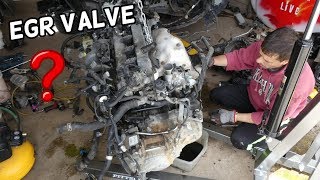
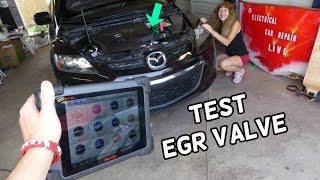
How to confirm: With the engine off, disconnect the EGR valve connector. Use a multimeter to check the resistance between the coil terminals on the valve itself. A Mazda service document indicates a target resistance of approximately 1.3 ohms, while another source suggests around 23 ohms is acceptable. An infinite reading (open) or zero reading (short) indicates a bad valve. A professional bidirectional scan tool can also command the valve to open and close; a lack of an audible click or response indicates failure. 🎬 See how to test the EGR valve with a multimeter.
Typical fix: Replace the entire EGR valve assembly and the associated gasket. 🎬 Watch: Step-by-step guide to replacing the EGR valve. It is highly recommended to use an OEM or high-quality aftermarket part, as some owners report issues with cheaper units.
Est. part cost: $260-$732 - Damaged Wiring or Connector 🟡 Medium Probability The wiring harness leading to the EGR valve is exposed to significant heat and vibration, which can lead to chafed insulation, broken wires, or corrosion in the connector pins over time. In some cases, the plastic of the connector itself can become brittle and disintegrate, causing a poor connection. There are documented owner experiences of replacing the EGR valve multiple times, only to find the true cause was an intermittent short in the harness.
How to confirm: Visually inspect the entire wiring harness from the EGR valve back to the PCM for any signs of damage, melting, or corrosion. Unplug the connector and check for bent, loose, or corroded pins, as well as physical disintegration of the connector housing. Wiggle the harness while the engine is running to see if it triggers the rough idle or code. Use a multimeter to perform a continuity test on each wire between the EGR connector and the PCM connector.
Typical fix: Repair the broken or shorted wire. If the connector is damaged, replace the connector pigtail. Part number examples include Replacement 612-058 or SKP SKS1780.
Est. part cost: $20-$50 - Clogged EGR Passages ⚪ Low Probability While very common for causing P0401 (Insufficient Flow), a severe carbon blockage can cause the valve pintle to stick. This can strain the control motor/solenoid, potentially leading to an electrical fault (P0403). This is less a direct cause of P0403 and more of a contributing factor that leads to the failure of the valve itself.
How to confirm: Remove the EGR valve and inspect the valve itself and the passages in the intake manifold for heavy carbon buildup.
Typical fix: Clean the carbon from the EGR valve and the manifold passages. However, if the code is P0403, the valve's electronics may have already been permanently damaged by the strain, and replacement will still be necessary even after cleaning.
Est. part cost: $10-$20 for cleaning supplies
Rare But Worth Checking
- Faulty Powertrain Control Module (PCM): → Shop Engine Control Module (ECM) This is very rare. The PCM's internal driver for the EGR circuit can fail, but all other possibilities, especially wiring faults, should be exhaustively ruled out before condemning the PCM. Note that Mazda did issue an emissions recall (7113L) for incorrect PCM software on this engine, which required reprogramming by a dealer.
Diagnosis Steps
- Scan for Codes: Use an OBD-II scanner to confirm P0403 is present and check for any other related codes.
- Visual Inspection: Inspect the EGR valve, its connector, and the wiring harness for any obvious signs of damage, melting, chafing, or corrosion.
- Check the Connector: Disconnect the EGR valve connector. Inspect the pins for damage or corrosion. Pay close attention to the physical condition of the connector itself, as the plastic can become brittle and disintegrate, causing poor pin connection.
- Test with Bidirectional Scanner (If Available): Use a professional scan tool like Autel or FORScan to actively command the EGR valve's stepper motor. Listen for an audible click from the valve as you command it on and off. A lack of sound indicates a failed motor.
- Test the Valve Circuit: With the key on and engine off, use a multimeter to check for battery voltage (B+) at the power supply wires on the harness side of the connector (Terminals C and D). Check for a good ground on the ground wire.
- Test the Valve Resistance: With the connector unplugged, measure the resistance across the terminals on the EGR valve itself. A Mazda service manual specifies a resistance of approximately 1.3 ohms, while other sources suggest a reading of around 23 ohms is acceptable. A reading of 0 ohms (short) or infinite ohms (open circuit) indicates a failed valve.
- Check Wiring Continuity: If the valve tests good, perform a continuity test on the signal and ground wires from the EGR connector back to the PCM to rule out a wiring break. Wiggle the harness during the test to check for intermittent opens/shorts.
- Check for Blockages: If electrical tests are inconclusive, remove the EGR valve and inspect it and the intake manifold passages for heavy carbon buildup that could cause the valve to stick.
Parts You'll Likely Need
- EGR Valve
(OEM #L3K9-20-300B (supersedes L3K9-20-300, L3K9-20-300A, L3K9-20-300A-9U))— This is the most common failure for a P0403 code, as the internal electronics of the valve fail, causing a circuit malfunction. The latest OEM part number is L3K9-20-300B.
Trusted brands: Mazda (Genuine OEM), Dorman, Standard Motor Products, CarQuest
OEM price range: $460-$732
Aftermarket price range: $210-$450 - EGR Valve Connector Pigtail — If the wiring check reveals a damaged or disintegrated connector housing, replacing the pigtail is necessary to ensure a solid electrical connection to the new EGR valve.
Trusted brands: Replacement (612-058), SKP (SKS1780), Wells (1P2707)
OEM price range: N/A
Aftermarket price range: $20-$50
Related Codes That Often Appear With This One
- P0401 — P0401 (EGR Flow Insufficient) is often caused by carbon buildup. If the valve gets stuck due to carbon, it can eventually lead to an electrical fault (P0403). They frequently appear together. 🎬 Watch: Troubleshooting P0401 and P0403 codes on your Mazda.
- P0300, P0301, P0302, etc. — Misfire codes can be triggered if the EGR valve is stuck open, allowing exhaust gas into the cylinders at idle when it shouldn't be, disrupting the air/fuel mixture.
Technical Service Bulletins (TSBs) & Recalls
- Emission Recall 7113L (supersedes MSP36): While not for P0403 specifically, Mazda issued this recall for 2.3L Turbo models because incorrect PCM software parameters could cause the vehicle to fail evaporative emission standards. The fix is a dealer-installed PCM software update. This is relevant as a faulty or out-of-date PCM is a rare but possible cause of electrical codes.
Platform-Specific Known Issues
- The EGR valve on the 2.3L Turbo engine is known to be prone to failure from both carbon buildup and internal electrical faults.
- Accessing the EGR valve requires removing the top-mount intercooler and battery, making the job more involved than on some other vehicles.
- Cleaning a carbon-fouled valve is often only a temporary fix; if the P0403 code is present, the electronics are likely already damaged and the valve will need replacement soon after.
Mechanic-Grade Diagnostic Values
- EGR Valve Coil Resistance — expected: Approximately 1.3 ohms (per a Mazda service document) or ~23 ohms (per another diagnostic source).. Failure: A reading of infinite ohms (open circuit) or 0 ohms (short circuit).
- EGR Valve Harness Power Supply Voltage — expected: Battery Voltage (B+), typically 12-13V with Key On, Engine Off.. Failure: No voltage indicates an open circuit in the power supply wire or a blown fuse.
Scan Tool Commands That Help
- Autel / FORScan or similar: Active Test: EGR Stepping Motor Position / EGR Valve Control — To command the EGR valve's internal motor to cycle open and closed. This allows a technician to listen for the audible click of the valve operating, confirming the motor works and is receiving the command from the PCM. A lack of response points to a failed valve or a break in the control circuit.
Wiring & Ground Locations
- EGR Valve Connector (6-pin) — On the EGR valve itself, located at the top rear of the engine, to the right of the center.. This is the primary connection point for all power and control signals. Pins C and D are the power supply (B+). The connector housing is known to become brittle and cause intermittent connections.
- PCM Connector — The Powertrain Control Module is located in the engine bay. Disconnecting it is required for end-to-end continuity testing of the EGR harness.. To definitively rule out a wiring break between the EGR valve and the computer, a continuity test must be performed from the EGR connector pins to their corresponding pins at the PCM connector.
Real Owner Repair Stories
- Mazdaspeeds.org forum user (Mazdaspeed 3 (same 2.3L MZR engine and EGR system)) — P0403 (EGR valve position control circuit short to ground or battery).
❌ Tried (didn't work) Replaced EGR valve with a used OEM part., Replaced EGR valve again with a new aftermarket part., Performed continuity tests on the harness wires to ground, which initially showed no fault.
✅ What actually fixed it The user discovered it was an intermittent short in one of the harness wires. After multiple valve replacements failed, wiggling and inspecting the harness caused the issue to temporarily disappear, pointing to a wiring fault rather than a component fault. The final fix was identifying and repairing the specific wire in the harness. - Mazda Forum user (Mazda 3 (similar EGR system)) — Persistent P0403 for nearly 2 years.
❌ Tried (didn't work) Replaced EGR valve 4 times with various aftermarket brands., Created a custom wiring harness directly to the PCM., Replaced harness pigtails., Cleaned intake manifold and replaced all vacuum lines., Performed continuity and resistance checks which passed.
✅ What actually fixed it After exhausting all other options, installing a genuine OEM Mazda EGR valve finally resolved the code, suggesting that the aftermarket valves were not compatible or failed to meet the PCM's specific electrical requirements.
OEM Part Supersession History
L3K9-20-300, L3K9-20-300A, L3K9-20-300A-9U→L3K9-20-300B— Standard part revision and improvement by the manufacturer.
Heads up: The latest part, L3K9-20-300B, is the recommended replacement for all previous versions and fits the entire 2007-2012 CX-7 model range with the 2.3L turbo engine.
Model Year Variations Within This Range
- 2007-2009 vs 2010-2012: There is a significant difference in the estimated professional repair cost. RepairPal data shows an average cost of $651-$982 for 2007-2009 models, versus $298-$430 for 2010-2012 models. This is likely due to changes in the OEM part price over time or potentially a slight variation in the part itself, although the primary part number L3K9-20-300B is listed for all years.
Diagnostic Flowchart
Used vs. New Parts: Buying Guide for This Vehicle
When a used part is the smart pick: A used OEM EGR valve from a low-mileage donor vehicle can be a cost-effective option, especially if the alternative is a new, unproven aftermarket brand. However, this is a high-risk approach.
Donor-vehicle mileage cap: roughly under 75000 miles for the part to have meaningful remaining life.
What to inspect on the donor part:
- Verify the part number on the used valve matches the OEM number (L3K9-20-300B or its predecessors).
- Inspect the electrical connector for any cracks, brittleness, or corrosion on the pins.
- Check the valve for excessive carbon buildup; a cleaner valve may indicate better engine health of the donor car.
- If possible, test the resistance across the coils before purchase to ensure it's within spec (~23 ohms).
OEM-only on this vehicle (don't cheap out):
- EGR Valve: Due to multiple forum reports of persistent P0403 codes with new aftermarket valves, using a Genuine Mazda OEM part is strongly recommended to ensure electronic compatibility with the PCM.
Aftermarket brands forum-validated for this vehicle:
- Standard Motor Products (SMP)
- Dorman (though some user reviews are mixed)
Brands owners have reported issues with on this vehicle:
- Unbranded, 'white-box' parts from online marketplaces have a high likelihood of causing the P0403 code to return due to incorrect electrical specifications.
Real Owner Stories
Aggregated from forums and TSBs cited above. Mileages and costs reflect what owners reported in those sources.
Mazdaspeed (2.3L MZR DISI Turbo I4)
Symptoms: The P0403 error code was present after replacing the EGR valve twice.
What fixed it: Repairing an intermittent short found in the wiring harness leading to the EGR valve.
Source hint: Mazdaspeeds.org thread titled 'P0403 error - egr valve position'
Related OBD-II Codes
Frequently Asked Questions
Is just cleaning the EGR valve a good permanent fix for code P0403 on my CX-7?
Why is it so difficult to get to the EGR valve on the 2.3L Turbo engine?
I replaced the EGR valve, but the P0403 code came back. What should I check next?
What resistance should I see when testing the EGR valve with a multimeter?
Is there a specific recall from Mazda for the P0403 EGR code?
Are other Mazda models with the 2.3L Turbo engine known for this same EGR problem?
Helpful Videos

The information in this article is provided for general reference and educational purposes only. Vehicle specifications, procedures, and part compatibility can vary by production date, trim level, and region. Always consult your vehicle's factory service manual and verify part numbers before purchasing or performing repairs. Safety-critical components such as airbags, seat belts, and braking systems should be installed by a qualified professional.
- Mazda CX-7:
- 🧭 Diagnostic Flowchart
- 🎬 Helpful Videos
- What's Unique About the 2007-2012 Mazda CX-7
- Symptoms You May Notice
- Most Likely Causes
- Rare But Worth Checking
- Diagnosis Steps
- Parts You'll Likely Need
- Related Codes That Often Appear With This One
- Technical Service Bulletins (TSBs) & Recalls
- Platform-Specific Known Issues
- Mechanic-Grade Diagnostic Values
- Scan Tool Commands That Help
- Wiring & Ground Locations
- Real Owner Repair Stories
- OEM Part Supersession History
- Model Year Variations Within This Range
- Used vs. New Parts: Buying Guide for This Vehicle
- Real Owner Stories
- Mazdaspeed (2.3L MZR DISI Turbo I4)
- Related OBD-II Codes
- Frequently Asked Questions
- 🎟️ Get 5% Off