

P0403 on 2010-2015 Toyota Prius: EGR Circuit Malfunction Causes and Fixes
On a 2010-2015 Prius, code P0403 is almost always an electrical issue with the EGR system, not a clog. Before replacing the expensive EGR valve, check the 10-amp 'EFI NO. 2' fuse under the hood, as this is a common and cheap fix for this specific code. If the fuse is good, the EGR valve's internal motor has likely failed.
- P0403 is an ELECTRICAL circuit code, not a flow/clogging code.
- ALWAYS check the 10-amp 'EFI NO. 2' fuse in the under-hood fuse box first. It's a simple, cheap, and common fix.
- Do not waste time cleaning the EGR cooler or passages to fix a P0403; this procedure addresses code P0401, although cleaning is recommended when replacing the valve.
- If the fuse is good, the EGR valve's internal motor has almost certainly failed. Test resistance to confirm before replacing.
- This issue is identical on the 2011-2017 Lexus CT200h.
What's Unique About the 2010-2015 Toyota Prius
While the 3rd generation Prius is famous for EGR system problems, those are typically related to carbon buildup in the EGR cooler and intake manifold, causing code P0401 (Insufficient Flow). Code P0403 is different; it specifically flags an electrical circuit failure. For this Prius generation, a surprisingly common cause for P0403 is a blown 10-amp fuse (EFI No. 2), which can also trigger other codes like P0102 (Mass Airflow Sensor) and P0031 (O2 Sensor Heater). Owners often mistakenly focus on cleaning the EGR passages for a P0403, when the root cause is purely electrical. However, severe carbon clogging can cause the valve to stick, which may strain and burn out the internal motor, leading to the P0403 fault.
Symptoms You May Notice
- Check Engine Light is on
- Rough or unstable idle
- Engine stalling, especially at idle
- Reduced engine power or hesitation during acceleration
- Failing a vehicle emissions test
- Reduced fuel economy
- Replacing the EGR valve without first checking the 'EFI NO. 2' fuse. Many owners have spent hundreds on a new valve when the only issue was a $1 fuse.
- Extensively cleaning the EGR cooler and intake manifold. While this is critical maintenance for preventing P0401 and can be a contributing factor to P0403, it will not resolve the P0403 electrical circuit code if the valve motor or wiring is already fried.
Most Likely Causes
- Blown 10A EFI No. 2 Fuse 🔴 High Probability This specific fuse powers the EGR valve circuit and is a known failure point on this platform, often causing P0403 and sometimes P0102 and/or P0031 simultaneously. 🎬 Watch: How to fix these common Prius error codes A short in another component on the same circuit, like an O2 sensor wire touching a heat shield, can also cause this fuse to blow.
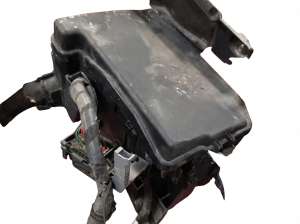
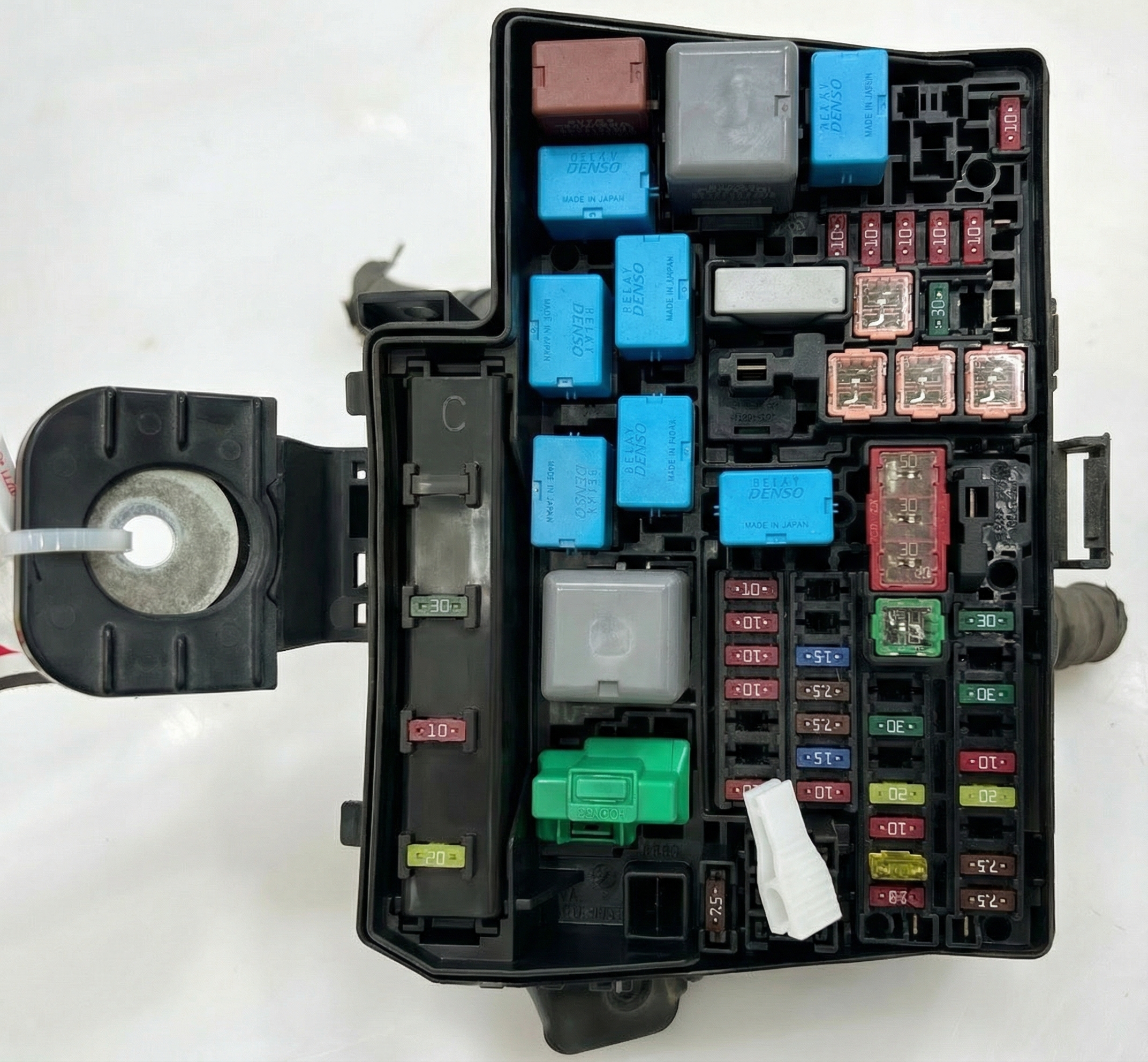
How to confirm: Locate the under-hood fuse box. Find the 10-amp fuse labeled 'EFI NO. 2' and visually inspect it or test for continuity with a multimeter.
Typical fix: Replace the blown 10A fuse. If it blows again, there is an underlying short circuit in the wiring or a connected component (EGR valve, MAF sensor, O2 sensor) that must be diagnosed.
Est. part cost: $1-$5 - Faulty EGR Valve Assembly 🟡 Medium Probability → Shop Exhaust Gas Recirculation (EGR) Valve The internal stepper motor that controls the valve pintle can fail electrically, creating an open or short circuit that the ECM detects. This can happen from normal wear or be accelerated by heavy carbon buildup causing the valve to stick and strain the motor.
How to confirm: After confirming the fuse is good, disconnect the EGR valve connector. Using a multimeter, measure the resistance between the terminals. According to service manuals, the resistance between terminals 1-2, 2-3, 4-5, and 5-6 should be between 24 and 30 Ω at 68°F (20°C). 🎬 See how to test the EGR valve with a multimeter A reading of infinity (open) or near zero (short) indicates a failed valve motor.
Typical fix: Replace the entire EGR valve assembly. It is highly recommended to also clean the EGR cooler, pipe, and intake manifold passages at the same time to prevent the new valve from failing prematurely.
Est. part cost: $150-$350 - Damaged Wiring or Connector ⚪ Low Probability The wiring harness to the EGR valve is located in the engine bay and is subject to heat, vibration, and potential rodent damage. In some cases, wiring for other components on the same circuit (like an O2 sensor) can short to the exhaust, blowing the fuse and triggering P0403.
How to confirm: Visually inspect the wiring harness and connector for any signs of fraying, melting, corrosion, or breaks. Perform a continuity test from the EGR connector to the ECM connector.
Typical fix: Repair the damaged section of wire or replace the connector pigtail.
Est. part cost: $10-$50
Rare But Worth Checking
- Faulty Engine Control Module (ECM): → Shop Engine Control Module (ECM) This is extremely rare. The ECM is the last component to suspect. All other possibilities, including fuses, the valve itself, and wiring, must be exhaustively ruled out before considering the ECM as the cause.
Diagnosis Steps
- Retrieve the trouble code with an OBD-II scanner. Confirm P0403 is present. Check for other codes like P0102 or P0031 that point to a shared fuse.
- Open the hood and locate the main fuse box.
- Find and inspect the 10-amp 'EFI NO. 2' fuse. Replace it if it is blown. If it blows again immediately, a short circuit is present.
- If the fuse is good, proceed to inspect the EGR valve connector and wiring for any visible damage (melting, corrosion, chewed wires).
- If wiring appears intact, disconnect the EGR valve connector (it has 6 pins).
- Using a multimeter set to Ohms, test the resistance of the EGR valve's internal motor coils. Check between pins 1-2, 2-3, 4-5, and 5-6. The specification is 24-30 Ohms. If any reading is out of spec, the valve is bad.
- If the valve tests good, perform a continuity check on the wiring harness between the EGR valve connector and the ECM.
- If a short is suspected (fuse blows repeatedly), disconnect components on the circuit one by one (EGR valve, MAF sensor, O2 sensor) to see if the short disappears, which will isolate the faulty component or wiring section.
- If all other components and wiring test good, the final possibility is a fault within the ECM itself, though this is highly unlikely.
Parts You'll Likely Need
- EGR Valve
(OEM #25620-37110, superseded by 25620-37120)— The internal motor of the valve is the most common component to fail electrically, triggering the P0403 circuit code after the fuse has been checked. The part was updated to a new number.
Trusted brands: Toyota (OEM), Denso, Aisin, Delphi, NGK
OEM price range: $250-$350
Aftermarket price range: $100-$250 - 10 Amp Mini Fuse
(OEM #90982-09021)— A known common failure point on this specific vehicle that powers the EGR circuit and can trigger code P0403.
Trusted brands: Bussmann, Littlefuse
OEM price range: $1-$5
Aftermarket price range: $1-$5
Related Codes That Often Appear With This One
- P0102 — The Mass Air Flow (MAF) sensor circuit and the EGR valve circuit are powered by the same 'EFI NO. 2' fuse. A blown fuse will often cause both P0403 and P0102 to appear together.
- P0031 — The Oxygen (O2) Sensor Heater Control Circuit is also on the same fused circuit. A short in the O2 sensor wiring can blow the fuse, causing P0403, P0102, and P0031 to all appear at once.
Platform-Specific Known Issues
- The 2010-2015 Prius is well-known for EGR system issues, but P0403 is distinct from the more common P0401 clogging issue. The diagnosis must focus on the electrical circuit.
- A blown 10A EFI No. 2 fuse is a specific quirk of this platform that can cause P0403, making it the first part to check. This fuse also powers the MAF and O2 sensor heater, so multiple codes often appear together.
- While P0403 is an electrical code, it is often the secondary result of the primary Prius problem: heavy carbon buildup in the EGR system. This buildup can cause the valve to stick, which overloads and burns out the valve's internal motor.
Mechanic-Grade Diagnostic Values
- EGR Valve Stepper Motor Coil Resistance — expected: 24 to 30 Ω at 20°C (68°F). Failure: Near zero ohms (short) or infinite ohms / OL (open circuit) between pins 1-2, 2-3, 4-5, or 5-6.
- Manifold Absolute Pressure (MAP) at warm idle — expected: Approx. 4 psi (absolute). Failure: This is a baseline reading before performing an active test.
- MAP Sensor response during Techstream 'Control the EGR Step Position' Active Test — expected: MAP reading increases (vacuum decreases) and idle becomes rough at a low step number (e.g., 14-17 out of 110) on a clean system.. Failure: Requiring a high step number (>30) to see any change in MAP or idle quality indicates a clogged EGR cooler or passages. No change at all could mean a completely blocked passage or a non-functional (stuck closed) valve.
- EGR Motor Control Circuit Voltage (at ECM) — expected: Pulse generation waveform during operation.. Failure: A fixed voltage of 0V on any of terminals EGR1, EGR2, EGR3, or EGR4 for more than 1 second will trigger DTC P0403.
Hidden / Shadow Codes Worth Checking
- Freeze Frame Data: While not a separate code, Toyota heavily relies on Freeze Frame Data, which captures a snapshot of all major sensor values at the moment the P0403 code was set. This data is critical for determining if the fault occurred when the engine was hot/cold, at idle/under load, etc., which helps narrow down the electrical fault's conditions. (see via Professional scan tool like Toyota Techstream or equivalent high-end scanner.)
Scan Tool Commands That Help
- Toyota Techstream: Active Test: 'Control the EGR Step Position' — This is a powerful diagnostic tool to use after checking the fuse and wiring. It allows you to command the EGR valve's stepper motor to open in small increments (0-110 steps) while the engine is idling. By observing the MAP sensor reading and listening to the idle quality, you can determine if the valve is physically moving and if the EGR passages are clear, helping to differentiate a bad valve motor from a clog (which would be a P0401 issue).
Wiring & Ground Locations
- Engine Harness Ground Points — There are several key ground wire clusters for the engine harness. One major point is on the engine block/head, near the top of the engine, where multiple ground wires converge on a single bolt.. A poor ground connection for the engine harness can cause a variety of electrical issues, including erratic behavior or fault codes for components controlled by the ECM, such as the EGR valve. Verifying these grounds are clean and tight is a crucial step in diagnosing any electrical fault.
- ECM (Engine Control Module) — Located in the left side of the engine compartment.. The EGR valve is directly controlled by the ECM. The wires from the EGR valve connector run to specific pins on the ECM connectors (e.g., EGR1, EGR2, EGR3, EGR4). Knowing the ECM's location is necessary for performing continuity and short-to-ground tests on the harness.
- EGR Valve Connector Pins (at ECM) — On the ECM connectors in the engine bay. The specific pins are labeled EGR1, EGR2, EGR3, and EGR4.. These are the final destination for the EGR stepper motor control signals. Testing for continuity between the valve connector and these specific pins can definitively rule out a wiring harness break.
Real Owner Repair Stories
- YouTube user 'insanely cool cars' (2010 Toyota Prius (2ZR-FXE)) — Persistent P0401 and P0403 codes that would not clear.
❌ Tried (didn't work) Replacing the EGR valve with a new one., Cleaning the original EGR cooler., Replacing the EGR cooler with a new one., Thoroughly cleaning the intake manifold and all EGR passages.
✅ What actually fixed it Replacing the Engine Control Module (ECM) finally resolved the codes. - Reddit user r/prius (2015 Toyota Prius, 161k miles) — P0403 Check Engine Light, lower than average gas mileage.
❌ Tried (didn't work) The code appeared 7 months *after* a full EGR system cleaning and head gasket replacement., A visual inspection confirmed the EGR valve was still clean.
✅ What actually fixed it The thread concluded with the owner planning to clean the intake manifold passages, which they noted looked dirty. This story illustrates that even after a major service, an electrical fault (P0403) can develop independently of carbon buildup.
"I Checked Everything" — The Actual Cause
- For code P0403, the equivalent of a 'smoke test clean' scenario is when all standard electrical checks pass, but the code persists. This includes confirming the EFI NO. 2 fuse is good, the EGR valve's coil resistances are within the 24-30 Ohm spec, and the wiring shows no visible damage. In one documented case, after all these checks and even replacing the EGR valve and cooler, the root cause was a faulty driver circuit inside the Engine Control Module (ECM). This is a last-resort diagnosis after every other part of the circuit has been proven good.
OEM Part Supersession History
25620-37110→25620-37120— The revised valve is a slightly different physical size. While not officially stated, revisions are typically made to improve durability and prevent sticking, which can lead to motor burnout.
Heads up: The parts are cross-compatible, but with caveats. When installing the newer '-37120' valve in a vehicle that had the older '-37110' valve, the wiring harness may be tight and need to be unclipped to provide enough slack. Additionally, Toyota TSB T-SB-0027-16 recommends a corresponding ECM calibration update when installing the newer valve, though it may function without it.25620-37120 (Valve only)→04004-58137 (Kit)— This is a kit part number that includes the updated EGR valve (25620-37120) along with the necessary gaskets for installation.
Heads up: This kit is often cheaper than buying the valve by itself from a dealer. It is a direct replacement.
Model Year Variations Within This Range
- 2010-2013: These earlier models were originally equipped with EGR valve part number 25620-37110.
- 2014-2015: These later models were typically equipped with the revised EGR valve, 25620-37120. They also feature improved piston rings to reduce oil consumption, which can indirectly affect the rate of carbon buildup in the EGR system over the long term.
Diagnostic Flowchart
Other Known Issues on This Vehicle
Issues unrelated to this code that are worth knowing about as an owner of this generation:
- EGR System Clogging (Cooler, Pipe, Intake Manifold) 🔴 High — Extremely common, typically requires cleaning every 60,000-100,000 miles. Directly contributes to head gasket failure if ignored. (Ref: No specific recall, but a well-documented maintenance item in the owner community.)
- Excessive Oil Consumption 🟠 Medium — Common on 2010-2014 models, often noticeable after 100,000 miles. Caused by piston and ring design. (Ref: T-SB-0168-16 (Inspection) and T-SB-0169-16 (Repair) were issued to address this with updated pistons/rings, but coverage was under the original powertrain warranty.)
- Head Gasket Failure 🔴 High — A significant issue for this generation, often occurring between 150,000-200,000 miles. Strongly linked to unaddressed EGR clogging, which causes engine hot spots. Symptoms include a rough, rattling startup.
- Brake Actuator / Booster Pump Failure 🔴 High — Common failure leading to loss of braking assist and multiple warning lights. Can occur at various mileages. (Ref: A recall was issued for some 2010 models. A Warranty Enhancement Program (ZG1) was also offered, extending coverage, but has since expired for most vehicles.)
- Hybrid Inverter Failure 🟠 Medium — Can fail, causing the car to shut down. Less common than other issues but very expensive to fix. (Ref: Toyota issued a Customer Support Program to extend the warranty on this component for many vehicles.)
- Center Multi-Function Display (MFD) Failure 🟡 Low — The main screen can go blank due to poorly soldered internal connections. It doesn't affect driving but loses all screen functions.
Used vs. New Parts: Buying Guide for This Vehicle
When a used part is the smart pick: Buying a used EGR cooler and pipe assembly from a junkyard or eBay can be a smart strategy. This allows you to take your time cleaning the used parts thoroughly at home, then perform the swap in a single day, minimizing vehicle downtime. Do not install a used cooler without cleaning it first.
Donor-vehicle mileage cap: roughly under 100000 miles for the part to have meaningful remaining life.
What to inspect on the donor part:
- For an EGR Cooler: Assume it is 100% clogged regardless of appearance and will require extensive cleaning with solvents, pressure washing, or specialized tools.
- For an EGR Valve: Check for physical damage to the connector. If possible, test the coil resistance (24-30 Ohms). Manually actuate the pintle to ensure it's not seized (though this doesn't test the motor).
- Check the source vehicle's history if possible; a part from a car with a known head gasket failure might have been subjected to coolant contamination.
OEM-only on this vehicle (don't cheap out):
- EGR Valve: Due to the electrical nature of the P0403 failure, using a genuine Toyota, Denso, or Aisin valve is strongly recommended. Forum members have reported some aftermarket valves sticking or failing prematurely.
Aftermarket brands forum-validated for this vehicle:
- Denso (often the OEM supplier)
- Aisin (often the OEM supplier)
Brands owners have reported issues with on this vehicle:
- Unbranded, low-cost EGR valves from online marketplaces have a reputation for sticking or having incorrect electrical characteristics.
Real Owner Stories
Aggregated from forums and TSBs cited above. Mileages and costs reflect what owners reported in those sources.
2010 Toyota Prius 1.8L Hybrid
Symptoms: Check engine light on with codes P0403, P0102, and P0031 appearing simultaneously.
What fixed it: Found the EFI NO. 2 fuse was blowing because an O2 sensor wire was shorting against a heatshield.
Source hint: PriusChat.com: A user with P0403, P0102, and P0031 found the shared 'EFI NO. 2' fuse was blowing due to a shorted O2 sensor wire touching the heatshield.
2012 Toyota Prius 1.8L Hybrid
Symptoms: P0403 code returned even after the owner attempted to clean the EGR system.
What fixed it: Replacement of the entire EGR valve assembly due to electrical failure of the internal motor.
Source hint: PriusChat.com: In a thread about P0403, users initially suggest cleaning the EGR system (the fix for P0401), but the original poster confirms the code returned, indicating the electrical failure of the valve itself.
2010-2015 Toyota Prius 1.8L Hybrid — ~175000 miles
Symptoms: P0403 code appeared seven months after a head gasket replacement and EGR cleaning.
What fixed it: Replacement of the faulty electrical component (EGR valve) as cleaning alone did not resolve the circuit fault.
Source hint: Reddit (r/prius): A user reported a P0403 code seven months after having a head gasket replaced and the EGR system cleaned
2011-2017 Lexus CT200h 1.8L Hybrid
Symptoms: Rough cold starts and a P0403 trouble code.
What fixed it: Replacement of the entire EGR valve assembly because the internal solenoid was sticking.
Source hint: LexusOwnersClub.co.uk: A Lexus CT200h (platform mate) owner with rough cold starts and a P0403 code was advised that the solenoid was sticking and the entire EGR valve assembly needed replacement.
Related OBD-II Codes
Frequently Asked Questions
Can a blown fuse cause the P0403 code on my 2010-2015 Prius?
I already cleaned my EGR cooler and pipe, so why did P0403 come back?
What are the specific resistance specs for testing the EGR valve motor on a 2ZR-FXE engine?
Is there a TSB for the oil consumption issue that might be related to my EGR problems?
Could an O2 sensor issue be related to my P0403 code?
Does the Lexus CT200h have this same P0403 issue?
Helpful Videos
We Have This Part in Stock

The information in this article is provided for general reference and educational purposes only. Vehicle specifications, procedures, and part compatibility can vary by production date, trim level, and region. Always consult your vehicle's factory service manual and verify part numbers before purchasing or performing repairs. Safety-critical components such as airbags, seat belts, and braking systems should be installed by a qualified professional.
- Toyota Prius:
- 🧭 Diagnostic Flowchart
- 🎬 Helpful Videos
- 🛍️ Shop This Part
- What's Unique About the 2010-2015 Toyota Prius
- Symptoms You May Notice
- Most Likely Causes
- Rare But Worth Checking
- Diagnosis Steps
- Parts You'll Likely Need
- Related Codes That Often Appear With This One
- Platform-Specific Known Issues
- Mechanic-Grade Diagnostic Values
- Hidden / Shadow Codes Worth Checking
- Scan Tool Commands That Help
- Wiring & Ground Locations
- Real Owner Repair Stories
- "I Checked Everything" — The Actual Cause
- OEM Part Supersession History
- Model Year Variations Within This Range
- Other Known Issues on This Vehicle
- Used vs. New Parts: Buying Guide for This Vehicle
- Real Owner Stories
- 2010 Toyota Prius 1.8L Hybrid
- 2012 Toyota Prius 1.8L Hybrid
- 2010-2015 Toyota Prius 1.8L Hybrid — ~175000 miles
- 2011-2017 Lexus CT200h 1.8L Hybrid
- Related OBD-II Codes
- Frequently Asked Questions
- 🎟️ Get 5% Off