

P0405 on 2000-2007 Ford Taurus 3.0L: EGR/DPFE Sensor Circuit Low Causes and Fixes
On a 2000-2007 Taurus with the 3.0L Vulcan engine, P0405 almost always points to a failed DPFE sensor or its connecting hoses. This is a common failure item, but it's a relatively easy and inexpensive DIY fix, with the part costing between $25 and $60. A key-on, engine-off voltage reading below 0.2V at the sensor is a strong indicator of a failed sensor.
- P0405 on your Taurus almost always means the DPFE sensor has failed. It's a common, well-documented issue.
- Before buying parts, perform a simple test: apply vacuum to the EGR valve at idle. If the engine stumbles, your passages are clear; if not, they're clogged.
- While testing, watch the DPFE voltage on a scan tool. If it doesn't rise when the engine stumbles, the sensor is bad.
- Always inspect the small rubber hoses connected to the sensor for cracks or leaks, as they are a cheap and easy fix.
- Do not replace the more expensive EGR valve unless you have confirmed it is faulty; the problem is usually the sensor or clogged passages.
What's Unique About the 2000-2007 Ford Taurus
Unlike some systems that use a position sensor on the EGR valve itself, Ford's 3.0L Vulcan engine from this era uses a separate DPFE sensor to measure EGR flow. This sensor, connected by two silicone hoses to the EGR tube, is a known high-failure part. The original equipment plastic housing can crack and the internal electronics are sensitive to heat and moisture, making it the most common point of failure when a P0405 code appears. Many aftermarket replacements now use a more durable metal housing to address this weakness.
Symptoms You May Notice
- Check Engine Light illuminated
- Rough or unstable idle
- Engine hesitation or stumbling on acceleration
- Engine stalling, especially at idle
- Noticeable decrease in fuel economy
- Engine pinging or knocking sounds
- Failing an emissions test
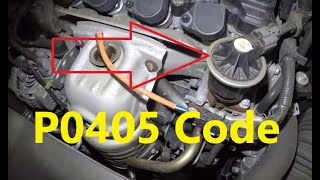
- Replacing the EGR valve when the actual problem is the DPFE sensor or clogged passages. The EGR valve is more expensive and harder to replace, so it's critical 🎬 See how to fix the P0405 code yourself. to diagnose the system correctly first.
Most Likely Causes
- Failed DPFE Sensor 🔴 High Probability The original equipment DPFE sensors were often made with plastic housings that are prone to cracking from heat and vibration. They are a very common failure point on this platform, with Ford having gone through several redesigns.
How to confirm: With the key on and engine off, backprobe the DPFE sensor's signal wire (or use a scan tool). It should read approximately 0.5V to 1.2V. If it reads near 0V or below 0.2V, the sensor is shorted internally and has a hard fault. You can also monitor the DPFE voltage with a scan tool while applying vacuum to the EGR valve; the voltage should rise from ~1.0V towards ~5.0V. If it doesn't change, the sensor is bad.
Typical fix: Replace the DPFE sensor and its two small connecting hoses. It is highly recommended to use a Motorcraft part or a high-quality aftermarket replacement with a metal body for better durability.
Est. part cost: $25-$60 - Clogged EGR Passages 🟡 Medium Probability Over time, carbon from the exhaust can build up and completely block the small passages in the intake manifold where the EGR gas enters.
How to confirm: With the engine idling, manually apply vacuum to the EGR valve using a hand pump. The engine should stumble badly or stall. If the idle does not change, the passages are clogged.
Typical fix: Remove the throttle body and EGR valve to gain access to the intake manifold ports. Clean the carbon buildup out of the ports using a small wire brush, pick, and carburetor cleaner.
Est. part cost: $5-$15 for cleaning supplies - Damaged Wiring or Connector ⚪ Low Probability
How to confirm: Visually inspect the 3-wire harness and connector for the DPFE sensor. Look for signs of corrosion, melted plastic, broken wires, or loose pins. Use a multimeter to check for 5V reference voltage and a good ground at the connector with the key on. The harness can get brittle from heat exposure.
Typical fix: Repair the damaged section of wiring or replace the connector pigtail.
Est. part cost: $10-$25 for a pigtail connector - Leaking or Disconnected DPFE Hoses ⚪ Low Probability
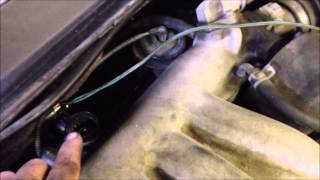
How to confirm: Visually inspect the two small silicone hoses that run from the metal EGR tube to the DPFE sensor. Check for cracks, splits, or loose connections. They can become brittle and fail over time. Also check that they are not switched, as this will cause incorrect readings.
Typical fix: Replace both hoses. They are often sold with a new DPFE sensor.
Est. part cost: $10-$20
Rare But Worth Checking
- Failed EGR Valve: → Shop Exhaust Gas Recirculation (EGR) Valve The EGR valve itself can fail, but it's less common for it to cause a P0405 circuit code. More often, a failed valve would cause a flow code like P0401 or P0402. However, if the valve is stuck and not allowing any flow, it could contribute to the diagnostic confusion.
- Faulty Powertrain Control Module (PCM): This is extremely rare. The PCM should only be considered after all other possibilities, including all wiring and sensors, have been exhaustively tested and proven to be good. Sometimes a software update or re-flash can resolve incorrect voltage detection thresholds.
Diagnosis Steps
- Connect an OBD-II scanner and check for any other codes that may be present. Note if a P1000 code is present, indicating a recent code clear.
- Visually inspect the DPFE sensor, its connector, and its wiring harness for any obvious damage, corrosion, or loose connections.
- Inspect the two silicone hoses running to the DPFE sensor for cracks, brittleness, or loose fittings. Ensure they are connected to the correct ports.
- With the ignition on but the engine off (KOEO), use a scan tool to view the live data for the DPFE sensor voltage. It should be around 0.5V to 1.2V. A reading less than 0.2V indicates a hard fault and strongly suggests a bad sensor or a wiring short to ground.
- Start the engine and let it idle. The DPFE voltage should remain steady.
- Locate the EGR valve and apply vacuum to it with a handheld vacuum pump. The engine should run very rough or stall. If there is no change in idle, the EGR passages are clogged.
- While applying vacuum to the EGR valve, watch the DPFE voltage on the scan tool. It should rise sharply, approaching 4.5-5.0V. If the engine stumbles (confirming flow) but the voltage doesn't rise, the DPFE sensor is faulty.
- If the sensor and passages seem okay, use a multimeter to verify the DPFE connector has a 5V reference, a good ground, and continuity on the signal wire back to the PCM.
Parts You'll Likely Need
- Differential Pressure Feedback (DPFE) Sensor
(OEM #4U7Z-9J460-AA)— This is the most frequent point of failure for a P0405 code on this vehicle due to its design and location. This part number supersedes several previous versions including 2F1Z-9J460-AA and YS4Z-9J460-AA.
Trusted brands: Motorcraft, Standard Motor Products (SMP), Walker
OEM price range: $50-$80
Aftermarket price range: $25-$50 - EGR Valve — Replaced if it is confirmed to be stuck, not holding vacuum, or if it's being removed for passage cleaning and is in poor condition.
Trusted brands: Motorcraft, Delphi
OEM price range: $80-$120
Aftermarket price range: $50-$90
Related Codes That Often Appear With This One
- P0401 — EGR Flow Insufficient Detected. This code often appears alongside P0405 if the root cause is clogged passages, preventing the DPFE sensor from seeing a pressure change.
- P0402 — EGR Flow Excessive Detected. This could happen if the EGR valve is stuck open, which might also be related to sensor circuit issues.
- P1000 — OBDII System Checks Incomplete. This code is common on Fords after clearing fault codes. It indicates that not all system monitors have completed their self-tests. If you see this with P0405, it may mean someone recently cleared the codes without fixing the root problem.
Platform-Specific Known Issues
- The plastic-bodied DPFE sensors originally used on these vehicles are known to fail frequently. Many aftermarket replacements use a more durable metal housing to combat this issue.
- A detailed video by ScannerDanner on a 2007 Taurus with P0405 demonstrates the diagnostic process, confirming a bad DPFE sensor with a KOEO voltage of 0.13V, far below the expected ~1.0V. 🎬 Watch this diagnostic walkthrough of a failed DPFE sensor.
- Owners on forums like Taurus Car Club of America and Reddit frequently cite the DPFE sensor as the primary culprit for P0405, 🎬 Learn more about the common causes and fixes for P0405. often being the first and only part needed for the repair.
Mechanic-Grade Diagnostic Values
- DPFE Sensor Signal Voltage (KOEO) — expected: 0.5V to 1.2V (Ford expanded spec is 0.2V to 1.3V to cover both metal and plastic sensor types).. Failure: A reading below 0.2V, which triggers the P0405 code.
- DPFE Sensor Reference Voltage (VREF) — expected: ~5.0V at the sensor connector with key on.. Failure: Voltage significantly below 5.0V indicates a wiring issue or a problem with the PCM's 5V reference circuit.
- DPFE Sensor Ground Circuit — expected: Near 0V, or <100mV when measured between the ground pin and battery negative.. Failure: A reading significantly above 0V indicates a poor ground connection, which can cause incorrect sensor readings.
- DPFE Sensor Signal Voltage (EGR Active) — expected: Voltage should rise from baseline (~1.0V) towards 4.5V-5.0V as vacuum is applied to the EGR valve.. Failure: Voltage does not rise when the engine stumbles (confirming EGR flow), indicating a failed sensor.
- EGR Vacuum Regulator (EVR) Solenoid Resistance — expected: 20 to 70 Ohms across the two pins of the solenoid.. Failure: Resistance is infinite (open circuit) or near zero (short circuit), indicating a failed solenoid coil.
Hidden / Shadow Codes Worth Checking
- Non-OBDII KOEO Test Code: When replacing an older metal-body DPFE sensor (~0.55V KOEO) with a newer plastic-body sensor (~1.0V KOEO), a Key-On Engine-Off self-test may flag a code because the PCM's old tolerance range is exceeded. This is not an OBD-II fault, will not illuminate the Check Engine Light, and should be ignored. (see via This may appear only when running a specific KOEO self-test with a capable scan tool, not during normal operation.)
Scan Tool Commands That Help
- Ford IDS, Forscan, or other professional scan tool: EGR Valve Actuation Test / Output State Control — This bidirectional command allows the technician to manually command the EGR Vacuum Regulator (EVR) solenoid on and off at idle. This forces the EGR valve to open, allowing the tech to watch the DPFE voltage PID on the scan tool. If the engine stumbles but the DPFE voltage doesn't rise, it confirms a bad DPFE sensor.
Wiring & Ground Locations
- DPFE Sensor Connector — On the DPFE sensor itself, typically a 3-wire connector located near the EGR valve at the rear of the engine.. This is the primary connection point to test for VREF (~5V), Signal (variable voltage), and Ground (~0V). A P0405 is a circuit code, making this connector a critical test point.
- G104 (or similar) — Common Ford PCM ground point. Often located on the left front fender apron, near or behind the battery.. A corroded or loose main PCM ground can cause a floating ground, leading to inaccurate sensor readings and triggering erroneous circuit codes like P0405. Verifying all major PCM grounds is a crucial step in advanced electrical diagnosis.
- PCM Case Grounds — Multiple ground wires from the main harness that bolt directly to the chassis near the PCM, often in the passenger-side kick panel area.. The DPFE sensor's ground is provided by the PCM (Signal Return). If the PCM itself has a poor ground to the chassis, the entire sensor reference system can be skewed.
Real Owner Repair Stories
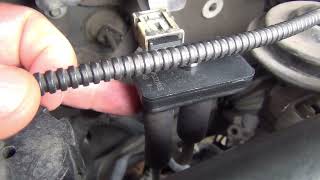
- YouTube video by 'Livid Living' (2000 Ford Taurus) — EGR-related trouble codes.
❌ Tried (didn't work) Initial inspection revealed a disconnected DPFE hose.
✅ What actually fixed it Upon trying to reattach the hose, the technician discovered the plastic nipples on the DPFE sensor itself were broken off and stuck inside the old hoses. The final fix was replacing the DPFE sensor and the two connecting hoses. - YouTube comment on 'Livid Living' video (Ford Taurus (year not specified)) — EGR code reappeared after replacing the EGR valve.
❌ Tried (didn't work) Replacing the EGR valve.
✅ What actually fixed it The actual problem was clogged carbon ports inside the intake manifold. The fix was to clean the manifold passages with carburetor cleaner and run a wire through the ports to clear the blockage. - NHTSA ODI #10583652 (Ford F-250 SD) — An owner reported needing to clear carbon from the intake and replace the EGR valve to resolve codes P0404, P0405, P115A, and U0100.
OEM Part Supersession History
2F1Z-9J460-AA, YS4Z-9J460-AA (and others)→4U7Z-9J460-AA (Motorcraft DPFE-4)— Design improvement. The original metal (aluminum) body sensors were prone to internal corrosion and electronic failure.
Heads up: The original metal sensors had a KOEO voltage of ~0.5V. The newer plastic replacement sensors have a KOEO voltage of ~1.0V. While Ford's official spec was widened to accommodate this, it's a critical diagnostic difference. A tech expecting 0.5V might misdiagnose a good 1.0V sensor.
Model Year Variations Within This Range
- 2000-2007 (entire range): The most significant variation within this generation was not a specific model year change, but the transition from the original equipment metal-bodied DPFE sensors to the updated plastic-bodied service replacements. Early models in this range likely came from the factory with the metal sensor, which was more prone to failure and had a different baseline voltage reading than the part that would replace it.
Diagnostic Flowchart
Other Known Issues on This Vehicle
Issues unrelated to this code that are worth knowing about as an owner of this generation:
- Automatic Transmission Failure (AX4N/AX4S) 🔴 High — Very common, especially in 2003-2005 models. Can fail suddenly without warning, often due to stripped torque converter splines.
- Camshaft Synchronizer Failure 🔴 High — A well-known failure point on the 3.0L Vulcan engine. Wear causes a characteristic 'chirping' or 'squeaking' noise from the engine. If it fails completely, it can shear the oil pump drive shaft, leading to catastrophic engine failure. (Ref: TSB 870197 mentioned for similar issues.)
- Broken Coil Springs 🔴 High — Primarily affects 1999-2001 models in corrosion-prone areas (salt belt). The front or rear springs can fracture and potentially puncture a tire. (Ref: NHTSA ID: 04V332000, Ford Recall 04S17, Customer Satisfaction Program 04M04.)
- Stalling / Hesitation from Idle Air Control (IAC) Valve 🟠 Medium — A faulty IAC valve can cause the engine to stall at idle or hesitate during acceleration. It is a common issue across many model years.
- Intake Manifold Gasket / O-Ring Leaks 🟡 Low — The O-rings and gaskets for the intake manifold system are known to degrade over time, causing vacuum leaks that lead to lean codes, random misfires, and poor idle quality.
Used vs. New Parts: Buying Guide for This Vehicle
When a used part is the smart pick: A used part is generally not recommended for this repair due to the low cost and high failure rate of the primary component. However, if the metal EGR tube that the DPFE hoses connect to is damaged, a used tube from a junkyard is a viable option.
Donor-vehicle mileage cap: roughly under 80000 miles for the part to have meaningful remaining life.
What to inspect on the donor part:
- For an EGR tube, inspect for heavy rust, corrosion, or cracks, especially at the welds.
- For an EGR valve, ensure the diaphragm holds vacuum with a hand pump and is not seized.
- NEVER buy a used DPFE sensor. It is a sensitive electronic component and a high-failure item; the risk of getting a bad part is extremely high.
OEM-only on this vehicle (don't cheap out):
- No parts for this specific repair are strictly 'OEM-only', as quality aftermarket brands are widely available and effective.
Aftermarket brands forum-validated for this vehicle:
- Motorcraft (OEM)
- Standard Motor Products (SMP)
- Walker Products
- Delphi
Brands owners have reported issues with on this vehicle:
- Unbranded, 'white-box' sensors from online marketplaces should be avoided. The calibration of the DPFE sensor is critical, and ultra-low-cost parts often have poor quality control, leading to repeat failures or incorrect readings out of the box.
Real Owner Stories
Aggregated from forums and TSBs cited above. Mileages and costs reflect what owners reported in those sources.
2007 Ford Taurus SE 3.0L
Symptoms: The Check Engine Light was on with code P0405, but there were no drivability complaints.
What fixed it: Diagnosis confirmed a bad DPFE sensor. With the key on and engine off, the sensor's voltage was 0.13V, far below the expected range of 0.5V-1.2V, indicating a hard fault.
Source hint: ScannerDanner video on a 2007 Taurus
Documented NHTSA Reports
- NHTSA ODI #10573470 (Ford F Super Duty) — A report notes the malfunction indicator light on with EGR related diagnostic trouble codes including P0401, P0402, P0403, P0404, P0405, or P0406, specifically referencing the exhaust system emission control gas recirculation valve.
Related OBD-II Codes
Frequently Asked Questions
I have a P0405 code on my Taurus and the original DPFE sensor is plastic. What's the best replacement part to use?
How can I test the DPFE sensor on my 3.0L Vulcan V6 with a scan tool to see if it's bad?
I think my EGR passages are clogged, not the sensor. How can I confirm this on my Taurus?
I hear a 'chirping' noise from my engine and also have a P0405 code. Are these related?
Does this P0405 diagnostic information also apply to my 2003 Mercury Sable with the 3.0L engine?
Besides the DPFE sensor itself, what should I check with the two small hoses connected to it?
Helpful Videos

We Have This Part in Stock

The information in this article is provided for general reference and educational purposes only. Vehicle specifications, procedures, and part compatibility can vary by production date, trim level, and region. Always consult your vehicle's factory service manual and verify part numbers before purchasing or performing repairs. Safety-critical components such as airbags, seat belts, and braking systems should be installed by a qualified professional.
- Ford Taurus:
- 🧭 Diagnostic Flowchart
- 🎬 Helpful Videos
- 🛍️ Shop This Part
- What's Unique About the 2000-2007 Ford Taurus
- Symptoms You May Notice
- Most Likely Causes
- Rare But Worth Checking
- Diagnosis Steps
- Parts You'll Likely Need
- Related Codes That Often Appear With This One
- Platform-Specific Known Issues
- Mechanic-Grade Diagnostic Values
- Hidden / Shadow Codes Worth Checking
- Scan Tool Commands That Help
- Wiring & Ground Locations
- Real Owner Repair Stories
- OEM Part Supersession History
- Model Year Variations Within This Range
- Other Known Issues on This Vehicle
- Used vs. New Parts: Buying Guide for This Vehicle
- Real Owner Stories
- 2007 Ford Taurus SE 3.0L
- Documented NHTSA Reports
- Related OBD-II Codes
- Frequently Asked Questions
- 🎟️ Get 5% Off