

P0405 on 2015-2019 Ford Transit 3.2L Diesel: EGR Sensor Circuit Low Causes and Fixes
On a 2015-2019 Ford Transit with the 3.2L Power Stroke diesel, code P0405 most often points to a failed EGR valve assembly. The position sensor that triggers the code is integrated into the valve. Replacement is the common fix, as cleaning is often ineffective. A 'circuit low' fault indicates the sensor's voltage signal to the PCM is below the expected threshold, typically under 0.3 volts. Expect to pay $250-$450 for an OEM part.
- P0405 on your Transit 3.2L Diesel means the EGR position sensor is sending a low voltage signal to the engine computer.
- The most common cause by far is a failed EGR valve assembly, as the sensor is built into it.
- Before replacing the expensive valve, perform a quick visual inspection of the wiring and connector for obvious damage.
- The correct OEM replacement part is Motorcraft FB3Z-9D475-C.
- Do not confuse this issue with separate recalls and warranty extensions for the EGR cooler or EGR temperature sensor.
What's Unique About the 2015-2019 Ford Transit
The 3.2L Power Stroke I5 diesel in the Ford Transit uses an electronically controlled EGR valve that has the position sensor built directly into the valve assembly. Unlike some other vehicles where the sensor can be replaced separately, on this engine, a P0405 code almost always requires replacing the entire EGR valve unit. While Ford has issued recalls and extended warranties for other EGR components on this engine, such as the EGR cooler (Customer Satisfaction Program 21M03) and temperature sensor (19B03), the valve itself is a common failure point that owners typically have to replace out of pocket.
Symptoms You May Notice
- Check Engine Light is on
- Reduced engine power or sluggish acceleration
- Rough or erratic idling
- Engine stalling
- Decreased fuel economy
- Failing an emissions test
- Engine pinging or knocking sounds
- Replacing the EGR temperature sensor. Ford issued a customer satisfaction program (19B03) for the EGR temperature sensor on these vehicles, which causes codes like P040D, but this will not fix a P0405 code.
- Replacing the EGR cooler. A leaking or clogged EGR cooler is a very common problem on this engine, covered by an extended warranty (21M03), but it typically causes coolant loss or different EGR flow codes, not a P0405 circuit fault.
Most Likely Causes
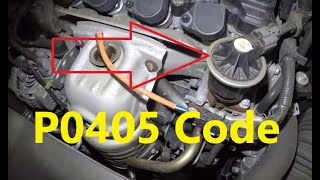
- Failed EGR Valve / Position Sensor 🔴 High Probability → Shop Exhaust Gas Recirculation (EGR) Valve The position sensor is integrated into the EGR valve assembly. Carbon and soot from the diesel exhaust can cause the valve to stick or the internal electronics of the sensor to fail, leading to a permanent low voltage signal. 🎬 Watch: How to diagnose and fix a P0405 circuit low code. Forum users frequently confirm that replacing the entire valve is the ultimate fix.
How to confirm: With a diagnostic scan tool, monitor the EGR position sensor voltage (PID). If the voltage is stuck at a very low value (Ford documentation specifies a threshold of <0.3V, while some scan tools suggest <0.2V indicates a hard fault) and does not change when the engine RPM changes, the sensor/valve assembly has failed.
Typical fix: Replace the entire EGR valve assembly. Cleaning is sometimes attempted but is often a temporary fix at best, as the internal sensor electronics are the common failure point, not just carbon buildup.
Est. part cost: $250 - $450 - Wiring Harness or Connector Issue 🟡 Medium Probability The wiring harness near the EGR valve is exposed to significant heat and vibration, which can lead to chafed wires or corrosion in the connector pins over time. The EGR valve is located at the rear of the engine bay, making access tight and inspection difficult.
How to confirm: Visually inspect the wiring and connector going to the EGR valve for any signs of damage, melting, or corrosion. Unplug the connector and check for a 5-volt reference signal and a good ground using a multimeter. If either is missing, you have a wiring issue that needs to be traced back to the PCM. A user on a Ford Transit forum reported solving a persistent P0405 by discovering a lack of 5V reference at the plug.
Typical fix: Repair the damaged section of wire or clean/replace the connector pigtail. In some cases, slightly twisting the male pins in the connector can improve a poor connection, but this should be a last resort.
Est. part cost: $10 - $50 - Clogged EGR Passages ⚪ Low Probability As a diesel engine, the 3.2L Power Stroke produces soot which can build up over time, restricting flow. While this more commonly causes P0401 (Insufficient Flow), a large piece of carbon breaking loose could potentially jam the valve in a nearly-closed position, leading to a position sensor fault.
How to confirm: This is difficult to confirm without removing the EGR valve. If the valve is removed and the passages are found to be heavily restricted with carbon, this is a likely contributor. This is usually diagnosed after a new valve fails to fix the issue.
Typical fix: Clean the EGR passages and the intake manifold. This is often done at the same time as an EGR valve replacement.
Est. part cost: $15 - $30 (for cleaning supplies)
Rare But Worth Checking
- Faulty Powertrain Control Module (PCM): This is extremely rare. The PCM should only be considered after all other possibilities, including the EGR valve and wiring, have been exhaustively tested and ruled out. A faulty PCM can sometimes misinterpret the sensor's signal or fail to provide the correct reference voltage.
Diagnosis Steps
- Connect an OBD-II scanner and confirm P0405 is the primary code. Note any other codes present.
- With the scanner, view the live data for the EGR Position Sensor PID (often labeled 'EGR_VLT' or similar). With the key on and engine off, the voltage should be stable. Ford's documentation indicates a fault is set below 0.3V.
- If the voltage is stuck near zero (<0.3V) and unresponsive when the engine is started and revved, the sensor has likely failed or there is a wiring fault.
- Turn the vehicle off. Locate the EGR valve at the rear of the engine, below the cowl. Visually inspect the electrical connector and nearby wiring for any signs of melting, chafing, or corrosion.
- Disconnect the EGR connector. With the key on, use a multimeter to check for a 5-volt reference signal on one pin and a good ground on another. Check the signal wire for any voltage; it should be near 0V when disconnected.
- If the 5V reference and ground are present, the fault is almost certainly within the EGR valve/sensor assembly itself. A forum user confirmed this exact diagnostic path: after replacing the valve, the P0405 code persisted. They then checked the connector and found no 5V reference, indicating a wiring problem was the true cause.
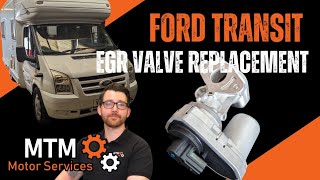
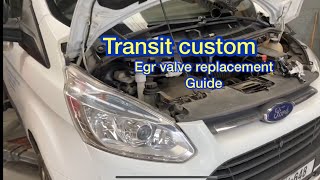
- At this point, the recommended repair is to replace the EGR valve assembly. 🎬 See this walkthrough for replacing the EGR valve on a Transit. Ensure you get new gaskets for the installation.
- After replacement, clear the codes and perform a drive cycle to ensure the Check Engine Light does not return. Some sources suggest an EGR relearn procedure may be necessary.
Parts You'll Likely Need
- EGR Valve Assembly
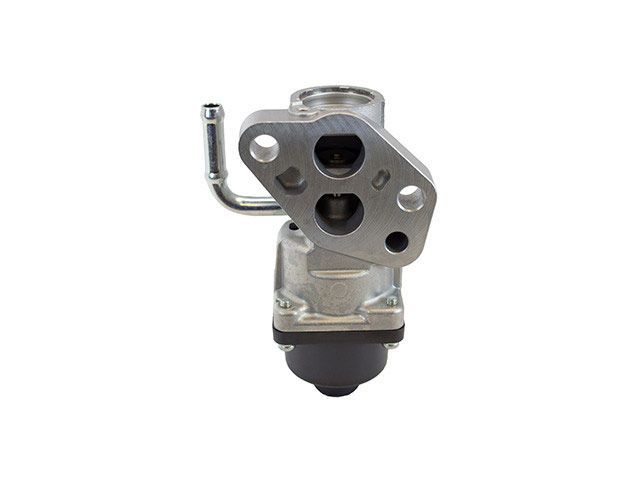
(OEM #FB3Z-9D475-C)— The position sensor that causes code P0405 is integrated into the EGR valve. Failure of this sensor or the valve mechanism requires replacing the entire unit. This part number supersedes the older BK2Z-9D475-A.
Trusted brands: Motorcraft (OEM)
OEM price range: $250-$450
Aftermarket price range: $180-$350
Related Codes That Often Appear With This One
- P0404 — P0404 (EGR 'A' Control Circuit Range/Performance) can appear with P0405 because a circuit low fault prevents the PCM from verifying the valve's performance, leading to both a specific electrical code (P0405) and a general performance code (P0404). 🎬 Watch: Replacing the EGR valve when dealing with a P0404 code.
- P0406 — P0406 (EGR Sensor 'A' Circuit High) is the opposite fault. Seeing them intermittently could suggest a severe wiring issue where the signal wire is shorting to both ground and power at different times, or a failing sensor with erratic output.
- P0401 — P0401 (EGR Flow Insufficient Detected) can sometimes accompany P0405 if the valve is physically stuck closed due to carbon buildup, which also causes the position sensor to report a low reading.
Platform-Specific Known Issues
- Ford has issued Customer Satisfaction Program 21M03, extending the warranty on the EGR *cooler* for some 3.2L Transits to 11 years or 120,000 miles. While not directly related to P0405, a failing cooler can cause other EGR system problems and is a very common failure on this engine.
- Customer Satisfaction Program 19B03 was also issued for the EGR *temperature sensor* on 2015-2016 models, which can cause a loss of power. This is a separate part from the EGR valve.
- Customer Satisfaction Program 23M01 extends the warranty on the Diesel Particulate Filter (DPF) to 11 years or 120,000 miles due to a tendency for the internal substrate to crack. This typically causes code P2002.
Mechanic-Grade Diagnostic Values
- EGR Position Sensor Voltage (PID) — expected: Varies with engine load, but should not be static.. Failure: Voltage is less than 0.30 volts for more than 3 seconds. A reading below 0.2V indicates a hard fault.
- EGR Connector - Reference Voltage — expected: Approximately 5.0 volts with key on, engine off.. Failure: Significantly lower than 5.0 volts, indicating an open or short in the VREF circuit from the PCM.
- EGR Connector - Signal Wire Voltage (unplugged) — expected: Should jump to ~5 volts when the connector is unplugged from the sensor.. Failure: Voltage remains near 0V, suggesting the signal wire is shorted to ground somewhere in the harness.
Scan Tool Commands That Help
- Ford IDS / FORScan / Capable Scan Tool: Fuel Pump Learn / Pressure Regulator Relearn — While not directly for the EGR valve, this procedure is often required after major work at the rear of the engine, such as replacing the high-pressure fuel pump regulator, which may be done concurrently with or disturbed during EGR valve replacement. Some aftermarket EGR valves also suggest a relearn procedure may be beneficial.
- Bosch / OTC Scan Tools: Reset Particulate Filter Differential Pressure Sensor — After replacing DPF-related components or if DPF codes are present alongside P0405, this reset is necessary. A lingering P0405 can cause DPF issues, so this may be part of a comprehensive repair.
Wiring & Ground Locations
- EGR Valve Connector — At the rear of the engine, below the cowl, mounted to the EGR valve assembly.. This is the primary connection point for the sensor. Checking for 5V reference, ground, and signal voltage here is the main electrical diagnostic step. A forum post for a similar Ford engine identifies the signal wire as Gray with a Blue stripe at pin 6 of the connector.
- Main Chassis Ground — Under the driver's seat, where the battery is located, there is a key ground connection from the battery to the seat mount box and van floor. Another critical ground runs from the gearbox to the inner wing.. Corrosion or looseness at these main ground points can cause floating grounds and erratic voltage readings for multiple engine sensors, including the EGR position sensor, leading to intermittent circuit codes like P0405.
- PCM Connector C1232B / C175B — On the Powertrain Control Module (PCM) located in the engine bay, often near the passenger side headlight area.. This is the termination point for the EGR sensor wiring. If voltage and ground tests fail at the sensor connector, the next step is to check for continuity and shorts between this connector and the sensor plug to isolate a harness fault from a PCM fault.
Real Owner Repair Stories
- fordtransitusaforum.com user (2015-2019 Ford Transit 3.2L (specific year not mentioned)) — Persistent P0405 code, Check Engine Light on.
❌ Tried (didn't work) Replacing the entire EGR valve assembly with a new one.
✅ What actually fixed it The P0405 code remained after part replacement. Further diagnosis revealed a lack of the 5-volt reference signal at the EGR valve's electrical connector. The root cause was a wiring fault in the harness, not the EGR valve itself. - NHTSA ODI #10583652 — An owner of a similar Ford diesel platform reported needing to clear carbon from the intake and replace the EGR valve to resolve codes P0404 and P0405. After the repair and a warmed-up EGR test, the system passed.
- NHTSA ODI #10573470 — A report notes the Malfunction Indicator Light coming on with a range of EGR-related diagnostic trouble codes, including P0401, P0404, P0405, and P0406, specifically identifying the emission control EGR valve as the component of concern.
OEM Part Supersession History
BK2Z-9D475-A→FB3Z-9D475-C— Standard part revision and update by Ford.
Diagnostic Flowchart
Other Known Issues on This Vehicle
Issues unrelated to this code that are worth knowing about as an owner of this generation:
- Variable Displacement Oil Pump Failure 🔴 High — Can occur at any mileage, often without warning. Failure is catastrophic to the engine. Exacerbated by improper oil change procedure (draining for >10 mins can cause loss of prime). (Ref: No recall, but it's a widely documented failure. Upgrading to a more robust gear-style pump is a common preventative measure.)
- Cracked Diesel Particulate Filter (DPF) 🔴 High → Shop Diesel Particulate Filter (DPF) — Common enough that Ford issued a warranty extension. Typically occurs between 60,000 and 120,000 miles. Causes code P2002. (Ref: Customer Satisfaction Program 23M01 (extends warranty to 11 years/120,000 miles).)
- Leaking/Clogged EGR Cooler 🔴 High → Shop Exhaust Gas Recirculation (EGR) Valve — Very common issue leading to coolant loss, overheating, and white smoke from the exhaust. Can cause subsequent engine damage if ignored. (Ref: Customer Satisfaction Program 21M03 (extends warranty to 11 years/120,000 miles).)
- Cracked Flexplate 🟠 Medium — Owners report a ticking or knocking sound from the transmission bellhousing area. The flexplate connecting the engine to the torque converter can develop cracks. (Ref: No specific TSB for the Transit 3.2L, but it's a known issue discussed in technician forums.)
- Failed NOx Sensors 🟠 Medium — The upstream NOx sensor is prone to failure, often triggered after a PCM software update. Causes emissions system warnings and limp mode. (Ref: Customer Satisfaction Program 21N02 (extended warranty for the front NOx sensor).)
- Crankcase Ventilation (CCV) Hose Assembly Failure 🟡 Low — The CCV hose can degrade, leading to oil leaks or drivability issues. (Ref: Customer Satisfaction Program 23N01 (provides a one-time repair for 11 years/120,000 miles).)
Used vs. New Parts: Buying Guide for This Vehicle
When a used part is the smart pick: Buying a used EGR valve for this repair is strongly discouraged. The part fails due to a combination of internal electronic failure and carbon buildup, both of which are common in used parts from a junkyard. The labor to access and replace the valve is significant enough that installing a part with a high risk of premature failure is not cost-effective.
Donor-vehicle mileage cap: roughly under 20000 miles for the part to have meaningful remaining life.
What to inspect on the donor part:
- Verify the part number is the latest revision (FB3Z-9D475-C).
- Inspect the electrical connector pins for any signs of corrosion, bending, or damage.
- Look for excessive carbon buildup in the ports, although this is not a reliable indicator of the internal sensor's health.
- If possible, get a part from a vehicle with a known low mileage and a documented front-end collision (indicating the engine was likely running well before the accident).
OEM-only on this vehicle (don't cheap out):
- EGR Valve Assembly
Aftermarket brands forum-validated for this vehicle:
- Motorcraft (OEM) is the most recommended brand for reliability.
Brands owners have reported issues with on this vehicle:
- While brands like Standard Motor Products and Wells exist, forum discussions and mechanic consensus heavily favor using the OEM Motorcraft part to avoid premature failure or compatibility issues, given the difficulty of the replacement job. Unbranded, low-cost options from online marketplaces are particularly risky.
Real Owner Stories
Aggregated from forums and TSBs cited above. Mileages and costs reflect what owners reported in those sources.
2015-2019 Ford Transit 3.2L Power Stroke I5 Diesel
Symptoms: The P0405 code would not go away even after replacing the EGR valve.
What fixed it: The actual problem was a missing 5-volt reference in the wiring harness going to the EGR valve.
Source hint: fordtransitusaforum.com: A thread titled 'P0405 won't go away' from May 2024
2015-2019 Ford Transit 3.2L Power Stroke I5 Diesel
Symptoms: A persistent P0405 code that remained after checking the wiring.
What fixed it: Replacing the entire EGR valve assembly was the only solution, indicating an internal failure of the integrated sensor.
Source hint: ford-trucks.com: In a thread titled 'P0405....still'
Related OBD-II Codes
Frequently Asked Questions
Is the common EGR cooler failure on my 3.2L Transit covered by a special warranty?
I replaced the EGR valve on my Transit, but the P0405 code immediately came back. What's the next step?
Should I try cleaning the EGR valve to fix a P0405 code?
My 2016 Transit is losing power. Could this be related to the EGR system?
What voltage reading on a scan tool confirms a P0405 fault on this Ford Transit?
Besides the EGR valve, what other major issues are common on the 3.2L Power Stroke engine?
Helpful Videos
We Have This Part in Stock


The information in this article is provided for general reference and educational purposes only. Vehicle specifications, procedures, and part compatibility can vary by production date, trim level, and region. Always consult your vehicle's factory service manual and verify part numbers before purchasing or performing repairs. Safety-critical components such as airbags, seat belts, and braking systems should be installed by a qualified professional.
- Ford Transit:
- 🧭 Diagnostic Flowchart
- 🎬 Helpful Videos
- 🛍️ Shop This Part
- What's Unique About the 2015-2019 Ford Transit
- Symptoms You May Notice
- Most Likely Causes
- Rare But Worth Checking
- Diagnosis Steps
- Parts You'll Likely Need
- Related Codes That Often Appear With This One
- Platform-Specific Known Issues
- Mechanic-Grade Diagnostic Values
- Scan Tool Commands That Help
- Wiring & Ground Locations
- Real Owner Repair Stories
- OEM Part Supersession History
- Other Known Issues on This Vehicle
- Used vs. New Parts: Buying Guide for This Vehicle
- Real Owner Stories
- 2015-2019 Ford Transit 3.2L Power Stroke I5 Diesel
- 2015-2019 Ford Transit 3.2L Power Stroke I5 Diesel
- Related OBD-II Codes
- Frequently Asked Questions
- 🎟️ Get 5% Off