

OBD-II Code P0411: Secondary Air Injection System Incorrect Flow Detected
The Ultimate 2026 Guide: What P0411 means, why it triggers, and how to fix it for good.
- A P0411 code indicates a failure in the Secondary Air Injection system, but the vehicle remains safe to drive for up to 6 months before catalytic converter damage occurs.
- Failed air pumps and stuck check valves cause 80% of P0411 codes, though 2010-2017 GM vehicles frequently suffer from carbon-clogged cylinder head ports.
- An active P0411 code triggers the Check Engine Light and guarantees an automatic failure during state emissions or smog inspections.
- Begin diagnosis by listening for a 30-90 second vacuum-cleaner noise on a cold start; silence indicates a blown fuse or dead pump, while noise points to a hose leak or valve blockage.
- Never replace a dead air pump without also replacing the $50-$100 check valve, as a stuck valve allows exhaust moisture to destroy the new pump within weeks.
What Does P0411 Mean?
Your Powertrain Control Module (PCM) detected a problem with the Secondary Air Injection (SAI) system. This system acts as a high-powered air pump, injecting fresh air into the exhaust for 30-90 seconds during a cold start. This extra oxygen burns unburned fuel, reducing emissions and heating the catalytic converter faster. The P0411 code triggers when the PCM commands the system on but does not see the expected voltage drop (typically below 0.125V) from the upstream oxygen sensor, indicating incorrect airflow.
Technical definition: SAE/OBD-II defines P0411 as "Secondary Air Injection System Incorrect Flow Detected." The Powertrain Control Module (PCM) triggers this when it fails to detect a characteristic voltage drop from the upstream oxygen sensor during the SAI system's cold-start self-test.
Can I Drive With P0411?
Yes, But With Caution. Yes, you can safely drive with a P0411 code. This fault does not affect core engine operation or safety. However, ignoring it guarantees an emissions test failure. Over time, richer cold-start emissions degrade the catalytic converter, leading to an $800 to $2500 repair.
Common Causes
- Failed Secondary Air Injection Pump (Very Common) — The electric pump that pushes air into the exhaust is the primary failure point. It fails electrically from a burned-out motor or mechanically from impeller damage. Water intrusion from a bad check valve is the leading cause of pump death.
- Faulty or Sticking Check Valve(s) (Very Common) — These one-way valves prevent hot exhaust gas from flowing backward into the air pump. Carbon buildup or corrosion causes them to stick open or closed, blocking airflow or allowing moisture to ruin the pump.
- Leaking, Cracked, or Blocked Hoses/Pipes (Common) — The rubber and plastic hoses carrying air from the pump to the exhaust crack from age, melt from heat, disconnect, or clog with carbon deposits, preventing proper airflow.
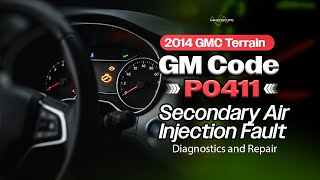
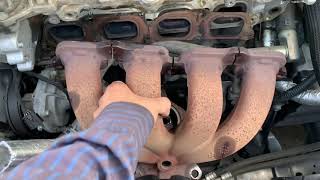
- Clogged Secondary Air Ports in Cylinder Head (Common) — On certain engines (notably 2010-2017 GM models 🎬 Watch: Full diagnostic and repair for GM secondary air systems), the small passages inside the cylinder head where air is injected become completely blocked with hard carbon deposits. This mimics a failed pump or valve.
- Blown Fuse or Faulty Relay (Less Common) — The air pump is a high-current device. A seized pump draws excessive current and blows its dedicated fuse. A faulty relay prevents the pump from turning on entirely.
- Defective Air Switching/Diverter Valve (Less Common) — This valve directs airflow. If it sticks or its vacuum control lines leak, the air fails to reach the exhaust stream at the right time.
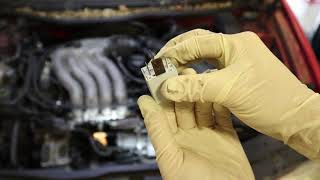
- Faulty Upstream Oxygen Sensor (Rare) — Because the PCM uses the O2 sensor to verify SAI operation, a sluggish or faulty O2 sensor 🎬 Watch: VW and Audi secondary air injection system diagnostics fails to report the change in oxygen levels correctly, falsely triggering a P0411 code.
- Faulty Air Injection Pressure Sensor (Rare) — Newer systems use a dedicated pressure sensor to monitor operation. If this sensor fails, it provides an inaccurate reading to the PCM, falsely triggering the code.
- Wiring or Connector Issues (Rare) — Frayed wires or corroded electrical connectors interrupt power or signals. This occurs frequently on pumps mounted low in the vehicle, exposed to road salt and water.
- PCM Software or Communication Error (Very Rare) — The PCM's software calibration is occasionally overly sensitive, or an internal module fault misinterprets sensor data. A manufacturer software update (reflash) resolves this.
Symptoms
- Check Engine Light is On — This is the most common and often the only symptom you notice. The light is your primary indicator of the fault.
- Failed Emissions Test — The P0411 code is an emissions-related fault, causing an automatic failure of any smog or emissions inspection.
- Noise on Cold Start (or Lack Thereof) — You normally hear a loud whirring or vacuum-cleaner-like sound from the engine bay for 30-90 seconds after a cold start. If you used to hear it and now you don't, the pump or its circuit has failed.
- Water/Moisture in Air Hoses — Finding water or black, sooty moisture inside the hoses leading from the check valve to the pump is a definitive sign that the check valve has failed.
- Engine Hesitation or Rough Idle on Cold Start — The engine occasionally runs slightly rough or hesitates for the first minute after starting up cold due to the incorrect air/fuel mixture.
- Backfiring from Exhaust — Incorrect air/fuel mixtures on startup occasionally lead to backfiring from the exhaust, especially during acceleration.
Diagnostic Flowchart
Tap your situation to follow the diagnostic path that matches what you're seeing on this code.
Common Fixes & Costs
- Replace Secondary Air Injection Pump
— Parts: $150-$400, Labor: $100-$200, ~1.5 hr book time
(Intermediate)
GMC Terrain (2011-2015, 2.4L): OEM GM Genuine: 12634644 (Alt: Dorman: 306-017, ACDelco: 215-704)
Subaru WRX (2008-2014): OEM Subaru: 14828AA050, 14828AA060 (Alt: Dorman: 306-010, Standard Motor Products: AIP1)
BMW 328i (E90, 2007-2013 N51): OEM Genuine BMW: 11727557903 (Alt: Pierburg: 7.22793.03.0, URO Parts: 11727557903) - Replace Secondary Air Injection Check Valve(s)
— Parts: $50-$200, Labor: $100-$200, ~1.2 hr book time
(DIY)
GMC Terrain (2011-2015, 2.4L): OEM GM Genuine: 12639108 (Alt: ACDelco: 214-2222, Dorman: 911-082)
Subaru WRX (2008-2014, Turbo): OEM Subaru: 14864AA030 (Right), 14864AA020 (Left) (Alt: Standard Motor Products: AV70 (Right), AV71 (Left))
BMW 328i (E90, 2007-2013 N51): OEM Genuine BMW: 11727557909 (Alt: Pierburg: 7.00424.05.0, Vemo: V20-66-0001) - Repair or Replace Leaking Hoses — Parts: $20-$100, Labor: $50-$150, ~0.8 hr book time (DIY)
- Replace Blown Fuse or Relay — Parts: $10-$40, Labor: $0-$50, ~0.2 hr book time (DIY)
- Clean Clogged Cylinder Head Ports — Parts: $20-$50, Labor: $400-$800, ~3.8 hr book time (Advanced)
Used vs. New Parts: Buying Guide
When a used part is worth it: Used air pumps and valves are cost-effective for older, high-mileage vehicles where budget is the primary concern, provided they are sourced from a reputable recycler with a warranty.
Donor-vehicle mileage cap: roughly under 100000 miles for the part to have meaningful remaining life.
Donor quality checklist:
- Source from a reputable auto recycler that inspects and tests parts.
- Verify the exact OEM part number for compatibility.
- Request clear photos to inspect for corrosion, cracks, or damage on electrical connectors.
- Ask about the donor vehicle's mileage and reason for being scrapped (avoid flood-damaged cars).
Decision logic:
- If The cost of a new aftermarket part is less than $150 → Buy new. The small savings on a used part aren't worth the risk of premature failure.
- If Your vehicle is over 150,000 miles and the repair is not urgent → A warrantied used part is a reasonable choice to save money.
- If The part is an air pump and the original failure was caused by a bad check valve → Buy a new pump and a new check valve. Installing a used pump with a bad valve leads to repeat failure.
Warranty tradeoff: Used parts typically come with a 30-90 day warranty covering only the part. New aftermarket parts offer 1-year to limited lifetime warranties. New OEM parts carry a 1-2 year warranty.
Worst-case if a used part fails: $200-500 if a used part fails after the warranty period, requiring repeat labor costs and another part.
What Happens If You Wait — Timeline
- 0-1 month: Code P0411 is set and the Check Engine Light is on. The SAI system does not operate on cold starts. There are no noticeable drivability symptoms. (MPG impact: 0%% · Added cost: $0)
- 1-6 months: Cold-start emissions are higher than designed. If the cause is a stuck-open check valve, a slight decrease in fuel economy occurs due to a constant lean condition. A brief rough idle may occur. (MPG impact: 0-5%% · Added cost: $0-$100 in wasted fuel)
- 6-18 months: The catalytic converter is repeatedly subjected to incorrect air/fuel mixtures during warm-up, slowly degrading its efficiency. If a bad check valve is the cause, the air pump seizes from moisture damage. (MPG impact: 3-8%% · Added cost: $250-$600 (for a new pump and valve))
- 18+ months: The catalytic converter's efficiency is significantly reduced, triggering code P0420. In a worst-case scenario, the converter substrate melts, causing an exhaust blockage and severe loss of power. (MPG impact: 5-15%% · Added cost: $800-$2500 (for catalytic converter replacement))
Cost of Not Fixing It
- Immediate: Guaranteed failure of any state emissions or smog inspection due to the active Check Engine Light. (Added cost: $0 (but vehicle cannot be legally registered/driven in many areas))
- 1-6 months: Increased cold-start emissions. A stuck-open check valve causes a lean condition, leading to a minor decrease in fuel economy. (Added cost: $50 - $200 (in extra fuel costs))
- 6+ months: Prolonged rich conditions during warm-up slowly degrade the catalytic converter's efficiency. Moisture entering through a failed check valve destroys the pump motor. (Added cost: $800 - $2500 (for catalytic converter replacement))
Diagnosis Steps
- Listen for the Air Pump
Start the engine when it is completely cold. You should hear a device that sounds like a vacuum cleaner run for 30-90 seconds. If you hear nothing, the pump isn't turning on (electrical issue). If you hear it, the problem is a blockage, leak, or bad valve downstream.
Tools: Your ears (Beginner) - Check the Fuse and Relay
If you didn't hear the pump, check its fuse and relay. Consult your owner's manual for the 'AIR Pump' fuse location. Pull the fuse to check if it's blown. Swap the relay with an identical one (like the horn relay) to test it. A blown fuse indicates a seized pump.
Tools: Owner's manual, fuse puller or pliers (Beginner) - Visually Inspect Hoses and Connections
Inspect all plastic and rubber hoses connected to the air pump. Follow them to the valves on the engine. Look for cracks, breaks, disconnected sections, or melting. Squeeze rubber hoses to check for brittleness.
Tools: Flashlight (Beginner) - Test the Check Valve
Disconnect the large hose going from the air pump to the check valve. Look inside for black soot or moisture—a sure sign the valve failed. With the engine off, blow air through the valve towards the exhaust (it should pass) and suck air from it (it should block). If air flows both ways, replace it.
Tools: Pliers or screwdriver (Intermediate) - Active Test with a Bidirectional Scan Tool (Pro Tip)
A professional scan tool commands the SAI system to run on demand with the engine off. Command the air pump 'ON' and listen for it. Command the switching valve 'ON' and 'OFF' and listen for a click. This tests the entire circuit without waiting for a cold start.
Tools: Bidirectional OBD-II Scan Tool (Advanced) - Test the Air Pump Manually
If the fuse and relay are good but the pump doesn't run, disconnect its electrical connector and use jumper wires to apply 12V power and ground directly from the battery. If the pump doesn't spin, it is dead.
Tools: Jumper wires, basic hand tools (Intermediate) - Monitor O2 Sensor Voltage (Pro Tip)
With a data-streaming scan tool, monitor the upstream O2 sensor voltage during a cold start. When the SAI pump activates, the voltage must drop below 0.125 volts (125mV). If the voltage does not drop, but you hear the pump running, it confirms a blockage or failed valve.
Tools: Data-streaming OBD-II Scan Tool (Advanced) - Check for Blockages (Advanced)
On vehicles known for clogged ports (like GM models), physically probe the air passages in the cylinder head to ensure they are clear of carbon. This requires removing the exhaust manifold for access.
Tools: Mechanic's pick set, flexible drill extension, shop vacuum (Advanced) - Test Pump & Valve Resistance (Pro Tip)
Disconnect the component and measure resistance between its terminals. An air pump motor shows very low resistance (near 0 ohms). A switching valve solenoid has a specific resistance (e.g., 10-40 ohms). Infinite resistance (OL) indicates an open circuit.
Tools: Digital Multimeter (DMM) (Advanced) - Check SAI Pressure Sensor Voltage (Pro Tip)
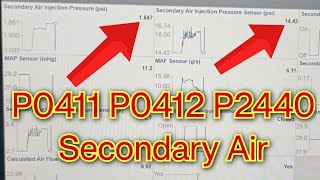
For vehicles with an SAI pressure sensor, monitor its PID. With the pump off, it reads atmospheric pressure. When commanded on, pressure rises to a specified value (e.g., 1.5-3.0 PSI). A sensor showing no change confirms a flow problem.
Tools: Data-streaming OBD-II Scan Tool (Advanced)
When This Code Triggers (Freeze-Frame Conditions)
- Engine State: Cold Start (The monitor primarily runs within the first 2.5 minutes after starting a cold engine.)
- Engine Coolant Temp: Below 122°F (50°C) (The engine must be cold for the test to initiate.)
- Ambient Air Temp: 45-85°F (7-29°C) (The PCM compares ambient and coolant temperatures to confirm a true cold soak.)
- Engine RPM: Idle (or steady cruise) (The initial test runs at idle, but some systems perform a secondary check during steady-state driving (e.g., 3 minutes at 55 mph).)
- Fuel Level: 15-85% (The SAI monitor fails to run if the fuel tank is too full or nearly empty.)
Related Codes
- P0410 — P0410 is a general 'Secondary Air Injection System Malfunction' code indicating an electrical fault (like a bad relay) preventing activation. P0411 means the system runs, but the resulting airflow is incorrect.
- P0412 — This code points to an electrical fault in the 'Switching Valve A' circuit (open circuit, short). P0411 means the valve is electrically fine but mechanically stuck or blocked. Fix P0412 first if both are present.
- P0491 / P0492 — These mean 'Secondary Air Injection System Insufficient Flow' for Bank 1 (P0491) and Bank 2 (P0492) on V-type engines. If you have P0491 but not P0492, the problem is isolated to the hoses, valve, or head passages for Bank 1 only.
- P0171 / P0174 — These 'System Too Lean' codes appear with P0411 if a faulty check valve gets stuck open. This allows unmetered air (a vacuum leak) into the exhaust during normal engine operation, which the oxygen sensor reads as a lean condition.
Climate & Environmental Factors
- Cold Climates: Increases failure rate. Cold temperatures exacerbate condensation in the exhaust, which is drawn back into the pump by a faulty check valve, freezes, and causes the motor to burn out or seize.
- High Humidity / Road Salt: Promotes corrosion and electrical failure. Pumps mounted low in the vehicle are exposed to moisture and road salt, corroding the pump housing, motor internals, and electrical connectors.
- Short-Trip Driving: Contributes to moisture and carbon buildup. Engines that fail to reach full operating temperature accumulate condensation in the exhaust and carbon deposits, damaging the pump and clogging check valves.
How to Talk to a Mechanic About This Code
Say this: "I have a P0411 code for the secondary air injection system. I'd like a diagnosis to confirm if the issue is the pump, a check valve, or a blockage. Can you please check for moisture in the pump hoses and, if it's a GM vehicle, check for clogged cylinder head ports before recommending parts?"
This signals you understand common failure points and prevents a shop from replacing the expensive pump without diagnosing the root cause, like a bad check valve, which would destroy the new pump.
Avoid saying:
- 'My check engine light is on.' (Too vague, invites a broad diagnostic fee)
- 'Just fix the P0411 code.' (Doesn't guide the technician towards a thorough diagnosis)
- 'I think I need a new air pump.' (Suggesting a specific repair without diagnosis leads to unnecessary parts replacement)
Questions to ask before authorizing the repair:
- What was the specific point of failure you found during diagnosis?
- If the pump failed, did you confirm the check valve is working correctly to protect the new one?
- Will you show me the old parts?
- What is the warranty on the parts and labor for this repair?
Where to Take It: Dealer vs Independent vs Chain
- Dealer:
Best for: Vehicles under an emissions or powertrain warranty, Vehicles with known manufacturer-specific issues covered by a Technical Service Bulletin (TSB), like clogged ports on GM vehicles
Downsides: Higher labor rates, typically 1.5x to 2x more than independent shops, May recommend replacing an entire assembly when only one component has failed (Typical cost: +50% vs. baseline) - Independent Shop:
Best fit for most out-of-warranty vehicles. An experienced independent mechanic accurately diagnoses and repairs P0411 issues at a lower cost than the dealer.
Best for: Out-of-warranty vehicles where cost is a factor, Shops with good reviews and ASE-certified technicians experienced with emissions systems
Downsides: Quality and diagnostic capabilities vary significantly between shops, May lack access to the latest manufacturer-specific TSBs (Typical cost: +0% vs. baseline) - Chain Shop:
Use with caution. Acceptable for a basic diagnosis or simple part replacement, but avoid for complex issues like clogged cylinder head ports.
Best for: Simple, straightforward repairs like a blown fuse or an obviously cracked hose
Downsides: Technician experience varies widely, Lacks advanced diagnostic tools to test system components individually, leading to guesswork (Typical cost: -10% vs. baseline)
When to Walk Away From the Repair
If the estimated repair cost exceeds 40-50% of your car's private-party value, seriously consider selling or trading it in instead of repairing it.
- Car worth $4000, fix is $2000: Walk away. The repair cost is 50% of the car's value, and other age-related issues are likely to arise soon.
- Car worth $12000, fix is $800: Fix it. The repair cost is well below the threshold and is a worthwhile investment to keep a more valuable car running properly.
- Car worth $2500, fix is $900: Borderline. At 36% of the vehicle's value, consider the car's overall condition. If it's otherwise reliable, the repair might be worth it.
What Scan Tool You Need for This Code
Minimum: A code reader that displays live data, specifically the upstream O2 sensor voltage.
A basic $20 code reader only shows the P0411 code. It cannot show live O2 sensor data, which is crucial for confirming if air actually reaches the exhaust when the pump runs.
Budget: BlueDriver Pro (~$100) — Connects to your smartphone to read/clear codes, view freeze frame data, and graph live O2 sensor voltage to verify system operation.
Mid-range: Innova 5610 (~$330) — Offers bidirectional control, allowing you to manually command the SAI pump and diverter valves on and off, making it much faster to test the electrical circuit.
Professional: Autel MaxiCOM MK808 / MK906BT (~$500-1200) — Provides full bidirectional control of the entire SAI system, along with OEM-level diagnostics to pinpoint the exact cause of the flow issue with certainty.
Rent vs buy: For a one-time fix, auto parts stores let you borrow a basic code reader for free. However, to properly diagnose P0411 by commanding the pump on, a bidirectional scanner is needed.
How to Clear the Code After You Fix It
- Fix the root cause of the problem.
- Use an OBD-II scan tool to clear the Diagnostic Trouble Codes (DTCs).
- Perform the specific drive cycle to allow the Secondary Air Injection readiness monitor to run.
Drive cycle (~15 minutes): The SAI monitor runs on a cold start. Let the vehicle sit for at least 8 hours to cool completely. Start the engine and let it idle for 2-5 minutes without touching the throttle. For some vehicles, a subsequent drive of 3-5 minutes at a steady 55 mph is required.
Readiness monitors affected: Secondary Air System, Oxygen (O2) Sensor, Catalyst
Before emissions retest: drive at least 50 miles to fully set monitors.
Watch out for:
- Disconnecting the battery clears the code but resets all readiness monitors to 'Not Ready', causing an automatic emissions test failure.
- The code returns on the next cold start if the underlying mechanical or electrical fault is not properly repaired.
- Failing to allow the vehicle to cool down completely (cold soak) prevents the SAI monitor from running.
Will This Fail Emissions / State Inspection?
Yes — this code typically fails an OBD-II emissions inspection.
- California: An active P0411 code is an automatic smog check failure. After repair, a specific drive cycle must be completed to set the 'Secondary Air System' readiness monitor to 'Ready' before a re-test.
- New York: The NYVIP3 inspection includes an OBD-II scan. A P0411 code causes the vehicle to fail the emissions portion. The check engine light must be off and readiness monitors set.
- Texas: In counties requiring emissions testing, an illuminated Check Engine Light for any DTC results in an automatic failure. Readiness monitors must be set before the vehicle passes inspection.
Most Commonly Affected Vehicles
- GMC / Chevrolet Terrain, Equinox, Acadia, Malibu (2010-2017) — Extremely prone to clogged secondary air injection ports in the cylinder head. GM released TSB 17-NA-080 detailing a cleaning procedure with special tools. Replacing the pump/valve fails to fix the issue if ports remain clogged.
- Subaru Impreza, WRX/STI, Forester, Legacy (2006-2014) — Common failure of the air pump and combination valves getting stuck. The valves fail first, allowing moisture to destroy the pump. Repair is expensive as turbo models use two valves.
- BMW 3-Series (E46, E90), 5-Series (E60), X3, X5 (2001-2013) — Common failures include the air pump, check valve, and the plastic hose between them which becomes brittle and cracks. A loud pump noise on startup that suddenly stops is a classic symptom of impending failure.
- Toyota / Lexus Tundra, Sequoia, Land Cruiser / GX470, LX470 (2007-2014) — Known for air pump and air switching valve failures. Toyota/Lexus initiated Warranty Enhancement Program ZHA extending coverage to 10 years or 150,000 miles. Replace both the pump and valves as a set.
- Volkswagen / Audi Jetta, Golf, Passat, A4, A3 (2.0T, 2.5L) (2005-2015) — Water intrusion into the air pump (combi-valve system) is a very common failure mode, often blowing the large 40A/50A fuse. For 2006-2008 2.5L engines, VW issued a service action to install an updated intake pipe.
- Mercedes-Benz C-Class, E-Class, ML-Class (2005-2015) — Failures focus on the air pump and check valve. The check valve fails and allows exhaust to flow backward, destroying the pump located in the front bumper area.
- Ford F-150, Mustang (2004-2015) — The air injection pump is susceptible to failure from moisture and road salt causing corrosion of the pump motor and its electrical connector.
- Honda Accord, CR-V (2003-2012) — Failures are typically related to the secondary air pump motor itself or the associated relay. The system is generally robust but susceptible to moisture-related failures.
Manufacturer-Specific Notes
- General Motors (GM): Air passages in the cylinder head clog with carbon on many 4-cylinder and V6 engines. TSB 17-NA-080 details the cleaning procedure. Replacing the pump or valve fails to fix the code if these ports are blocked.
- Toyota/Lexus: Failures happen as a pair: a failed check/switching valve lets moisture into the pump, destroying both. Replace the pump and valves together to prevent repeat failure. Warranty Enhancement Program ZHA covered many vehicles.
- Volkswagen/Audi: The air pump mounts low in the vehicle, making it prone to sucking in water, leading to pump failure and a blown fuse. The plastic housing also cracks or separates at the rivets, causing a loud leak.
- Subaru: On turbo models (WRX/STI, Forester XT), two separate air switching valves are prone to sticking open or closed. Subaru offered an extended warranty on these components for some models.
- Mercedes-Benz: The check valve is a common failure point. A key diagnostic clue is a pump that continues to run for an extended period or runs at odd times after the initial cold start, indicating a stuck valve.
Real Owner Stories
2015 Chevy Equinox at 110K miles - The Misdiagnosis Loop
Check Engine Light came on with P0411. No other symptoms. Owner took it to a general mechanic.
What they tried:
- Mechanic replaced the secondary air pump. Code returned the next day.
- Mechanic replaced the 4-pin electrical connector to the pump. Code returned again on the next cold start.
Outcome: Owner researched GM-specific issues and found TSB 17-NA-080 regarding clogged cylinder head ports. A different shop confirmed the ports were completely blocked with carbon. After a 4-hour cleaning procedure (~$600), the original pump and valve worked correctly and the code was resolved.
Lesson: On GM vehicles, clogged head passages are a very common cause for P0411. Verify the air passages are clear before replacing the pump or valves.
2008 Subaru WRX at 140K miles - The Double Failure
Loud vacuum cleaner noise on cold starts lasting for a minute, along with a P0411 code. The noise grew progressively louder over several months.
What they tried:
- Owner replaced the air pump relay, with no change.
- Inspected the hoses and found black soot and moisture inside the main hose leading from the pump.
Outcome: The moisture confirmed the check valve failed. The owner replaced both the air pump and the two air switching valves at the same time. Total cost for aftermarket parts was $550. The noise disappeared and the code did not return.
Lesson: Moisture in the air pump hose is a definitive sign of check valve failure. Replace the pump and valve(s) together, as a bad valve destroys the pump.
2014 Chevy Cruze 1.8L at 85K miles - The Simple Fix
Vehicle presented a current P0411 code and a pending P0171 (System Too Lean) code.
What they tried:
- Mechanic performed a visual inspection first.
- Checked the secondary air pump, diverter valve, and all connected hoses.
Outcome: The problem was a loose hose connection right at the secondary air pump, causing a false reading at the pressure sensor. After re-securing the hose clamp, the mechanic activated the pump via scan tool and confirmed normal pressure readings. Codes were cleared and did not return.
Lesson: Always start with simple visual checks. A loose connection triggers a flow code just as easily as a failed part.
2000 VW Eurovan VR6 - The Seized Pump
P0411 check engine light appeared. Owner wanted to ensure reliability for an upcoming trip.
What they tried:
- Owner removed the pump and noticed a small amount of water inside.
- Tested the old pump by applying 12V power directly to its terminals. The pump sparked and would not spin, confirming it was seized.
Outcome: A new pump was installed, codes were cleared, and the light stayed off. The seized motor was caused by water intrusion.
Lesson: Confirm a dead pump by applying 12V directly to it. Finding water inside indicates the check valve failed and must be replaced to protect the new pump.
How to Prevent This Code From Triggering
- Periodically Inspect the Check Valve (Every 30,000 miles or 2 years) — A failing check valve allows corrosive exhaust condensate to flow back into the air pump, causing it to seize. Disconnect the hose and check for soot or moisture.
- Use Top Tier Certified Gasoline (Every fill-up) — Gasolines with higher detergent levels prevent carbon deposits, reducing the chance of clogged air injection ports in the cylinder head and stuck check valves.
- Ensure Engine Reaches Full Operating Temperature (Weekly) — Frequent short trips lead to excess condensation in the exhaust system. A longer drive (20+ minutes) weekly burns off this accumulated moisture, protecting the pump.
- Inspect Air Filter Housing and Intake Hoses (During every oil change) — The SAI pump draws fresh air from the engine's intake. A cracked air filter box or loose hose allows unfiltered, moist air into the pump, leading to rapid failure.
Frequently Asked Questions
What does the secondary air injection system do?
It pumps fresh air into your exhaust for the first 30-90 seconds after a cold start. This extra oxygen burns off excess unburned fuel, reducing harmful pollution. It also helps your catalytic converter reach its effective operating temperature much faster.
What is the most common misdiagnosis for P0411?
The most common mistake is replacing the air pump without checking the check valve. A new pump quickly fails if a bad check valve allows hot exhaust and moisture to flow backward into it. On GM vehicles, mechanics often mistakenly replace parts when the actual problem is carbon-clogged cylinder head ports.
Can I just delete or bypass the secondary air injection system?
While physically possible using block-off plates, deleting the system guarantees a permanent Check Engine Light and an automatic emissions test failure. Proper deletion requires specialized ECU tuning to disable the codes. This modification is illegal for street-driven vehicles in most jurisdictions.
Will a P0411 code fail my emissions test?
Yes. An active P0411 code illuminates the Check Engine Light, resulting in an automatic failure of any state emissions or smog inspection.
Can a bad O2 sensor cause a P0411 code?
Yes, though it is rare. The PCM relies on the upstream O2 sensor to verify SAI system operation. A sluggish or faulty O2 sensor fails to register the airflow change, causing the PCM to incorrectly trigger a P0411 code.
What is the difference between P0410 and P0411?
P0410 is a general system malfunction code indicating an electrical issue, meaning the PCM cannot activate the system. P0411 is an 'incorrect flow' code, meaning the system runs but the PCM detects improper airflow. Diagnostically, P0410 points to relays or wiring, while P0411 points to blockages, leaks, or stuck valves.
Will the P0411 code clear itself?
No, the code will not clear itself permanently. You must repair the underlying mechanical or electrical problem and clear the code with an OBD-II scanner. While it might temporarily turn off after successful drive cycles, the fault remains stored in the PCM's memory.
How much does it cost to fix P0411?
A simple DIY fix like replacing a fuse or relay costs under $40. Professional repairs involving a new air pump or check valves typically range from $300 to $600. Complex repairs like cleaning clogged GM cylinder head ports exceed $800 due to extensive labor.
Key Takeaways
- A P0411 code indicates a failure in the Secondary Air Injection system, but the vehicle remains safe to drive for up to 6 months before catalytic converter damage occurs.
- Failed air pumps and stuck check valves cause 80% of P0411 codes, though 2010-2017 GM vehicles frequently suffer from carbon-clogged cylinder head ports.
- An active P0411 code triggers the Check Engine Light and guarantees an automatic failure during state emissions or smog inspections.
- Begin diagnosis by listening for a 30-90 second vacuum-cleaner noise on a cold start; silence indicates a blown fuse or dead pump, while noise points to a hose leak or valve blockage.
- Never replace a dead air pump without also replacing the $50-$100 check valve, as a stuck valve allows exhaust moisture to destroy the new pump within weeks.
Helpful Videos
Shop the Parts Behind P0411
Below are the parts most often responsible for code P0411, ranked by how frequently each one is the actual culprit (per the diagnosis above). Tap any to see what we have for your vehicle.



The information in this article is provided for general reference and educational purposes only. Vehicle specifications, procedures, and part compatibility can vary by production date, trim level, and region. Always consult your vehicle's factory service manual and verify part numbers before purchasing or performing repairs. Safety-critical components such as airbags, seat belts, and braking systems should be installed by a qualified professional.
- 🧭 Diagnostic Flowchart
- 🎬 Helpful Videos
- 🛍️ Shop This Part
- What Does P0411 Mean?
- Can I Drive With P0411?
- Common Causes
- Symptoms
- Common Fixes & Costs
- Used vs. New Parts: Buying Guide
- What Happens If You Wait — Timeline
- Cost of Not Fixing It
- Diagnosis Steps
- When This Code Triggers (Freeze-Frame Conditions)
- Related Codes
- Climate & Environmental Factors
- How to Talk to a Mechanic About This Code
- Where to Take It: Dealer vs Independent vs Chain
- When to Walk Away From the Repair
- What Scan Tool You Need for This Code
- How to Clear the Code After You Fix It
- Will This Fail Emissions / State Inspection?
- Most Commonly Affected Vehicles
- Manufacturer-Specific Notes
- Real Owner Stories
- 2015 Chevy Equinox at 110K miles - The Misdiagnosis Loop
- 2008 Subaru WRX at 140K miles - The Double Failure
- 2014 Chevy Cruze 1.8L at 85K miles - The Simple Fix
- 2000 VW Eurovan VR6 - The Seized Pump
- How to Prevent This Code From Triggering
- Frequently Asked Questions
- What does the secondary air injection system do?
- What is the most common misdiagnosis for P0411?
- Can I just delete or bypass the secondary air injection system?
- Will a P0411 code fail my emissions test?
- Can a bad O2 sensor cause a P0411 code?
- What is the difference between P0410 and P0411?
- Will the P0411 code clear itself?
- How much does it cost to fix P0411?
- Key Takeaways
- 🎟️ Get 5% Off