

OBD-II Code P0417: Secondary Air Injection System Switching Valve 'B' Circuit Shorted
The Ultimate Guide to Diagnosing and Fixing P0417 for DIYers and Professionals
- P0417 indicates a short circuit in the secondary air injection switching valve 'B', typically caused by an internal solenoid failure dropping resistance near 0 ohms.
- Always check the secondary air injection system's 40A or 50A fuse first; a blown fuse instantly confirms a hard short circuit exists.
- Never replace a seized secondary air pump without also replacing the $20-$50 one-way check valve, as a stuck check valve is the root cause of moisture intrusion.
- On Toyota 4.7L and 5.7L V8 engines, installing a $400 aftermarket bypass kit permanently resolves P0417 codes and avoids 8-12 hours of intake manifold labor.
What Does P0417 Mean?
P0417 signifies that your vehicle's Powertrain Control Module (PCM) has detected a short circuit in the electrical system for the Secondary Air Injection (SAI) Switching Valve 'B'. The SAI system pumps fresh air into the exhaust manifold for the first 30-90 seconds after a cold start. This burns off rich fuel mixtures and heats the catalytic converter faster, reducing emissions. A 'shorted' circuit means electricity is taking an unintended path, usually to ground or another wire, indicating an electrical fault rather than a mechanical one.
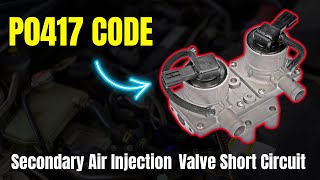
🎬 Watch: Understanding the P0417 secondary air injection short circuit.Technical definition: The Powertrain Control Module (PCM) registers a continuous high voltage condition or abnormally low resistance (a short) in the control circuit for the Secondary Air Injection (SAI) switching valve 'B'. A shorted circuit occurs when the control wire contacts a ground source or another voltage source. This condition often blows a fuse and prevents the PCM from controlling the valve.
Can I Drive With P0417?
Yes, But With Caution. Yes, you can drive with a P0417 code; it does not cause immediate engine damage or pose a safety risk. However, your vehicle will fail emissions testing, blocking registration. Prolonged driving with a malfunctioning emissions system alters exhaust temperatures during cold starts, which damages the catalytic converter over time. Replacing a catalytic converter costs $950 to $2,500, making prompt repair financially prudent.
Common Causes
- Faulty Secondary Air Injection (SAI) Switching Valve 'B' (Very Common) — The internal solenoid coil within the valve is the most common failure point. It shorts out, creating a path of near-zero resistance that the PCM detects as a fault.
- Wiring or Connector Damage (Common) — The wiring harness leading to the switching valve degrades from engine heat, vibrations, and abrasion. Wires melt, chafe, or break, causing a short to the engine block (ground) or another wire. Connectors fail from corrosion or backed-out pins.
- Moisture Intrusion and Corrosion (Common) — Water entering the switching valve or its electrical connector frequently causes shorts. This happens when the one-way check valve fails, allowing hot, moist exhaust gas to flow backward into the system.
- Blown Fuse or Faulty Relay (Common) — A short circuit increases current draw, blowing the corresponding SAI system fuse as a protective measure. A failing relay that controls the SAI pump or valves also creates electrical abnormalities triggering P0417.
- Failed Secondary Air Injection Pump (Less Common) — If the main air pump motor seizes from age or water ingestion, it draws excessive current. This overloads the circuit, blowing a fuse or damaging the relay and wiring, which the PCM interprets as a valve circuit fault.
- Clogged Secondary Air Passages (Uncommon) — On direct-injection models (Audi/VW), carbon buildup clogs air passages in the cylinder head. While this typically sets a flow code (P0410), resulting system pressure changes sometimes contribute to electrical misdiagnosis.
- Faulty Powertrain Control Module (PCM) (Rare) — In rare instances, the driver circuit within the PCM fails. Consider this only after thoroughly testing the valve, wiring, fuses, and relays.
Symptoms
- Failed Emissions Test — With an active P0417 code, your vehicle automatically fails OBD-II emissions inspections because the SAI system is a critical emissions component.
- Abnormal Noise on Cold Start (or Lack Thereof) — You may hear a loud vacuum-cleaner-like noise for a minute after a cold start, indicating a failing air pump. Conversely, the absence of this normal sound means the system is not activating.
- Hesitation or Rough Idle on Cold Start — The engine runs slightly rough or hesitates for the first minute after starting because the SAI system fails to compensate for the rich air/fuel mixture. This disappears once the engine warms up.
- Engine Stalling — The electrical short and resulting system malfunction sometimes cause the engine to stall at idle or shortly after startup.
- Check Engine Light is On (also visible on scanner) — The PCM illuminates the Malfunction Indicator Lamp (MIL) immediately upon detecting the fault.
Diagnostic Flowchart
Tap your situation to follow the diagnostic path that matches what you're seeing on this code.
Common Fixes & Costs
- Replace Blown Fuse and/or SAI Relay — Parts: $5-$50, Labor: $25-$100, ~0.3 hr book time (Beginner)
- Replace Secondary Air Injection Switching Valve 'B' — Parts: $80-$350, Labor: $100-$300, ~1.5 hr book time (Intermediate)
- Repair Damaged Wiring or Replace Connector — Parts: $10-$60, Labor: $150-$300, ~2 hr book time (Intermediate)
- Replace Secondary Air Injection Pump (and Check Valve) — Parts: $200-$700, Labor: $150-$400, ~2.5 hr book time (Intermediate)
- Professional Diagnosis and Repair — Parts: $0-$500, Labor: $180-$850, ~1.5 hr book time (Professional)
DIY vs Professional
- Replace Blown Fuse and/or SAI Relay 🟢 Beginner
Tools: Fuse puller (often included in fuse box), owner's manual. - Replace Secondary Air Injection Switching Valve 'B' 🟢 Beginner
Tools: Socket set, wrenches, pliers, flashlight. Access can be tight, requiring extensions or swivel sockets. - Repair Damaged Wiring or Replace Connector 🟢 Beginner
Tools: Multimeter, wire strippers, crimpers, heat shrink tubing, soldering iron (recommended). - Replace Secondary Air Injection Pump 🟢 Beginner
Tools: Socket set, wrenches, hose clamp pliers, jack and jack stands (pump may be located in fender well).
Used vs. New Parts: Buying Guide
When a used part is worth it: For the common fix (SAI Switching Valve), a used part is rarely recommended. These valves fail from internal corrosion and electrical shorts, and a used part has unknown history and wear. A used part only makes sense if it's from a very low-mileage wreck and the cost savings are significant (over 70% less than new).
Donor-vehicle mileage cap: roughly under 30000 miles for the part to have meaningful remaining life.
Donor quality checklist:
- Verify the donor vehicle was not scrapped for emissions or electrical issues.
- Inspect the electrical connector on the used part for any signs of corrosion, melting, or damage.
- Match the part number exactly; electronic components are often vehicle-specific.
Decision logic:
- If The part is an electronic valve or pump → buy new OEM or a reputable aftermarket brand (e.g., Bosch, Pierburg, Denso). The risk of premature failure on a used electronic part is too high.
- If The vehicle is a Toyota/Subaru with known high failure rates for this part → buy new, as even low-mileage used parts may be prone to the same design flaw.
- If Budget is the absolute primary concern and the vehicle is old → a used part is a gamble, but may provide a temporary solution. Expect a much shorter lifespan.
Warranty tradeoff: Used parts typically have a 30-90 day warranty at best, which may not cover labor costs. New aftermarket parts often carry a 1-year to limited lifetime warranty. New OEM parts offer the best guarantee of fit and function.
Worst-case if a used part fails: $200-$500 if a used valve fails, you have to pay for the repeat labor to install another one.
What Happens If You Wait — Timeline
- 0-1 month: Code P0417 is set, and the Check Engine Light is on. The SAI system is disabled by the PCM. No other symptoms are noticeable. The vehicle will fail an emissions test. (MPG impact: 0%% · Added cost: $0)
- 1-6 months: The catalytic converter's warm-up period is extended on every cold start. This leads to slightly higher emissions and begins to put minor thermal stress on the converter substrate as it's not reaching operating temperature as designed. (MPG impact: 0-1%% · Added cost: $0)
- 6-18 months: The cumulative effect of improper warm-up cycles begins to degrade the catalytic converter's efficiency. This leads to the appearance of a P0420 (Catalyst System Efficiency Below Threshold) code, especially on higher mileage vehicles. (MPG impact: 1-3%% · Added cost: $50-150 in wasted fuel)
- 18+ months: Continued operation without a functional SAI system significantly shortens the lifespan of the catalytic converter. The substrate becomes contaminated or cracked, requiring a full replacement. (MPG impact: 3-5%% · Added cost: $1200-$2800 (catalytic converter replacement))
Cost of Not Fixing It
- Immediate: Automatic emissions inspection failure. Check Engine Light remains on, masking new problems. (Added cost: 0)
- 1-6 months: Catalytic converter warm-up period extends, leading to slightly higher emissions and minor thermal stress. (Added cost: 0)
- 6+ months: Prolonged exposure to incorrect exhaust temperatures degrades the catalytic converter substrate, requiring full replacement. (Added cost: $1200-$2800)
Diagnosis Steps
- Check Fuses and Relays
Consult your owner's manual to locate the secondary air injection system fuse(s) and relay. A blown fuse strongly indicates a short. Test the relay by swapping it with an identical one from a less critical system (e.g., the horn).
Tools: Fuse puller, Owner's Manual (Beginner) - Analyze Freeze Frame Data
Use an OBD-II scanner to view freeze frame data. This provides a snapshot of engine conditions (RPM, coolant temp) when P0417 set. Expect to see it triggered at a low coolant temperature shortly after startup.
Tools: OBD-II Scan Tool (Beginner) - Visual Inspection
Inspect the entire wiring harness for the 'B' switching valve. Look for burnt insulation near the exhaust manifold, chafing, or corrosion. Check the connector for bent pins and ensure it seats securely.
Tools: Flashlight, Inspection Mirror (Beginner) - Test the Switching Valve Solenoid Resistance
Disconnect the valve connector. Set a multimeter to Ohms (Ω) and measure resistance between the two pins on the valve. A healthy solenoid reads 20-50 Ohms depending on the vehicle. A reading near 0 Ohms indicates a dead internal short, confirming valve failure.
Tools: Multimeter (Intermediate) - Test the Switching Valve Circuit with a Multimeter
With the valve disconnected and ignition on (engine off), test the power supply wire in the connector. It must have battery voltage (12.0V - 12.6V). Test the control wire; it must read 0V. Voltage on the control wire indicates a short to power. Zero volts on the power wire indicates an open or short to ground.
Tools: Multimeter (Intermediate) - Inspect for Secondary Damage: Check Valves and Hoses
Inspect the one-way check valve(s) in the hoses between the pump and exhaust. Failed check valves allow moisture to travel backward, destroying the pump and valves. Squeeze hoses to check for brittleness.
Tools: Hands, Flashlight (Intermediate) - Command the System On with a Bi-Directional Scanner
Use a bi-directional scan tool to command the SAI pump and switching valve 'B' on. Listen for the pump to run and the valve to click. This isolates the issue between the control side (PCM/wiring) and the component side.
Tools: Bi-directional OBD-II Scan Tool (Advanced) - Advanced: Check Live Data PIDs
Monitor live data PIDs like 'SAI Pump Relay Command' and 'SAI Valve Command'. When commanding the system on, the status must change. Erratic pressure readings suggest an electrical issue.
Tools: Bi-directional OBD-II Scan Tool (Advanced) - Advanced: Scope the Control Circuit Waveform
Connect an oscilloscope to the valve's control wire. When commanded on, voltage pulls to ground (0V). A short to ground shows 0V constantly. A short to power shows battery voltage constantly.
Tools: Automotive Oscilloscope (Professional)
When This Code Triggers (Freeze-Frame Conditions)
- Engine Coolant Temp: 40-85°F (cold start, before reaching operating temp)
- RPM: 800-1200 (idling or slightly elevated idle shortly after startup)
- Engine Run Time: < 120 seconds (fault occurs during the initial warm-up phase)
- Vehicle Speed: 0 mph (vehicle is stationary)
Related Codes
- P0416 — Direct counterpart meaning 'Switching Valve B Circuit Open'. P0417 indicates too much current flow (short); P0416 indicates no current flow (open wire or dead solenoid).
- P0414 — Identical fault for 'Switching Valve A Circuit Shorted'. Common on V-engines with a separate valve for each cylinder bank.
- P0410 — General performance code. Sets when the PCM commands the system on but sees no expected change in downstream oxygen sensors. Indicates lack of airflow, not necessarily an electrical fault.
- P0418 — Malfunction in 'Secondary Air Injection System Relay A Circuit'. A faulty relay causes voltage issues leading to P0417, so they occasionally appear together.
Climate & Environmental Factors
- High Humidity / Moisture: Condensation naturally forms in the exhaust. If the check valve fails, moisture travels back into the air pump and switching valves, causing corrosion and electrical shorts.
- Cold Climates: Moisture inside the SAI pump or lines freezes. When the system activates at startup, the frozen pump motor seizes, causing a massive current spike that blows the main fuse.
- Altitude: Altitude has minimal direct effect on P0417. It affects overall SAI performance, potentially leading to flow codes (P0410) as the system pumps less dense air.
How to Talk to a Mechanic About This Code
Say this: "I have a P0417 code indicating a short in the secondary air injection switching valve 'B' circuit. Please check the system fuse and test the valve's resistance before recommending major part replacements."
This signals you understand the specific system and likely electrical failure points. It directs the technician to perform targeted tests (fuse, resistance) rather than immediately replacing the most expensive part, saving diagnostic time and money.
Avoid saying:
- 'Just fix whatever's wrong'
- 'My check engine light is on, can you look at it?' (too vague — invites upsell)
- 'Whatever you recommend'
Questions to ask before authorizing the repair:
- Was the fuse for the secondary air injection system blown?
- What was the resistance measurement in ohms across the switching valve's terminals?
- Did you inspect the wiring harness for any visible melting, chafing, or corrosion?
- If the air pump needs to be replaced, was the one-way check valve inspected for failure? (A key root cause)
- What is the warranty on the recommended parts and labor?
Where to Take It: Dealer vs Independent vs Chain
- Dealer:
Recommended if your vehicle is known for a complex P0417-related issue (like Toyota Tundras) or may be covered by a warranty extension.
Best for: Vehicles still under an emissions or powertrain warranty., Complex, manufacturer-specific issues (e.g., Toyota Tundra under-manifold repairs, Audi/VW carbon cleaning)., Recalls or Technical Service Bulletins (TSBs) related to the SAI system.
Downsides: Typically the highest labor rate., May prefer to replace an entire assembly rather than perform a more targeted wiring repair. (Typical cost: +50% vs. baseline) - Independent Shop:
Best overall fit for most out-of-warranty P0417 repairs. A good independent shop diagnoses a short circuit effectively and is more likely to offer cost-saving repairs like fixing a wire instead of replacing a whole harness.
Best for: Out-of-warranty vehicles where cost is a factor., Straightforward electrical diagnosis and part replacement (valve, pump, wiring repair)., Vehicles with common, well-documented P0417 failures.
Downsides: Shop quality and diagnostic skill can vary widely; check reviews and look for ASE certifications., May not have access to the latest manufacturer-specific software or TSBs. (Typical cost: +0% vs. baseline) - Chain Shop:
AVOID for P0417 diagnosis. The risk of an incorrect diagnosis (e.g., replacing a good pump when the wiring is bad) is high. Best used only for purchasing parts if you are doing the repair yourself.
Best for: Simple, unrelated maintenance like oil changes or tire rotations.
Downsides: Technician skill varies dramatically., High pressure to meet sales targets can lead to upselling unnecessary parts., May lack the advanced diagnostic experience for electrical faults beyond basic part swapping. (Typical cost: -10% vs. baseline)
When to Walk Away From the Repair
If the estimated repair cost exceeds 40-50% of the car's Kelley Blue Book (KBB) private-party value, you should pause and consider alternatives like selling the car as-is or trading it in.
- Car worth $8000, fix is $2500: Walk away from this specific repair; seek alternatives
- Car worth $12000, fix is $750: Fix it — the repair cost is well below the threshold and restores full value.
- Car worth $2500, fix is $1500: Walk away — the repair is over 50% of the car's value. Not economically sound.
What Scan Tool You Need for This Code
Minimum: A code reader that can display Freeze Frame data. However, for a proper diagnosis of a P0417, a tool with bi-directional control is highly recommended.
A basic $20 code reader will only tell you the P0417 code exists. It cannot help you determine if the fault is the valve, the wiring, or the pump. A bi-directional scanner allows you to command the SAI pump and valve to turn on, letting you hear if they are working, which is a critical diagnostic step.
Budget: BlueDriver Pro (~$100) — Reads and clears codes, shows freeze frame data, and graphs live data. While it has limited bi-directional 'active tests', it provides enough data for a knowledgeable DIYer to begin diagnosis.
Mid-range: Foxwell NT510 Elite / Innova 5610 (~$180) — Offers manufacturer-specific diagnostics and bi-directional controls. This allows you to command the SAI pump and valves directly, which is the most effective way for a DIYer to confirm if the components are responding to the PCM.
Professional: Autel MaxiCOM MK808 / Launch X431 Series (~$500-1200) — Provides full bi-directional control for all vehicle systems, advanced active tests, and sometimes ECU coding functions. These are professional-level tools that offer the same capabilities as a dealership for diagnosing complex electrical faults.
Rent vs buy: You can borrow a basic OBD-II scanner from stores like AutoZone for free with a refundable deposit. This is perfect for confirming the code and viewing freeze frame data. However, these loaner tools typically do not have the bi-directional control needed for a full diagnosis. Buy a mid-range scanner if you plan to diagnose and repair your own vehicles regularly.
How to Clear the Code After You Fix It
- Use an OBD-II scan tool to clear the P0417 code.
- Perform a complete drive cycle to run the system's readiness monitor.
- Check for pending codes after the drive cycle.
Drive cycle (~20 minutes): After a cold soak (engine off for 8+ hours), start the engine and idle for 2-3 minutes to run the SAI system test. Follow with 10 minutes of mixed driving.
Readiness monitors affected: Secondary Air System, Catalyst, Oxygen (O2) Sensor
Before emissions retest: drive at least 50 miles to fully set monitors.
Watch out for:
- Clearing the code with a scanner resets all readiness monitors, requiring a full drive cycle before an emissions test.
- Not allowing the vehicle to cool down completely (a 'cold soak') will prevent the SAI monitor from running.
- The code will return immediately if the underlying short circuit was not properly repaired.
Will This Fail Emissions / State Inspection?
Yes — this code typically fails an OBD-II emissions inspection.
- California: An active P0417 code is an automatic test failure. After repair, a drive cycle must be completed to set the 'Secondary Air System' readiness monitor to 'Ready' before a re-test is possible.
- New York: The NYS DMV inspection includes an OBD-II scan. A P0417 code will cause the vehicle to fail the emissions portion of the inspection.
- Texas: In the 17 counties requiring emissions testing, a vehicle with an illuminated Check Engine Light for P0417 will fail the OBD portion of the inspection. As of 2025, safety inspections are being phased out for non-commercial vehicles, but emissions testing in these counties remains.
Most Commonly Affected Vehicles
- Toyota Tundra, Sequoia (2007-2013) — Extremely common on 4.7L and 5.7L V8 engines. The system sits under the intake manifold, making replacement a 6-10 hour job. Owners frequently install bypass kits to avoid costly repairs.
- Subaru Impreza, Forester, Legacy, WRX/STI (2006-2014) — Air switching valves ('combi valves') seize due to moisture and corrosion. They are sold as a complete left/right assembly (e.g., part 14864AA030), increasing cost.
- Volkswagen / Audi Jetta, Golf, A4, Q5, Q7 (2006-2016) — Direct-injection (FSI/TFSI) engines suffer from carbon buildup in secondary air passages. This causes flow issues triggering SAI codes. Walnut shell blasting is a common related repair.
- Chevrolet / GMC Silverado, Sierra, Tahoe, Suburban (2007-2014) — Check valves fail on V8 models, allowing exhaust condensation to flood and seize the air pump. This blows the main fuse, triggering P0417.
- BMW 3-Series, 5-Series, X3, X5 (2006-2013) — Failures stem from bad pumps, clogged check valves, or blocked air passages in the cylinder head.
- Ford F-150, Mustang (2004-2010) — P0417 occurs due to a failed valve solenoid or wiring that becomes brittle from exhaust heat exposure.
- Nissan Titan, Armada (2004-2015) — Issues stem from a faulty Integrated Power Distribution Module (IPDM) containing the air pump relay, or damaged valve wiring.
- Mercedes-Benz C-Class, E-Class, ML-Class (2005-2012) — Pumps fail due to moisture. Relay and valve electrical faults are also common. Always check the fuse and relay first.
Manufacturer-Specific Notes
- Toyota/Lexus: On V8 models, the entire SAI system is buried under the intake manifold, turning replacement into an 8-12 hour job. Aftermarket bypass kits are a popular alternative. Toyota issued Warranty Enhancement Program CSP ZLH/ZE7 for moisture-related failures.
- General Motors (GM): Replacing a seized air pump without replacing the faulty check valve guarantees repeat failure. GM issued TSB 18-NA-061 for moisture and ice buildup in cold climates.
- Subaru: Switching valves fail from internal corrosion and are sold as a single, expensive assembly. Check for TSBs and warranty extensions before replacing.
- Audi/Volkswagen: Carbon buildup clogs tiny secondary air ports in the cylinder head on direct-injection engines. Audi issued a warranty extension for cleaning these ports on 3.0T and 3.2L engines.
Real Owner Stories
2007 Toyota Tundra 4.7L V8 with Limp Mode
Check Engine and Traction Control lights came on, and the truck went into 'Limp Home Mode'. Scanned codes pointed to the secondary air injection system being stuck open.
What they tried:
- Replaced the secondary air injection pump.
- Replaced the secondary air injection valve.
- Cleared codes with an OBD-II scanner, but the fault returned immediately after driving a few feet.
Outcome: Owner ultimately installed a Hewitt Technologies Gen 2 Bypass Kit. This kit electronically mimics a functional SAI system for the ECU. The installation took about 2 hours, cleared the codes, and permanently resolved the limp mode issue.
Lesson: On many Toyotas, the cost and labor for an OEM repair are extremely high. An aftermarket bypass kit is a widely used, permanent, and more affordable solution to avoid recurring failures.
2005 GMC Envoy 4.2L I6 with P0410 and P0417
Check Engine Light on with a P0410 (general system fault). Owner suspected a failing component and decided to investigate.
What they tried:
- Visually inspected the air pump, relay, and check valve.
- Noticed the air pump wasn't as loud as it used to be on cold starts, suggesting it was failing.
- Removed the air injection check valve and discovered the internal plunger was completely rusted and seized shut due to water intrusion.
Outcome: Replaced only the corroded air injection check valve (ACDelco 214-2222). This single part resolved the P0410 and prevented future electrical codes like P0417. The pump and relay were still functional.
Lesson: Don't assume the most expensive part (the pump) is the cause. A seized check valve is a very common failure that allows moisture to travel backward, destroying other components. Always inspect the check valve first.
2011 VW Jetta 2.5L - Fuse Blows Immediately
P0417 code appeared. After locating the fuse for the Secondary Air Injection system, the owner found it was blown.
What they tried:
- Replaced the blown 40A fuse for the SAI pump.
- The new fuse blew instantly upon the next cold start when the SAI system tried to activate.
Outcome: An instantly blown fuse indicates a dead short to ground. The owner tested the resistance of the SAI pump motor and found it was near zero ohms, confirming the pump motor had seized and was causing the short. Replacing the SAI pump (Bosch 0580000025) and the fuse fixed the problem.
Lesson: If a fuse blows immediately, you have a hard short circuit. Don't just keep replacing fuses. Unplug components on that circuit one by one (pump, valve) until the fuse no-longer blows to isolate the shorted part.
How to Prevent This Code From Triggering
- Periodically inspect and clean the one-way check valve(s) (Every 30,000 miles or every 2 years) — Carbon buildup causes the check valve to stick open, allowing corrosive exhaust moisture to flow backward into the pump and valves, causing rust and electrical shorts. Cleaning restores function, but replacement is the best prevention.
- Inspect and clean SAI system passages during other services (When intake manifold or cylinder head work is performed) — On direct-injection engines (Audi/VW), carbon clogs the air passages in the head. Cleaning these ports with solvents or walnut blasting ensures air can flow, preventing pressure buildup that stresses system components.
- Protect wiring harnesses near the exhaust manifold (Once, or when working in the area) — Engine bay heat makes wiring insulation brittle over time. Installing a high-temperature protective sleeve (e.g., Nomex or fiberglass loom) over the SAI valve harness prevents wires from cracking and shorting to ground.
- Ensure the air filter housing is sealed correctly (Every air filter change) — The SAI pump draws its air from the clean side of the engine's air filter box. A cracked or improperly sealed housing allows unfiltered, damp air and debris into the SAI pump, accelerating wear and causing moisture-related failures.
Frequently Asked Questions
What is the most common misdiagnosis for P0417?
The most frequent mistake is replacing the secondary air pump without replacing the failed one-way check valve. The stuck check valve allows exhaust moisture to flow backward and seize the new pump.
Can a bad oxygen sensor cause a P0417 code?
No, a bad oxygen sensor cannot directly cause a P0417 code, which is a specific electrical circuit fault. However, a faulty O2 sensor triggers general performance codes like P0410.
What does the 'B' in 'Switching Valve B' signify?
On engines with two cylinder banks (V6 or V8), there are two separate switching valves. 'A' corresponds to Bank 1, and 'B' corresponds to Bank 2.
Can I just remove the fuse for the air pump to fix this?
No. Removing the fuse de-powers the circuit, changing the code to an 'open' (P0416) or relay circuit code (P0418). The Check Engine Light remains on, and you will fail emissions testing.
Will a P0417 code clear itself?
No, this code indicates a hard electrical fault and will not resolve on its own. The Check Engine Light stays illuminated until the short circuit is physically repaired and cleared with a scan tool.
Is the secondary air injection system really necessary?
For engine performance, no; it only operates briefly at startup. For legal and environmental reasons, yes; its malfunction prevents you from passing a smog check.
What's the difference between a switching valve and a check valve?
The switching valve is an electronically controlled solenoid that allows air into the exhaust. The check valve is a passive, one-way mechanical flap preventing hot exhaust gases from flowing backward into the system.
Key Takeaways
- P0417 indicates a short circuit in the secondary air injection switching valve 'B', typically caused by an internal solenoid failure dropping resistance near 0 ohms.
- Always check the secondary air injection system's 40A or 50A fuse first; a blown fuse instantly confirms a hard short circuit exists.
- Never replace a seized secondary air pump without also replacing the $20-$50 one-way check valve, as a stuck check valve is the root cause of moisture intrusion.
- On Toyota 4.7L and 5.7L V8 engines, installing a $400 aftermarket bypass kit permanently resolves P0417 codes and avoids 8-12 hours of intake manifold labor.
Helpful Videos
![How to Fix P0417 Engine Code in 3 Minutes [2 DIY Methods / Only $9.86]](https://img.youtube.com/vi/2JHMUqYCwfU/mqdefault.jpg)


Shop the Parts Behind P0417
Below are the parts most often responsible for code P0417, ranked by how frequently each one is the actual culprit (per the diagnosis above). Tap any to see what we have for your vehicle.



The information in this article is provided for general reference and educational purposes only. Vehicle specifications, procedures, and part compatibility can vary by production date, trim level, and region. Always consult your vehicle's factory service manual and verify part numbers before purchasing or performing repairs. Safety-critical components such as airbags, seat belts, and braking systems should be installed by a qualified professional.
- 🧭 Diagnostic Flowchart
- 🎬 Helpful Videos
- 🛍️ Shop This Part
- What Does P0417 Mean?
- Can I Drive With P0417?
- Common Causes
- Symptoms
- Common Fixes & Costs
- DIY vs Professional
- Used vs. New Parts: Buying Guide
- What Happens If You Wait — Timeline
- Cost of Not Fixing It
- Diagnosis Steps
- When This Code Triggers (Freeze-Frame Conditions)
- Related Codes
- Climate & Environmental Factors
- How to Talk to a Mechanic About This Code
- Where to Take It: Dealer vs Independent vs Chain
- When to Walk Away From the Repair
- What Scan Tool You Need for This Code
- How to Clear the Code After You Fix It
- Will This Fail Emissions / State Inspection?
- Most Commonly Affected Vehicles
- Manufacturer-Specific Notes
- Real Owner Stories
- 2007 Toyota Tundra 4.7L V8 with Limp Mode
- 2005 GMC Envoy 4.2L I6 with P0410 and P0417
- 2011 VW Jetta 2.5L - Fuse Blows Immediately
- How to Prevent This Code From Triggering
- Frequently Asked Questions
- What is the most common misdiagnosis for P0417?
- Can a bad oxygen sensor cause a P0417 code?
- What does the 'B' in 'Switching Valve B' signify?
- Can I just remove the fuse for the air pump to fix this?
- Will a P0417 code clear itself?
- Is the secondary air injection system really necessary?
- What's the difference between a switching valve and a check valve?
- Key Takeaways
- 🎟️ Get 5% Off