

P0420 on 2010-2017 Audi S5 3.0T: Catalyst Efficiency Causes and Fixes
On the Audi S5 with the 3.0L Supercharged V6, code P0420 almost always indicates a failing Bank 1 (passenger side) catalytic converter due to a known design flaw causing extreme heat damage. Before replacing the expensive converter, check for a crucial ECM software update (TSB 01 16 85 / 2041120) and inspect the PCV system. A replacement is a labor-intensive job.
- For the Audi S5 3.0T, P0420 is very likely a failed catalytic converter, not just a sensor.
- Before any expensive repairs, have a dealer check if TSB 01 16 49 (ECM update and PCV check) applies and has been performed.
- Proper diagnosis is crucial. Do not replace O2 sensors without data to prove they are faulty; the converter is the more probable cause.
- Catalytic converter replacement is a difficult, expensive, and labor-intensive job on this vehicle that is not recommended for a typical DIY mechanic.
What's Unique About the 2008-2017 Audi S5
The 3.0L Supercharged V6 (3.0T) engine has a well-documented 'Achilles' heel' regarding its catalytic converters. Audi mounted the converters very close to the engine block, exposing them to extreme heat. This design causes the internal ceramic honeycomb structure to degrade, melt, and collapse over time, often leading to premature failure and a P0420 code. While on many cars P0420 might be a simple sensor issue, on this platform, it very frequently points directly to a physically failing catalytic converter. This issue is shared across many Audi models using this engine, including the S4, A6, A7, and Q5.
Generation note: The specified 3.0L Supercharged V6 engine was available in the B8 generation S5 Cabriolet (2010-2012) and the facelifted B8.5 generation S5 Coupe and Cabriolet (2013-2017). The earlier B8 S5 Coupe (2008-2012) used a 4.2L V8 and is not covered by this guide.
Symptoms You May Notice
- Reduced engine performance, sluggish acceleration, or intermittent 'limp mode'.
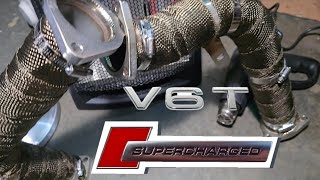
- Rattling or metallic shaking sounds from underneath the vehicle, especially on startup, indicating a physically broken catalyst substrate. 🎬 See how to identify and fix common 3.0T exhaust rattles.
- A 'rotten egg' or sulfur smell from the exhaust.
- Decreased fuel efficiency.
- Illuminated Check Engine Light is the primary symptom.
- Immediately replacing the oxygen sensors without proper diagnosis. On the 3.0T platform, the P0420 code is more frequently caused by the catalytic converter itself rather than the sensors. Many owners report on forums like AudiWorld that replacing sensors did not solve the problem.
Most Likely Causes
- Failed Bank 1 Catalytic Converter 🔴 High Probability → Shop Catalytic Converter The converters are mounted too close to the engine, leading to extreme heat that degrades and melts the internal structure, causing a blockage or inefficiency. This is a widely documented design flaw on the 3.0T engine, with failures sometimes occurring between 50,000 and 70,000 miles.
How to confirm: After ruling out other causes, a backpressure test can confirm a blockage. 🎬 Watch: How to test your catalytic converter in 15 minutes. A visual inspection using a borescope inserted through the upstream O2 sensor port may reveal a melted, clogged, or collapsed catalyst honeycomb.
Typical fix: Replacement of the Bank 1 catalytic converter assembly. Due to the high cost of OEM parts, some owners opt for high-quality aftermarket units or test pipes combined with an ECU tune (for off-road use only).
Est. part cost: $800-$2500 - Outdated ECM Software or Faulty PCV Valve 🟡 Medium Probability → Shop PCV Valve Audi issued Technical Service Bulletin 01 16 85 (superseding 01 16 49, also known as 2041120/4) for this exact issue on 2011-2015 models. The TSB notes that the original diagnostic thresholds in the Engine Control Module (ECM) software were too sensitive and could falsely trigger P0420/P0430. The bulletin advises an ECM software update and also calls for inspection of the crankcase pressure regulating valve (PCV).
How to confirm: An Audi dealership or specialist shop with ODIS software can check the vehicle's service history and current ECM software version to see if the TSB update has been performed.
Typical fix: Update the ECM software to the latest version. If the PCV valve is faulty (e.g., torn diaphragm causing vacuum leaks), it must be replaced.
Est. part cost: $100-$250 - Failed Oxygen (O2) Sensor ⚪ Low Probability → Shop Oxygen Sensor While a failing downstream (post-catalyst) O2 sensor can theoretically cause a P0420 code, forum discussions and technician reports for the 3.0T engine indicate this is not the most common cause; the converter itself is the more likely failure point. Owners often replace sensors first only to have the code return.
How to confirm: Use a diagnostic scan tool to graph the voltage of the upstream and downstream O2 sensors. The downstream sensor's voltage should be relatively stable. If it fluctuates and mimics the upstream sensor, the catalyst is likely bad. If the sensor's reading is stuck or slow to respond, the sensor itself may be faulty.
Typical fix: Replace the Bank 1 downstream oxygen sensor.
Est. part cost: $80-$200 - Exhaust Leak ⚪ Low Probability Flex pipes and exhaust manifold gaskets can crack over time, allowing unmetered oxygen to enter the exhaust stream before the downstream O2 sensor. This can skew its readings and trigger the code. However, on this platform, the flex pipes are located well after the secondary O2 sensors, making them an unlikely cause for P0420.
How to confirm: Perform a visual inspection of the exhaust system from the engine to the post-cat O2 sensor. A smoke test is the most effective way to pinpoint small leaks, especially at the manifold-to-converter flange.
Typical fix: Repair the leak by replacing the faulty gasket or welding the cracked component.
Est. part cost: $50-$300
Diagnosis Steps
- Scan for all DTCs. If any misfire (P030x), fuel system (P017x), or O2 sensor circuit codes are present, diagnose and repair them first, as they can be root causes of catalyst failure.
- Check with an Audi dealer if TSB 01 16 85 (2041120/4) has been performed. If not, getting the ECM software update is a critical and cost-effective first step.
- Inspect the crankcase pressure regulating valve (PCV system) for proper operation, as noted in the TSB. Check for whistling noises or excessive vacuum at the oil cap when running, which indicates a torn diaphragm.
- Thoroughly inspect the exhaust system for any leaks between the engine and the downstream O2 sensor, particularly at the manifold and converter flanges. A smoke test is recommended.
- Use a scan tool to graph the live data for Bank 1 Sensor 1 (upstream) and Bank 1 Sensor 2 (downstream). At a steady 2500 RPM, the upstream sensor should switch rapidly between high and low voltage. The downstream sensor should hold a relatively steady, high voltage, ideally between 0.6V and 0.8V. If the downstream sensor mirrors the upstream sensor's fluctuations, the catalyst has failed.
- If the downstream sensor appears lazy, stuck, or unresponsive, test the sensor itself before condemning the converter. However, be aware that on this platform, this is the less likely scenario.
- If all other possibilities are ruled out, the catalytic converter is the faulty component. A backpressure test can be performed to confirm a physical blockage, or a borescope can be used to visually inspect for a melted or broken catalyst substrate.
Parts You'll Likely Need
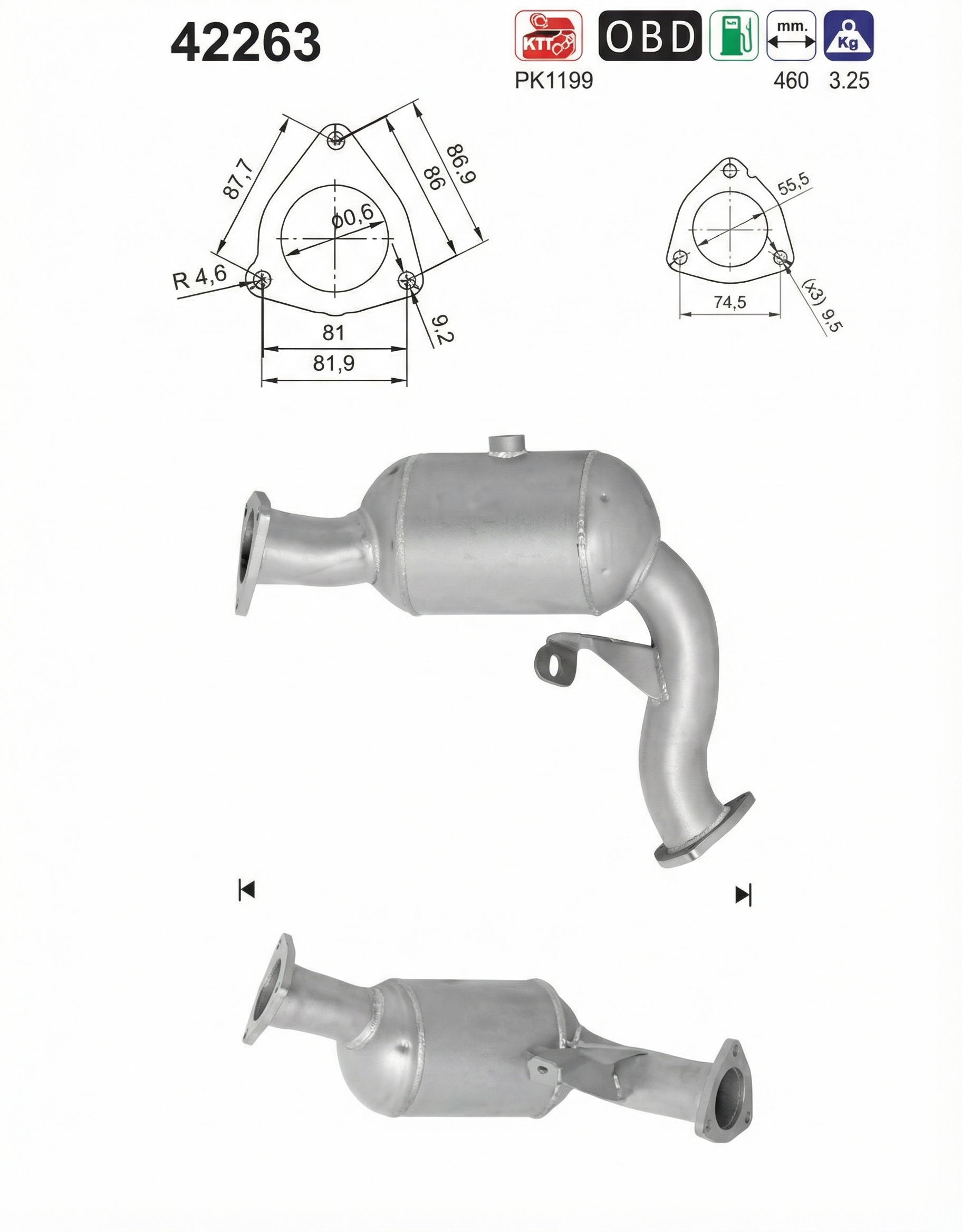
- Catalytic Converter (Bank 1)
(OEM #8K0254250KX (or 8K0254253AX))— This is the most common failure item for a P0420 code on this specific engine due to a design flaw leading to heat damage.
Trusted brands: Audi (OEM), MagnaFlow, HottExhaust (OEM Grade)
OEM price range: $1800-$2800
Aftermarket price range: $800-$1500 - Downstream Oxygen Sensor (Bank 1, Sensor 2)
(OEM #06E906265S (Bosch 17362))— This is a less common cause but may be replaced as part of a thorough diagnosis or if its readings are confirmed to be faulty.
Trusted brands: Bosch (OEM supplier), NTK
OEM price range: $180-$250
Aftermarket price range: $80-$150 - Crankcase Pressure Regulating Valve (PCV Valve)
(OEM #06E103547H (or latest revision))— Specifically mentioned in Audi TSB 2041120 as a component to inspect and potentially replace when diagnosing P0420/P0430 codes. A failure can cause incorrect crankcase pressure and oil consumption, which can harm the catalysts.
Trusted brands: Audi (OEM), Vaico
OEM price range: $100-$200
Aftermarket price range: $50-$120
Related Codes That Often Appear With This One
- P0430 — This is the identical 'Catalyst Efficiency Below Threshold' code but for Bank 2 (driver's side). Since both catalytic converters are subjected to the same high-heat conditions, it is common for them to fail around the same time. The Audi TSB addresses both codes simultaneously.
- P0300-P0306 — These are misfire codes (P0300 for random, P0301-P0306 for specific cylinders). An engine misfire allows unburnt fuel to be dumped into the exhaust, where it can ignite inside the catalytic converter. This dramatically increases the converter's temperature, accelerating its failure and melting the substrate.
Technical Service Bulletins (TSBs) & Recalls
- TSB 01 16 49 (2041120/3): Addresses MIL on for DTC P042000 and/or P043000. Recommends an ECM software update for overly narrow diagnostic limitations and advises checking the crankcase pressure regulating valve.
Platform-Specific Known Issues
- The primary issue is the premature failure of the catalytic converters, often between 50,000 and 70,000 miles. This is directly attributed to their placement near the engine, causing the internal ceramic substrate to melt or fracture from extreme heat.
- Audi Technical Service Bulletin 01 16 85 (2041120/4) acknowledges that overly sensitive software can trigger false P0420/P0430 codes and recommends an ECM update for 2011-2015 models.
Mechanic-Grade Diagnostic Values
- Downstream O2 Sensor (Bank 1, Sensor 2) Voltage — expected: A steady reading between 0.6V and 0.8V at a constant 2500 RPM with a warm engine.. Failure: Voltage fluctuates rapidly, mimicking the upstream O2 sensor's waveform.
- Short-Term and Long-Term Fuel Trims — expected: Within a range of -5% to +5% at idle and under load.. Failure: Consistently high positive values (>10%) could indicate a vacuum leak, while high negative values could indicate a leaking injector, both of which can damage a catalyst over time.
- Exhaust Backpressure (Vacuum Gauge Method) — expected: 16 to 21 inches of mercury (inHg) at idle. When revved to 2500 RPM, vacuum will drop and then quickly return to the baseline reading.. Failure: At 2500 RPM, the vacuum reading is slow to return to baseline or continues to drop, indicating a blockage in the exhaust.
- Exhaust Backpressure (Pressure Transducer Method) — expected: Should be below 1.5 PSI at idle and not exceed 3 PSI at 2500 RPM.. Failure: Readings of 3-4 PSI or higher indicate a significant blockage, likely a clogged catalytic converter.
Hidden / Shadow Codes Worth Checking
- Mode $06 Data: This is not a trouble code, but a diagnostic mode that provides access to the raw results of the ECU's self-tests for various emissions components, including the catalyst efficiency monitor. It allows a technician to see the specific test value the ECU generated, and how close it was to the pass/fail threshold, before a DTC is even set. (see via Requires an advanced scan tool like VCDS, ODIS, or a high-end handheld scanner (e.g., BlueDriver, Foxwell NT510) that can access Mode $06 test results.)
Scan Tool Commands That Help
- VCDS (Ross-Tech) or ODIS (Audi Dealer): Catalyst Readiness Test / Basic Settings — After a repair (like replacing a cat or O2 sensor) or clearing codes, the catalyst monitor must run successfully to confirm the fix and turn off the CEL. This function allows a technician to manually initiate the test sequence without having to perform a lengthy, specific drive cycle. The procedure may involve holding the brake and accelerator while in the Basic Settings menu to allow the ECU to control RPM and run the test.
Real Owner Repair Stories
- AudiWorld Forums, user 'infamous107' (2002 Audi A4 1.8T (Note: Different engine, but the diagnostic journey and final fix are highly relevant to the P0420 issue on Audis in general).) — Persistent P0420 Check Engine Light.
❌ Tried (didn't work) Replaced both O2 sensors, Replaced spark plugs and coils, Fixed a cracked vacuum tube, Replaced the catalytic converter, Installed an O2 sensor spacer (worked for one month, then code returned)
✅ What actually fixed it After replacing nearly every related part, the owner took the car to an Audi dealership for an ECM 'reflash'. The software update, which cost $180, adjusted the sensitivity of the catalyst monitor and permanently resolved the P0420 code. - AudiWorld Forums, user 'macgy' (Audi with P0420 code (model not specified).) — P0420 code present.
❌ Tried (didn't work) Not specified, but implied other diagnostics were considered.
✅ What actually fixed it The user replaced the PCV valve, and the P0420 code did not return for two years.
"I Checked Everything" — The Actual Cause
- In cases where an exhaust smoke test reveals no leaks, the P0420 code on this platform often persists due to one of two non-leak causes: 1) The catalytic converter has internally failed (melted substrate) without any external breach, which is the most common cause on the 3.0T engine. 2) The ECU software has diagnostic thresholds that are too sensitive, falsely triggering the code even with a healthy converter. An ECM update as per TSB 01 16 85 is the fix in this scenario.
OEM Part Supersession History
06E103547H→06E103547S, 06E103547AB, and latest known revision 06E103547AH— Revisions to improve reliability and address failures of the internal diaphragm, which is a common issue.
Heads up: The newest revision (AH) is the preferred replacement and is backwards compatible.
Model Year Variations Within This Range
- 2011-2015: Models within this range are specifically called out in Audi TSB 01 16 85 (2041120/4) as potentially having overly sensitive ECU software that can falsely trigger P0420/P0430. An ECM software update is the prescribed first step for these vehicles.
Diagnostic Flowchart
Other Known Issues on This Vehicle
Issues unrelated to this code that are worth knowing about as an owner of this generation:
- Water Pump & Thermostat Failure 🔴 High — Common failure item, often between 40,000-80,000 miles. Early (2010-2012) models are more prone. A class action lawsuit was filed regarding this issue. (Ref: Multiple service actions and TSBs exist. A class action lawsuit was filed for some models.)
- S-Tronic (DL501/0B5) Mechatronic Unit Failure 🔴 High — Common on cars approaching 80,000-120,000 miles. Symptoms include harsh/jerky shifting, flashing PRNDS light, and loss of gears (odd or even).
- Intake Valve Carbon Buildup 🟠 Medium — Significant power loss and misfires can occur after 60,000-80,000 miles due to the direct injection design. Requires manual cleaning (walnut blasting).
- PCV Valve Failure 🟠 Medium → Shop PCV Valve — The diaphragm can tear, causing a high-pitched whistle, unstable idle, and excessive oil consumption. Often fails before 100,000 miles. (Ref: TSB 2069351 / 01 23 30 addresses a related breather line issue.)
- Crank Pulley Failure 🟠 Medium — The rubber damper on the crank pulley can fail, causing the serpentine and supercharger belts to slip or shred. One owner on Audizine reported a failure at 57,000 miles.
Used vs. New Parts: Buying Guide for This Vehicle
When a used part is the smart pick: For this specific P0420 repair, sourcing used parts is generally not recommended. A used PCV valve is a poor choice as the internal diaphragm fails with age, and the part is inexpensive new. A used O2 sensor carries risk and offers minimal savings. A used catalytic converter is a significant gamble and strongly advised against.
Donor-vehicle mileage cap: roughly under 30000 miles for the part to have meaningful remaining life.
What to inspect on the donor part:
- For a catalytic converter, visually inspect the honeycomb structure from both ends with a bright light; it must be perfectly intact with no signs of melting, clogging, or missing pieces.
- Shake the converter vigorously; any rattling sound indicates a broken internal substrate and the part is junk.
- Assume any used converter from a 3.0T donor has already been subjected to the same extreme heat and has a significantly reduced lifespan.
OEM-only on this vehicle (don't cheap out):
- Catalytic Converter: This is the strongest recommendation. Aftermarket converters, especially cheaper ceramic ones, often lack the required precious metal loading to satisfy Audi's sensitive catalyst monitor, leading to the P0420 code returning.
- PCV Valve: While quality aftermarket versions exist, the OEM part has undergone multiple revisions to improve reliability and is the safest choice.
Aftermarket brands forum-validated for this vehicle:
- Bosch or NTK for Oxygen Sensors (Bosch is the OEM supplier).
- MagnaFlow for catalytic converters (ensure it is a CARB-compliant or OEM-grade unit if required by your state).
- Vorsprung Autowerk for high-performance metallic catalysts, though this is for modified vehicles and may require ECU tuning.
Brands owners have reported issues with on this vehicle:
- Unbranded, ultra-cheap catalytic converters found on sites like eBay or Amazon. These are almost guaranteed to fail the ECU's efficiency test and are a waste of money and significant labor.
Real Owner Stories
Aggregated from forums and TSBs cited above. Mileages and costs reflect what owners reported in those sources.
2013 Audi S5 3.0T
Symptoms: P0420 and P0430 codes appearing together.
What fixed it: The owner discussed the issue on a forum regarding codes appearing on their 2013 model, which is covered under the TSB for ECM software updates.
Source hint: https://www.audizine.com/forum/showthread.php/761845-P0420-and-P0430-codes-on-my-2013-S5
2011-2015 Audi S5 3.0T — ~60000 miles
Symptoms: Check Engine Light illuminated; internal ceramic substrate melted or fractured from extreme heat due to placement near the engine.
What fixed it: Replacement of the catalytic converter assembly; some owners opt for high-quality aftermarket units or test pipes with an ECU tune due to high OEM costs.
Cost: $800-$2500
Source hint: vehicle_specific_issues
Related OBD-II Codes
Frequently Asked Questions
Does TSB 01 16 85 apply to my 2013 Audi S5 with the 3.0T engine?
I'm hearing a metallic rattling under my S5 at startup; is this related to the P0420 code?
At what mileage do the catalytic converters typically fail on the Audi 3.0T Supercharged V6?
Can a faulty PCV valve cause a P0420 code on my S5?
Should I replace my oxygen sensors first to fix the P0420 code?
Is there a way to visually confirm if my S5's catalytic converter has melted?
Helpful Videos


Used OEM Parts in Stock
New Aftermarket Parts Available

The information in this article is provided for general reference and educational purposes only. Vehicle specifications, procedures, and part compatibility can vary by production date, trim level, and region. Always consult your vehicle's factory service manual and verify part numbers before purchasing or performing repairs. Safety-critical components such as airbags, seat belts, and braking systems should be installed by a qualified professional.
- Audi S5:
- 🧭 Diagnostic Flowchart
- 🎬 Helpful Videos
- 🛍️ Shop This Part
- What's Unique About the 2008-2017 Audi S5
- Symptoms You May Notice
- Most Likely Causes
- Diagnosis Steps
- Parts You'll Likely Need
- Related Codes That Often Appear With This One
- Technical Service Bulletins (TSBs) & Recalls
- Platform-Specific Known Issues
- Mechanic-Grade Diagnostic Values
- Hidden / Shadow Codes Worth Checking
- Scan Tool Commands That Help
- Real Owner Repair Stories
- "I Checked Everything" — The Actual Cause
- OEM Part Supersession History
- Model Year Variations Within This Range
- Other Known Issues on This Vehicle
- Used vs. New Parts: Buying Guide for This Vehicle
- Real Owner Stories
- 2013 Audi S5 3.0T
- 2011-2015 Audi S5 3.0T — ~60000 miles
- Related OBD-II Codes
- Frequently Asked Questions
- 🎟️ Get 5% Off