

P0420 on 2019-2026 Genesis G70 3.3T: Catalyst Efficiency Causes and Fixes
Code P0420 on a Genesis G70 3.3T most often means the Bank 1 catalytic converter is failing, which is a costly repair ($2,500+). However, it's critical to first rule out a much cheaper faulty downstream oxygen sensor (around $50-$150 for the part) or an exhaust leak. Underlying issues like a recalled turbo oil feed pipe leaking oil can also be the root cause.
- P0420 on the G70 3.3T points to the catalytic converter on the rear bank (near the firewall) being inefficient.
- Before assuming the worst (a $2,500+ catalytic converter), you must rule out a bad downstream O2 sensor (a ~$100 part) and any exhaust leaks.
- Check for open recalls. A known turbo oil line recall (NHTSA #24V191000) can cause oil leaks that destroy the catalytic converter.
- If your car is modified with aftermarket downpipes, the code may be a known side effect that requires O2 sensor spacers, not a repair.
- Always fix underlying engine problems like misfires, oil leaks, or rich fuel conditions before replacing a catalytic converter, or the new one will fail too.
What's Unique About the 2019-2026 Genesis G70
The Genesis G70's 3.3L twin-turbo engine is a high-performance, direct-injection (GDI) platform. While P0420 is a generic code, on this vehicle it's important to consider engine-specific issues. A known safety recall (NHTSA 24V-191, Recall 019G) for a cracking left-hand turbo oil feed pipe can leak oil directly into the exhaust, contaminating and destroying the catalytic converter. Furthermore, these engines are sensitive to modifications; aftermarket downpipes or high-flow cats often trigger this code if not paired with a proper tune or O2 sensor spacers, sometimes called 'mini cats'.
Generation note: The Genesis G70 received a significant facelift for the 2022 model year, creating the first generation (2019-2021) and the facelift generation (2022-2026). However, the Lambda II 3.3L twin-turbo engine and primary emissions components remained largely the same. The issues described here, including the major recalls and warranty extensions, apply to both generations within the specified year range.
Symptoms You May Notice
- Check Engine Light is on.
- Reduced engine power or sluggish acceleration, especially if the converter is clogged.
- A rotten egg or sulfur smell from the exhaust, indicating the converter is struggling to process sulfur in the fuel.
- Failing a state emissions inspection.
- In some owner experiences, rough idle or misfiring under load, sometimes accompanied by a flashing check engine light.
- Abnormal exhaust note or sound.
- Immediately replacing the expensive catalytic converter without first testing the much cheaper oxygen sensors.
- Replacing oxygen sensors without checking for exhaust leaks first.
- For modified vehicles, assuming a part has failed when the code is actually being caused by high-flow or catless downpipes that require an O2 sensor spacer or a specific tune to prevent the code.
- Replacing the catalytic converter without addressing the root cause of its failure, such as a leaking turbo oil feed line, a faulty HPFP, or engine misfires. The new converter will likely fail again.
Most Likely Causes
- Failing Catalytic Converter 🔴 High Probability → Shop Catalytic Converter Catalytic converters can fail from age or contamination. On this engine, contamination is a significant risk due to a safety recall (Recall 019G) for a cracking turbo oil feed pipe that leaks oil onto the exhaust. Additionally, a warranty extension (Z05G) exists for a faulty high-pressure fuel pump (HPFP) that can cause a rich condition (P0088), which also destroys converters over time.
How to confirm: After confirming O2 sensors and the exhaust system are good, this is the most likely cause. A technician can perform a back-pressure test to check for a clog. Graphing sensor data will show the downstream O2 sensor voltage fluctuating similarly to the upstream sensor.
Typical fix: Replace the Bank 1 catalytic converter. This is a very expensive part. Bank 1 is the passenger side assembly.
Est. part cost: $2300-$2500 - Failed Downstream (Post-Catalyst) Oxygen Sensor 🟡 Medium Probability → Shop Oxygen Sensor Oxygen sensors are wear-and-tear items operating in a harsh environment. A lazy or faulty sensor can send incorrect data to the ECM, falsely triggering a P0420 code. It is a common misdiagnosis to replace the converter when only the sensor was bad.
How to confirm: Use a scan tool to graph the Bank 1 Sensor 2 voltage. At a steady RPM on a warm engine, the voltage should be relatively stable (e.g., >0.6V). If it's stuck low, stuck high, or fluctuating wildly in sync with the upstream sensor (when the cat is known to be good), the sensor is likely bad.
Typical fix: Replace the Bank 1, Sensor 2 oxygen sensor. Bank 1 is the rear/passenger side bank, closer to the firewall.
Est. part cost: $50-$150 - Exhaust Leak 🟡 Medium Probability Leaks can occur at gaskets or flex pipes. An exhaust leak located between the upstream and downstream O2 sensors can draw in outside air, causing the downstream sensor to read incorrectly (showing high oxygen) and trigger the code.
How to confirm: Perform a visual inspection for black soot marks around exhaust flanges and listen for hissing or tapping sounds, especially on a cold start. The most effective method is a professional smoke test, which forces smoke through the exhaust system to reveal any leaks.
Typical fix: Replace the leaking gasket or repair/replace the cracked pipe section.
Est. part cost: $20-$200
Rare But Worth Checking
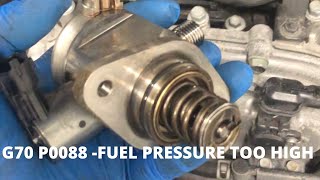
- Engine Running Rich: An engine that consistently runs rich (too much fuel) will send unburned fuel into the exhaust, which can overheat and destroy the catalytic converter over time. A warranty extension (Z05G / TSB 25-FL-002G) exists for a faulty high-pressure fuel pump (HPFP) on 2019-2023 G70s that can cause a rich condition, often with code P0088. 🎬 Watch: Diagnosing high fuel pressure and stalling issues.
- Failing Upstream (Pre-Catalyst) Oxygen Sensor: → Shop Oxygen Sensor While the downstream sensor triggers the code, a faulty upstream (air-fuel ratio) sensor can cause improper fuel control, leading to rich or lean conditions that damage the catalytic converter over time.
- ECM Software Issue: On other Hyundai/Genesis models, TSBs have been issued to update the ECM software to correct overly sensitive parameters for setting P0420. It's worth checking with a dealer if any such 'logic update' TSBs apply to your specific vehicle's VIN.
- Worn Spark Plugs or Ignition Coils: → Shop Ignition Coil Worn spark plugs (due at 42k miles) or failing ignition coils can cause incomplete combustion, leading to misfires (P030x codes) that dump raw fuel into the exhaust, quickly destroying the catalytic converter.
Diagnosis Steps
- Scan for all DTCs. Address any other codes first, especially for misfires (P030x), fuel system pressure (P0088), or fuel trim (P0172/P2097).
- Check for Recalls/TSBs. Verify with a dealer if Recall 019G (turbo oil feed pipe) and Warranty Extension Z05G (HPFP) have been performed on your vehicle.
- Inspect for Exhaust Leaks. Visually inspect the exhaust system for soot trails or cracks at the manifold, gaskets, and flex pipes between the two Bank 1 sensors. A smoke test is the most reliable method.
- Graph O2 Sensor Live Data. Warm up the engine completely. Bring RPM to a steady 2,500.
- Observe Bank 1, Sensor 1 (Upstream). Voltage should fluctuate rapidly between approximately 0.1V and 0.9V.
- Observe Bank 1, Sensor 2 (Downstream). On a good converter, this reading should be relatively steady and high (e.g., above 0.6V).
- If the downstream sensor voltage is fluctuating in a similar pattern to the upstream sensor, it confirms the catalyst is not working efficiently.
- If the downstream sensor voltage is flat but low (e.g., <0.2V) or not reading at all, the sensor itself may be faulty or have a wiring issue.
- If O2 sensors and the exhaust system are confirmed to be in good working order, the catalytic converter is the culprit.
Parts You'll Likely Need
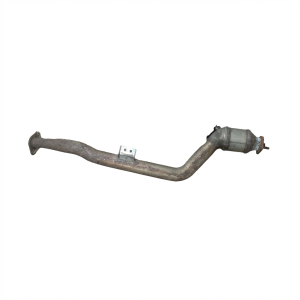
- Bank 1 Catalytic Converter
(OEM #28610-G9750)— This is the most common, though most expensive, direct cause for a legitimate P0420 code. Bank 1 is the passenger-side assembly.
Trusted brands: Genuine Genesis
OEM price range: $2300-$2500
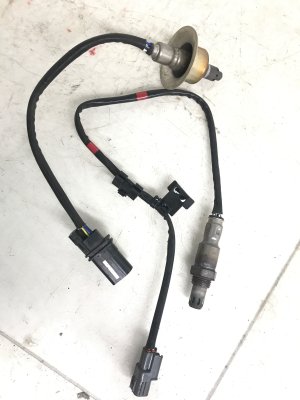
Aftermarket price range: $600-$1200 - Bank 1, Sensor 2 (Downstream Oxygen Sensor)
(OEM #39210-3L550)— This sensor is responsible for reporting catalyst efficiency. It can fail and send incorrect readings, making it a critical diagnostic step and a common, inexpensive fix.
Trusted brands: Bosch, NGK, NTK, Denso, Genuine Hyundai/Genesis
OEM price range: $150-$250
Aftermarket price range: $50-$150 - Bank 1, Sensor 1 (Upstream Oxygen Sensor) — A failing upstream sensor can cause incorrect fuel mixtures that damage the catalytic converter over time, leading to a P0420 code. It's a less common direct cause but a frequent root cause.
Trusted brands: Bosch, NGK, NTK, Denso, Genuine Hyundai/Genesis
OEM price range: $150-$250
Aftermarket price range: $70-$160
Related Codes That Often Appear With This One
- P0430 — This is the identical code but for Bank 2 (the front/driver's side bank). Seeing both may indicate a systemic issue like a fuel problem (e.g., HPFP failure) or oil contamination affecting both banks.
- P0300-P0306 — Cylinder misfire codes (P030X) mean unburned fuel is being dumped into the exhaust. This is a primary cause of catalytic converter failure and must be addressed first.
- P0088 — This code for 'Fuel Rail/System Pressure - Too High' is a strong indicator that the high-pressure fuel pump (HPFP) is failing, a known issue on this platform with a warranty extension. This rich condition will destroy the catalytic converter.
- P0172, P2097 — Fuel trim codes indicating a rich condition (P0172: System Too Rich, P2097: Post Catalyst Fuel Trim Too Rich) point to an underlying engine management problem that must be fixed to save the new catalytic converter.
Technical Service Bulletins (TSBs) & Recalls
- NHTSA #24V191000 (Genesis Recall 019G): Describes the procedure to replace the left-hand turbo oil feed pipe assembly on 2019-2022 G70 3.3T models to prevent oil leaks and potential fires.
- Warranty Extension Z05G (TSB 25-FL-002G): Extends the warranty for the High Pressure Fuel Pump (HPFP) on some G70 models, which can cause a rich running condition (DTC P0088) that may lead to catalyst damage.
Platform-Specific Known Issues
- A safety recall (NHTSA #24V191000 / Genesis Recall 019G) was issued for 2019-2022 G70 3.3T models for a cracking left-hand (Bank 2) turbocharger oil feed pipe. An oil leak onto hot exhaust components can cause fires and also contaminate the catalytic converters, leading to premature failure.
Mechanic-Grade Diagnostic Values
- O2 Sensor Heater Circuit Resistance — expected: 5.0 to 15.0 Ohms at ambient temperature.. Failure: An infinite resistance (Open Line) or zero resistance (short) indicates a failed heater element within the sensor.
- Primary (Upstream) O2 Sensor Signal Wire Identification — expected: The signal wire is RED on the 3.3T engine's wiring harness.. Failure: N/A - This is an identification detail.
Hidden / Shadow Codes Worth Checking
- Mode $06, TID $21: This is not a DTC, but a deeper diagnostic test result. TID (Test ID) $21 corresponds to the 'Catalyst Monitor Bank 1'. A professional scan tool can read the raw test value and compare it against the minimum and maximum thresholds set by the manufacturer. A value outside this range indicates the catalyst failed the test, leading to the P0420 code. A value that is close to the limit can indicate a marginal converter. (see via A professional-grade scan tool with Mode $06 capabilities (e.g., Hyundai GDS, advanced Autel/Launch scanners).)
Scan Tool Commands That Help
- Hyundai GDS (or GDS-Mobile): Resetting Adaptive Values — This function should be used after replacing a catalytic converter, oxygen sensors, or addressing a fuel system issue. It clears the long-term fuel trims and other learned engine parameters, forcing the ECM to relearn values with the new components, which can prevent a recurring code.
- Hyundai GDS (or GDS-Mobile): Flight Record — For intermittent P0420 issues. This function can be triggered to record a data snapshot of all sensor parameters in the minutes leading up to the trigger event, helping to capture the conditions that cause the fault.
Wiring & Ground Locations
- Upstream O2 Sensor Signal Wire — In the wiring harness connector for the upstream (pre-catalyst) oxygen sensors.. For technicians performing advanced diagnostics or installing tuning devices that modify O2 signals, knowing the signal wire is RED on the 3.3T engine saves significant time and prevents mis-wiring.
Real Owner Repair Stories
- Reddit user in r/GenesisG70 (2022 Genesis G70 3.3T AWD, ~32k miles) — Check engine light with code P0420 appeared a few days after purchasing the car.
❌ Tried (didn't work) The dealership diagnosed the P0420 and replaced the Bank 1 catalytic converter under warranty.
✅ What actually fixed it Unresolved. The same P0420 code returned a few days after the catalytic converter was replaced. The owner was scheduled to return to the dealer for a fourth time, suspecting O2 sensors, an exhaust leak, or a wiring issue. This highlights that replacing the converter is not always the final fix. - Reddit user in r/GenesisG70 (Genesis G70 3.3T (year not specified)) — P0420 code appeared two days after installing aftermarket secondary downpipes.
✅ What actually fixed it The community consensus was that this is a common result of changing exhaust components. The primary fix suggested was to ensure new OEM gaskets were used during installation to prevent any micro-leaks that could trigger the code. If leaks are ruled out, an O2 sensor spacer or a tune is the next step.
When the Usual Fixes Don't Work
- A recurring theme in owner forums is the P0420 code returning even after the most expensive fix—catalytic converter replacement—has been performed by a dealer under warranty. This strongly indicates that the root cause is often not the converter itself, but an underlying issue that was not addressed. Technicians and owners should aggressively investigate for subtle exhaust leaks (especially at gaskets), faulty O2 sensors sending borderline data, or intermittent fuel control problems before and even after replacing a catalytic converter to prevent a repeat failure.
OEM Part Supersession History
39210-3L550→Unknown— Part availability
Heads up: There is conflicting information. Some official Hyundai parts sites list this downstream O2 sensor as discontinued for the G70, while other OEM Kia/Hyundai parts vendors still actively sell it for both the G70 and the mechanically identical Kia Stinger. A technician should verify the correct, current part number with a dealer using the vehicle's VIN before ordering.
Model Year Variations Within This Range
- 2019+: The factory diagnostic tool changed. Vehicles up to ~2018 use the GDS-1 tablet system. Newer models, including the 2019-2026 G70, require the newer GDS-Mobile system (VCI-II interface) which runs on a subscription basis with a compatible Android tablet. An independent shop may not have full diagnostic capability on a newer G70 if they only have the older GDS system.
Diagnostic Flowchart
Other Known Issues on This Vehicle
Issues unrelated to this code that are worth knowing about as an owner of this generation:
- Cracking LH Turbo Oil Feed Pipe 🔴 High — Common enough to trigger a safety recall (019G / NHTSA 24V-191) affecting 2019-2022 models. The pipe can crack from heat exposure, leaking oil onto the exhaust manifold. (Ref: Recall 019G / NHTSA 24V-191)
- High-Pressure Fuel Pump (HPFP) Failure 🟠 Medium → Shop Fuel Pump — A known issue where the fuel control valve wears, causing a rich condition and triggering code P0088. Affects 2019-2023 models. Can lead to power loss at low speeds. (Ref: Warranty Extension Z05G (TSB 25-FL-002G))
- Brake Rotor Warping / Shudder 🟡 Low — Frequently reported by owners of both the G70 and its platform-mate, the Kia Stinger. Owners report brake shudder or vibration, often fixed by upgrading to aftermarket pads and rotors.
- Interior Rattles 🟡 Low — Some owners report rattles from areas like the sunroof assembly or the plastic housing behind the rearview mirror, particularly in hot climates.
- Water Entry into Starter Solenoid 🔴 High — A recall was issued for 2019 models where water could enter the starter solenoid, potentially causing an electrical short and engine compartment fire. (Ref: NHTSA Recall 20V191000)
Used vs. New Parts: Buying Guide for This Vehicle
When a used part is the smart pick: For this specific repair, using used parts is highly discouraged for major components. The only potential exception might be a low-mileage, undamaged exhaust pipe section if a specific piece is needed for a repair, but never the catalytic converter itself.
Donor-vehicle mileage cap: roughly under 30000 miles for the part to have meaningful remaining life.
What to inspect on the donor part:
- For any exhaust component, check for heavy rust, dents, or scraped sections that indicate impact damage.
- Look at the cut ends of the pipe; a clean cut from a professional yard is better than a jagged, torched-off piece.
- Avoid any parts with visible oil or coolant residue in the pipes.
OEM-only on this vehicle (don't cheap out):
- Catalytic Converter: Aftermarket converters are a significant gamble on modern, sensitive engines like the 3.3T. Many do not have the same loading of precious metals as OEM and will fail to meet the ECM's strict efficiency monitoring, causing the P0420 code to return within weeks or months.
- Exhaust Gaskets: When replacing any exhaust component, always use new, high-quality OEM gaskets to ensure a perfect seal. Re-using old gaskets or using cheap aftermarket ones is a common cause of leaks that trigger this code.
Aftermarket brands forum-validated for this vehicle:
- O2 Sensors: NTK or Denso are the original equipment manufacturers for many brands, including Hyundai/Genesis. Buying from these brands is often identical to the Genuine part at a lower cost.
Brands owners have reported issues with on this vehicle:
- Generic, unbranded 'high-flow' catalytic converters from online marketplaces. They are almost guaranteed to fail the efficiency test and trigger a P0420 code.
Real Owner Stories
Aggregated from forums and TSBs cited above. Mileages and costs reflect what owners reported in those sources.
2022 Genesis G70 3.3T
Symptoms: Persistent check engine light with code P0420. The code returned only a few days after a major repair.
What fixed it: The dealer initially replaced the catalytic converter under warranty, but the recurrence suggested an underlying issue with the O2 sensor or wiring.
Source hint: r/GenesisG70 thread titled 'Check engine light code P0420 won't go away after repair'
Genesis G70 3.3T
Symptoms: Car entered limp mode with no turbo boost and experienced bank 1 misfires.
What fixed it: The symptoms pointed toward a potentially clogged catalytic converter.
Source hint: r/GenesisG70 thread titled 'G70 P0420 Code'
Related OBD-II Codes
Frequently Asked Questions
Is there a recall for the 2019-2022 Genesis G70 3.3T that could cause a P0420 code?
My G70 has a P0088 code along with P0420; are they related?
Which side of the engine is Bank 1 on the G70 3.3L V6?
Can I just replace the O2 sensor to fix P0420 on my G70?
How much does a replacement catalytic converter cost for the G70 3.3T?
Does the Kia Stinger GT have the same P0420 issues as the G70?
Helpful Videos
We Have This Part in Stock

The information in this article is provided for general reference and educational purposes only. Vehicle specifications, procedures, and part compatibility can vary by production date, trim level, and region. Always consult your vehicle's factory service manual and verify part numbers before purchasing or performing repairs. Safety-critical components such as airbags, seat belts, and braking systems should be installed by a qualified professional.
- Genesis G70:
- 🧭 Diagnostic Flowchart
- 🎬 Helpful Videos
- 🛍️ Shop This Part
- What's Unique About the 2019-2026 Genesis G70
- Symptoms You May Notice
- Most Likely Causes
- Rare But Worth Checking
- Diagnosis Steps
- Parts You'll Likely Need
- Related Codes That Often Appear With This One
- Technical Service Bulletins (TSBs) & Recalls
- Platform-Specific Known Issues
- Mechanic-Grade Diagnostic Values
- Hidden / Shadow Codes Worth Checking
- Scan Tool Commands That Help
- Wiring & Ground Locations
- Real Owner Repair Stories
- When the Usual Fixes Don't Work
- OEM Part Supersession History
- Model Year Variations Within This Range
- Other Known Issues on This Vehicle
- Used vs. New Parts: Buying Guide for This Vehicle
- Real Owner Stories
- 2022 Genesis G70 3.3T
- Genesis G70 3.3T
- Related OBD-II Codes
- Frequently Asked Questions
- 🎟️ Get 5% Off