

P0422 on 2010-2015 Hyundai Tucson 2.4L: Main Catalyst Failure Causes & Fixes
On the 2010-2015 Tucson 2.4L, code P0422 almost always means the catalytic converter has failed due to excessive engine oil consumption, a known issue with the Theta II engine. Before replacing the converter (a ~$1,500+ job), you must address the oil burning problem. This underlying engine issue may be covered under a lifetime extended warranty resulting from the Hyundai Theta II Engine Litigation settlement.
- P0422 on this Tucson almost always points to a failed catalytic converter caused by a serious engine issue.
- The number one cause is excessive oil consumption from the 2.4L Theta II engine, which is a widely known defect.
- DO NOT simply replace the catalytic converter without addressing the oil consumption. The new part will fail.
- Before paying for any repairs, contact a Hyundai dealer with your VIN to check for eligibility under extended warranties or recalls related to the engine.
- Diagnosis must start with checking the engine oil level and monitoring for consumption.
What's Unique About the 2010-2015 Hyundai Tucson
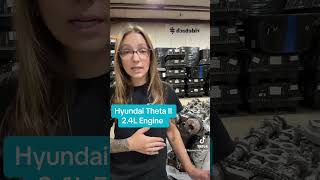
The P0422 code on this specific Tucson is rarely a simple case of a worn-out catalytic converter. It is almost always a direct consequence of the well-documented problems with the 2.4L Theta II engine, particularly excessive oil consumption and connecting rod bearing wear. Manufacturing issues led to class-action lawsuits alleging that the engines were defective, causing premature wear, oil burning, and eventual seizure. This oil burning contaminates and destroys the catalytic converter, making P0422 a strong indicator of a much more serious underlying engine problem. Simply replacing the converter will not solve the issue long-term. As a result of the lawsuits, Hyundai extended the engine warranty to a lifetime warranty for qualifying vehicles that have had the Knock Sensor Detection System (KSDS) software update performed.
Symptoms You May Notice
- Check Engine Light is on
- Reduced engine power or sluggish acceleration
- Poor fuel economy
- Excessive oil consumption (requiring frequent top-offs)
- A sulfur or 'rotten egg' smell from the exhaust (less common)
- Failing a state emissions inspection
- Engine knocking noise (indicates severe bearing wear)
- Replacing the oxygen sensors without checking the health of the catalytic converter.
- Replacing the catalytic converter without first diagnosing and fixing the underlying engine oil consumption. The new converter will be destroyed by the oil and the P0422 code will return.
Most Likely Causes
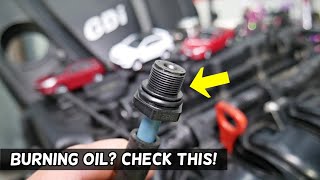
- Excessive Engine Oil Consumption 🔴 High Probability The 2.4L Theta II engine is notorious for premature piston ring and cylinder bore wear, leading to high oil consumption that contaminates and destroys the catalytic converter. This defect was the subject of a major class-action lawsuit. 🎬 Watch: Why the Theta II engine burns so much oil
How to confirm: Monitor engine oil levels closely; a loss of more than 1 quart per 1,000 miles is a major red flag. A Hyundai dealer must perform an official oil consumption test to qualify for warranty coverage. Your VIN must also have the KSDS update (Campaign 953) completed to be eligible for the lifetime engine warranty.
Typical fix: The root cause requires an engine rebuild or replacement, which may be covered under Hyundai's Lifetime Warranty Extension (TXXI) for connecting rod bearing failure if the vehicle qualifies. Some owners report dealers attempting an "engine cleaning" first.
Est. part cost: $0 (if under warranty) - $7000+ - Failed Catalytic Converter 🔴 High Probability → Shop Catalytic Converter The converter itself fails because it has been contaminated and clogged by burnt engine oil or, less commonly, unburnt fuel from misfires. It is a symptom of the engine problem, not the root cause.
How to confirm: After confirming oxygen sensors are working and there are no exhaust leaks, the converter is the culprit. A professional can use a temperature gun to check for a significant temperature increase from the converter's inlet to its outlet (a working cat should be hotter at the outlet). A clogged cat may show a temperature drop.
Typical fix: Replace the manifold catalytic converter assembly. THIS SHOULD ONLY BE DONE AFTER the root cause (oil consumption) is fixed under warranty, otherwise the new converter will fail again quickly.
Est. part cost: $800 - $2500+ - Engine Misfires 🟡 Medium Probability Worn spark plugs or failing ignition coils can cause misfires, dumping raw fuel into the exhaust which rapidly overheats and melts the internal structure of the catalytic converter.
How to confirm: Misfires will usually trigger other codes, such as P0300, P0301, P0302, P0303, or P0304. The engine may run rough, especially under load.
Typical fix: Diagnose and fix the cause of the misfire first. This typically involves replacing spark plugs and/or ignition coils.
Est. part cost: $50 - $250 - Faulty Oxygen (O2) Sensors ⚪ Low Probability → Shop Oxygen Sensor Sensors can fail with age, but on this vehicle, they are more likely to be contaminated by burning oil, causing them to read incorrectly. However, they are usually accurately reporting the failure of the catalytic converter.
How to confirm: A mechanic can use a scan tool to graph the voltage of the upstream and downstream O2 sensors. A healthy downstream sensor should show a relatively steady voltage. If it is switching rapidly like the upstream sensor, it confirms the catalyst is not working. Replacing the sensor is rarely the fix.
Typical fix: Replace the downstream (and possibly upstream) oxygen sensor. This is a common misdiagnosis; the sensors are usually just reporting the bad converter.
Est. part cost: $70 - $200 per sensor
Rare But Worth Checking
- Exhaust Leak: A crack or bad gasket in the exhaust system between the front and rear O2 sensors can allow extra oxygen to enter, confusing the sensor readings and triggering the code. This should be checked before replacing expensive parts.
- EVAP System Disconnection: While less common on the Tucson, manufacturer records for other Hyundai models like the Elantra (NHTSA ODI #10457133) show that fuel vapor pipes disconnecting from the EVAP canister can trigger a P0422 code, indicating a leak in the EVAP system.
Diagnosis Steps
- Check Engine Oil Level: Before doing anything else, check the engine oil. If it is low, top it off and begin monitoring for excessive consumption (e.g., >1 quart per 1000 miles). This is the most critical step for this vehicle.
- Contact Hyundai Dealer with VIN: Contact a Hyundai dealership with your VIN. Inquire about open campaigns, specifically Service Campaign 953 (KSDS update) and the status of your Lifetime Engine Warranty (TXXI). This step is crucial and can save thousands of dollars.
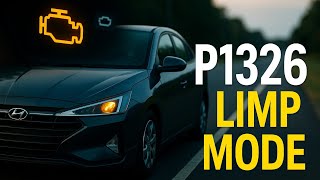
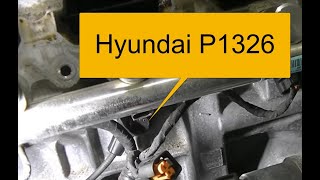
- Check for Other Codes: Use an OBD-II scanner to check for any other pending or active codes. Pay close attention to misfire codes (P030x) or the KSDS warning code (P1326). 🎬 See how to diagnose and fix the P1326 KSDS code Address these codes first.
- Initiate Oil Consumption Test: If you suspect high oil consumption, you must have an authorized Hyundai dealer perform an official, documented oil consumption test to proceed with any engine warranty claim.
- Inspect for Exhaust Leaks: Visually and audibly inspect the exhaust system from the engine manifold to the downstream O2 sensor for any cracks, holes, or gasket leaks, which can falsely trigger a P0422 code.
- Analyze Oxygen Sensor Data: Using a capable scan tool, graph the upstream and downstream O2 sensor voltages. The upstream sensor should switch rapidly between ~0.1V and ~0.9V. A healthy downstream sensor on a working converter should hold a relatively steady, high voltage (~0.6V-0.8V). If the downstream sensor is mirroring the upstream sensor's activity, the converter has failed. 🎬 Watch: How to diagnose catalyst efficiency codes
- Confirm Catalytic Converter Failure: If all other steps are exhausted and the engine issue has been addressed, the converter itself is the final point of failure. A professional diagnosis can confirm this with temperature or gas analysis.
Parts You'll Likely Need
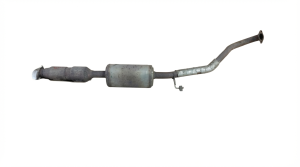
- Manifold Catalytic Converter Assembly
(OEM #Varies by emissions type. ULEV (Federal) is 28960-2G880 for 2010-2013 models. SULEV (California) is 28950-2G360 for 2010-2013 models. 2014-2015 GDI models use different parts.)— This is the part that has failed to trigger the code. Its failure is almost always a symptom of the engine's oil consumption problem on this vehicle.
Trusted brands: Hyundai (OEM), MagnaFlow, Walker Exhaust, AP Exhaust Technologies
OEM price range: $1500 - $3200
Aftermarket price range: $600 - $1200 - Engine Assembly (Short or Long Block) — This is the ultimate fix for the root cause of catalyst failure: excessive oil consumption. This may be covered under warranty.
Related Codes That Often Appear With This One
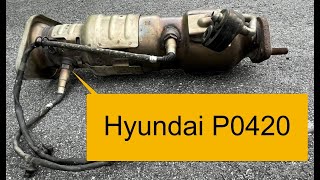
- P0420 — P0420 is the identical code for catalyst efficiency but is sometimes used interchangeably with P0422 by different scan tools. TSB 16-FL-003 specifically addresses P0420 for this vehicle.
- P0300-P0304 — These are cylinder misfire codes. An ongoing misfire will destroy a catalytic converter by sending unburnt fuel into it, causing it to overheat and melt.
- P0171 — This 'System Too Lean' code can be caused by an exhaust leak upstream of the O2 sensor, which can also contribute to an incorrect P0422 reading. TSB 16-FL-003 also addresses this code alongside P0420.
- P1326 — This code is specific to the Knock Sensor Detection System (KSDS). If the KSDS detects vibration patterns indicative of impending rod bearing failure, it will trigger this code and put the vehicle into limp mode. The presence of this code is a key qualifier for engine replacement under the lifetime warranty.
Technical Service Bulletins (TSBs) & Recalls
- TSB 16-FL-003: Addresses P0420/P0171 on 2014-2015 2.4L GDI models, involving an ECM update and potential catalyst replacement for P0420.
- Service Campaign 953: A product improvement campaign to install the Knock Sensor Detection System (KSDS) software. This update is a prerequisite for the extended engine warranties.
- Warranty Extension TXXI / TSB 22-EM-001H-1: Outlines the terms for the Lifetime Warranty on the engine short block for connecting rod bearing failure for vehicles that have had Campaign 953 performed.
- TSB 23-FL-003H: Recommends using a Techron-based fuel system cleaner twice per oil change interval to help prevent carbon deposits on GDI and MPI engines.
Platform-Specific Known Issues
- This code is strongly linked to the Theta II 2.4L engine's propensity for excessive oil consumption and catastrophic failure due to manufacturing defects. Many of these engines are covered by a lifetime warranty extension as part of a class-action lawsuit settlement. It is crucial to check with a dealer about warranty status before paying for any repairs.
- Hyundai issued TSB 16-FL-003 for the 2014-2015 Tucson 2.4L for code P0420, which involves an ECM software update and, if necessary, catalyst replacement to prevent overheating of the converter.
Mechanic-Grade Diagnostic Values
- Downstream O2 Sensor (Bank 1, Sensor 2) Voltage at idle (warm engine) — expected: Relatively stable voltage between 0.4V and 0.9V.. Failure: Voltage is stuck below 0.2V, or it switches rapidly, mirroring the upstream sensor.
- Downstream O2 Sensor (B1S2) Heater Circuit Resistance — expected: 3.3 - 10 Ohms at room temperature (approx. 20°C / 68°F).. Failure: A reading of infinity (OL) indicates an open circuit; near zero indicates a short.
- Fuel Pressure (2010-2013 2.4L MPI models) — expected: 42 ~ 64 PSI.. Failure: Low pressure can indicate a clogged filter or failing pump; high pressure can indicate a faulty regulator.
- High-Pressure Fuel System (2014-2015 2.4L GDI models) — expected: 290 ~ 3,626 PSI.. Failure: Code P0087 (Fuel Rail/System Pressure - Too Low) will often accompany other issues if the high-pressure fuel pump is failing.
Wiring & Ground Locations
- Engine to Chassis Ground Strap — Typically a braided copper strap connecting the engine block or transmission housing to the vehicle's chassis/frame, often near a motor mount or the gearbox.. A poor or corroded main engine ground can cause erratic voltage readings from sensors, including oxygen sensors. The ECU relies on a stable ground reference. An unstable ground can cause the alternator to behave erratically, further impacting sensor data and potentially leading to misdiagnosis.
- PCM/ECM Ground — The Powertrain Control Module (PCM) has its own ground wires, often terminating at a ground point on the inner fender or firewall.. A compromised ground specifically for the PCM can lead to incorrect interpretation of sensor data, potentially triggering false codes like P0422. All sensor readings are relative to the PCM's ground potential.
OEM Part Supersession History
Unknown (Old Kia Logo)→95220-2S000— Part update/refresh.
Heads up: A failing starter relay can cause intermittent starting problems, which might be misdiagnosed as a more severe issue. One owner noted receiving the updated Hyundai/Kia part (with the new logo) when purchasing a replacement for their 2012 Tucson.
Model Year Variations Within This Range
- 2010-2013: These models use a Multi-Point Injection (MPI) fuel system. Fuel pressure is lower (42-64 PSI), and they are less prone to intake valve carbon buildup as the fuel washes over the valves.
- 2014-2015: These models use a Gasoline Direct Injection (GDI) fuel system. This involves a much higher fuel pressure (up to 3,626 PSI) managed by a high-pressure, cam-driven fuel pump. GDI engines are more susceptible to intake valve carbon buildup and fuel dilution of the engine oil, which can accelerate wear if not maintained with proper oil changes.
Diagnostic Flowchart
Other Known Issues on This Vehicle
Issues unrelated to this code that are worth knowing about as an owner of this generation:
- Engine Bearing Failure / Seizure 🔴 High — Widespread enough to trigger multiple class-action lawsuits and a lifetime warranty extension. Can occur at various mileages, often preceded by a knocking noise or oil consumption. (Ref: Service Campaign 953 (KSDS update), Warranty Extension TXXI (Lifetime Warranty), Recall 198, Recall 209.)
- Brake Light Switch Failure 🟠 Medium — A common failure item leading to the ESC light illuminating, cruise control not working, and the vehicle not shifting out of Park. A recall was issued. (Ref: NHTSA Recall 13V113000)
- Oil Leaks from Oil Pan / Timing Cover 🟡 Low — Seepage or leaks from the oil pan sealant and timing chain cover are commonly reported as the vehicles age.
- CVVT / Oil Control Valve (OCV) Malfunction 🟠 Medium — Failure of the Oil Control Valve is common, often caused by low/dirty oil or sludge. It typically triggers codes like P0010 or P0011 and can be a precursor to more serious engine issues.
Used vs. New Parts: Buying Guide for This Vehicle
When a used part is the smart pick: For this specific vehicle and code, buying a used engine assembly from a reputable recycler can be a viable option if the vehicle is out of warranty and the original engine has failed due to the known Theta II issues. A used catalytic converter is generally not recommended.
Donor-vehicle mileage cap: roughly under 80000 miles for the part to have meaningful remaining life.
What to inspect on the donor part:
- Obtain the VIN of the donor vehicle to check its history for accidents and maintenance.
- Look for evidence of regular oil changes (e.g., service records, lack of heavy sludge under the oil cap).
- Inspect for external damage, leaks, or corrosion on the engine block and components.
- If possible, get compression test numbers from the donor engine before purchase.
OEM-only on this vehicle (don't cheap out):
- Catalytic Converter: Aftermarket converters for this vehicle are known to have a shorter lifespan and may not meet strict emissions standards, leading to the P0422 code returning. Given the high cost, an OEM part is a more reliable long-term solution after the root cause (oil consumption) is fixed.
- Engine Assembly: While a used OEM engine is an option, avoid no-name rebuilt engines. A warrantied remanufactured engine from a reputable supplier or an OEM short/long block is the safest bet.
Aftermarket brands forum-validated for this vehicle:
- Denso (for O2 sensors)
- NTK (for O2 sensors)
Brands owners have reported issues with on this vehicle:
- Unbranded, 'no-name' catalytic converters from online marketplaces are frequently cited as failing within a year.
Real Owner Stories
Aggregated from forums and TSBs cited above. Mileages and costs reflect what owners reported in those sources.
2015 Hyundai Tucson 2.4L — 85000 miles
Symptoms: The vehicle began consuming 1 quart of oil every 800-1000 miles. The owner was denied a dealer consumption test.
What fixed it: The owner documented the experience but did not reach a resolution with the dealer in the cited report, highlighting the difficulty of getting consumption claims accepted.
Source hint: Reddit - r/Hyundai - 'Hyundai Oil Consumption Issue - Acceptance & Long Term Plan'
2015 Hyundai Tucson 2.4L — ~100000 miles
Symptoms: Engine failure described as 'blew up'.
What fixed it: A Hyundai technician confirmed the likelihood of engine replacement under the lifetime warranty extension.
Source hint: Reddit - r/Hyundai - 'Gf's Tucson blew up'
2014 Hyundai Tucson 2.4L — ~95000 miles
Symptoms: Excessive oil burning and difficulty dealing with the dealership regarding an oil consumption claim.
What fixed it: The owner ultimately traded the vehicle in rather than continuing to fight for a repair.
Source hint: BobIsTheOilGuy.com - 'Update on my sister's oil burning Tucson'
Documented NHTSA Reports
Hyundai Fuel System Issues
Symptoms: An owner reported that pipes from the fuel tank conveying fuel vapors disconnected from the EVAP canister, triggering a P0422 check engine light and causing the vehicle to fail state inspection.
What fixed it: NHTSA ODI #10457133 describes this as a leak in the EVAP system resulting from the disconnected pipes.
Source hint: NHTSA ODI #10457133
Related OBD-II Codes
Frequently Asked Questions
Does TSB 16-FL-003 apply to my 2014-2015 Hyundai Tucson 2.4L?
Is the P0422 code covered under the Hyundai Lifetime Engine Warranty (TXXI)?
What is Service Campaign 953, and why is it required for my Tucson?
My dealer wants to do an 'engine cleaning' for my oil consumption; is this the standard fix?
How much oil consumption is considered a 'red flag' for the 2.4L Theta II engine?
Can I just replace the oxygen sensors to fix the P0422 code?
Helpful Videos
Used OEM Parts in Stock
New Aftermarket Parts Available



The information in this article is provided for general reference and educational purposes only. Vehicle specifications, procedures, and part compatibility can vary by production date, trim level, and region. Always consult your vehicle's factory service manual and verify part numbers before purchasing or performing repairs. Safety-critical components such as airbags, seat belts, and braking systems should be installed by a qualified professional.
- Hyundai Tucson:
- 🧭 Diagnostic Flowchart
- 🎬 Helpful Videos
- 🛍️ Shop This Part
- What's Unique About the 2010-2015 Hyundai Tucson
- Symptoms You May Notice
- Most Likely Causes
- Rare But Worth Checking
- Diagnosis Steps
- Parts You'll Likely Need
- Related Codes That Often Appear With This One
- Technical Service Bulletins (TSBs) & Recalls
- Platform-Specific Known Issues
- Mechanic-Grade Diagnostic Values
- Wiring & Ground Locations
- OEM Part Supersession History
- Model Year Variations Within This Range
- Other Known Issues on This Vehicle
- Used vs. New Parts: Buying Guide for This Vehicle
- Real Owner Stories
- 2015 Hyundai Tucson 2.4L — 85000 miles
- 2015 Hyundai Tucson 2.4L — ~100000 miles
- 2014 Hyundai Tucson 2.4L — ~95000 miles
- Documented NHTSA Reports
- Hyundai Fuel System Issues
- Related OBD-II Codes
- Frequently Asked Questions
- 🎟️ Get 5% Off