

OBD-II Code P0427: Catalyst Temperature Sensor Circuit Low (Bank 1)
The Ultimate Guide to Diagnosing and Fixing P0427
- P0427 triggers when the Bank 1 catalyst temperature sensor voltage drops below 0.5V, indicating a direct electrical circuit fault.
- Corroded connectors, melted wiring harnesses, and failed sensors cause 90% of P0427 codes, especially in regions using winter road salt.
- Driving with an active P0427 code reduces fuel economy by 5-10%, guarantees an emissions test failure, and risks $1,000+ in permanent catalytic converter damage.
- Never replace the catalytic converter for a P0427 code alone; use a multimeter to test the sensor's 5V reference and ground circuits first.
What Does P0427 Mean?
The code P0427 means your car's Powertrain Control Module (PCM) detects a voltage signal from the catalyst temperature sensor that is below the specified threshold, typically under 0.5 volts. This sensor monitors the catalytic converter's temperature to ensure efficient operation and prevent overheating. A 'circuit low' signal indicates a direct electrical problem with the sensor, its wiring, a blown fuse, or the PCM.
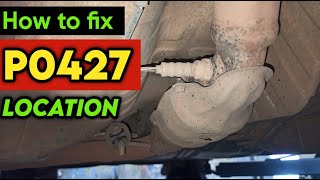
Technical definition: The SAE/ISO definition for P0427 is "Catalyst Temperature Sensor Circuit Low (Bank 1) 🎬 Watch: A quick overview of the P0427 code and sensor location.". The PCM has detected the voltage signal from the Bank 1 catalyst temperature sensor is below the minimum threshold (e.g., < 0.255V) for a set duration. This condition proves an open circuit, a short to ground, or a sensor failed in a high-resistance state.
Can I Drive With P0427?
Yes, But With Caution. You can drive short distances, but extended driving is not recommended. Ignoring the code guarantees a failed emissions test, causes a 5-10% reduction in fuel economy, and risks severe damage to the catalytic converter. Driving with this fault for weeks causes the converter to overheat or clog, resulting in a $800-$2,500+ repair.
Common Causes
- Faulty Wiring, Corroded Connectors, or Bad Grounds (Very Common) — The sensor's wiring is exposed to extreme heat, moisture, and road debris. This environment causes wires to break, melt, or short to ground. Corroded connectors or a poor ground connection create high resistance, leading to a severe voltage drop that triggers the code.
- Defective Catalyst Temperature Sensor (Common) — The sensor is a thermistor that changes resistance with temperature. It fails internally over time, becoming an open circuit (infinite resistance) or losing its ability to respond to heat, sending a constant low voltage signal to the PCM.
- Blown Fuse or Faulty Relay (Less Common) — On vehicles with actively heated catalyst systems (common in German makes), a specific fuse or relay protects the sensor circuit. If this fuse blows, power to the sensor circuit is cut, dropping the signal to zero.
- Exhaust Leaks (Less Common) — A leak in the exhaust manifold, flex pipe, or gaskets before the catalytic converter draws cool ambient air into the exhaust stream. This artificially cools the sensor, causing it to report a lower-than-actual temperature.
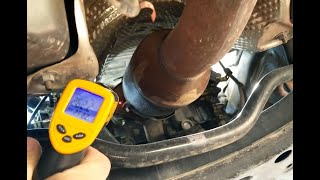
- Damaged or Clogged Catalytic Converter (Rare) — Internal damage or clogging prevents the converter from reaching its proper operating temperature ('light-off'). 🎬 Learn how to test your catalytic converter using an infrared thermometer. The PCM interprets the resulting low temperature reading as a sensor fault.
- Faulty Powertrain Control Module (PCM) or Software (Rare) — The internal PCM circuit that processes the sensor voltage can fail, or a software calibration bug incorrectly flags normal voltage fluctuations as a fault. This requires a PCM replacement or a dealer software update (TSB).
Symptoms
- Check Engine Light is On — The Malfunction Indicator Lamp (MIL) illuminates immediately and remains on as long as the fault is active.
- Failed Emissions Test — An active P0427 code automatically fails an OBD-II emissions inspection because the catalyst monitor cannot run.
- Reduced Fuel Economy — The PCM defaults to a richer fuel mixture to protect the catalytic converter from overheating, causing a 5-10% decrease in MPG.
- Hesitation or Power Loss — The PCM enters a limited performance mode ('limp mode') to prevent damage, resulting in noticeably reduced acceleration.
- Extended Engine Warm-Up Time — On vehicles with catalyst heating systems, a P0427 fault disables the heater, causing the engine and exhaust to take longer to reach optimal temperature.
- Rough Idle or Jerking — Significant fuel trim adjustments based on the faulty sensor reading cause the engine to run unevenly at idle or low speeds.
Diagnostic Flowchart
Tap your situation to follow the diagnostic path that matches what you're seeing on this code.
Common Fixes & Costs
- Repairing Damaged Wiring or Connectors — Parts: $10 - $30, Labor: $75 - $150 (labor), ~0.8 hr book time (Intermediate)
- Replacing the Catalyst Temperature Sensor — Parts: $120 - $280, Labor: $80 - $150 (labor), ~1.0 hr book time (DIY)
- Replacing a Blown Fuse — Parts: $1 - $10, Labor: $0 - $60 (diagnostic time), ~0.1 hr book time (Beginner)
- PCM Reprogramming or Software Update — Parts: $0, Labor: $120 - $200 (dealership labor), ~1.0 hr book time (Professional)
- Replacing the Catalytic Converter — Parts: $800 - $2000+, Labor: $150 - $300 (labor), ~1.5 hr book time (Professional)
- Replacing the Powertrain Control Module (PCM) — Parts: $600 - $1200 (part, requires programming), Labor: $200 - $300 (labor and programming), ~2.0 hr book time (Professional)
DIY vs Professional
- Replacing a Blown Fuse 🟢 Beginner
Tools: Fuse puller, owner's manual. - Replacing the Catalyst Temperature Sensor 🟢 Beginner
Tools: OBD-II scanner, socket set, penetrating oil, torque wrench, safety glasses. - Repairing Damaged Wiring or Connectors 🟢 Beginner
Tools: Digital multimeter, wire strippers, wire cutters, soldering iron or quality crimp tool, heat-shrink tubing. - PCM Reprogramming or Software Update 🟢 Beginner
Tools: Proprietary dealership-level scan tool and software subscription. - Replacing the Catalytic Converter 🟢 Beginner
Tools: Vehicle lift, extensive socket/wrench set, torque wrench, exhaust cutting/welding tools.
Used vs. New Parts: Buying Guide
When a used part is worth it: Buying a used catalyst temperature sensor is never recommended. It is a low-cost wear item, and the labor to replace it twice outweighs any initial savings. OEM is preferred for specific makes like Subaru.
Donor-vehicle mileage cap: roughly under 20000 miles for the part to have meaningful remaining life.
Donor quality checklist:
- Stick to reputable aftermarket brands like Bosch, Denso, or Walker Products.
- Avoid no-name online marketplace sensors; incorrect resistance values cause the code to return immediately.
- For Subaru, only an OEM sensor reliably fixes the issue long-term.
Decision logic:
- If The vehicle is a Subaru, BMW, or Mercedes-Benz → Purchase an OEM sensor. Aftermarket sensor compatibility is a known failure point.
- If The vehicle is a domestic or other common make → A new aftermarket sensor from a quality brand is a safe, cost-effective choice.
- If The part is difficult to access (high labor cost) → Buy the highest quality OEM part to avoid paying for labor twice.
Warranty tradeoff: Used sensors have no warranty. Aftermarket new sensors offer 1-year to limited lifetime warranties. OEM parts installed by a dealer carry a 1-2 year parts and labor warranty.
Worst-case if a used part fails: $150-300 if a cheap aftermarket sensor fails early, requiring repeat labor costs.
What Happens If You Wait — Timeline
- 0-1 month: Check Engine Light illuminates. The PCM defaults to a safe strategy, enriching the fuel mixture. The vehicle fails an emissions test. (MPG impact: 0-5%% · Added cost: $0-25 in wasted fuel)
- 1-4 months: A 5-10% drop in fuel economy occurs as the PCM runs a rich mixture to protect the unmonitored catalyst. You experience a rougher idle or minor hesitation. (MPG impact: 5-10%% · Added cost: $50-150 in wasted fuel)
- 4-9 months: The catalytic converter suffers damage. Without temperature feedback, the PCM cannot prevent overheating. The internal ceramic substrate cracks or melts, triggering a P0420 code. (MPG impact: 10-15%% · Added cost: $800 - $2,500 if the catalytic converter requires replacement.)
- 9+ months: Severe catalytic converter damage creates an exhaust blockage. This leads to significant power loss, stalling, and damage to exhaust valves or downstream O2 sensors. (MPG impact: 15-25%+% · Added cost: $1,500 - $3,000+ for replacing the converter and damaged engine components.)
Cost of Not Fixing It
- 0-1 month: Failed emissions test and a 5-10% decrease in fuel economy due to the PCM running a rich fuel mixture. (Added cost: $20-$50 in extra fuel costs per month.)
- 1-6 months: The catalytic converter overheats or partially clogs because the PCM cannot monitor its temperature, causing irreversible damage. (Added cost: $800 - $2,500 for a new catalytic converter.)
- 6+ months: Severe catalytic converter damage creates exhaust blockages, causing significant power loss, engine stalling, and damage to downstream oxygen sensors. (Added cost: $1,000 - $3,000+ to replace the converter and damaged sensors.)
Diagnosis Steps
- Scan for All Trouble Codes
Use an OBD-II scanner to read all stored codes. Address codes for oxygen sensors (P0138), misfires (P0300), or catalyst efficiency (P0420) first, as they provide critical diagnostic context.
Tools: OBD-II Scanner (Beginner) - Visually Inspect Sensor, Wiring, and Exhaust
Locate the Bank 1 catalyst temperature sensor. Inspect the sensor, connector, and wiring harness for burns, fraying, or corrosion. Check for black soot indicating an exhaust leak near the sensor.
Tools: Flashlight, Safety Glasses, Mechanic's Mirror (Beginner) - Check for Blown Fuses
Consult the wiring diagram to locate the fuse for the emissions or catalyst heating system (especially on German vehicles). Test the fuse with a multimeter for continuity. A blown fuse proves a short circuit exists.
Tools: Owner's Manual, Multimeter or Fuse Tester (Beginner) - Analyze Live Sensor Data
Monitor the 'Catalyst Temperature Sensor Bank 1' PID with a live data scanner. A reading stuck below 0.5V (especially near 0V) confirms the low circuit condition. A healthy sensor shows a rising voltage (0.8V - 1.2V+) as the exhaust heats up.
Tools: OBD-II Scanner with Live Data (Intermediate) - Test the Circuit for Reference Voltage
Disconnect the sensor. Turn the ignition 'ON' (engine off). Use a multimeter to probe the harness-side connector pins for the PCM's 5.0-volt reference signal. If 5V is missing, the wiring harness or PCM is faulty.
Tools: Digital Multimeter, Vehicle Wiring Diagram (Intermediate) - Perform a Voltage Drop Test on the Ground Circuit
Connect the red multimeter lead to the battery negative terminal and the black lead to the sensor's ground pin (back-probing with the engine running). A reading above 100 millivolts (0.1V) proves excessive ground resistance that requires repair.
Tools: Digital Multimeter with Back-Probing Pins (Advanced) - Test Sensor Resistance vs. Temperature
Remove the sensor. Measure resistance across its pins at room temperature. Use a heat gun to warm the tip; resistance must decrease smoothly as temperature increases. An open circuit (OL) or static resistance confirms a dead sensor.
Tools: Digital Multimeter, Heat Gun, Repair Manual (Advanced) - Bypass the Sensor with a Jumper Wire (Advanced)
Disconnect the sensor and turn the ignition on. Jump the 5V reference pin to the signal wire pin on the harness connector. If the scanner's live data jumps to near 5V, the wiring and PCM are good, proving the sensor is the sole failure point.
Tools: Fused Jumper Wire, Wiring Diagram (Advanced)
When This Code Triggers (Freeze-Frame Conditions)
- Engine Coolant Temp: 170-220°F (77-104°C) (The engine must be fully warmed up for the catalyst monitor to run.)
- RPM: 1500-3000 (Steady cruise RPM, excluding high-load acceleration or deceleration.)
- Engine Load: 20-60% (Light to moderate throttle application during highway cruising.)
- Vehicle Speed: 45-65 mph (72-105 km/h) (Sustained highway driving for several minutes gets the catalyst to a stable, hot temperature for testing.)
Related Codes
- P0428 — The direct opposite code, 'Catalyst Temperature Sensor Circuit High'. P0427 indicates a short to ground or open circuit, while P0428 indicates a short to power or a sensor failed with very low internal resistance.
- P0426 — 'Catalyst Temperature Sensor Range/Performance'. Sets when the sensor's signal is erratic or irrational. P0427 points to a consistently low signal, while P0426 suggests an intermittent wiring problem or a failing sensor.
- P0420 — 'Catalyst System Efficiency Below Threshold'. A P0427 fault causes a false P0420 because the PCM assumes the catalyst is too cold to be efficient. Always fix electrical circuit codes (P0427) before efficiency codes (P0420).
- P0425 — 'Catalyst Temperature Sensor Circuit Malfunction'. A general electrical fault detected in the sensor's circuit, often set alongside P0427.
Climate & Environmental Factors
- Cold Climates with Road Salt: Saltwater is a powerful electrolyte that dramatically accelerates corrosion of the sensor body, connector pins, and wiring insulation. This corrosion creates high resistance or short circuits, the primary cause of a 'Circuit Low' fault.
- High Humidity / Coastal Regions: A constantly humid or salt-air environment promotes moisture intrusion in electrical connectors, degrading signal integrity and leading to persistent P0427 codes.
- High Altitude: Changes in air density affect the engine's air-fuel mixture and catalyst operating temperatures, unmasking borderline sensor or wiring issues that do not trigger a code at sea level.
How to Talk to a Mechanic About This Code
Say this: "I have a P0427 code, which is a catalyst temperature sensor circuit fault. I'd like to schedule a diagnostic to confirm if the issue is the sensor, the wiring, or a fuse. Please test the sensor circuit before recommending a replacement part."
This signals that you understand P0427 is an electrical fault. It directs the mechanic to perform a proper diagnosis rather than blindly replacing the sensor or catalytic converter.
Avoid saying:
- 'My check engine light is on, can you look at it?' (too vague — invites upsell)
- 'I think I need a new catalytic converter.' (incorrectly suggests an expensive part)
- 'Just fix whatever's wrong'
Questions to ask before authorizing the repair:
- Did you test the sensor's 5V reference voltage and ground connection?
- What were the results of the wiring inspection?
- Can you show me the faulty part and explain why it failed?
- What is the warranty on the parts and labor for this specific repair?
Where to Take It: Dealer vs Independent vs Chain
- Dealer:
Recommended for in-warranty vehicles or specific German makes known for complex catalyst heating circuits.
Best for: Vehicles under the federal emissions warranty (8 years/80,000 miles for major components, 2 years/24,000 miles for sensors)., Complex German vehicles (BMW, Mercedes) where the code relates to a specific heating control module.
Downsides: Highest labor rates., May replace an entire component assembly rather than troubleshoot a specific wire. (Typical cost: +50% vs. baseline) - Independent Shop:
Best fit for most out-of-warranty vehicles. A good independent shop with strong electrical diagnostic skills is ideal.
Best for: Out-of-warranty vehicles where cost is a factor., Diagnosing and repairing common electrical faults like wiring or sensor replacement.
Downsides: Quality varies. Look for shops with ASE-certified technicians, specifically with L1 (Advanced Engine Performance) certification. (Typical cost: +0% vs. baseline) - Chain Shop:
Acceptable for a free initial code scan. Take the vehicle to a professional diagnostic shop if they recommend replacing the catalytic converter based on this code alone.
Best for: Getting the code read for free.
Downsides: Technicians lack the advanced electrical diagnostic skills needed for circuit issues., High pressure to sell parts leads to replacing a sensor without confirming it is the root cause. (Typical cost: -10% vs. baseline)
When to Walk Away From the Repair
If the estimated repair cost exceeds 40-50% of the car's private-party value, pause and carefully consider your options.
- Car worth $4000, fix is $2000: Walk away. A repair costing 50% of the car's value is rarely a good investment on an older vehicle.
- Car worth $12000, fix is $1800: Fix it. The repair cost is only 15% of the vehicle's value.
- Car worth $2500, fix is $1500: Walk away. The repair cost is 60% of the car's value. Put that money toward a replacement vehicle.
What Scan Tool You Need for This Code
Minimum: A scanner that reads and clears codes, and views live data for the Catalyst Temperature Sensor.
A basic code reader only provides the 'P0427' number. Proper diagnosis requires viewing the live voltage from the sensor to confirm it is reading low. Access to Mode $06 data is helpful to see catalyst monitor self-test results.
Budget: BlueDriver Pro (~$120) — Connects to your smartphone to read the code, view live data graphing for the temperature sensor, and access Mode $06 data to check the catalyst monitor's status.
Mid-range: Foxwell NT510 Elite (~$180) — Offers manufacturer-specific diagnostics and bi-directional control to test components, which is useful for German makes with catalyst heating systems.
Professional: Autel MaxiCOM MK808 (~$500) — Provides full bidirectional control, extensive data graphing, and OE-level diagnostics for all vehicle systems, allowing for in-depth circuit testing.
Rent vs buy: Major auto parts stores scan codes for free. This is a good first step. If you diagnose cars more than once a year, buying a tool like the BlueDriver is a worthwhile investment.
How to Clear the Code After You Fix It
- Use an OBD-II scan tool to clear the P0427 code.
- Perform a complete drive cycle to run the readiness monitors.
- Verify the Catalyst monitor status is 'Ready' or 'Complete' on the scan tool.
Drive cycle (~30 minutes): Start with a cold engine (sit for 8+ hours). Idle for 2-3 minutes. Drive at a steady 55 mph for 5-10 minutes. Coast down to 20 mph without braking. Drive for 5 minutes in stop-and-go city traffic. Park and idle for 2 minutes.
Readiness monitors affected: Catalyst monitor, Oxygen (O2) sensor monitor
Before emissions retest: drive at least 100 miles to fully set monitors.
Watch out for:
- Disconnecting the battery clears the code but resets all readiness monitors, forcing a lengthy relearn process.
- The code returns immediately if the underlying electrical fault remains.
- Short city trips cannot complete the catalyst monitor drive cycle; sustained highway driving is mandatory.
Will This Fail Emissions / State Inspection?
Yes — this code typically fails an OBD-II emissions inspection.
- California: An active P0427 code is an automatic failure. After repair, all OBD readiness monitors must be 'Complete'. You must drive 100+ miles through several drive cycles before a retest.
- New York: A P0427 code and illuminated Check Engine Light result in an immediate failure. The Catalyst readiness monitor must be complete to pass.
- Texas: Vehicles with an active P0427 code fail the OBD-II inspection. The vehicle is rejected from testing if the catalyst monitor is 'Not Ready'.
Most Commonly Affected Vehicles
- Subaru Forester, Outback, Impreza, WRX (2005-2014) — Extremely common. Using an OEM replacement sensor is mandatory, as aftermarket sensors have incorrect resistance ranges. Check for TSBs related to harness routing on 2008-2011 models.
- BMW 3 Series, 5 Series, X3, X5 (2005-2015) — The code often points to the catalyst heating system. Diagnosis must include checking the specific fuse and relay for the heater circuit before replacing the sensor.
- Mercedes-Benz C-Class, E-Class, ML-Class (2006-2016) — Often related to the catalyst pre-heating circuit. A fault in the heating element control unit triggers this code, requiring advanced diagnostics beyond a simple sensor check.
- Audi A4, A6, Q5 (2007-2017) — Causes range from sensor failure to wiring problems. The wiring harness routes near hot components, making heat-shielding critical after repairs.
- Volkswagen Golf, Passat, Tiguan (2008-2018) — Commonly associated with a failing temperature sensor or wiring harness issues. Check for corrosion inside the connector.
- Honda Civic, Accord, CR-V (2007-2017) — Traced back to a failing temperature sensor or wiring fault. The 2012-2015 Civic has a known issue with the sensor connector backing out.
- Chevrolet Silverado, Equinox, Cruze (2008-2018) — Mechanics frequently find corroded connectors or a faulty sensor. On Silverado models, check the ground strap from the engine to the frame for corrosion.
Manufacturer-Specific Notes
- Subaru: The catalyst temperature sensor is notoriously sensitive. Using an OEM sensor is critical; aftermarket sensors cause the code to return within weeks. Check for recall WRE-21 on 2017-2019 Imprezas/Crosstreks for ignition coil issues affecting the exhaust.
- BMW/Mercedes-Benz/Audi: These brands use a dedicated catalyst heating control unit. P0427 is triggered by a failure in this unit or a blown fuse, not just the sensor. Diagnosis requires checking power and control signals at the heating module.
- General Motors (GM): A corroded main engine-to-chassis ground strap causes numerous low-voltage sensor codes, including P0427. A voltage drop test on the main grounds is a mandatory diagnostic step.
- All Brands (Warranty): The Federal Emissions Warranty covers the catalyst temperature sensor for 2 years/24,000 miles, while the catalytic converter and PCM are covered for 8 years/80,000 miles. Check dealer coverage if near these limits.
Real Owner Stories
2012 Subaru Forester with P0420 and P0427
Check engine light illuminated. The car was burning a significant amount of oil, a known issue for that model year.
What they tried:
- A shop diagnosed a bad catalytic converter and recommended replacement.
- The owner feared the oil consumption would destroy the new converter.
Outcome: The owner managed the issue by periodically clearing the code with a $35 OBD2 tool and monitoring for performance loss. Aftermarket converters were deemed a hit-or-miss solution.
Lesson: On vehicles with known oil consumption issues, a catalyst code is a symptom of the converter being fouled by burnt oil. Replacing the converter without addressing the oil issue guarantees a repeat failure.
2011 Honda CR-V with 130,000 km, code P0420
Check Engine Light appeared. A mechanic cleared the code and added fuel system cleaner, but the light returned. A second mechanic replaced the Air/Fuel (O2) sensor.
What they tried:
- Fuel system cleaner.
- Replaced upstream A/F Oxygen Sensor.
- Received quotes to replace the catalytic converter.
Outcome: While waiting for the converter replacement, the Check Engine Light turned off on its own, highlighting the intermittent nature of the fault.
Lesson: Catalyst efficiency codes are intermittent. Misdiagnosing the issue by replacing an O2 sensor first is a common and costly mistake.
2016 VW Golf 1.8T after hitting road debris
Immediately after hitting road debris, the Check Engine Light, TPMS light, and cooling fans activated. The owner found a loose cable under the car.
What they tried:
- Visual inspection of the undercarriage.
Outcome: Physical damage to the undercarriage wiring harness caused the electrical faults. The loose cable was part of the catalyst temperature sensor circuit.
Lesson: If P0427 appears immediately after an impact, the cause is physical damage to the under-vehicle wiring harness or the sensor. Inspect the harness for tears or cuts.
2007 Subaru Impreza 2.5i failing smog check
Check Engine Light was on, failing a California smog check. The initial code scan pointed to the catalytic converter.
What they tried:
- Forum members advised against replacing the catalytic converter immediately.
- Further diagnosis revealed an exhaust leak and a separate EVAP system code.
Outcome: An exhaust leak caused a false catalyst code. Repairing the leak resolved the issue without replacing the expensive converter.
Lesson: Always check for exhaust leaks before condemning a catalytic converter. A leak introduces oxygen that confuses sensors and triggers incorrect diagnostic codes.
How to Prevent This Code From Triggering
- Fix Engine Misfires and Rich Running Conditions Immediately (Immediately upon MIL) — Unburned fuel entering the exhaust causes extreme temperatures that destroy the catalytic converter and the temperature sensor.
- Use Top Tier Detergent Gasoline (Every fill-up) — High-quality fuels contain detergents that keep fuel injectors clean, preventing carbon buildup that fouls sensors and overloads the catalytic converter.
- Perform an Occasional 'Italian Tune-Up' (Once a month) — Sustained highway driving (20-30 minutes) allows the exhaust system to reach optimal temperature, burning off carbon deposits accumulated during short city trips.
- Replace Upstream Oxygen (A/F) Sensors as Maintenance (Every 100,000 miles) — O2 sensors become slow with age, causing poor fuel control that overheats and damages the catalytic converter and its temperature sensor.
- Annual Undercarriage Inspection and Cleaning (Once per year) — Washing the undercarriage removes corrosive road salts that damage sensor bodies and wiring connectors.
Frequently Asked Questions
What is 'Bank 1'?
'Bank 1' refers to the side of the engine containing cylinder #1. On an inline 4-cylinder or straight-6 engine, there is only one bank. On a V6, V8, or V12 engine, consult a vehicle-specific repair manual to identify Bank 1.
Where is the catalyst temperature sensor located?
It screws directly into the exhaust system, typically just before or directly into the catalytic converter body. It looks similar to an oxygen sensor but is a distinct part.
What are the most common mistakes when diagnosing P0427?
The biggest mistake is replacing the catalytic converter without proper diagnosis, as P0427 is an electrical circuit code. The second most common error is replacing the sensor without first testing the wiring and connector for the 5V reference voltage and a solid ground.
Can I fix P0427 myself?
Replacing a blown fuse is a beginner task. Replacing the sensor is a DIY job for someone with moderate experience, provided the circuit has been tested first. Diagnosing and repairing wiring or PCM issues requires advanced electrical skills.
Will the P0427 code clear itself?
If the fault is intermittent, the check engine light turns off after several successful drive cycles. However, the code remains stored in the PCM's history, and the underlying problem usually returns.
Will a fuel additive or 'catalytic converter cleaner' fix a P0427 code?
No. A fuel additive cannot fix a P0427 code. This code indicates an electrical circuit fault, not a dirty or inefficient converter.
Is the catalyst temperature sensor the same as an oxygen sensor?
No, they are different sensors with distinct functions, though they are located near each other. Oxygen (O2) sensors measure oxygen content to manage the air-fuel ratio. The catalyst temperature sensor exclusively measures the physical temperature of the catalytic converter.
What happens if a catalyst temperature sensor fails?
The PCM loses critical temperature data, preventing it from protecting the catalytic converter from overheating. It triggers the Check Engine Light, reduces fuel economy, and causes an automatic emissions test failure.
How do I reset the P0427 code?
Clear the code using the 'Clear Codes' function on an OBD-II scanner after performing a repair. Alternatively, disconnect the battery's negative terminal for 15 minutes, though this resets all vehicle electronics and drive cycle monitors.
Key Takeaways
- P0427 triggers when the Bank 1 catalyst temperature sensor voltage drops below 0.5V, indicating a direct electrical circuit fault.
- Corroded connectors, melted wiring harnesses, and failed sensors cause 90% of P0427 codes, especially in regions using winter road salt.
- Driving with an active P0427 code reduces fuel economy by 5-10%, guarantees an emissions test failure, and risks $1,000+ in permanent catalytic converter damage.
- Never replace the catalytic converter for a P0427 code alone; use a multimeter to test the sensor's 5V reference and ground circuits first.
Helpful Videos
Shop the Parts Behind P0427
Below are the parts most often responsible for code P0427, ranked by how frequently each one is the actual culprit (per the diagnosis above). Tap any to see what we have for your vehicle.



The information in this article is provided for general reference and educational purposes only. Vehicle specifications, procedures, and part compatibility can vary by production date, trim level, and region. Always consult your vehicle's factory service manual and verify part numbers before purchasing or performing repairs. Safety-critical components such as airbags, seat belts, and braking systems should be installed by a qualified professional.
- 🧭 Diagnostic Flowchart
- 🎬 Helpful Videos
- 🛍️ Shop This Part
- What Does P0427 Mean?
- Can I Drive With P0427?
- Common Causes
- Symptoms
- Common Fixes & Costs
- DIY vs Professional
- Used vs. New Parts: Buying Guide
- What Happens If You Wait — Timeline
- Cost of Not Fixing It
- Diagnosis Steps
- When This Code Triggers (Freeze-Frame Conditions)
- Related Codes
- Climate & Environmental Factors
- How to Talk to a Mechanic About This Code
- Where to Take It: Dealer vs Independent vs Chain
- When to Walk Away From the Repair
- What Scan Tool You Need for This Code
- How to Clear the Code After You Fix It
- Will This Fail Emissions / State Inspection?
- Most Commonly Affected Vehicles
- Manufacturer-Specific Notes
- Real Owner Stories
- 2012 Subaru Forester with P0420 and P0427
- 2011 Honda CR-V with 130,000 km, code P0420
- 2016 VW Golf 1.8T after hitting road debris
- 2007 Subaru Impreza 2.5i failing smog check
- How to Prevent This Code From Triggering
- Frequently Asked Questions
- What is 'Bank 1'?
- Where is the catalyst temperature sensor located?
- What are the most common mistakes when diagnosing P0427?
- Can I fix P0427 myself?
- Will the P0427 code clear itself?
- Will a fuel additive or 'catalytic converter cleaner' fix a P0427 code?
- Is the catalyst temperature sensor the same as an oxygen sensor?
- What happens if a catalyst temperature sensor fails?
- How do I reset the P0427 code?
- Key Takeaways
- 🎟️ Get 5% Off