

P0430 on 2008-2012 Audi S5 4.2L V8: Catalyst Efficiency Causes and Fixes
P0430 on your S5 V8 most often means the Bank 2 (driver's side) catalytic converter is failing, a costly repair. However, always check for cheaper fixes first, like a bad downstream O2 sensor or an exhaust leak, as these can mimic a failed converter. On this platform, the repair is notoriously labor-intensive.
- P0430 on your S5 V8 means the driver's side catalytic converter is underperforming.
- Do not immediately assume you need a new converter. Thoroughly check for exhaust leaks and test the downstream O2 sensor first.
- Address any engine misfires or fuel mixture problems BEFORE replacing the catalytic converter, or you will likely damage the new part.
- Be aware that replacing the catalytic converter on this car is a very large and expensive job due to poor access.
- If you have high mileage, there's a strong chance the converter itself has failed, but due diligence in diagnosis can save you thousands.
What's Unique About the 2008-2012 Audi S5
For the B8-generation S5 with the CAUA 4.2L V8, the P0430 code is often the beginning of a costly journey. These direct-injection (FSI) engines are known for carbon buildup on intake valves, which can cause misfires that slowly damage the catalytic converters over time. Furthermore, replacing the catalytic converter is not a simple bolt-off, bolt-on job; it's a notoriously difficult and labor-intensive process that often requires lowering the engine subframe and transmission for access, making professional repair very expensive. Forum users on AudiWorld and Audizine frequently discuss the high labor costs associated with this specific repair, confirming it is significantly more involved than on many other vehicles.
Symptoms You May Notice
- Check Engine Light illuminated
- Failure to pass state emissions inspection
- Reduced engine power or sluggish acceleration, especially if the converter becomes clogged
- A sulfur or "rotten egg" smell from the exhaust
- A rattling sound from underneath the car if the internal structure of the converter has broken apart
- In cold weather, a rough idle may be more noticeable.
- Immediately replacing the catalytic converter without proper diagnosis. A faulty O2 sensor or a simple exhaust leak is a much cheaper fix and should be ruled out first.
- Using a 'catalytic converter cleaner' additive. While some users report temporary success, these products cannot repair a physically damaged or chemically spent converter and are not a long-term solution.
- Installing an O2 sensor spacer. This is a workaround, not a fix. It pulls the sensor out of the exhaust stream to trick the computer. It may clear the code, but it masks the underlying problem and will cause the car to fail a visual emissions inspection.
Most Likely Causes
- Failing Catalytic Converter 🔴 High Probability → Shop Catalytic Converter Catalytic converters have a finite lifespan and can be damaged by long-term engine issues like misfires (often from carbon buildup) or oil consumption. High mileage is a primary factor, and owners on forums report failures commonly occurring over 100k miles.
How to confirm: After ruling out all other causes, this is the default diagnosis. A temperature gun can be used to check inlet vs. outlet temps (outlet should be significantly hotter). A glowing red converter after a hard drive indicates a severe clog.
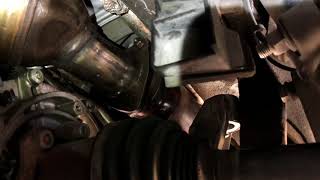
Typical fix: Replace the Bank 2 catalytic converter. This is a very labor-intensive job on this vehicle, often quoted at 6-8 hours of labor. 🎬 Watch this walkthrough of the labor-intensive catalytic converter replacement.
Est. part cost: $400-$1200 (aftermarket), $2000+ (OEM) - Failing Downstream Oxygen Sensor (Bank 2, Sensor 2) 🟡 Medium Probability → Shop Oxygen Sensor O2 sensors wear out over time, typically between 80,000-120,000 km, and can become 'lazy', sending slow or inaccurate signals to the ECM, which can be misinterpreted as a failing converter. It's a common maintenance item and a logical first part to replace during diagnosis.
How to confirm: Use a scan tool to graph the voltage of the downstream O2 sensor. A healthy sensor on a good converter will show a relatively steady voltage. If the voltage is stuck, or switching rapidly like the upstream sensor, it may be faulty.
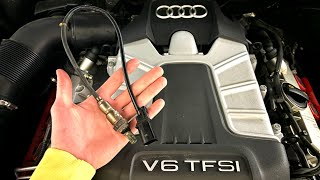
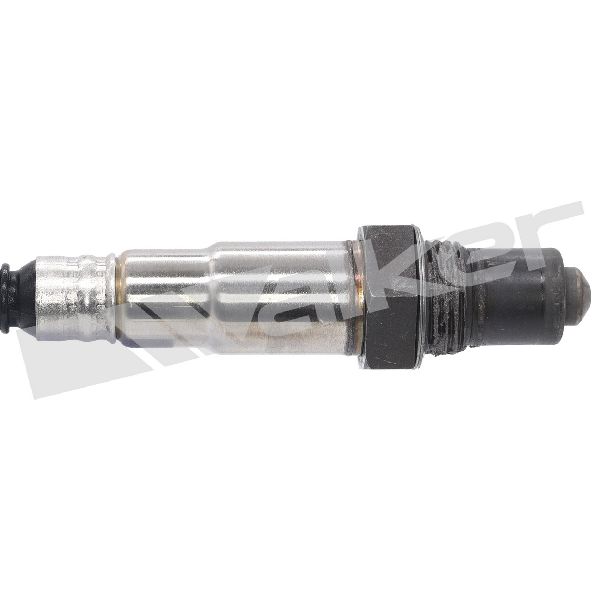
Typical fix: Replace the Bank 2, Sensor 2 (downstream) oxygen sensor. The OEM part number is often cited as 07L906265F for this application.
Est. part cost: $50-$100 (aftermarket), $150-$250 (OEM) - Exhaust Leak ⚪ Low Probability Corrosion and vibration can cause leaks at gaskets or the flex pipes located just before the catalytic converters. A leak in this area can introduce oxygen into the exhaust stream, confusing the O2 sensors.
How to confirm: Perform a visual inspection of the exhaust system from the engine to the rear O2 sensor. Look for black soot stains around flanges and listen for ticking or hissing noises that are more pronounced when the engine is cold. Spraying soapy water on suspected areas can reveal bubbles.
Typical fix: Replace the leaking gasket or repair the leaking section of the exhaust.
Est. part cost: $20-$100 - Engine Misfires or Rich/Lean Condition ⚪ Low Probability The 4.2L FSI engine is notorious for significant carbon buildup on the intake valves, sometimes leading to power loss and misfires in as little as 40,000-60,000 km. This unburned fuel can enter the exhaust and destroy the catalytic converter. Leaking fuel injectors are also a known issue.
How to confirm: Check for other stored trouble codes, such as P030x (misfire) or codes for fuel trim (P0171, P0174, P0172, P0175). A loss of power and rough idle are also strong indicators of carbon buildup.
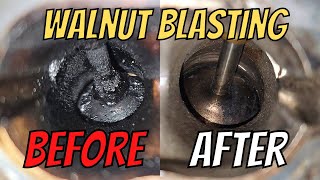
Typical fix: Address the root cause of the misfire or fuel mixture issue. This could involve replacing spark plugs, ignition coils, cleaning intake valves (walnut blasting service) 🎬 See a step-by-step guide on DIY walnut blasting for carbon buildup., or replacing fuel injectors.
Est. part cost: $100-$1500+
Rare But Worth Checking
- ECM Software Update: In some cases, manufacturers release software updates for the Engine Control Module (ECM) to adjust the sensitivity of the catalyst monitor. It's worth asking an Audi dealership if any technical service bulletins (TSBs) or software updates apply to your vehicle's VIN for P0430 before proceeding with expensive repairs. Some owners on forums have noted a reflash can sometimes resolve the issue.
Diagnosis Steps
- Read all fault codes stored in the ECM. Pay close attention to any misfire, fuel trim, or oxygen sensor codes. Address these first.
- Inspect the exhaust system for leaks. Check the exhaust manifold, gaskets, and especially the flex pipes between the upstream and downstream O2 sensors for any signs of black soot or audible leaks.
- Use a scan tool with live data capability. Graph the voltage signals for Bank 2 Sensor 1 (upstream) and Bank 2 Sensor 2 (downstream).
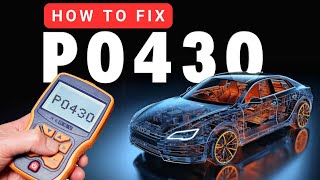
- Analyze the O2 sensor data. The upstream sensor should fluctuate rapidly between ~0.1V and ~0.9V. The downstream sensor should hold a relatively steady, high voltage (e.g., >0.6V). If the downstream sensor's graph mimics the upstream sensor's rapid switching, the catalyst is not functioning. 🎬 Watch: How to diagnose and fix a P0430 catalyst code.
- If the downstream sensor signal appears flat, stuck, or slow to respond, the sensor itself is likely faulty.
- Use an infrared thermometer to check the catalytic converter's temperature. The outlet pipe should be at least 100°F (38°C) hotter than the inlet pipe after the engine is fully warmed up. If it's cooler or the same temperature, the converter is likely clogged or inactive.
- IMPORTANT: If any misfire (P030x) or fuel system codes are present, you MUST diagnose and repair those issues first. Installing a new catalytic converter on an engine that is misfiring will quickly destroy the new part.
Parts You'll Likely Need
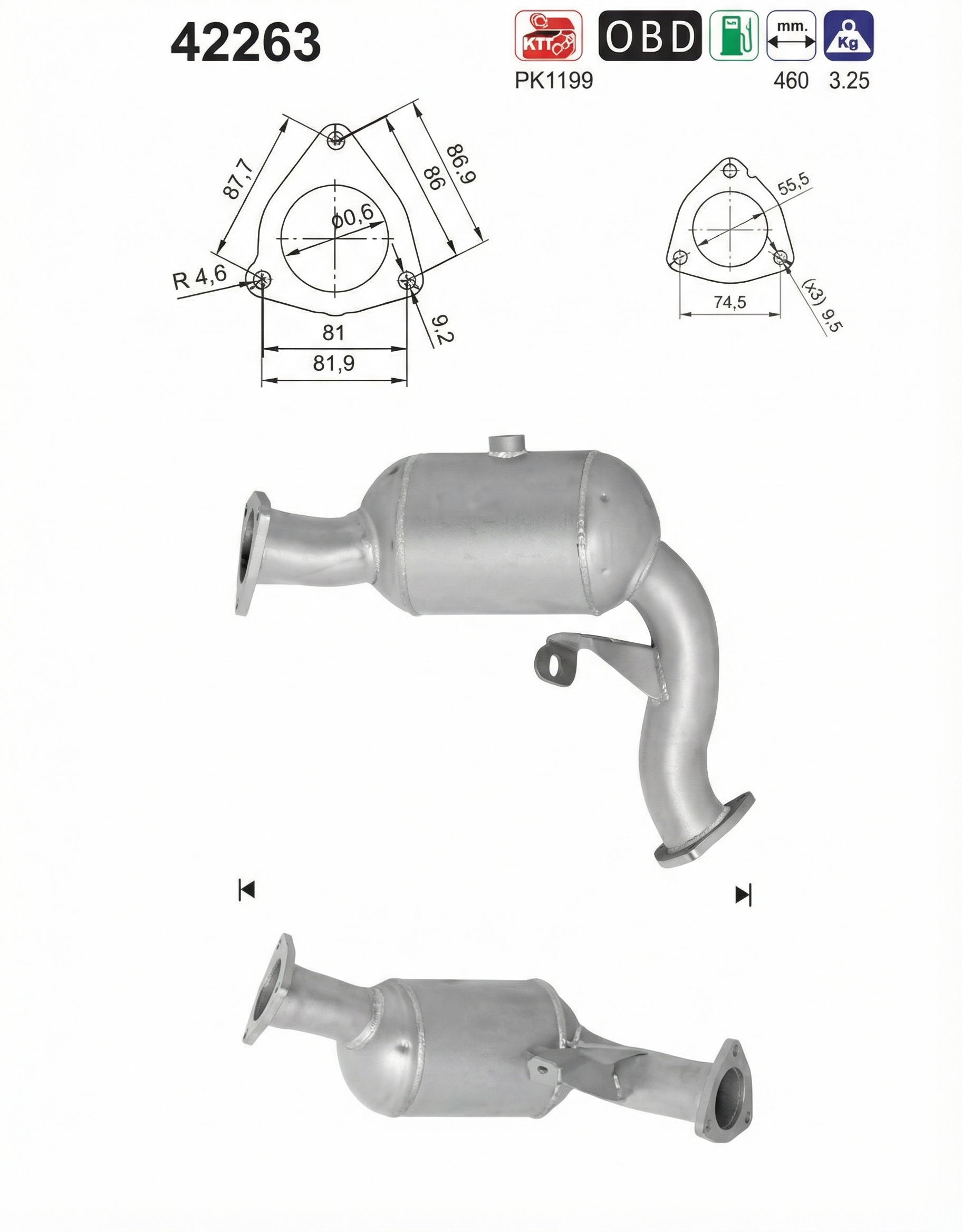
- Bank 2 Catalytic Converter
(OEM #8K0254252X (or similar variant))— This is the most common direct cause for P0430 when all other factors are ruled out. The internal catalyst materials degrade over time and with mileage.
Trusted brands: Walker, MagnaFlow, Davico, Audi (OEM)
OEM price range: $2000-$3000
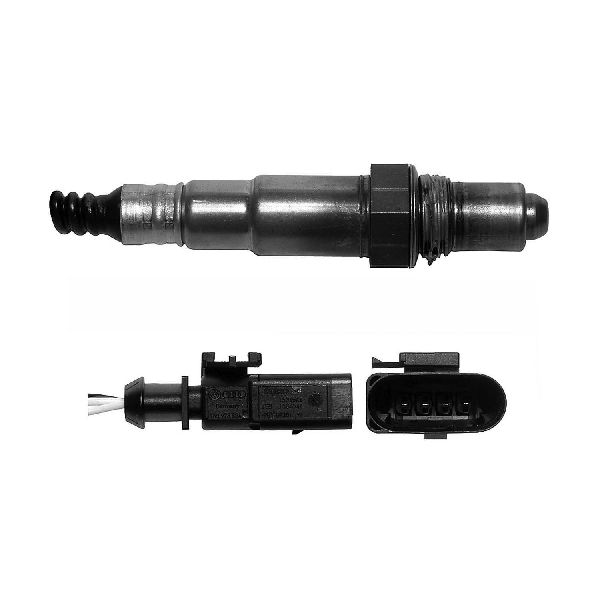
Aftermarket price range: $400-$1200 - Bank 2 Downstream Oxygen Sensor
(OEM #07L906265F)— A faulty sensor can send incorrect data, falsely triggering a P0430 code. It is a common point of failure and a wise part to replace during diagnosis before condemning the expensive converter.
Trusted brands: Bosch, NTK, Denso, Audi (OEM)
OEM price range: $150-$250
Aftermarket price range: $50-$100
Related Codes That Often Appear With This One
- P0420 — This is the identical code for Bank 1 (passenger side). It's common for both converters to fail around the same time on a high-mileage vehicle.
- P0300-P0308 — These are misfire codes. Unburned fuel from a misfire can enter the exhaust and overheat the catalytic converter, causing permanent damage. On the S5 V8, misfires are often linked to carbon buildup or failing ignition coils.
- P0174 / P0171 — These are 'System Too Lean' codes for Bank 2 and Bank 1. An unmetered air leak (like a vacuum leak or exhaust leak before the O2 sensor) can cause these codes and also contribute to the P0430 fault.
Platform-Specific Known Issues
- The replacement of the catalytic converters on the 4.2L V8 is known to be extremely difficult due to tight clearances, requiring the subframe and/or transmission to be lowered for access.
- The FSI direct-injection engine is prone to significant carbon buildup on the intake valves, which can lead to misfires and subsequently damage the catalytic converters.
Mechanic-Grade Diagnostic Values
- VCDS Catalyst Monitor Test Values (Bank 2) — expected: The test value should be lower than the specified maximum threshold. For example, a test result of 3293 against a maximum of 2341 indicates a failure.. Failure: When the first number (test value) is greater than the second number (threshold value) in the VCDS output, the catalyst monitor fails.
- VCDS O2 Sensor Live Data (Post-Cat, Bank 2) — expected: A relatively steady voltage, typically above 0.6V, when the engine is at operating temperature and under a steady cruise.. Failure: Voltage rapidly switching between ~0.1V and ~0.9V, mimicking the pre-cat sensor's behavior. This indicates the catalyst is not storing oxygen.
Scan Tool Commands That Help
- VCDS (VAG-COM): Engine -> Measuring Blocks -> Group 042 or 043 — To observe the live catalyst temperature and the status of the catalyst heating and testing procedures. This allows a technician to see if the system is even attempting to run the catalyst monitor.
- VCDS (VAG-COM): Engine -> Basic Settings -> Group 043 (Catalytic Converter Test) — To manually initiate the catalytic converter test. The procedure requires pressing the brake and accelerator pedals to the floor, after which the ECU will run the test and report a 'Test On' or 'Test Off' status. This forces the system to evaluate the converter's efficiency.
- VCDS (VAG-COM) / ODIS: Basic Settings -> "IDE00553 Automatic test sequence" or "B200 Readiness Code" — To force the vehicle to run all the necessary tests to set the OBDII readiness monitors. After a repair, this can quickly confirm if the fix was successful without days of driving. If the cat monitor still won't set, specific tests for the catalyst can be run from the same Basic Settings menu.
Wiring & Ground Locations
- Engine Ground Connection (12) — In the engine compartment on the left side (driver's side for LHD).. A poor main engine ground can cause erratic voltage signals from all engine sensors, including the oxygen sensors, leading to incorrect readings and false codes.
- Ground Connection on left front long member (671, 672) — On the left side frame rail in the engine bay.. This is a primary chassis ground point. Corrosion or looseness here can affect the ground path for various electronic modules and sensors, including the ECM and its sensor inputs.
- ECM Connector T94 — The 94-pin connector at the Engine Control Module (ECM), located in the plenum chamber (the area under the plastic cowl at the base of the windshield).. This is the main connector where all sensor signals, including those from the O2 sensors, are processed. Water ingress into the plenum chamber is a known Audi issue and can cause corrosion on these pins, leading to a host of sensor-related codes.
- Main Engine Ground Cable — Connected from the body/frame rail to the engine mount bracket, typically on the passenger side for the S4/S6, but should be visually verified on the S5. It is best seen from underneath the engine.. This is the primary high-current ground path for the engine block. Degradation of this strap can cause the starter and alternator to seek ground through smaller paths, like sensor ground wires, potentially damaging them or causing significant signal noise.
Real Owner Repair Stories
- AudiWorld Forums (2010 Audi S5 4.2L V8) — P0430 code returned after replacing the catalytic converter.
❌ Tried (didn't work) Replacing the catalytic converter, Replacing O2 sensors
✅ What actually fixed it The user discovered a crack in the exhaust manifold. The crack was allowing unmetered air to enter the exhaust stream before the O2 sensors, which the ECU interpreted as a failed catalytic converter. Replacing the exhaust manifold finally resolved the P0430 code.
"I Checked Everything" — The Actual Cause
- A cracked exhaust manifold can cause a P0430 code even if a smoke test of the exhaust system from the catalytic converter backwards comes back clean. The crack is often a hairline fracture that only opens up under the heat and pressure of the engine running, allowing air to be sucked in, but may not be large enough to show a significant leak during a low-pressure smoke test on a cold engine.
OEM Part Supersession History
Not specified→07L906265F— This is the commonly cited current OEM part number for the downstream oxygen sensor.
Heads up: While this part number is widely listed for the S5 4.2L, always confirm with a VIN at an Audi dealer. Sensor manufacturers like Bosch or Delphi may offer an equivalent under a different number.
Model Year Variations Within This Range
- 2008-2012 (Coupe Only): The 4.2L V8 engine was only available in the S5 Coupe. The S5 Cabriolet (convertible) of the same B8 generation (2010-2012) used a 3.0L supercharged V6, which has different components and diagnostic considerations.
- 2010.5-2012: Some forum discussions suggest there may be minor differences in engine components between early (2008-2010) and later (post-2010.5) V8 models, particularly when sourcing a complete used engine. One user noted being told only a '10.5, '11, or '12 engine from a manual car could be used as a direct replacement for a 2012 manual, though this is anecdotal and may relate to accessories rather than the core engine.
Diagnostic Flowchart
Other Known Issues on This Vehicle
Issues unrelated to this code that are worth knowing about as an owner of this generation:
- Intake Valve Carbon Buildup 🔴 High — Very common. Noticeable power loss can occur as early as 40,000-60,000 km. Requires periodic manual cleaning (walnut blasting).
- Timing Chain Guide/Tensioner Wear 🔴 High — Less common than the previous B6/B7 S4, but still a significant concern, especially on higher mileage (100k+ miles) cars. A rattle on cold start is the primary symptom. Repair is extremely labor-intensive as the chains are at the rear of the engine.
- Thermostat Failure 🟠 Medium — Common failure item, often occurring between 60,000-90,000 miles. Can cause overheating or engine not reaching operating temperature. Replacement is labor-intensive. (Ref: TSBs were issued for some VINs regarding faulty thermostats.)
- Intake Manifold Runner Flap/Motor Failure 🟠 Medium — The plastic linkage or internal motor for the intake manifold runner flaps can fail, causing fault codes and rough running. Often occurs after carbon cleaning or on higher mileage cars.
- Coolant Leaks 🟡 Low — Slow coolant loss from various sources like the overflow tank or other cooling system components is frequently reported by owners.
Used vs. New Parts: Buying Guide for This Vehicle
When a used part is the smart pick: A used OEM catalytic converter from a low-mileage, rear-ended donor vehicle can be a viable option given the extremely high cost of a new OEM part. It is generally a better choice than a new, cheap aftermarket converter which may not meet emissions standards or last long. Used O2 sensors are generally not recommended due to their low cost new and their nature as a wear item.
Donor-vehicle mileage cap: roughly under 60000 miles for the part to have meaningful remaining life.
What to inspect on the donor part:
- Verify the donor vehicle's mileage and check its VIN history for any reports of major engine trouble or fire.
- Visually inspect the converter for any physical damage, crushed pipes, or broken hangers.
- Look at the honeycomb structure inside; it should be intact, not melted, clogged, or broken apart. A borescope can be helpful.
- Ensure the donor car was not from a region with heavy road salt use to avoid excessively corroded hardware.
OEM-only on this vehicle (don't cheap out):
- Catalytic Converter: While expensive, the OEM converter is designed to meet the specific emissions requirements and flow characteristics of the CAUA engine. Many mechanics report that aftermarket converters, especially budget options, frequently fail to resolve P0430/P0420 codes on modern Audis or fail within a year.
Aftermarket brands forum-validated for this vehicle:
- O2 Sensors: Bosch, NTK, and Denso are the original equipment manufacturers for most European cars and are considered reliable replacements. Delphi is also a reputable OE supplier.
- Catalytic Converters: MagnaFlow and Walker are reputable aftermarket brands that offer direct-fit options. While more affordable than OEM, be aware that even these may have a shorter lifespan or borderline performance on sensitive vehicles like the S5. Ensure any aftermarket converter is EPA-certified for your state.
Brands owners have reported issues with on this vehicle:
- Unbranded, ultra-low-cost catalytic converters sold on platforms like eBay or Amazon. These often lack the precious metal loading required to function correctly and will almost certainly fail to keep the Check Engine Light off.
Real Owner Stories
Aggregated from forums and TSBs cited above. Mileages and costs reflect what owners reported in those sources.
2008-2012 Audi S5 4.2L V8 — ~110000 miles
Symptoms: Owner diagnosed and discussed the decision between expensive OEM units and aftermarket options after the catalyst efficiency dropped below the threshold.
What fixed it: Replacement of both catalytic converters.
Source hint: Audizine thread titled 'P0430 and P0420 Codes on S5'
2008-2012 Audi S5 4.2L V8
Symptoms: Simultaneous appearance of P0420 and P0430 codes; owner debated using spacers versus full replacement and questioned if O2 sensors were the root cause.
What fixed it: Discussion focused on O2 sensor replacement as a primary diagnostic step.
Source hint: A5OC thread titled 'p0420-p0430-catalyst-efficiency-bank-1-and-2'
2007-2012 Audi R8 4.2L FSI V8
Symptoms: Catalyst system bank 2 efficiency below threshold; shared the same underlying components and triggers as the S5 platform.
What fixed it: Addressed shared emissions components and catalyst efficiency issues.
Source hint: Vehicle specific issues and platform mates section regarding R8 4.2L
Related OBD-II Codes
Frequently Asked Questions
Is there a specific OEM part number for the downstream oxygen sensor on my 4.2L S5?
Why is the labor cost so high for replacing the catalytic converter on the Audi S5 4.2L V8?
Can carbon buildup on my intake valves cause the P0430 code?
At what mileage do the catalytic converters typically fail on this vehicle?
Should I replace my O2 sensors before committing to a catalytic converter replacement?
Will an exhaust leak cause a false P0430 code on my S5?
Helpful Videos
Used OEM Parts in Stock
New Aftermarket Parts Available


The information in this article is provided for general reference and educational purposes only. Vehicle specifications, procedures, and part compatibility can vary by production date, trim level, and region. Always consult your vehicle's factory service manual and verify part numbers before purchasing or performing repairs. Safety-critical components such as airbags, seat belts, and braking systems should be installed by a qualified professional.
- Audi S5:
- 🧭 Diagnostic Flowchart
- 🎬 Helpful Videos
- 🛍️ Shop This Part
- What's Unique About the 2008-2012 Audi S5
- Symptoms You May Notice
- Most Likely Causes
- Rare But Worth Checking
- Diagnosis Steps
- Parts You'll Likely Need
- Related Codes That Often Appear With This One
- Platform-Specific Known Issues
- Mechanic-Grade Diagnostic Values
- Scan Tool Commands That Help
- Wiring & Ground Locations
- Real Owner Repair Stories
- "I Checked Everything" — The Actual Cause
- OEM Part Supersession History
- Model Year Variations Within This Range
- Other Known Issues on This Vehicle
- Used vs. New Parts: Buying Guide for This Vehicle
- Real Owner Stories
- 2008-2012 Audi S5 4.2L V8 — ~110000 miles
- 2008-2012 Audi S5 4.2L V8
- 2007-2012 Audi R8 4.2L FSI V8
- Related OBD-II Codes
- Frequently Asked Questions
- 🎟️ Get 5% Off