

P0430 on 2014-2018 Chevrolet Impala 3.6L: Cracked Catalytic Converter Causes & Fixes
On the Impala 3.6L V6, P0430 is very often caused by a cracked Bank 2 (front) catalytic converter, a known issue confirmed by GM TSB #17-NA-321. You may also notice an exhaust smell or a ticking noise when cold. Before replacing O2 sensors, visually inspect the converter assembly (GM Part #84216836) for cracks near the mounting flange, as this is the most probable cause.
- P0430 on a 2014-2018 Impala 3.6L V6 points to a problem with the Bank 2 (front/radiator side) catalytic converter.
- Before buying any parts, inspect the catalytic converter and its flanges for cracks and soot, as this is a known issue covered by TSB 17-NA-321.
- Do not automatically replace the oxygen sensors; they are more likely reporting a real problem with the converter than being the problem themselves.
- If you have low engine power along with the code, the converter may be clogged, which requires more immediate attention.
- Ensure any underlying engine issues like misfires are fixed before installing a new catalytic converter to prevent repeat failure.
What's Unique About the 2014-2018 Chevrolet IMPALA
While this code can have several causes on any vehicle, the 2014-2018 Impala with the 3.6L V6 is subject to a specific known issue. General Motors issued a Technical Service Bulletin (TSB #17-NA-321) acknowledging that the catalytic converter assembly can develop cracks near the mounting flange. This leads directly to an exhaust leak and a P0430 code, making converter failure a much higher probability on this car than just a bad sensor. The TSB also applies to other GM vehicles with the LFX engine, such as the 2013-2018 Cadillac XTS. Note that this guide does not apply to the "Impala Limited," which was a carryover of the previous generation sold to fleets.
Diagnostic Flowchart
Tap your situation to follow the diagnostic path that matches what you're seeing on this vehicle.
Symptoms You May Notice
- Check Engine Light is on
- An exhaust smell, similar to rotten eggs or fumes, may be noticeable inside or outside the car.
- An audible exhaust leak, often described as a ticking or hissing sound, especially when the engine is cold before the metal expands.
- Reduced engine power or sluggish acceleration if the converter is clogged.
- Vehicle will not pass an emissions inspection.
- Replacing the oxygen sensor(s) without first thoroughly inspecting the exhaust system for cracks and leaks, as highlighted in TSB 17-NA-321.
Most Likely Causes
- Cracked or Failed Catalytic Converter (Bank 2) 🔴 High Probability → Shop Catalytic Converter A manufacturer TSB (#17-NA-321) was issued for a known problem with cracks forming around the catalytic converter's mounting flange, causing an exhaust leak and triggering this code.
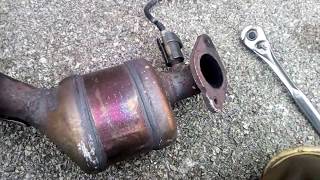
How to confirm: With the engine cold, visually inspect the Bank 2 (front) 🎬 Watch: A walkthrough of the front Bank 2 converter inspection. catalytic converter and its flanges for black soot marks, cracks, or breaks. An audible exhaust leak (ticking or hissing) may also be present. The crack typically occurs at the weld where the pipe meets the flange that bolts to the cylinder head.
Typical fix: Replace the entire Bank 2 catalytic converter assembly. The GM OEM part number is 84216836 🎬 See the fastest way to replace these GM 3.6L converters. (Left/Front side).
Est. part cost: $300-$800 - Exhaust Leak (other than converter body) 🟡 Medium Probability Exhaust gaskets and flex pipes can degrade over time from heat cycles and corrosion.
How to confirm: Inspect all exhaust piping and gaskets between the engine and the downstream O2 sensor for leaks. A common method is to use a shop vacuum in 'blow' mode to pressurize the exhaust (engine off) and spray soapy water on joints to look for bubbles.
Typical fix: Replace the leaking gasket or faulty section of pipe.
Est. part cost: $20-$150 - Faulty Downstream Oxygen Sensor (Bank 2, Sensor 2) ⚪ Low Probability → Shop Oxygen Sensor
How to confirm: Use a scan tool to graph the voltage of the Bank 2 downstream O2 sensor. A healthy sensor on a good converter will show a relatively steady voltage. If the sensor's reading is stuck or mirrors the rapid fluctuations of the upstream sensor (and the converter/exhaust are confirmed to be intact), the sensor is likely faulty. Many owners mistakenly replace the O2 sensor first, only to find the P0430 code returns because the actual issue was the converter.
Typical fix: Replace the Bank 2 downstream (post-catalyst) oxygen sensor.
Est. part cost: $50-$120 - Underlying Engine Condition ⚪ Low Probability High mileage vehicles can suffer from issues like worn piston rings causing oil consumption, which can contaminate and destroy a catalytic converter over time.
How to confirm: Check for other diagnostic trouble codes related to misfires (P0300-P0306) or fuel mixture (P0171, P0174). An engine misfire or incorrect air/fuel ratio can send unburnt fuel into the exhaust, overheating and destroying the catalytic converter over time. Also monitor for excessive oil consumption.
Typical fix: Diagnose and repair the root cause (e.g., replace spark plugs, ignition coils, fuel injectors, or fix vacuum leaks) BEFORE replacing the catalytic converter.
Est. part cost: $50-$500+
Diagnosis Steps
- Scan for Codes: Use an OBD-II scanner to confirm P0430 is the only code. If other codes are present (especially misfire or fuel system codes), address them first.
- Check for TSBs and Special Coverage: Be aware of TSB #17-NA-321, which points directly to a cracked converter. Also, check with a GM dealer or online for any 'Special Coverage' programs like N182185580 that might extend the warranty for this specific part, although this particular program may not apply to all years.
- Inspect for Exhaust Leaks: With the engine cold, start the car and listen for any ticking or hissing sounds from the front of the engine bay near the radiator. Visually inspect the Bank 2 converter, its flanges, and nearby exhaust pipes for black soot marks indicating a leak. The crack is most often found at the weld on the mounting flange.
- Analyze Oxygen Sensor Data: Using a scan tool with live data capability, graph the voltage signals for Bank 2 Sensor 1 (upstream) and Bank 2 Sensor 2 (downstream). On a healthy, warm engine, Sensor 1 should fluctuate rapidly between ~0.1V and ~0.9V. Sensor 2 should hold a much steadier, higher voltage (e.g., ~0.6V-0.8V). If Sensor 2's graph mimics Sensor 1's rapid switching, the converter is not working.
- Test the Oxygen Sensor: If the converter and exhaust system appear physically sound, but the sensor data is suspect (e.g., stuck at one voltage), the sensor itself may be faulty. You can test it with a multimeter or by swapping it with the Bank 1 downstream sensor to see if the trouble code follows (changing to P0420).
- Check for Backpressure: If a clogged converter is suspected (symptom: low power), a mechanic can perform a backpressure test by checking the pressure at the upstream oxygen sensor port. Pressure at idle should not exceed 1 PSI, and at 2500 RPM it should not exceed 3 PSI. Excessive pressure confirms a blockage.
- Confirm Converter Failure: If all other possibilities are ruled out and the evidence from step 3 (visual crack) or step 4 (sensor data) points to inefficiency, the catalytic converter needs to be replaced.
Parts You'll Likely Need
- Catalytic Converter (Bank 2, Radiator Side)
(OEM #84216836)— This is the most common failure point for code P0430 on this specific vehicle, as documented by a manufacturer TSB regarding cracks in the assembly.
Trusted brands: ACDelco (OEM), Walker (e.g., #16728), MagnaFlow (e.g., #52184), AP Exhaust
OEM price range: $700-$950
Aftermarket price range: $300-$700 - Downstream Oxygen Sensor (Bank 2, Sensor 2)
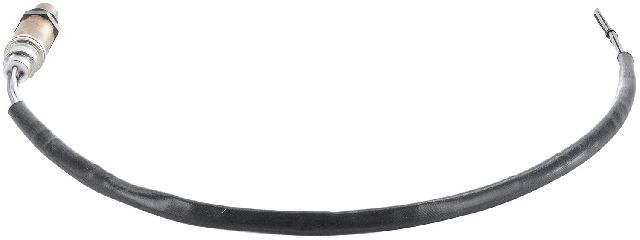
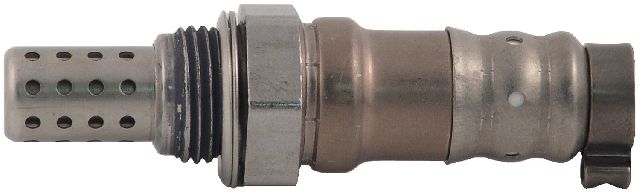
(OEM #12661898)— This part is sometimes replaced as a misdiagnosis, but can also fail. It's wise to replace it when installing a new catalytic converter, as a faulty sensor can't properly monitor the new part, and exhaust work can sometimes damage an old sensor during removal.
Trusted brands: ACDelco, Denso, Bosch, NTK
OEM price range: $80-$150
Aftermarket price range: $50-$120
Related Codes That Often Appear With This One
- P0420 — This is the equivalent code for Bank 1 (rear converter). It's common for both converters to fail around the same time due to age and mileage, and the TSB for the cracked flange applies to both P0420 and P0430.
- P0300-P0306 — Misfire codes. An unresolved misfire can dump raw fuel into the exhaust, which superheats and melts the internal structure of the catalytic converter, causing it to fail.
Technical Service Bulletins (TSBs) & Recalls
- 17-NA-321: Customer may comment on an exhaust smell and/or leak with possible malfunction indicator lamp illuminated. During diagnosis, a technician may find DTC P0430 and/or P0420. This may be due to a crack around the catalytic mounting flange. Correction: Replace converter assembly with new service part.
Platform-Specific Known Issues
- TSB #17-NA-321: General Motors issued this bulletin for 2014-2018 Impalas (among other models with the 3.6L engine) due to potential cracks forming around the catalytic converter mounting flange. Symptoms include an exhaust smell and DTC P0430 or P0420. The official correction is to replace the entire converter assembly with part #84216836 for the left/front side (Bank 2) or #20929196 for the right/rear side (Bank 1).
- Owner Repair Experience: An owner of a 2012 Impala with the same 3.6L engine and 265k miles reported a P0430 code. While they initially considered O2 sensors or spark plugs, the high mileage pointed towards eventual converter failure, which is a common fate for these parts, especially if there's any oil consumption.
Mechanic-Grade Diagnostic Values
- Downstream O2 Sensor (Bank 2, Sensor 2) Voltage — expected: Relatively steady voltage, slowly fluctuating between 0.6V and 0.8V at operating temperature.. Failure: Voltage rapidly mimics the upstream sensor's fluctuations (0.1V-0.9V), indicating a failed converter. A stuck or slow-to-respond voltage suggests a faulty sensor.
- Long-Term and Short-Term Fuel Trims (Bank 2) — expected: The combined total of long-term and short-term fuel trims should ideally be within +/- 10%.. Failure: High positive numbers (e.g., >25%) indicate the PCM is compensating for a vacuum leak or other lean condition that could be the root cause of the P0430, not the converter itself.
- Exhaust Backpressure Test — expected: At idle, pressure should not exceed 1 PSI. At 2500 RPM, it should not exceed 3 PSI.. Failure: Pressure significantly above 3 PSI at 2500 RPM indicates a clogged catalytic converter or other exhaust restriction.
Hidden / Shadow Codes Worth Checking
- Mode 6, Test ID $81 (Catalyst Monitor Bank 2): This is not a trouble code, but a specific onboard diagnostic test result. It provides the raw data the PCM uses to determine the efficiency of the Bank 2 catalytic converter. Technicians can view this data to see if the converter is marginal or failing before the P0430 code is set. (see via A professional scan tool with Mode 6 capabilities, such as the GM GDS2 or a high-end aftermarket scanner.)
Scan Tool Commands That Help
- GDS2 (GM Global Diagnostic System 2): Vehicle DTC Information — To perform a full vehicle scan and identify all stored Diagnostic Trouble Codes in every module, which is the first step in any diagnosis.
- GDS2 (GM Global Diagnostic System 2): Clear All DTCs — Used after a repair is completed to clear the P0430 code and other stored codes. The vehicle must then be driven through several warm-up cycles to confirm the fix was successful and the code does not return.
- GDS2 (GM Global Diagnostic System 2): Engine Data / Oxygen Sensor Data — To view live data streams from the upstream and downstream oxygen sensors to evaluate their performance and, by extension, the performance of the catalytic converter.
Wiring & Ground Locations
- G103 / G104 — On the 3.6L LFX, G104 is located at the front of the engine. Other important grounds (like G103) are located on the cowl in the engine compartment, often above the brake booster.. The Engine Control Module (ECM) and its sensors rely on clean, tight ground connections. A corroded or loose engine ground can cause incorrect or erratic sensor readings, potentially leading to a false P0430 code or other drivability issues.
- O2 Sensor Connector — The downstream O2 sensor (Bank 2, Sensor 2) is located on the exhaust pipe after the catalytic converter. The connector is part of the wiring harness leading from the sensor.. The wiring and connector for the downstream O2 sensor can become damaged or corroded. A wiggle test on the connector while watching live data can reveal intermittent connections that cause false P0430 codes.
Real Owner Repair Stories
- 2CarPros Forum User (2012 Chevrolet Impala LTZ 3.6L LFX) — P0420 and P0430 codes present, slow acceleration, loss of power between 4500-5000 RPM.
❌ Tried (didn't work) Replaced engine with a low-mileage unit., Replaced both manifold catalytic converters (Bank 1 and Bank 2)., Replaced all four oxygen sensors., Replaced resonator with a straight pipe.
✅ What actually fixed it The user had not yet performed a crankshaft position sensor system relearn procedure after the engine swap, which is a required step. A mechanic also suggested the third (downstream) catalytic converter could be clogged, causing the power loss even after the manifold converters were replaced.
Model Year Variations Within This Range
- 2014-2018: The 3.6L V6 in the 2014-2018 Impala is the LFX version. While there were minor updates and a transition to the LFY engine in other GM models around 2018, the Impala largely retained the LFX. The core issue of the cracked catalytic converter flange described in TSB 17-NA-321 applies across this entire model year range for the Impala with the 3.6L engine.
Helpful Videos
Used OEM Parts in Stock
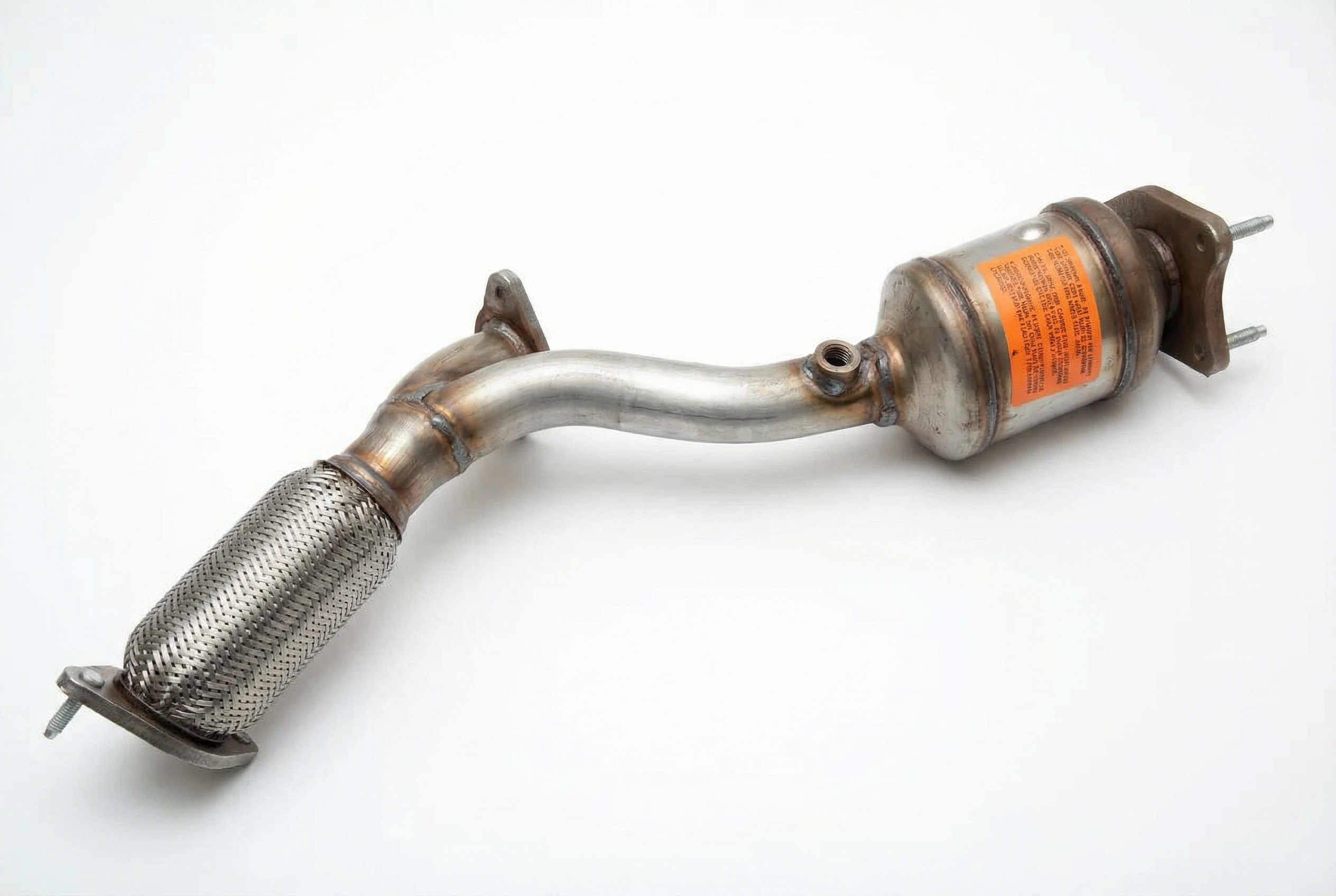
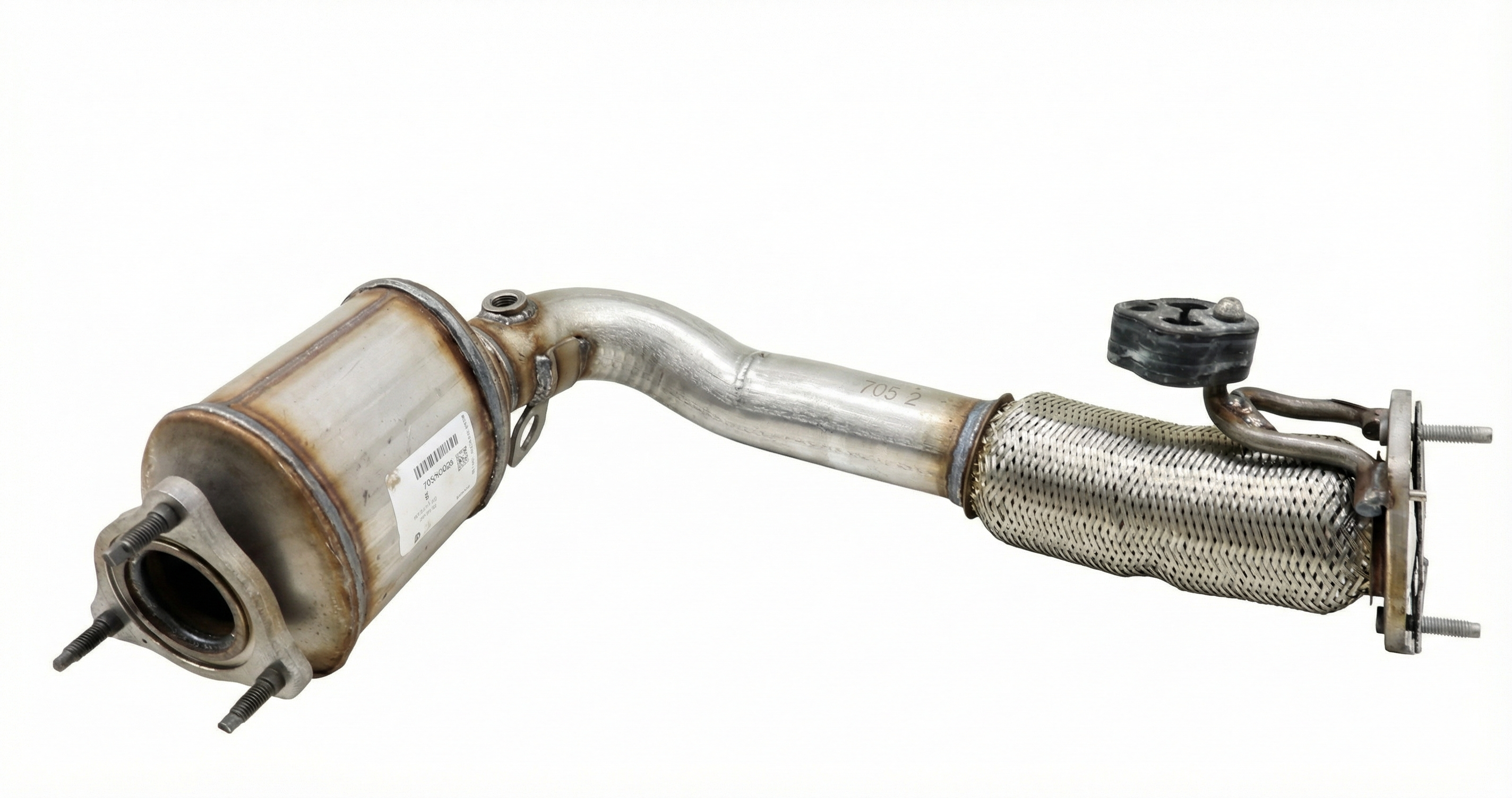
New Aftermarket Parts Available



The information in this article is provided for general reference and educational purposes only. Vehicle specifications, procedures, and part compatibility can vary by production date, trim level, and region. Always consult your vehicle's factory service manual and verify part numbers before purchasing or performing repairs. Safety-critical components such as airbags, seat belts, and braking systems should be installed by a qualified professional.
- Chevrolet IMPALA:
- 🧭 Diagnostic Flowchart
- 🎬 Helpful Videos
- 🛍️ Shop This Part
- What's Unique About the 2014-2018 Chevrolet IMPALA
- Symptoms You May Notice
- Most Likely Causes
- Diagnosis Steps
- Parts You'll Likely Need
- Related Codes That Often Appear With This One
- Technical Service Bulletins (TSBs) & Recalls
- Platform-Specific Known Issues
- Mechanic-Grade Diagnostic Values
- Hidden / Shadow Codes Worth Checking
- Scan Tool Commands That Help
- Wiring & Ground Locations
- Real Owner Repair Stories
- Model Year Variations Within This Range
- 🎟️ Get 5% Off