

P0430 on 2018 Chevrolet Tahoe: Catalyst Efficiency Causes and Fixes
P0430 on a 2018 Tahoe means the driver's side (Bank 2) catalytic converter is inefficient. While this can mean the converter has failed, first check for cheaper causes like exhaust leaks from broken manifold bolts or a bad air filter seal, as noted in GM Technical Service Bulletin #16-NA-111. A faulty oxygen sensor is also a common culprit, but should be tested before replacement.
- P0430 points to the driver's side catalytic converter, but do not assume the converter is the problem.
- Before buying any parts, thoroughly inspect for exhaust leaks (especially broken manifold bolts) and check the air filter box seal (TSB #16NA111).
- Use a scan tool to watch O2 sensor data. A downstream sensor that mimics the upstream sensor indicates a bad converter, but a faulty sensor can also be the cause.
- If you replace the catalytic converter, you must first fix any underlying issues like oil consumption or engine misfires, or the new converter will also fail.
- Always use high-quality OEM (ACDelco) or reputable aftermarket (Denso, Bosch) oxygen sensors, as these trucks can be sensitive to cheaper parts.
What's Unique About the 2018-2018 Chevrolet TAHOE
For the 2018 Tahoe (K2XX platform), P0430 is frequently caused by issues other than the converter itself. General Motors issued a TSB (#16-NA-111) specifically pointing to a poor seal on the air filter box, which can allow sand and debris to be ingested, damaging the O2 sensors and clogging the converter. Furthermore, the 5.3L and 6.2L V8 engines in these trucks are notorious for the rearmost exhaust manifold bolts breaking. This creates an exhaust leak that lets in outside oxygen, tricking the O2 sensors and causing a false P0430 code long before the converter itself has actually failed. Lastly, oil consumption related to the Active Fuel Management (AFM) system can contaminate and destroy the catalytic converter, making it crucial to check for underlying engine issues before replacing expensive parts.
Diagnostic Flowchart
Tap your situation to follow the diagnostic path that matches what you're seeing on this vehicle.
Symptoms You May Notice
- Check Engine Light is on
- Vehicle fails an emissions test
- Reduced engine power and sluggish acceleration
- Decreased fuel economy
- A sulfur or "rotten egg" smell from the exhaust
- Rattling noise from under the vehicle if the internal catalyst material has broken apart
- Audible ticking or puffing noise from the engine bay, especially on a cold start, indicating an exhaust manifold leak
- Replacing the catalytic converter without first checking for exhaust leaks, a bad air filter seal, or faulty oxygen sensors.
- Replacing oxygen sensors without checking for exhaust leaks that are causing the incorrect sensor readings.
- Installing cheap aftermarket catalytic converters or oxygen sensors, which may not meet the required specifications and can cause the code to return.
Most Likely Causes
- Failing Catalytic Converter (Bank 2) 🔴 High Probability → Shop Catalytic Converter Often a secondary failure caused by oil consumption, persistent misfires, or contamination from a leaking airbox fouling the catalyst material. The converter itself can also simply wear out after 100,000+ miles.
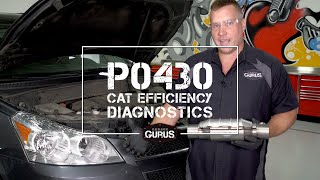
How to confirm: After ruling out all other causes, use an infrared thermometer on a hot engine; the converter outlet should be at least 100°F hotter than the inlet. A scan tool showing the downstream O2 sensor voltage (B2S2) mimicking the upstream sensor's (B2S1) rapid switching also points to a bad converter.
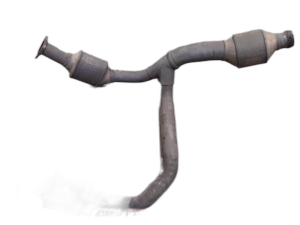
Typical fix: Replace the Bank 2 (driver's side) catalytic converter assembly. The root cause (e.g., oil burning, misfires, air intake leak) MUST be fixed first or the new converter will fail quickly.
Est. part cost: $400-$1900 - Exhaust System Leak 🔴 High Probability These V8 engines are known for the rearmost exhaust manifold bolts breaking off due to thermal stress, causing a leak at the cylinder head. This allows oxygen to enter the exhaust stream, which fools the O2 sensors into triggering a false P0430 code.
How to confirm: Listen for a distinct ticking or puffing noise from the driver's side of the engine, especially on a cold start, which often disappears as the engine warms up and the metal expands. Look for black soot trails near the rear of the exhaust manifold flange against the cylinder head. A professional smoke test is the most reliable way to find a leak.
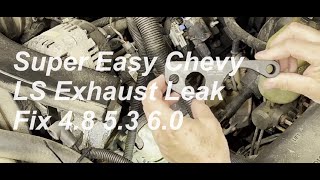
Typical fix: Replace the broken manifold bolts and the manifold gasket. This can be labor-intensive due to the bolt's location near the firewall. Sometimes a special clamp (like Dorman 917-142) can be used as a quicker fix without extracting the broken bolt. 🎬 See this easy fix for broken exhaust manifold bolts.
Est. part cost: $20-$150 - Faulty Downstream Oxygen Sensor 🟡 Medium Probability → Shop Oxygen Sensor O2 sensors have a finite lifespan and can fail or become contaminated, sending inaccurate data to the ECM. These trucks are known to be sensitive to aftermarket sensors, which can cause false codes.
How to confirm: Use a scan tool to graph the sensor's voltage; it should be relatively stable between 0.6V and 0.8V on a fully warm engine at steady RPM. The easiest test is to swap the downstream (Sensor 2) sensors between Bank 1 and Bank 2. If the code changes to P0420, the sensor is faulty.
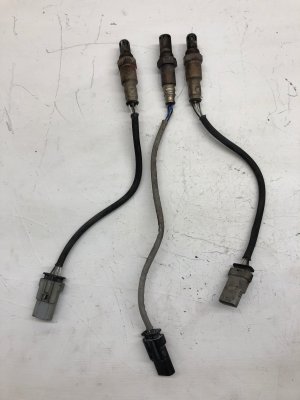
Typical fix: Replace the Bank 2, Sensor 2 (downstream, driver's side) oxygen sensor. Use of an OEM ACDelco or quality Denso sensor is highly recommended to avoid compatibility issues.
Est. part cost: $50-$120 - Air Intake System Leak 🟡 Medium Probability As per TSB #16-NA-111, the air filter housing may not seal correctly, allowing unmetered and often dirty/sandy air to enter the engine. This debris can physically damage the delicate element in the O2 sensor and clog the catalytic converter, causing P0420/P0430.
How to confirm: Visually inspect the air filter box, its seal, and the entire intake tube from the box to the throttle body. Look for signs of dirt or sand on the 'clean' side of the air filter housing.
Typical fix: Reseat the air filter and housing correctly. If the housing is warped or the clips are broken, it must be replaced to ensure a proper seal. Replace the air filter if dirty.
Est. part cost: $20-$150
Rare But Worth Checking
- Engine Misfires or Rich/Lean Fuel Conditions: If you have other codes like P0300-P0308 (misfires) or P0171/P0172/P0174/P0175 (fuel trim), these are the root cause. Unburned fuel (from misfires) or incorrect fuel mixtures will superheat and destroy a catalytic converter. These issues must be repaired first, or the new converter will fail quickly.
- Excessive Oil Consumption: If your Tahoe burns oil (often related to the Active Fuel Management system's lifters or piston rings), the oil contaminates the catalytic converter, causing it to fail. This was also noted in an owner complaint for an older model (NHTSA ODI #10663266). This is a major engine issue that must be addressed to prevent repeat converter failure.
Diagnosis Steps
- Check for other DTCs with a scan tool. Address any misfire, fuel system, or O2 sensor heater codes first, as they are the root cause.
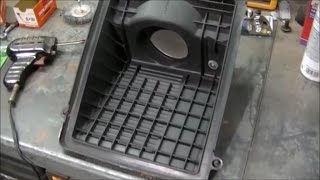
- Inspect the air intake system for leaks, paying close attention to the air filter box seal as per TSB #16-NA-111. Check for dirt/debris past the filter. 🎬 Watch: How to repair a leaking air filter box.
- Perform a thorough visual and auditory inspection of the exhaust system. On a cold start, listen for a ticking/puffing noise near the driver's side firewall, which strongly indicates a broken manifold bolt.
- If a leak is suspected, confirm its location using a smoke machine or by feeling for escaping air.
- If no leaks are found, use a scan tool to observe live data for the Bank 2 oxygen sensors. The upstream sensor (B2S1) should fluctuate rapidly, while the downstream sensor (B2S2) should hold a relatively steady, high voltage (e.g., >0.6V). If B2S2 mimics B2S1, the converter is likely bad.
- Test the downstream O2 sensor by swapping it with the Bank 1 downstream sensor. Clear codes and drive. If the code follows the sensor and changes to P0420, the sensor is the problem.
- If all other components test good, confirm converter failure by measuring its inlet and outlet temperatures with an infrared thermometer. A hot, running engine should show the outlet is at least 100°F hotter than the inlet.
Parts You'll Likely Need
- Catalytic Converter (Bank 2)
(OEM #19420265)— This is the component identified by the code, though it often fails due to other root causes. Bank 2 is the driver's side.
Trusted brands: ACDelco, MagnaFlow, Walker Exhaust
OEM price range: $1500-$1900
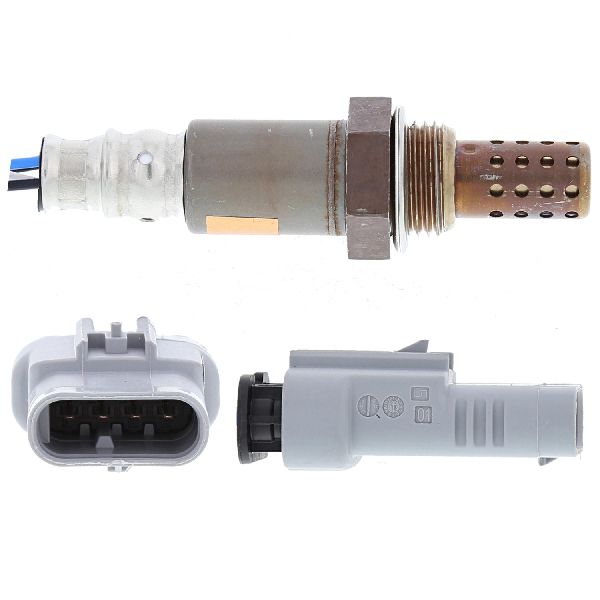
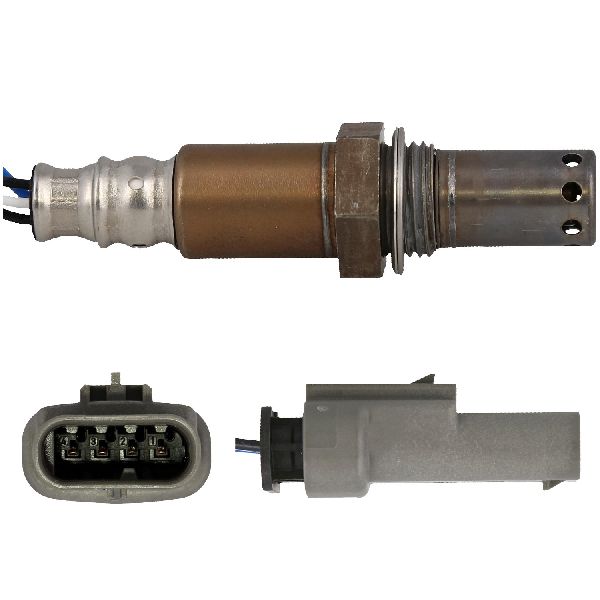
Aftermarket price range: $400-$900 - Oxygen Sensor (Bank 2, Sensor 2)
(OEM #12677896)— A faulty downstream sensor is a common cause of a false P0430 code. Note: Part number 12675980 is often listed for upstream but may be used in some downstream applications; always verify with VIN. The correct downstream-specific part is often 12677896.
Trusted brands: ACDelco, Denso, Bosch
OEM price range: $70-$130
Aftermarket price range: $50-$120
Related Codes That Often Appear With This One
- P0420 — This is the identical code for Bank 1 (passenger side). It is common for both converters to degrade at a similar rate, or for a systemic issue like an air intake leak or oil consumption to affect both banks.
- P0300-P0308 — These are cylinder misfire codes. A misfire allows raw, unburned fuel to enter the exhaust, which superheats and destroys the catalytic converter. A misfire is a direct cause of P0430.
- P0175 — This code means "System Too Rich (Bank 2)". A rich fuel mixture can overload and damage the catalytic converter over time, leading to the P0430 code.
Technical Service Bulletins (TSBs) & Recalls
- This informational bulletin, updated several times to include models up to 2019, provides diagnostic steps for P0420 and P0430 codes. It highlights that excessive sand or debris can bypass a poorly sealing air filter, contaminating O2 sensors and blocking the catalytic converter. It explicitly instructs technicians to validate the air box seal before replacing any parts.
- An informational bulletin noting that catalyst efficiency diagnostic trouble codes P0420 and P0430 are intentionally disabled by the ECM for the first hour of operation on new vehicles. This is for factory information and not a diagnostic aid for in-service vehicles.
Platform-Specific Known Issues
- A known issue with the air box and air filter seal can cause P0430, as documented in GM TSB #16NA111.
- The 5.3L V8 engine with Active Fuel Management (AFM) can suffer from excessive oil consumption, which poisons the catalytic converters, leading to premature failure.
- The rearmost exhaust manifold bolts are prone to breaking, causing an exhaust leak that is a very common misdiagnosis for a failed catalytic converter.
- GM TSB #PIP3119P notes that the diagnostic tests for codes P0420 and P0430 are disabled for the first hour of engine operation on some new vehicles to prevent false codes.
Mechanic-Grade Diagnostic Values
- Downstream O2 Sensor (B2S2) Voltage at steady cruise — expected: Relatively stable voltage, typically between 0.65V and 0.74V.. Failure: Voltage fluctuates rapidly, mirroring the upstream (B2S1) sensor, or is stuck low (e.g., near 0.1V-0.2V).
- Long-Term Fuel Trim (LTFT) for Bank 2 — expected: -5% to +5%.. Failure: Values consistently greater than +10% or less than -10% indicate a fuel mixture problem that must be fixed before replacing the converter.
- Heated Oxygen Sensor (HO2S) Heater Resistance — expected: 5 to 16 Ω (Ohms).. Failure: A reading outside this range indicates a faulty heater element within the sensor.
- Catalytic Converter Temperature Differential — expected: Outlet should be at least 100°F hotter than the inlet on a fully warmed-up engine.. Failure: Outlet temperature is similar to or cooler than the inlet temperature, indicating no chemical reaction is occurring.
Wiring & Ground Locations
- Fuse F90 (Underhood Fuse Box) — In the main fuse box on the driver's side of the engine bay.. This 15A fuse provides power to the heater circuit for the Bank 1 (passenger side) oxygen sensors. While not for Bank 2, a fault here can indicate a systemic wiring issue.
- Fuse F100 (Underhood Fuse Box) — In the main fuse box on the driver's side of the engine bay.. This 15A fuse provides power to the heater circuit for the Bank 2 (driver's side) oxygen sensors. A blown fuse will cause the sensors to respond slowly, potentially affecting catalyst monitoring.
- Bank 2 Sensor 2 (Downstream) Connector Wires — On the driver's side exhaust pipe, after the catalytic converter.. For diagnosis, the signal wires are typically Tan and Purple. The heater circuit wires are Pink (power) and Black (ground). Damage to these wires can cause a false P0430 code.
Real Owner Repair Stories
- Tahoe Yukon Forum user 'mckpaul' (2007-2014 generation Tahoe with 129,000 miles) — P0430 code appeared shortly after major engine work (lifter and cam replacement for a P0305 misfire) and installation of new aftermarket catalytic converters.
❌ Tried (didn't work) Swapping the downstream O2 sensors between Bank 1 and Bank 2; the P0430 code remained on Bank 2, ruling out a bad sensor., Resetting fuel alcohol composition and fuel trims, which were initially incorrect after the repair.
✅ What actually fixed it The user suspected an exhaust leak from the recent head work. Although not explicitly stated as the final fix, the strong evidence (fluctuating downstream O2 sensor despite new parts) and forum consensus pointed towards either a small, inaudible exhaust leak at the manifold gasket or a faulty new aftermarket converter that was damaged by the original misfire condition before it was fixed. - YouTube channel 'Mareno The Car Guy' (2015-2020 Chevrolet Tahoe LT 5.3L) — Persistent P0420/P0430 code after replacing the catalytic converter and fixing broken exhaust manifold bolts.
❌ Tried (didn't work) Replacing the catalytic converter (passenger side was cut out and a new one welded in)., Installing an exhaust manifold bolt repair clamp to fix a known leak.
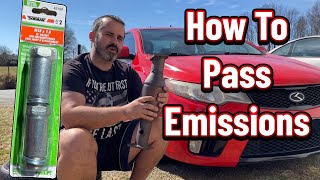
✅ What actually fixed it As a workaround, not a true repair, the owner installed an O2 sensor spacer (also called a non-fouler or extender) on the downstream O2 sensor. This pulls the sensor tip out of the direct exhaust stream, tricking it into sending a stable voltage to the ECM and preventing the P0430 code. This is not an emissions-compliant repair and will mask the underlying problem.
When the Usual Fixes Don't Work
- In one documented case on a mechanically similar Silverado, a technician diagnosed a P0430 code. Instead of immediately replacing the catalytic converter, they identified a missing exhaust manifold bolt on the driver's side. The resulting exhaust leak was the true cause of the code. Replacing the gasket and all manifold bolts resolved the P0430 without needing to replace the expensive converter, highlighting the importance of checking for leaks first.
Helpful Videos

Used OEM Parts in Stock
New Aftermarket Parts Available


The information in this article is provided for general reference and educational purposes only. Vehicle specifications, procedures, and part compatibility can vary by production date, trim level, and region. Always consult your vehicle's factory service manual and verify part numbers before purchasing or performing repairs. Safety-critical components such as airbags, seat belts, and braking systems should be installed by a qualified professional.
- Chevrolet TAHOE:
- 🧭 Diagnostic Flowchart
- 🎬 Helpful Videos
- 🛍️ Shop This Part
- What's Unique About the 2018-2018 Chevrolet TAHOE
- Symptoms You May Notice
- Most Likely Causes
- Rare But Worth Checking
- Diagnosis Steps
- Parts You'll Likely Need
- Related Codes That Often Appear With This One
- Technical Service Bulletins (TSBs) & Recalls
- Platform-Specific Known Issues
- Mechanic-Grade Diagnostic Values
- Wiring & Ground Locations
- Real Owner Repair Stories
- When the Usual Fixes Don't Work
- 🎟️ Get 5% Off