

P0430 on 2010-2015 Lexus RX450h: Catalyst Efficiency Bank 2 Causes and Fixes
On a 2010-2015 Lexus RX450h, especially the 2010-2011 models, code P0430 is very often caused by a faulty downstream oxygen sensor on Bank 2, not the expensive catalytic converter. Lexus issued a TSB for this exact issue. A proper diagnosis with a scan tool to check specific voltage and impedance values is critical before replacing any parts.
- For a 2010-2015 RX450h with code P0430, do not immediately replace the catalytic converter.
- The most probable cause, especially on 2010-2011 models, is a faulty Bank 2 downstream oxygen sensor.
- A specific diagnostic test exists: with a scan tool, check if the B2S2 voltage is >= 1.275V or its impedance is > 300 ohms. If so, the sensor is bad.
- Bank 2 is the front exhaust manifold, closer to the radiator.
- Replacing the O2 sensor is a fraction of the cost of a new catalytic converter and is the official fix in many cases.
What's Unique About the 2010-2015 Lexus RX450h
For the 2010-2011 RX450h specifically, Lexus acknowledged a common problem where the Bank 2 downstream oxygen sensor itself would fail and falsely trigger the P0430 code. The manufacturer released Technical Service Bulletins (TSBs L-SB-0127-11 Rev2 and the superseding L-SB-0005-15) with a very specific diagnostic procedure to test the sensor's voltage and impedance. This makes it essential to test the sensor before assuming the multi-thousand-dollar catalytic converter has failed, as the sensor is the most common point of failure for this code on these model years.
Symptoms You May Notice
- Check Engine Light is on
- Vehicle will fail an emissions/smog test
- Potential for slightly reduced fuel economy
- In rare cases of a clogged converter, sluggish acceleration or a rotten egg smell from the exhaust.
- Immediately replacing the catalytic converter without first performing the TSB-specified diagnostic test on the Bank 2, Sensor 2 oxygen sensor. This is a very expensive mistake on this specific vehicle, especially the 2010-2011 models.
Most Likely Causes
- Failing Bank 2, Sensor 2 Oxygen Sensor 🔴 High Probability → Shop Oxygen Sensor Lexus issued TSBs L-SB-0005-15 and L-SB-0127-11 for 2010-2011 models due to a high failure rate of this specific sensor, causing a false P0430 code. This is the most widely reported cause in owner forums for these model years.
How to confirm: Use a scan tool like Toyota Techstream with the engine fully warmed up. Monitor the Bank 2, Sensor 2 (B2S2) live data. If the voltage is 1.275V or higher, OR the impedance is over 300 ohms, the sensor is faulty per the TSB.
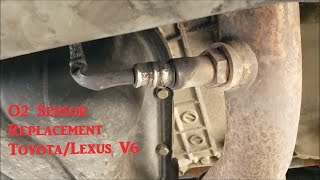
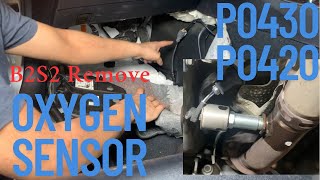
Typical fix: Replace the Bank 2, Sensor 2 oxygen sensor and the corresponding exhaust gaskets. This sensor is located on the front (radiator side) exhaust manifold, after the catalytic converter element. 🎬 See this walkthrough on removing the Bank 2 Sensor 2.
Est. part cost: $80-$180 - Failing Bank 2 Catalytic Converter 🟡 Medium Probability → Shop Catalytic Converter Catalytic converters are wear items and can fail over time due to age, mileage, or other engine issues like misfires or burning oil. While less common than the O2 sensor issue on this car, it is the next logical failure point.
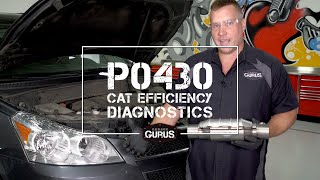
How to confirm: If the O2 sensor passes the TSB diagnostic test and no exhaust leaks are found, the converter is the likely culprit. A mechanic can use an infrared thermometer to check for a significant temperature increase from the converter's inlet to its outlet (outlet should be hotter), which 🎬 Watch: Professional diagnostic steps for testing catalytic converter efficiency. indicates it is working. A small temperature difference suggests failure.
Typical fix: Replace the Bank 2 catalytic converter assembly, which is integrated with the exhaust manifold on the front (radiator) side of the engine.
Est. part cost: $500-$2000+ - Exhaust Leak ⚪ Low Probability Leaks can develop at gasket flanges or from cracks in the exhaust pipes, particularly at welds. A leak between the upstream and downstream sensors can draw in outside air, fooling the downstream sensor and triggering the code.
How to confirm: Visually inspect the exhaust system between the engine and the downstream O2 sensor for black soot marks, cracks, or loose flanges. A smoke test is highly effective; pressurize the exhaust with a smoke machine (or a DIY setup with a shop-vac and smoke source) and look for smoke escaping. Alternatively, spraying soapy water on joints while pressurizing the exhaust can reveal leaks as bubbles.
Typical fix: Replace the leaking gasket or repair the cracked pipe section. One owner reported fixing the issue with high-temp muffler sealant on a leaking flange before the sensor.
Est. part cost: $20-$100
Rare But Worth Checking
- Failing Air-Fuel Ratio Sensor (Bank 2, Sensor 1): → Shop Oxygen Sensor A failing upstream A/F sensor can cause an incorrect air-fuel mixture, which over time can damage the catalytic converter. This would typically be accompanied by other codes like P0171 or P0174 and should be addressed first.
- Engine Misfires or Rich/Lean Running Condition: Unburned fuel from misfires or an improper fuel mixture can overheat and destroy the catalytic converter. These are root causes that must be fixed to prevent repeat failure of a new converter.
Diagnosis Steps
- Connect an OBD-II scanner and confirm P0430 is the only code present. If other codes exist (e.g., for misfires or other sensors), diagnose them first.
- Crucial Step for 2010-2011 Models: With the engine fully warmed up, use a capable scan tool (like Toyota Techstream) to monitor the live data for 'Bank 2, Sensor 2 Oxygen Sensor'.
- Check the B2S2 voltage and impedance. Per Lexus TSB L-SB-0127-11 and L-SB-0005-15, if the voltage is at or above 1.275V, OR the impedance is over 300 ohms, the sensor has failed.
- If the sensor is confirmed bad, replace the Bank 2, Sensor 2 oxygen sensor. This is the most likely fix.
- If the sensor readings are normal, the next step is to thoroughly inspect for exhaust leaks between the cylinder head and the downstream O2 sensor. Use a smoke tester or the soapy water method on all flange gaskets and welds.
- If no leaks are found and the O2 sensor tests good, use the scan tool to graph the voltage of the upstream (A/F Sensor B2S1) and downstream (O2 Sensor B2S2) sensors. If the downstream sensor's waveform mirrors the upstream sensor's rapid fluctuations, the catalytic converter has likely failed.
- As a final check, an infrared temperature gun can be used. A properly functioning converter should have an outlet temperature significantly hotter than its inlet temperature. If the temperatures are similar, it confirms the catalyst is not working.
- If all other possibilities are exhausted, the Bank 2 catalytic converter is the faulty component and requires replacement.
Parts You'll Likely Need
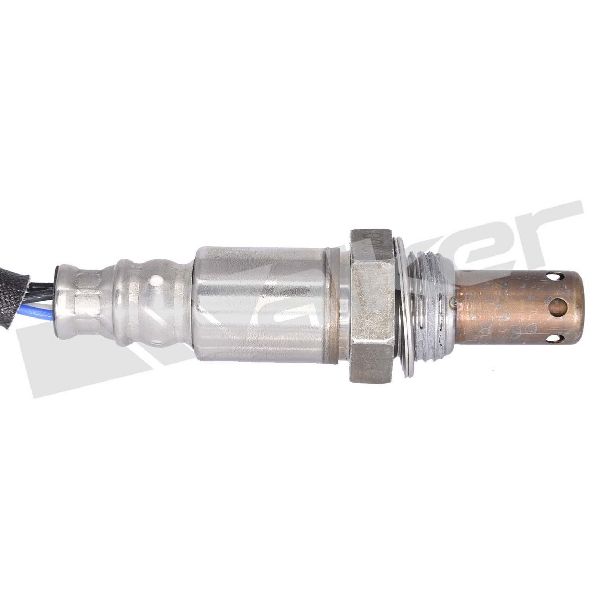
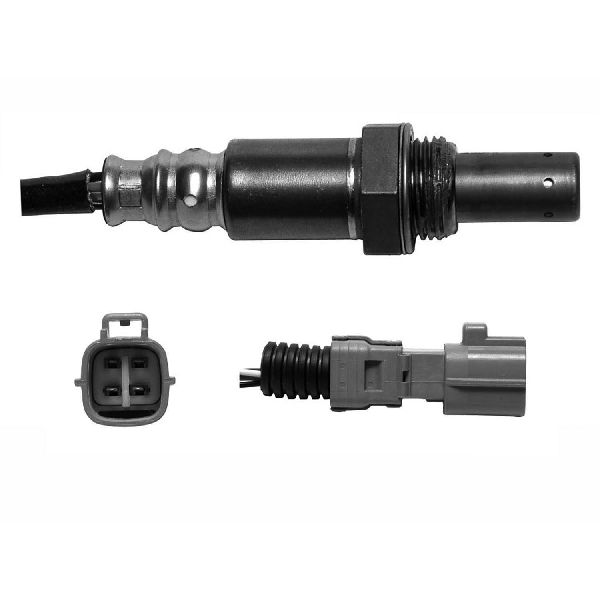
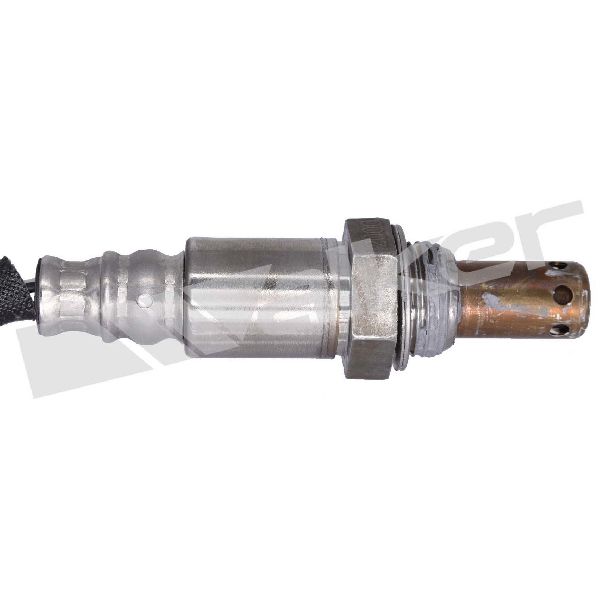
- Bank 2 Sensor 2 Oxygen Sensor
(OEM #89465-0E040 (supersedes 89465-48220))— This is the most common cause of P0430 on 2010-2011 RX450h models, as documented by Lexus in TSBs L-SB-0005-15 and L-SB-0127-11.
Trusted brands: Denso (OEM supplier, Part #234-4521 is a common cross-reference), Lexus (OEM)
OEM price range: $150-$230
Aftermarket price range: $80-$150 - Bank 2 Catalytic Converter (Front/Radiator Side)
(OEM #17150-0P250 (Manifold Assembly))— This is the second most likely cause if the oxygen sensor tests good and there are no exhaust leaks. It is an integrated manifold/converter unit.
Trusted brands: Walker Exhaust, MagnaFlow, AP Exhaust, Dorman
OEM price range: $1000-$2500+
Aftermarket price range: $450-$900
Technical Service Bulletins (TSBs) & Recalls
- L-SB-0005-15: MIL "ON" DTC P0430 - Supersedes the earlier bulletin. Confirms the diagnostic condition for 2010 RX450h, provides specific voltage (≥1.275V) /impedance (>300 ohms) tests for the O2 sensor, and lists updated part numbers including the new sensor 89465-0E040.
- L-SB-0127-11 Rev2: MIL "ON" DTC P0430 - The earlier TSB covering the same issue for 2010-2011 models, also pointing to the O2 sensor as the likely culprit and providing the same diagnostic thresholds.
Platform-Specific Known Issues
- Lexus TSB L-SB-0127-11 Rev2 and its successor L-SB-0005-15 apply to 2010-2011 RX450h models and detail a specific diagnostic procedure for a faulty Bank 2 O2 sensor causing P0430. Following this procedure is critical to avoid misdiagnosis.
Mechanic-Grade Diagnostic Values
- Mode $06 Catalyst Monitor Test Value — expected: Value should be above the minimum threshold specified in Techstream (e.g., above 0.249).. Failure: A test value that is approaching or has fallen below the minimum threshold indicates a degrading or failed catalytic converter, even if the P0430 code has not yet been triggered.
- Bank 2 Sensor 2 (B2S2) Voltage — expected: Should be a relatively stable voltage, typically between 0.5V and 0.8V on a healthy, warm converter.. Failure: Per TSB L-SB-0005-15, a voltage reading of 1.275V or higher indicates a failed sensor.
- Bank 2 Sensor 2 (B2S2) Impedance — expected: A low resistance value.. Failure: Per TSB L-SB-0005-15, an impedance reading over 300 ohms indicates a failed sensor.
Hidden / Shadow Codes Worth Checking
- Mode $06, TID $81-$84, CID $01-$02: These are not trouble codes but Test IDs (TID) and Component IDs (CID) for the catalyst efficiency monitor. They allow a technician to view the raw test values the ECM uses to determine catalyst health. This can show a catalyst that is borderline or degrading before it fails the threshold to set a P0430 code. (see via Toyota Techstream software, under the 'Engine Control and ECT' -> 'Monitor' -> 'Details' menu for the catalyst monitor test.)
Scan Tool Commands That Help
- Toyota Techstream: Active Test: Control the Injection Volume for A/F Sensor — This function allows a technician to force the engine rich or lean (+/- 12.5% fuel injection volume) and observe the reaction of the upstream and downstream sensors. A healthy downstream O2 sensor should show a slow, delayed reaction compared to the upstream A/F sensor. If the downstream sensor reacts too quickly or not at all, it can indicate a problem with the sensor itself or the catalyst.
- Toyota Techstream: Monitor -> Details — Used after a drive cycle to view the stored results of the catalyst efficiency self-test (Mode $06 data). This is crucial for seeing how close the catalyst is to the failing threshold, helping to differentiate between a truly bad cat and other potential causes.
Wiring & Ground Locations
- Main Engine Ground — A primary ground strap typically connects from the engine block or cylinder head to the chassis/frame rail on the passenger side of the engine bay. Another key ground is often located on the lower bolt of the alternator.. A poor engine ground can cause a voltage offset in sensor readings. While not a common cause for P0430, verifying the main ground connections are clean and tight is a fundamental step in diagnosing any electronic or sensor-related issue.
- ECM Pins for B2S2 — On the Engine Control Module (ECM), the signal for the Bank 2 Sensor 2 (downstream) is typically found on specific pins. For a 2GR-FE engine family, these would be pins like OX2A and OX2B on connector E6. Exact pin numbers can vary, requiring a model-specific wiring diagram for confirmation.. For advanced diagnosis of a persistent P0430 where the sensor and cat are suspect, a technician can directly measure voltage and resistance at the ECM pins. This definitively rules out any wiring harness issues (opens, shorts, high resistance) between the sensor and the computer.
Real Owner Repair Stories
- ClubLexus user 'vighnesh' (2010 Lexus RX450h) — P0430 code. Dealer quoted $5000 for catalytic converter and O2 sensor replacement.
❌ Tried (didn't work) Initial diagnosis from the dealer pointed to a bad catalytic converter.
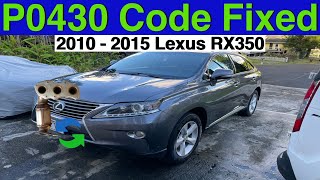
✅ What actually fixed it The user reported the final 'fix' was installing a spark plug non-fouler on the Bank 2 O2 sensor. This tricks the computer by pulling the sensor out of the direct exhaust stream. Note: This is not a true repair and will likely cause an emissions test failure; it only masks the symptom by fooling the ECM. - YouTube user 'Fix it Angel' (2010-2015 Lexus RX350 (same platform/engine family, relevant repair)) — Persistent P0430 code that would return weekly after being cleared.
❌ Tried (didn't work) Using two bottles of Cataclean fuel system cleaner., Replacing both Bank 2 oxygen sensors (Sensor 1 and Sensor 2)., Attempting to install a cheap, poorly-fitting aftermarket catalytic converter which resulted in exhaust leaks.
✅ What actually fixed it Replacing the Bank 2 (radiator side) catalytic converter with a quality, properly fitting unit. Upon removal of the original converter, the internal honeycomb structure was found to be broken.
OEM Part Supersession History
89465-48220→89465-0E040— The original sensor was prone to premature failure, leading to false P0430 codes. The new part number is the revised, more reliable sensor specified in TSBs L-SB-0127-11 and L-SB-0005-15.
Heads up: While both may physically fit, installing the old part number (if found) is not recommended as it carries the original design flaw. Always use the superseded part number 89465-0E040 or its equivalent for this repair.
Model Year Variations Within This Range
- 2010-2011: These model years are specifically called out in Lexus TSBs for having a high likelihood of the P0430 code being caused by a faulty Bank 2, Sensor 2 oxygen sensor rather than the catalytic converter itself. The diagnostic procedure in the TSB is most critical for these years.
Diagnostic Flowchart
Other Known Issues on This Vehicle
Issues unrelated to this code that are worth knowing about as an owner of this generation:
- ABS Brake Actuator Failure 🔴 High — Can occur on higher mileage vehicles. A TSB (L-SB-0011-23) was issued for 2016-2019 models for internal leaks, but the component can be a weak point on earlier models as well. Another TSB (L-SB-0005-21) addresses a squawk/knock noise from the actuator due to air inside. (Ref: L-SB-0011-23, L-SB-0005-21)
- Inverter Coolant Pump Failure 🔴 High — Failure of the small electric water pump for the hybrid inverter can lead to inverter overheating and a 'Check Hybrid System' warning. This is a critical component for the health of the expensive inverter assembly.
- 12V Auxiliary Battery Failure 🟠 Medium — The 12V battery can drain if the vehicle is left unused for several weeks. A failing 12V battery can cause numerous random electrical issues and warning lights, sometimes mimicking more severe hybrid system problems.
- VVT-i Oil Line Leak/Rupture 🔴 High — Early 2GR-FE engines (a close relative to the 2GR-FXE) were known for a rubber section of the VVT-i oil line that could degrade and leak or rupture, leading to rapid oil loss. Most have been updated to an all-metal line under a recall campaign. (Ref: Toyota Recall Campaign)
- Water Pump Seepage/Failure 🟠 Medium — The engine water pump is a known wear item on the 2GR engine family and can begin to seep or fail, sometimes as early as 30-50k miles, though higher mileage failures are more common.
Used vs. New Parts: Buying Guide for This Vehicle
When a used part is the smart pick: For this specific repair, a used part is generally not recommended for either the oxygen sensor or the catalytic converter. O2 sensors are wear items with a finite lifespan, and a used one is an unknown quantity. Used catalytic converters are often illegal to sell in many jurisdictions and have a high risk of being non-functional or near the end of their life.
Donor-vehicle mileage cap: roughly under 50000 miles for the part to have meaningful remaining life.
What to inspect on the donor part:
- For a catalytic converter, it is nearly impossible to assess internal health externally.
- Ask for the VIN of the donor vehicle to verify low mileage and check for accident history (an impact could damage the converter's internal structure).
- Inspect for any signs of external rust, dents, or broken welds.
- If possible, request documentation of the donor vehicle's mileage.
OEM-only on this vehicle (don't cheap out):
- Catalytic Converter: This is strongly recommended. Aftermarket converters, especially cheaper ones, often lack the necessary amount of precious metals to satisfy the sensitive ECU on modern Lexus vehicles, leading to the P0430 code returning within a year or even sooner.
- Air/Fuel and Oxygen Sensors: While not strictly OEM-only, using the OEM supplier (Denso) is the safest bet. Avoid no-name or suspiciously cheap sensors, as they are frequently counterfeit or of poor quality and can cause more diagnostic headaches.
Aftermarket brands forum-validated for this vehicle:
- Denso (for Oxygen Sensors - they are the OEM supplier)
- Walker Exhaust (for Catalytic Converters - generally considered a reputable higher-tier aftermarket option)
- MagnaFlow (for Catalytic Converters - another reputable brand, sometimes focused more on performance)
Brands owners have reported issues with on this vehicle:
- Unbranded or 'white box' parts from online marketplaces like eBay or Amazon, which have a high risk of being counterfeit or low quality.
- Extremely cheap catalytic converters (e.g., under $200 for a direct-fit manifold converter) are very likely to fail quickly.
Real Owner Stories
Aggregated from forums and TSBs cited above. Mileages and costs reflect what owners reported in those sources.
2010 Lexus RX450h 2GR-FXE
Symptoms: The Check Engine Light came on with code P0430. A dealership quoted $5,000 for a new catalytic converter replacement.
What fixed it: Diagnosis of the O2 sensor first as recommended by forum members, following the known TSB for sensor failure rather than immediately replacing the expensive converter.
Cost: $5000-$5000
Source hint: ClubLexus - 'Code p0430 on Rx450h 2010'
2010 Lexus RX450h 2GR-FXE
Symptoms: P0430 code triggered by an exhaust leak at a flange before the sensor.
What fixed it: Applied high-temp muffler sealant on the leaking flange to seal the exhaust system.
Source hint: ClubLexus - 'Code p0430'
Related OBD-II Codes
Frequently Asked Questions
My 2010 Lexus RX450h has a P0430 code; does TSB L-SB-0005-15 apply to my vehicle?
What are the specific diagnostic thresholds for the Bank 2 O2 sensor on a 2011 RX450h?
Where is the Bank 2, Sensor 2 oxygen sensor located on the 2GR-FXE engine?
If I need to replace the O2 sensor due to the TSB, what is the updated part number?
Can an exhaust leak cause a P0430 on this Lexus even if the converter is good?
Is the Bank 2 catalytic converter integrated into the manifold on the RX450h?
Helpful Videos

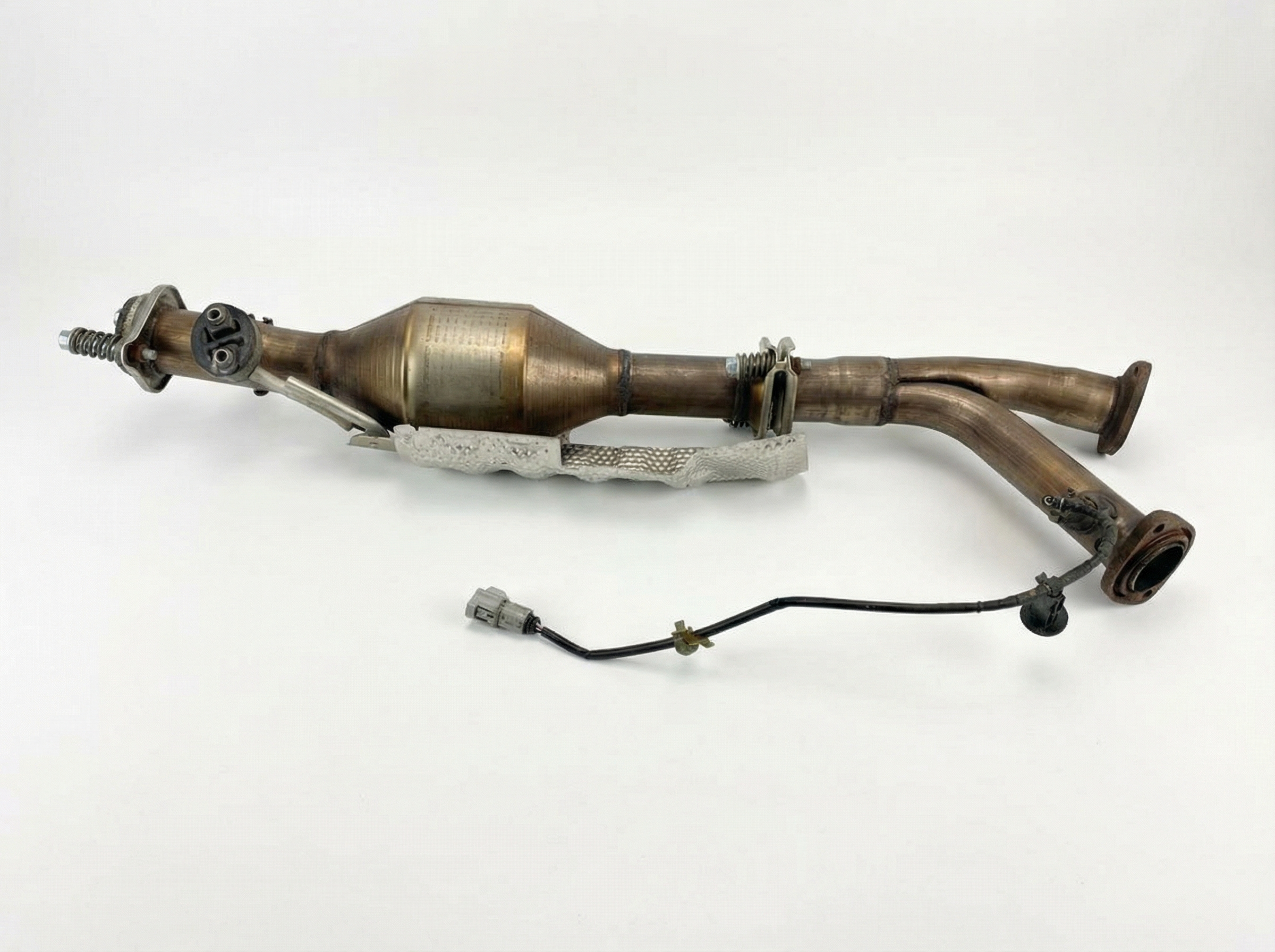
Used OEM Parts in Stock
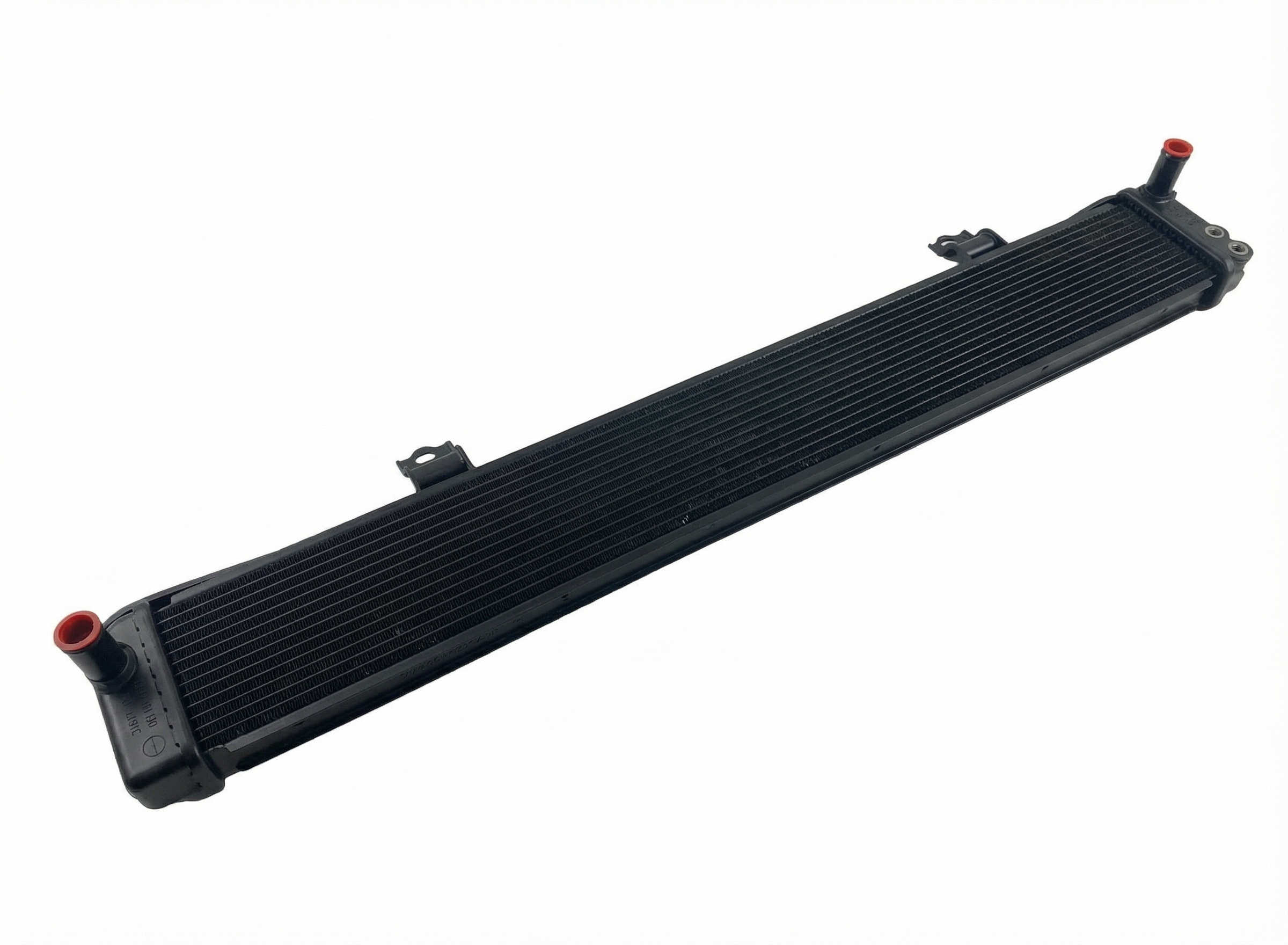
New Aftermarket Parts Available

The information in this article is provided for general reference and educational purposes only. Vehicle specifications, procedures, and part compatibility can vary by production date, trim level, and region. Always consult your vehicle's factory service manual and verify part numbers before purchasing or performing repairs. Safety-critical components such as airbags, seat belts, and braking systems should be installed by a qualified professional.
- Lexus RX450h:
- 🧭 Diagnostic Flowchart
- 🎬 Helpful Videos
- 🛍️ Shop This Part
- What's Unique About the 2010-2015 Lexus RX450h
- Symptoms You May Notice
- Most Likely Causes
- Rare But Worth Checking
- Diagnosis Steps
- Parts You'll Likely Need
- Technical Service Bulletins (TSBs) & Recalls
- Platform-Specific Known Issues
- Mechanic-Grade Diagnostic Values
- Hidden / Shadow Codes Worth Checking
- Scan Tool Commands That Help
- Wiring & Ground Locations
- Real Owner Repair Stories
- OEM Part Supersession History
- Model Year Variations Within This Range
- Other Known Issues on This Vehicle
- Used vs. New Parts: Buying Guide for This Vehicle
- Real Owner Stories
- 2010 Lexus RX450h 2GR-FXE
- 2010 Lexus RX450h 2GR-FXE
- Related OBD-II Codes
- Frequently Asked Questions
- 🎟️ Get 5% Off