

P0440 on 2007-2012 Hyundai Santa Fe: EVAP System Malfunction Causes and Fixes
For a 2007-2012 Hyundai Santa Fe, code P0440 usually points to a simple fix like a loose gas cap or a faulty EVAP valve. The most common repair is replacing the canister purge valve in the engine bay or the canister close valve at the rear of the vehicle. A smoke test is the most reliable way to confirm the leak's location before replacing parts.
- Always check your gas cap first. Make sure it's tight and the seal isn't cracked before buying any parts.
- If the gas cap isn't the issue, the two most likely culprits are the canister purge valve (in the engine bay) and the canister close valve (at the rear of the car).
- Before replacing the gas cap, inspect the fuel filler neck for rust. Cleaning this surface can often solve the problem for free.
- A smoke test is the most accurate way to diagnose an EVAP leak if the cause isn't one of the common valves or the gas cap.
What's Unique About the 2007-2012 Hyundai Santa Fe
On the second-generation (CM) Hyundai Santa Fe, the P0440 code is a common issue that owners often trace back to one of two specific valves: the Purge Control Solenoid Valve (PCSV) in the engine bay or the Canister Close Valve (CCV) near the rear charcoal canister. While the gas cap is always the first thing to check, these two valves are frequent failure points. Additionally, owners have reported that rust buildup on the fuel filler neck can prevent the gas cap from sealing properly, triggering this code even with a new cap. Access to the PCSV on pre-facelift V6 models (2007-2009 2.7L & 3.3L) can be particularly challenging due to its location under the intake manifold.
Symptoms You May Notice
- Check Engine Light is on
- A faint fuel odor around the vehicle, especially after refueling
- Failure to pass an emissions inspection
- Slight decrease in fuel economy
- Replacing the gas cap when the actual problem is a rusted fuel filler neck preventing a proper seal.
- Replacing EVAP system components without first performing a smoke test, potentially missing a simple cracked hose.
- Replacing the fuel tank pressure sensor when a valve or hose is the actual source of the leak.
Most Likely Causes
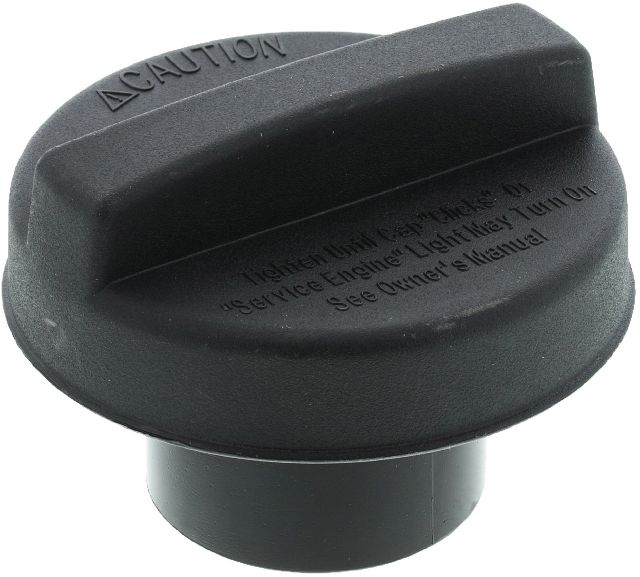
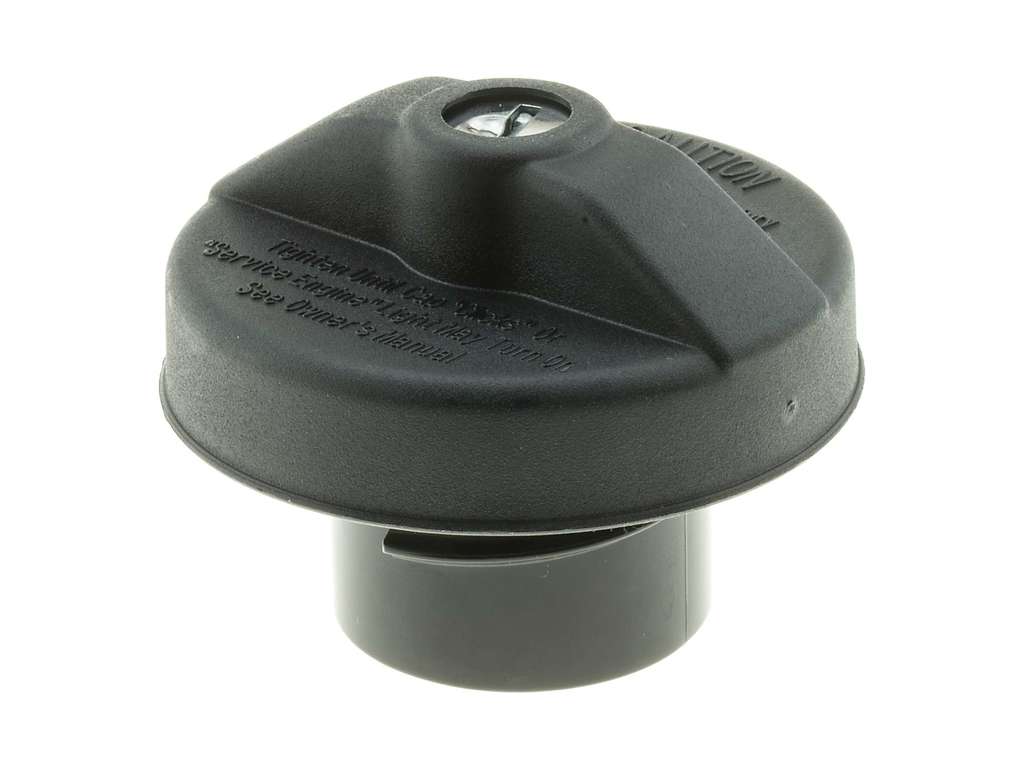
- Loose or Faulty Gas Cap 🔴 High Probability → Shop Fuel Tank Cap This is the most common cause for any EVAP code on any vehicle. The cap's seal can degrade over time or it may simply not have been tightened correctly after refueling.
How to confirm: Ensure the gas cap is tightened until it clicks at least once. Inspect the rubber O-ring on the cap for cracks, stiffness, or damage. A visual inspection is usually sufficient.
Typical fix: Tighten the cap. If the seal is damaged, replace the gas cap.
Est. part cost: $15-$30 - Faulty Canister Purge Valve (PCSV) 🟡 Medium Probability → Shop Vapor Canister This solenoid valve is located in the engine bay and is frequently exposed to heat, causing it to fail by sticking open or closed. It's a very common failure item on many Hyundai and Kia models.
How to confirm: The valve is located in the engine bay, connected to the intake manifold. On V6 models, it is tucked under the intake plenum, making access difficult. You can test it by applying 12V power to its terminals to see if the solenoid clicks open and closed. A more definitive test is to remove it and see if you can blow air through it; it should be closed when not energized.
Typical fix: Replace the canister purge valve. This is generally a simple plug-and-play replacement, though access on the V6 models is tight.
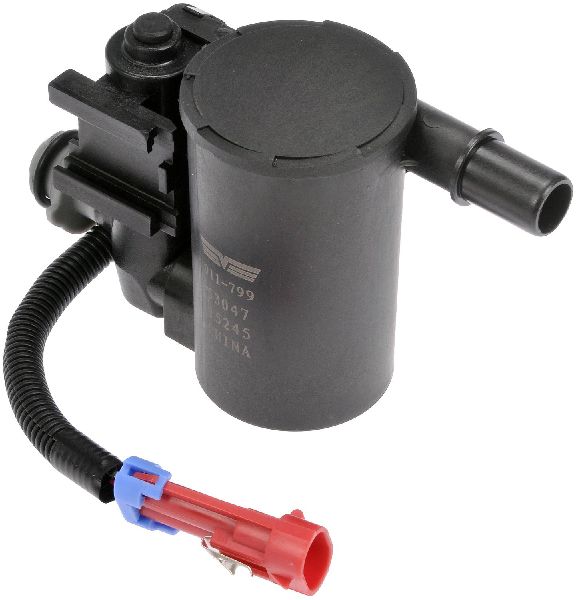
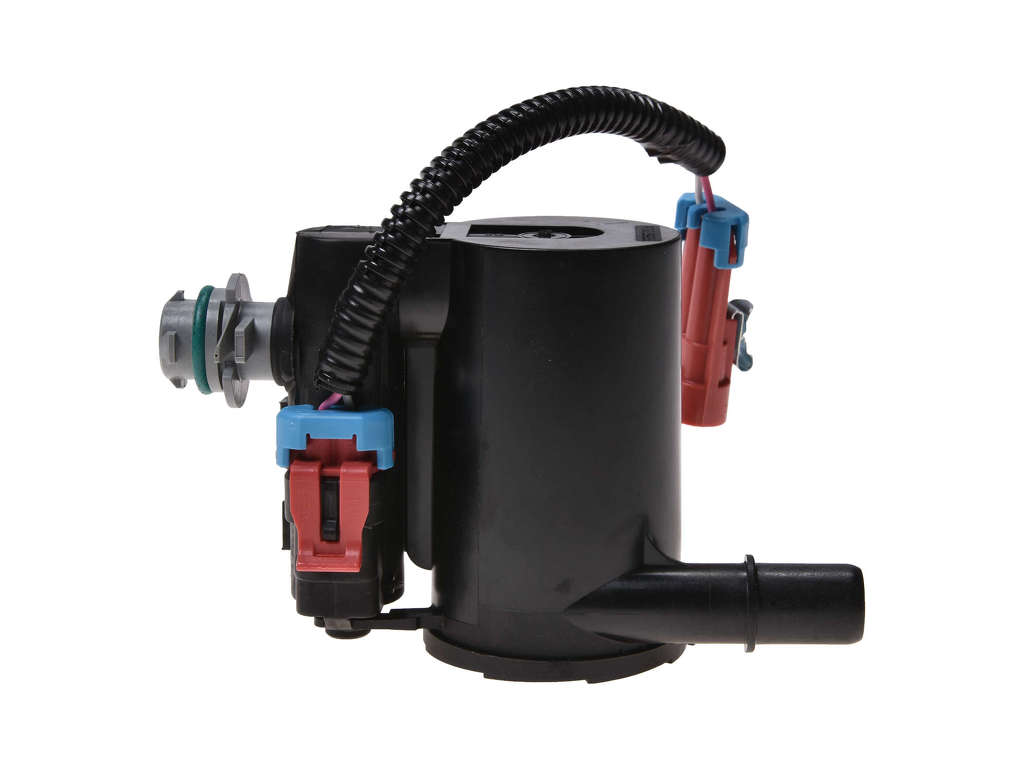
Est. part cost: $40-$80 - Faulty Canister Close Valve (CCV) / Vent Solenoid 🟡 Medium Probability → Shop Vapor Canister Located at the rear of the vehicle near the charcoal canister, this valve is exposed to road salt and debris, which can cause corrosion and lead to it sticking open or closed.
How to confirm: The valve is mounted on or near the charcoal canister, behind the driver's side rear wheel. It can be tested similarly to the purge valve by applying power and checking its operation. Often, it fails due to internal corrosion that isn't visible. A scan tool that can command the valve to cycle is also useful for diagnosis.
Typical fix: Replace the canister close valve assembly.
Est. part cost: $50-$100 - Rusted Fuel Filler Neck ⚪ Low Probability → Shop Fuel Filler Neck Over time, the metal lip of the fuel filler neck where the gas cap seals can develop rust and corrosion, creating an imperfect seal even with a brand-new gas cap. This is especially common in regions that use road salt.
How to confirm: Remove the gas cap and visually inspect the metal surface that the cap's rubber gasket presses against. Look and feel for any rust, pitting, or bubbling paint.
Typical fix: Clean the sealing surface of the filler neck thoroughly with a Scotch-Brite pad or fine-grit sandpaper until it is smooth and clean. Apply a very light coat of grease to prevent future rust.
Est. part cost: $0-$5 - Cracked or Disconnected EVAP Hoses ⚪ Low Probability
How to confirm: Visually inspect all accessible EVAP lines, both in the engine bay and under the vehicle near the fuel tank, for any obvious cracks, brittleness, or disconnections. The most reliable way to find a small leak is with a professional smoke test, which forces smoke through the system to reveal the leak source.
Typical fix: Replace the damaged section of hose and secure it with clamps.
Est. part cost: $10-$30
Rare But Worth Checking
- Cracked Charcoal Canister: → Shop Vapor Canister The canister itself can develop cracks from age or physical impact, creating a leak. This is usually found during a smoke test after all valves and hoses have been checked.
- Faulty Fuel Tank Pressure Sensor: → Shop Fuel Tank Though uncommon, the sensor that monitors EVAP system pressure can fail and send incorrect data to the ECM, triggering the code even if there is no leak.
Diagnosis Steps
- Read the Code: Confirm P0440 is present and check for any other related EVAP codes (e.g., P0441, P0442, P0455).
- Inspect the Gas Cap: Remove the gas cap, inspect the seal for damage, and ensure it's tightened correctly (at least one click). This is the most common fix.
- Inspect the Fuel Filler Neck: Check the sealing surface of the filler neck for rust or debris. Clean it if necessary.
- Visually Inspect Hoses: Check the EVAP hoses in the engine bay and around the canister at the rear for any obvious cracks or loose connections.
- Test the Canister Purge Valve (PCSV): Locate the valve in the engine bay. With the engine off, disconnect it and try to blow through it; it should be closed. You can also apply 12V to see if the solenoid clicks. Access on V6 models is difficult and may require removal of the intake manifold cover.
- Test the Canister Close Valve (CCV): Locate the valve near the charcoal canister at the rear. Test its operation with a 12V source or a capable scan tool. These are known to fail from corrosion.
- Perform a Smoke Test: If the cause is still not apparent, a smoke test is the most effective way to find the exact location of a leak in the EVAP system. This step is highly recommended before replacing more expensive parts.
Parts You'll Likely Need
- Canister Purge Valve / Purge Control Solenoid Valve (PCSV)
(OEM #28910-3E100 (for 2.7L V6) / 28910-3C100 (for 3.3L V6) / 28910-25100 (for 2.4L I4))— This valve is located in the hot engine bay and is a common failure point, often getting stuck open or closed. Part number varies by engine.
Trusted brands: Hyundai (OEM), Dorman, Beck/Arnley
OEM price range: $60-$90
Aftermarket price range: $40-$75 - Canister Close Valve (CCV) / Vent Valve
(OEM #31430-0W000 (This part number appears in some catalogs but may be part of a larger assembly. A common aftermarket part is Dorman 911-815))— Located under the vehicle, this valve is prone to failure from corrosion and debris, causing it to stick.
Trusted brands: Hyundai (OEM), Dorman, Standard Motor Products (SMP), SKP
OEM price range: $80-$120
Aftermarket price range: $50-$100 - Fuel Cap
(OEM #31010-3L600)— The simplest and most common cause of all EVAP codes. The seal wears out over time.
Trusted brands: Hyundai (OEM), Stant
OEM price range: $25-$40
Aftermarket price range: $15-$30
Related Codes That Often Appear With This One
- P0442 — P0442 indicates a small leak. A general malfunction (P0440) is often the precursor to the system identifying a specific leak size.
- P0455 — P0455 indicates a large leak. If a component like the purge valve or canister close valve fails completely, it can trigger both the general malfunction code and the large leak code.
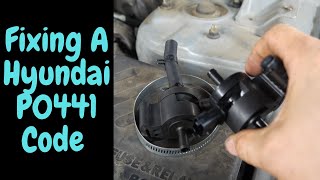
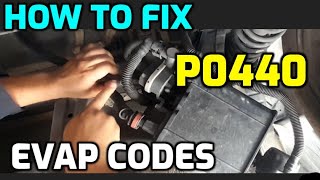
- P0441 — P0441 indicates incorrect purge flow, which is almost always caused by a faulty canister purge valve—a primary cause of P0440 as well. 🎬 Watch: How to replace the purge valve and fix P0441 codes.
Platform-Specific Known Issues
- Real Owner Experience: P0455 and P0440 Fixed by CCV: A user on hyundai-forums.com with a 2008 Santa Fe reported getting EVAP codes after having fuel sending units replaced. After changing the gas cap didn't work, the issue was traced to a leak in the EVAP system that was likely disturbed during the initial repair. This highlights how other repairs near the fuel tank can inadvertently cause EVAP codes.
- DIY Story: Cleaning the Fuel Filler Neck: → Shop Fuel Filler Neck On the same forum, another owner with a P0442 code (small leak) on their Santa Fe successfully resolved the issue not by replacing
Mechanic-Grade Diagnostic Values
- Canister Close Valve (CCV) Solenoid Resistance — expected: 14 - 18 Ohms. Failure: A reading of OL (infinite resistance) indicates an open coil. A reading near zero ohms indicates a shorted coil.
- Canister Purge Valve (PCSV) Solenoid Resistance (General Spec) — expected: 15 - 30 Ohms. Failure: A reading far outside this range, especially OL (open) or 0 (short), indicates a failed solenoid coil.
- Canister Close Valve (CCV) Connector Voltage — expected: Pin 1: Battery Voltage (~12V) with Key On, Engine Off. Pin 2: Ground (controlled by ECM).. Failure: No voltage at Pin 1 suggests a problem with the power supply circuit (fuse, wiring).
Scan Tool Commands That Help
- Hyundai GDS (or capable professional scanner): EVAP System Active Test / Bidirectional Control — This function is used to manually command the Canister Purge Solenoid Valve (PCSV) and Canister Close Valve (CCV) to open or close. It is a critical step to verify if the valves are responding to commands and are not mechanically stuck. For example, you can command the CCV closed and the PCSV open to see if the system can hold a vacuum, or command them individually and listen for an audible 'click'.
Wiring & Ground Locations
- G52 — Located in the left rear of the engine compartment on 2008 3.3L models.. This is a primary ground point for the Powertrain Control Module (PCM) which controls the EVAP solenoids. A corroded or loose G52 ground can cause intermittent or faulty operation of EVAP components, leading to codes like P0440.
- G39 — Located in the left rear of the engine compartment on 2008 models, near G52.. This ground is associated with the immobilizer system but shares a location with other critical engine management grounds. Ensuring all grounds in this area are clean and tight is good practice when diagnosing electrical-related EVAP codes.
Real Owner Repair Stories
- Reviewer on a product listing for Dorman 911-815 (2007 Hyundai Santa Fe) — Car was hard to start after re-fueling.
❌ Tried (didn't work) Initial attempt involved trying to remove the entire mounting bracket for the purge valve, which was very difficult.
✅ What actually fixed it Replacing the canister purge valve (PCSV). The owner noted the key was to release the hose clamps and slide the valve out of its rubber mount toward the driver's side, which was still difficult but the correct procedure.
OEM Part Supersession History
31430-0W000→31430-2B500 (for later models)— Part was updated for the 2010-2012 facelift models with different engines (2.4L/3.5L).
Heads up: The part 31430-0W000 is for the 2007-2009 Santa Fe. The 2010-2012 models use different part numbers like 31430-2B500. The mounting brackets and connectors may differ, making them not interchangeable. Always verify with VIN.
Model Year Variations Within This Range
- 2007-2009: These models used the 2.7L and 3.3L V6 engines. The Canister Purge Valve (PCSV) is notoriously located on the rear of the intake manifold, making it very difficult to access. Part numbers are 28910-3E100 (2.7L) and 28910-3C100 (3.3L).
- 2010-2012: These facelifted models used the 2.4L I4 and 3.5L V6 engines. The Canister Purge Valve (PCSV) was moved to a much more accessible location on or near the top of the intake manifold. The part numbers are different from the earlier models.
Diagnostic Flowchart
Other Known Issues on This Vehicle
Issues unrelated to this code that are worth knowing about as an owner of this generation:
- Faulty Fuel Level Sensor 🟠 Medium → Shop Fuel Tank Sending Unit — Very common across 2007-2009 models. The fuel gauge becomes erratic or reads empty, often triggering code P0463. The fix requires accessing the fuel tank, often by removing the rear seats.
- Front Valve Cover Gasket Leak (V6 Models) 🔴 High — Common on 3.3L V6 engines. The front valve cover gasket leaks oil directly onto the alternator below, causing alternator failure and loss of electrical power. (Ref: Service Campaign 936 (TSB #15-01-031) was issued for 2007-2009 models to inspect and replace the gasket and alternator if contaminated.)
- Engine Failure / Excessive Oil Consumption 🔴 High — The 2012 model year with the 2.4L Theta II engine is particularly noted for engine failures related to connecting rod bearings. Other engine issues and oil consumption problems have been reported across the generation. (Ref: Related to larger Hyundai Theta II engine settlements and recalls, though the 2012 Santa Fe was specifically cited for issues.)
- Transmission Hesitation / Hard Shifting 🟡 Low — Owners of 2007-2009 models have reported issues with sluggish or jerky automatic transmission shifting.
- EGR Valve Clogging 🟡 Low — Carbon buildup can clog the EGR valve, leading to a rough or erratic idle. This is a common issue on many vehicles, but noted for this platform.
Used vs. New Parts: Buying Guide for This Vehicle
When a used part is the smart pick: Used parts like the charcoal canister assembly can be a cost-effective choice, especially if the entire assembly (including the CCV) is sourced from a low-mileage, non-rust-belt donor vehicle. Hoses and brackets are also good candidates for used parts.
Donor-vehicle mileage cap: roughly under 80000 miles for the part to have meaningful remaining life.
What to inspect on the donor part:
- For a charcoal canister, check for any physical cracks or signs of being saturated with fuel (unusually heavy).
- For valves (PCSV, CCV), look for minimal corrosion on the electrical pins and plastic housing.
- Ensure all hose connection nipples are intact and not brittle or cracked.
- Ask for the VIN of the donor car to verify it's from a compatible year range and engine type.
OEM-only on this vehicle (don't cheap out):
- No specific parts for this repair are strictly OEM-only, but OEM valves often have better longevity than the cheapest aftermarket options.
Aftermarket brands forum-validated for this vehicle:
- Dorman (specifically for the Canister Close Valve, part 911-815, which is a widely cited replacement)
- Standard Motor Products (SMP)
- Beck/Arnley
Brands owners have reported issues with on this vehicle:
- No-name, unbranded valves from online marketplaces should be avoided as their internal solenoids and seals may fail prematurely.
Real Owner Stories
Aggregated from forums and TSBs cited above. Mileages and costs reflect what owners reported in those sources.
2008 Hyundai Santa Fe
Symptoms: The vehicle triggered EVAP codes shortly after having the fuel sending units replaced. A new gas cap did not resolve the issue.
What fixed it: The issue was traced to a leak in the EVAP system, specifically the Canister Close Valve (CCV), which was likely disturbed during the fuel tank area repair.
Source hint: hyundai-forums.com thread titled 'Real Owner Experience: P0455 and P0440 Fixed by CCV'
Hyundai Santa Fe (2007-2012 generation)
Symptoms: P0442 small leak code present.
What fixed it: Cleaning the sealing surface of the fuel filler neck with a Scotch-Brite pad or fine-grit sandpaper to remove rust and pitting.
Source hint: hyundai-forums.com thread titled 'DIY Story: Cleaning the Fuel Filler Neck'
Related OBD-II Codes
Frequently Asked Questions
I have a 2008 Santa Fe and the fuel gauge is acting erratic while my P0440 code is on. Are these related?
Is there a TSB for the oil leak I noticed while checking my Purge Control Solenoid Valve (PCSV)?
I can't reach the purge valve on my V6 Santa Fe to test it. Is this normal?
My gas cap looks fine, but I still have a leak code. Could it be the filler neck?
Does the 2012 Santa Fe have specific engine concerns I should know about while fixing EVAP codes?
Helpful Videos
We Have This Part in Stock


The information in this article is provided for general reference and educational purposes only. Vehicle specifications, procedures, and part compatibility can vary by production date, trim level, and region. Always consult your vehicle's factory service manual and verify part numbers before purchasing or performing repairs. Safety-critical components such as airbags, seat belts, and braking systems should be installed by a qualified professional.
- Hyundai Santa Fe:
- 🧭 Diagnostic Flowchart
- 🎬 Helpful Videos
- 🛍️ Shop This Part
- What's Unique About the 2007-2012 Hyundai Santa Fe
- Symptoms You May Notice
- Most Likely Causes
- Rare But Worth Checking
- Diagnosis Steps
- Parts You'll Likely Need
- Related Codes That Often Appear With This One
- Platform-Specific Known Issues
- Mechanic-Grade Diagnostic Values
- Scan Tool Commands That Help
- Wiring & Ground Locations
- Real Owner Repair Stories
- OEM Part Supersession History
- Model Year Variations Within This Range
- Other Known Issues on This Vehicle
- Used vs. New Parts: Buying Guide for This Vehicle
- Real Owner Stories
- 2008 Hyundai Santa Fe
- Hyundai Santa Fe (2007-2012 generation)
- Related OBD-II Codes
- Frequently Asked Questions
- 🎟️ Get 5% Off