

P0440 on 2017-2025 Jeep Compass 2.4L: EVAP System Malfunction Causes and Fixes
This code indicates a general fault in the evaporative emissions (EVAP) system. The most common cause is a loose or faulty gas cap. If that's not the issue, the next most likely culprit on this engine is a failed EVAP purge valve, which is a relatively inexpensive and accessible part to replace. Difficulty starting after refueling is a classic symptom of a bad purge valve on this platform.
- P0440 on your Jeep Compass means there's a general problem in the EVAP (emissions) system.
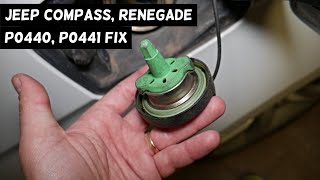
- Always check your gas cap first. Make sure it's tight and the seal isn't cracked. This fixes the problem a surprising amount of the time.
- If the gas cap isn't the issue, the next most likely cause is a bad EVAP purge valve, located on the back of the engine.
- You can continue to drive the vehicle without causing harm, but you won't pass an emissions test and your remote start may not work.
- A DIY fix is very possible, often costing under $50 for a new gas cap or purge valve.
What's Unique About the 2017-2025 Jeep Compass
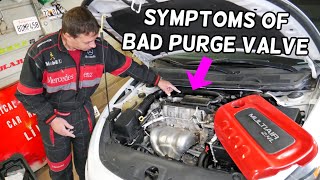
For the second-generation Jeep Compass and its platform mates using the 2.4L MultiAir engine, the P0440 code is very frequently linked to the purge valve/solenoid located on the back of the engine. While a loose gas cap is always the first suspect for any EVAP code, many owners of this specific vehicle find that a stuck or failing purge valve is the true root cause. A key indicator of this specific failure is difficulty starting the vehicle immediately after refueling. This part controls the flow of captured fuel vapors into the engine to be burned.
Generation note: The 2017 model year was a transition year. The first generation (MK) ended in 2017, and the second generation (MP) began in 2017. This guide primarily applies to the second-generation (MP) Jeep Compass from 2017-2025, which is equipped with the 2.4L MultiAir engine.
Symptoms You May Notice
- Check Engine Light is on
- Remote start may be disabled while the Check Engine Light is active.
- Difficulty starting the engine immediately after refueling (car may crank longer, stumble, or stall).
- A faint smell of fuel (in rare cases of a significant leak)
- Replacing the charcoal canister before thoroughly testing the purge valve and checking for simple hose leaks. The purge valve is a more frequent and cheaper failure point.
- Repeatedly replacing the gas cap with aftermarket versions. Some vehicles are sensitive and may require an OEM cap to create a perfect seal.
Most Likely Causes
- Loose or Faulty Gas Cap 🔴 High Probability → Shop Fuel Tank Cap This is the most common cause across all vehicles for any EVAP code due to user error (not tightening) or simple wear and tear of the cap's seal.
How to confirm: Ensure the gas cap is tightened until it clicks at least three times. Inspect the rubber seal on the cap for cracks, stiffness, or damage. If the light doesn't go away after a few drive cycles, the cap may be faulty.
Typical fix: Tighten the cap. If the seal is bad or the cap is damaged, replace the gas cap. Using an OEM cap is recommended.
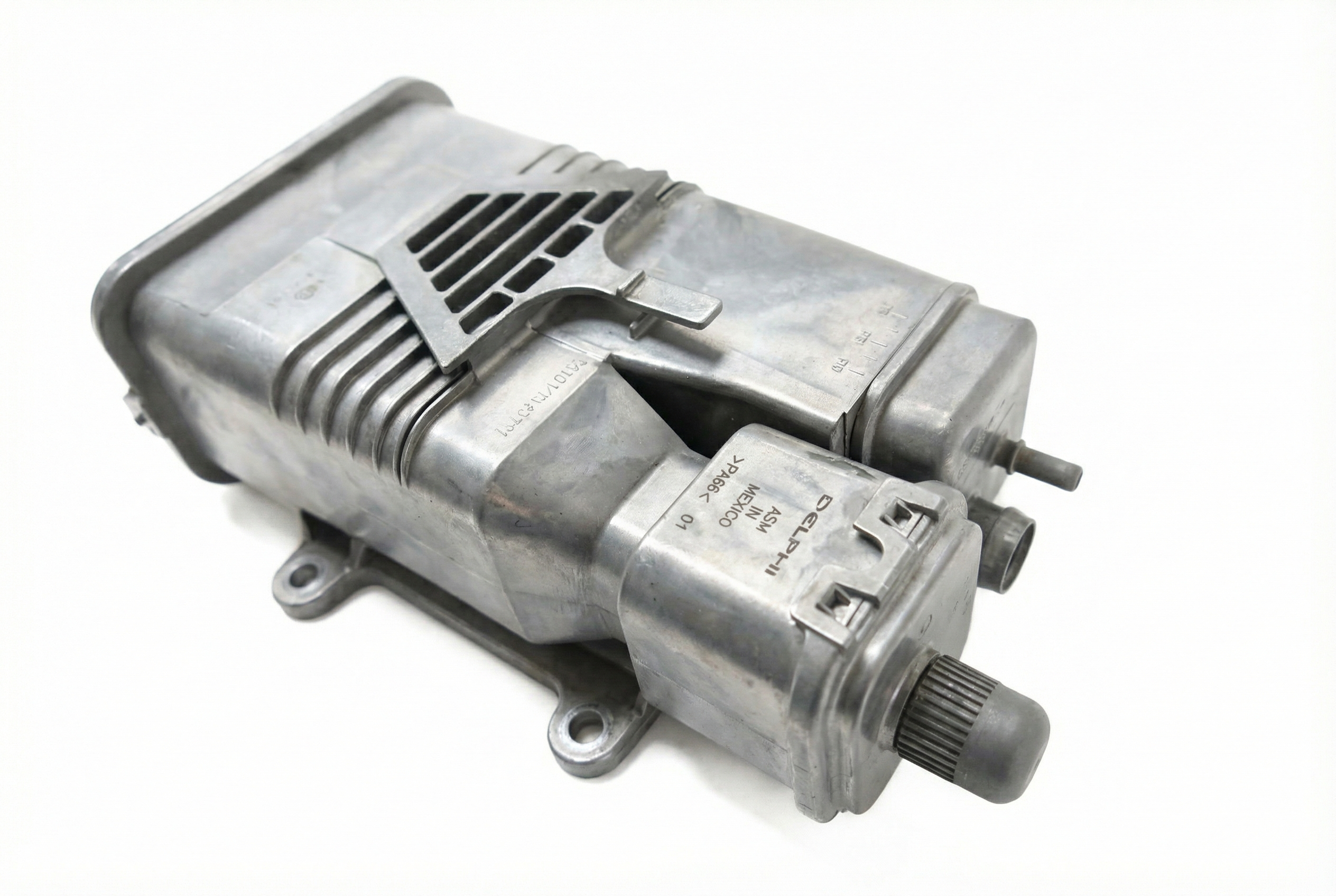
Est. part cost: $15-$30 - Faulty EVAP Purge Valve/Solenoid 🔴 High Probability → Shop Vapor Canister This is a very common failure point on the 2.4L MultiAir engine. The valve can get stuck open, flooding the intake with fuel vapors at the wrong time, or stuck closed.
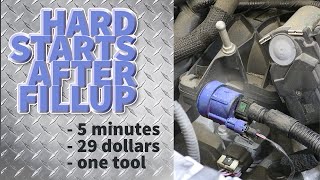
How to confirm: A classic symptom is difficulty starting the engine right after filling the gas tank. 🎬 See how to fix hard starting issues after refueling. To test, locate the valve on the back of the engine. Apply a 12V source to its electrical connector terminals; a healthy valve will 'click'. If it's stuck open, you'll be able to blow through it when it's de-energized.
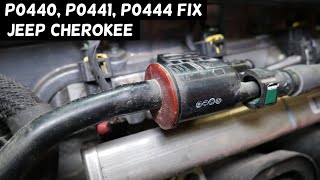
Typical fix: Replace the purge valve. It is held in place by one or two bolts and connected by two hoses and an electrical connector.
Est. part cost: $25-$60 - Cracked or Disconnected EVAP Hoses 🟡 Medium Probability The plastic and rubber hoses, especially the ones connected to the purge valve near the hot engine, can become brittle and crack over time.
How to confirm: Visually inspect all accessible EVAP lines, particularly the lines running to and from the purge valve and around the charcoal canister near the fuel tank. A smoke test is the most effective way to find a small crack that isn't obvious.
Typical fix: Replace the cracked section of hose. In some cases, a pre-formed hose assembly may need to be purchased.
Est. part cost: $10-$50
Rare But Worth Checking
- Faulty Charcoal Canister or Vent Valve: → Shop Vapor Canister The charcoal canister stores fuel vapors. It can become saturated or cracked, or the vent valve attached to it can fail. This is less common than a purge valve failure but is a possibility for persistent EVAP issues.
- Faulty EVAP System Integrity Module (ESIM): → Shop Vapor Canister On some newer Jeep models, this module (also called a leak detection pump) is used to test the system pressure. It's located near the charcoal canister by the rear wheel. If it fails, it can trigger a P0440 code.
- Leaking Fuel Tank Filler Neck: → Shop Fuel Tank Rust or damage to the metal pipe leading from the gas cap to the fuel tank can cause a leak that will trigger a P0440 code.
- Faulty Fuel Tank Pressure Sensor: → Shop Fuel Tank This sensor monitors pressure in the EVAP system. If it provides incorrect readings to the computer, it can cause a P0440 code even if there are no leaks. This usually triggers its own specific codes but can be an underlying issue.
Diagnosis Steps
- Check the Gas Cap: This is the first and easiest step. Remove the cap, inspect the seal for damage, and reinstall it, ensuring it clicks several times. Clear the code and see if it returns after a few days of driving.
- Consider Recent Refueling: If the code appeared shortly after you filled up and the car was hard to start, the purge valve is the primary suspect. Proceed to step 4.
- Visually Inspect Hoses: Check the EVAP hoses around the engine bay, especially those connected to the purge valve on the rear of the engine. Look for obvious cracks, loose connections, or deterioration.
- Test the Purge Valve: Locate the purge valve on the back of the 2.4L engine. Disconnect the electrical connector. Use a 12V power source to briefly apply voltage to the two pins on the valve. You should hear a distinct click. If there is no click, the solenoid is bad. 🎬 Watch: Step-by-step guide to testing and replacing the purge valve.
- Check for Purge Valve Leak: With the valve disconnected and engine off, try to blow air through it. It should be closed and not allow air to pass. If you can blow through it, it's stuck open and needs to be replaced.
- Perform a Smoke Test: If the above steps do not identify the problem, the next step is to use an automotive smoke machine. This tool feeds low-pressure smoke into the EVAP system (usually through a service port, sometimes marked with a green cap). The leak will be revealed by the escaping smoke.
- Inspect Canister and ESIM/Vent Valve: While performing the smoke test, pay close attention to the charcoal canister (located near the fuel tank) and the attached vent valve or ESIM for any signs of smoke.
Parts You'll Likely Need
- EVAP Canister Purge Valve / Solenoid
(OEM #Verify for 2.4L engine, 68444726AA may be for 1.3L)— This is the most common component to fail on the 2.4L MultiAir engine that causes a P0440 or P0441 code, after the gas cap has been ruled out.
Trusted brands: Mopar, Bosch, Standard Motor Products
OEM price range: $40-$60
Aftermarket price range: $25-$45 - Fuel Cap / Gas Cap
(OEM #68245042AA (example for platform-mate Renegade))— The seal on the gas cap wears out over time, causing a pressure leak that the system detects. It's the simplest and most common fix for any EVAP code.
Trusted brands: Mopar, Stant
OEM price range: $25-$35
Aftermarket price range: $15-$25
Related Codes That Often Appear With This One
- P0441 — P0441 indicates 'Incorrect Purge Flow'. Since a faulty purge valve is a common cause for P0440 on this vehicle, it's very common to see P0441 appear alongside it, as the root cause (the valve) affects both general system integrity and specific flow rates.
- P0455 / P0456 — P0455 (Large Leak) or P0456 (Small Leak) may appear with P0440. P0440 is a general system malfunction, while the other codes provide more specific information about the size of the leak the system has detected. Owners often report these codes together.
Technical Service Bulletins (TSBs) & Recalls
- TSB 18-061-16 (May 27, 2016): For the 2016 Jeep Renegade with the 2.4L engine, this bulletin involves a software flash for the Engine Control Module (ECM) to address several potential diagnostic trouble codes, including P0440, P0441, P0455, and P0456. This suggests that in some cases, the code may be triggered by software sensitivity rather than a hard part failure.
Platform-Specific Known Issues
- Common Failure Sequence: Many owners report a common diagnostic path: the P0440 code appears, they replace the gas cap which does not fix the issue, and then they replace the purge valve on the back of the engine which ultimately resolves the code. Checking for cracked hoses near the new purge valve during replacement is also a common and recommended step.
- Difficulty Starting After Refueling: A widely reported symptom specific to a failed purge valve on this engine family is difficulty starting the vehicle right after getting gas. This happens because a stuck-open purge valve allows un-metered fuel vapor from the tank to flood the intake manifold, creating a rich condition that makes starting difficult until the excess vapor is cleared. This is discussed by owners of the Dodge Dart with the same 2.4L engine.
Mechanic-Grade Diagnostic Values
- EVAP Purge Valve Solenoid Resistance — expected: 20-60 Ohms (general specification). Failure: A reading of infinite resistance (Open Loop) or near-zero resistance (short circuit) indicates a failed solenoid coil.
- ESIM Switch Voltage (at PCM) — expected: ~4.5V when the system is at atmospheric pressure (switch open).. Failure: Voltage should drop towards 0V when a vacuum of ~1 inch of water is applied to the system, indicating the switch has closed. If the voltage does not drop, the ESIM switch is faulty.
- Fuel Tank Pressure (FTP) Sensor Voltage — expected: Approximately 1.3V to 1.7V at atmospheric pressure (gas cap off).. Failure: A reading stuck at 0V or 5V, or one that doesn't change when pressure/vacuum is applied, points to a faulty sensor or wiring issue.
Scan Tool Commands That Help
- Pro-level scanner (Autel, WiTech, JScan): EVAP System Test / Large Leak Test — This is a forced, intrusive test that commands the vent valve closed and the purge valve open to create a vacuum, then seals the system to monitor for decay. It's used to verify the functionality of the entire system, including the ESIM switch, without waiting for the vehicle's natural self-test.
- Pro-level scanner (Autel, WiTech, JScan): Purge Valve Control / Vapor Management Valve Command — Allows the technician to manually command the purge valve on and off to check for a click, and to see the corresponding effect on short-term fuel trims and O2 sensor readings to confirm it is flowing vapor when commanded.
- Pro-level scanner (Autel, WiTech, JScan): Vent Valve Control / Canister Vent Valve Command — Used to manually command the normally-open vent valve to the closed position. This is essential for sealing the system before performing a smoke test to ensure the smoke doesn't just exit through the fresh air vent.
Wiring & Ground Locations
- Purge Valve Connector — On the back side of the 2.4L engine, mounted near the intake manifold.. This is the primary point for electrical testing of the purge valve. The connector has a plastic safety lock tab (often red or white) that must be slid out before the release tab can be pressed to disconnect it. Corrosion or damage here will cause circuit codes and prevent the valve from operating.
- ESIM Connector — On the ESIM module, which is attached directly to the charcoal canister. The canister assembly is located near the fuel tank, typically accessible after removing the rear driver's or passenger's side wheel and wheel well liner.. This is the connection point for testing the ESIM's internal switch. A technician can check for the ~4.5V reference from the PCM and watch for the drop to 0V during a vacuum test.
- Engine Ground Strap — While not specific to the Compass in the search results, a common ground point on similar Jeep platforms is a braided strap from an engine mount to the chassis, often near the alternator.. A corroded or broken main engine or chassis ground can cause a host of intermittent and difficult-to-diagnose electrical issues, including erratic sensor readings and module communication errors that could potentially trigger an EVAP code.
Real Owner Repair Stories
- YouTube channel 'Clark's Place' (2018 Jeep Grand Cherokee (similar EVAP system design)) — Check Engine Light with code P0440.
❌ Tried (didn't work) The owner did not report trying other fixes first, but opted for a comprehensive repair.
✅ What actually fixed it The owner found a visibly cracked and brittle plastic EVAP hose in the engine bay. He replaced the bad section of hose with rubber fuel line and clamps. At the same time, because the vehicle had over 100,000 miles, he also replaced the EVAP canister's leak detection pump (ESIM) and the purge valve as a preventative measure. The combination of these repairs resolved the P0440 code.
"I Checked Everything" — The Actual Cause
- A common high-level diagnostic scenario occurs when a smoke test reveals no leaks, yet the P0440 code persists. In the Chrysler ESIM system, this often points to a faulty ESIM module itself, rather than a physical leak. A technician can verify this using a scan tool to monitor the ESIM switch status. With the system sealed, they apply a light vacuum to the EVAP service port. If the scan tool shows the ESIM switch does not change state (e.g., from 'Open' to 'Closed' or from ~4.5V to ~0V) despite the applied vacuum, the ESIM's internal switch or diaphragm has failed and the module must be replaced. The system is holding pressure correctly, but the sensor responsible for verifying that integrity is not working.
OEM Part Supersession History
N/A→4627182AA— This is the correct OEM part number for the EVAP Canister Purge Valve for the 2.4L MultiAir engine in the 2017-2022+ Jeep Compass.
Heads up: This part fits a wide range of Chrysler/Jeep/Dodge/Ram vehicles with the 2.4L engine. It corrects the part number 68444726AA mentioned in Pass 2, which is likely for a different engine (e.g., 1.3L Turbo).4861963AA, 4861963AB, 4861963AC→04861963AD— Updated design or supplier for the Evaporative System Integrity Module (ESIM).
Model Year Variations Within This Range
- 2017-2025: Some Jeep Compass models with the 2.4L engine are equipped with a 'Zero EVAP' system, designated by engine codes EDD or EDE. The standard 2.4L is coded ED6. While the general function is the same, specific components or diagnostic strategies for the 'Zero EVAP' system may differ from the standard system, making it crucial to verify the engine code before ordering parts or performing tests.
Diagnostic Flowchart
Real Owner Stories
Aggregated from forums and TSBs cited above. Mileages and costs reflect what owners reported in those sources.
2019 Jeep Compass Trailhawk
Symptoms: Owner reported an 'evap leak' check engine light. They noted the vehicle is capless and hadn't been refueled recently.
What fixed it: The owner diagnosed the issue by checking all the lines first, which were fine. They suspected the purge solenoid valve was the most likely cause of the problem.
Source hint: YouTube comment: '2019 Jeep Compass Trailhawk evap leak. How to DIY. Q'
2015 Dodge Dart 2.4L
Symptoms: Vehicle triggered EVAP codes P0440, P0457, and P0441.
What fixed it: The owner had a smoke test performed which found no issues, and replaced the gas cap, but the codes returned. This illustrates a common diagnostic dead-end before addressing the purge valve.
Source hint: Reddit /r/dodgedart - 'Help Wanted (EVAP Issue After Recall Completed)'
2.4L MultiAir Engine Vehicles
Symptoms: P0440 code appeared alongside difficulty starting the vehicle right after getting gas.
What fixed it: Replaced the gas cap which did not fix the issue, and then replaced the purge valve on the back of the engine which ultimately resolved the code.
Source hint: Common Failure Sequence / Difficulty Starting After Refueling (Article Context)
Related OBD-II Codes
Frequently Asked Questions
Why is my 2017-2025 Jeep Compass hard to start right after getting gas with a P0440 code?
Does TSB 18-061-16 apply to my Jeep Compass?
My Jeep Compass has remote start, but it stopped working when the P0440 code appeared. Is this normal?
I replaced the gas cap on my 2.4L Compass but the P0440 code came back. What should I check next?
How do I test the EVAP purge valve on my 2.4L MultiAir engine?
Helpful Videos
We Have This Part in Stock


The information in this article is provided for general reference and educational purposes only. Vehicle specifications, procedures, and part compatibility can vary by production date, trim level, and region. Always consult your vehicle's factory service manual and verify part numbers before purchasing or performing repairs. Safety-critical components such as airbags, seat belts, and braking systems should be installed by a qualified professional.
- Jeep Compass:
- 🧭 Diagnostic Flowchart
- 🎬 Helpful Videos
- 🛍️ Shop This Part
- What's Unique About the 2017-2025 Jeep Compass
- Symptoms You May Notice
- Most Likely Causes
- Rare But Worth Checking
- Diagnosis Steps
- Parts You'll Likely Need
- Related Codes That Often Appear With This One
- Technical Service Bulletins (TSBs) & Recalls
- Platform-Specific Known Issues
- Mechanic-Grade Diagnostic Values
- Scan Tool Commands That Help
- Wiring & Ground Locations
- Real Owner Repair Stories
- "I Checked Everything" — The Actual Cause
- OEM Part Supersession History
- Model Year Variations Within This Range
- Real Owner Stories
- 2019 Jeep Compass Trailhawk
- 2015 Dodge Dart 2.4L
- 2.4L MultiAir Engine Vehicles
- Related OBD-II Codes
- Frequently Asked Questions
- 🎟️ Get 5% Off