

P0441 on 2017-2022 Jeep Compass 2.4L: EVAP Incorrect Purge Flow Causes & Fixes
On a 2017-2022 Jeep Compass with the 2.4L engine, code P0441 is almost always caused by a faulty EVAP purge valve. This is a DIY-friendly fix with the part costing between $35 for an aftermarket replacement and $75 for an OEM Mopar part. A key symptom of a stuck-open valve is a rough idle or difficulty starting immediately after refueling.
- P0441 on your 2017-2022 Compass points directly to an issue with vapor flow, not a system leak.
- The most likely cause, by a wide margin, is a faulty EVAP purge valve (OEM Part #04627182AA).
- A tell-tale symptom of a bad purge valve is a rough idle or trouble starting right after you get gas.
- Replacing the purge valve is a simple, accessible, and affordable repair that most owners can do themselves in under an hour.
- Do not replace the gas cap or leak detection pump (ESIM) for this specific code, as they are not the cause.
What's Unique About the 2017-2022 Jeep Compass
The 2.4L Multiair engine is used across many Stellantis (Chrysler, Dodge, Jeep, Fiat) vehicles, including the Cherokee, Renegade, and Dart, and P0441 is a common code across all of them. The primary cause is almost always the purge valve itself. A key piece of information from a Chrysler/Jeep diagnostic document is that the P0441 test will only run *after* the system has successfully passed a small leak test. This means P0441 on your Compass is very likely a flow or component problem, not a system leak like a loose gas cap would cause (which would typically set a different code like P0456).
Symptoms You May Notice
- Check Engine Light is on.
- Failure to pass an emissions/smog test.
- A slightly rough or unstable idle in some cases, if the purge valve is stuck open.
- Difficulty starting or stalling immediately after refueling. This is a strong indicator the purge valve is stuck open, creating a rich condition.
- A faint fuel odor may be present, but this is not a common symptom for this specific code.
- Fluctuating transmission temperatures or a feeling that the vehicle is "not wanting to get gas" have been noted by owners in conjunction with this code (NHTSA ODI #11516014).
- Replacing the gas cap. While a bad gas cap can cause EVAP codes, it typically triggers leak codes (like P0455, P0456, or P0457), not the P0441 'incorrect flow' code on this vehicle.
- Replacing the EVAP System Integrity Monitor (ESIM) or leak detection pump. A Chrysler/Jeep document explicitly states this component cannot cause a P0441 code. A faulty ESIM is a common cause for leak codes like P0456 on this platform, but not for P0441.
Most Likely Causes
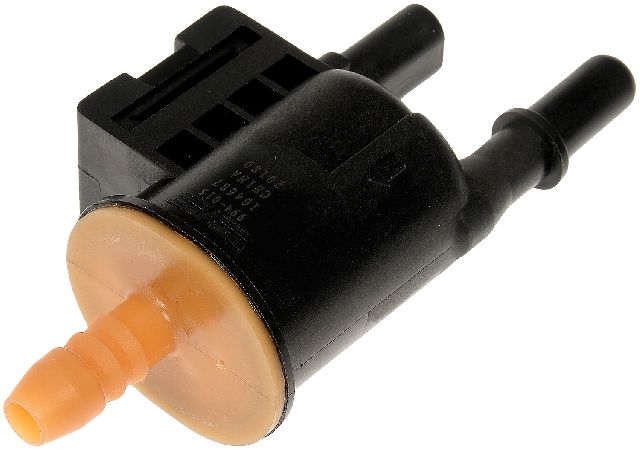
- Faulty EVAP Purge Valve/Solenoid 🔴 High Probability → Shop Vapor Canister This is a known high-failure item on the 2.4L Multiair engine family used in the Compass, Renegade, Dart, and others. The valve is a small electronic solenoid that cycles frequently and can get stuck open, stuck closed, or fail to open fully over time.
How to confirm: With the engine off, disconnect the valve. Try to blow air through it; if air passes, it is stuck open and is bad. If it's closed, use a scan tool to command the valve to open and listen for a distinct click. You can also apply 12V directly to its pins to test for the click. A stuck-open valve is the most likely cause if you experience hard starting after refueling.
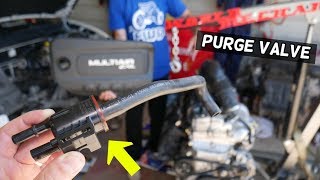
Typical fix: Replace the purge valve. It is located on the rear of the engine, mounted to the intake manifold. 🎬 Watch: See the exact location and how to replace it.
Est. part cost: $35-$75 - Cracked or Disconnected EVAP Hoses 🟡 Medium Probability The vacuum hoses connected to the purge valve are made of rubber and plastic and can become brittle and crack over time due to engine heat and vibration. Manufacturer Bulletin #1807023 notes that a disconnected crankcase ventilation hose can also be found during investigation of performance codes like P0441.
How to confirm: Visually inspect the hoses running to and from the purge valve for obvious cracks, breaks, or loose connections. A smoke test is the most definitive way to find a small, hard-to-see leak in the purge line.
Typical fix: Replace the damaged section of hose.
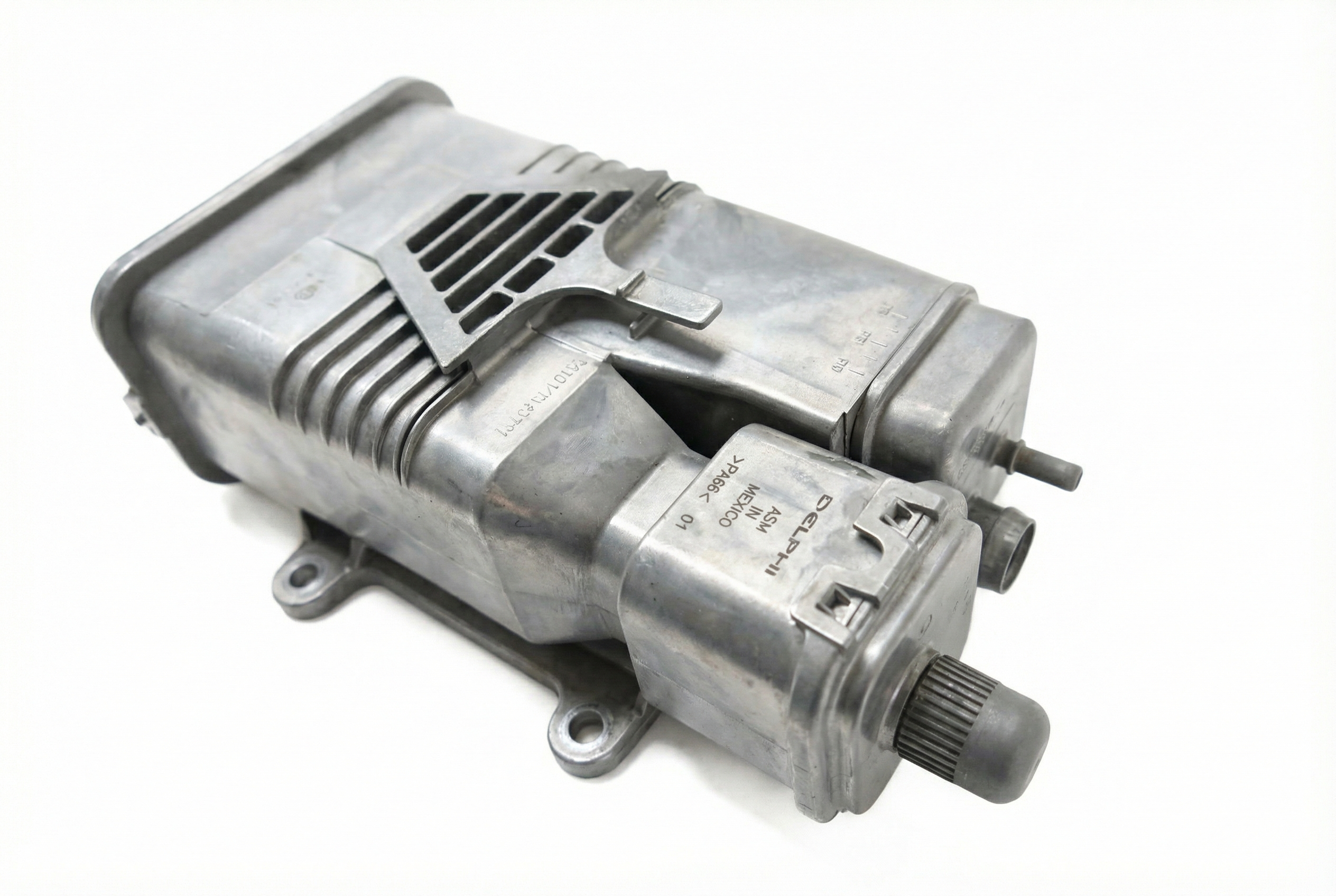
Est. part cost: $5-$20 - Clogged EVAP Purge Line or Charcoal Canister ⚪ Low Probability → Shop Vapor Canister This can happen if the charcoal canister fails and sends charcoal pellets into the purge line, creating a blockage. Overfilling the fuel tank repeatedly can also saturate the canister with liquid fuel, leading to failure and blockage.
How to confirm: Disconnect the purge line from the purge valve and from the canister. Attempt to blow compressed air through the line to check for restrictions.
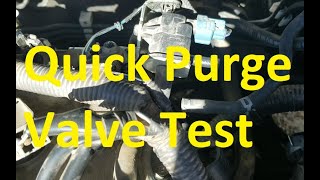
Typical fix: If the line is blocked, it may need to be cleared or replaced. If the canister is the source of the blockage, the canister itself must be replaced. 🎬 Watch: A simple way to test the valve without tools.
Est. part cost: $100-$250
Rare But Worth Checking
- Faulty Fuel Tank Pressure (FTP) Sensor: → Shop Fuel Tank The PCM relies on the FTP sensor to verify purge flow. If the sensor gives an inaccurate reading, the PCM might incorrectly flag a P0441 code. One owner of a related 2016 Jeep Cherokee reported that replacing the fuel pressure sensor resolved their P0441 issue after other attempts failed. Manufacturer Bulletin #1806122 also links P0441 with an EVAP pressure switch stuck closed.
- Outdated PCM Software: Jeep and other Stellantis brands have issued software updates for platform-mates like the Renegade, Dart, and Fiat 500X to fix overly sensitive P0441 triggers. TSBs like #18-022-17 REV. A for the Dart and #08-010-16 REV. D for the 500X specifically address this. While not confirmed with a specific TSB for the Compass, it's a strong possibility if all hardware checks out.
Diagnosis Steps
- Confirm P0441 is the only code present. If other codes exist, address them first, especially lean codes (P0171) or other EVAP codes.
- Check for symptoms like rough idle or hard starting after refueling, which strongly suggest a stuck-open purge valve.
- Locate the EVAP purge valve on the rear of the engine, near the intake manifold.
- Inspect the electrical connector and all attached vacuum hoses for cracks, damage, or loose fittings.
- Disconnect the purge valve. Attempt to blow through it. If air passes, the valve is stuck open and must be replaced.
- If the valve is closed, use a scan tool to command it open. Listen for a click. No click suggests an electrical failure in the valve or its circuit.
- If the valve clicks, test for vacuum. With the engine running, the port on the valve leading to the intake manifold should have vacuum. The port coming from the charcoal canister should only have vacuum when the valve is commanded open.
- If the valve and hoses appear to be in good working order, check with a dealer for any available PCM software updates, as this is a known fix on platform-mates.
- If all else fails, a professional smoke test to rule out obscure leaks or a check of the Fuel Tank Pressure sensor may be necessary.
Parts You'll Likely Need
- EVAP Vapor Canister Purge Valve / Solenoid
(OEM #04627182AA)— This is the most common point of failure for code P0441 on the 2.4L Multiair engine. It is a mechanical and electronic part that wears out over time.
Trusted brands: Mopar, Standard Motor Products (SMP), Dorman, SKP
OEM price range: $60-$75
Aftermarket price range: $35-$55
Related Codes That Often Appear With This One
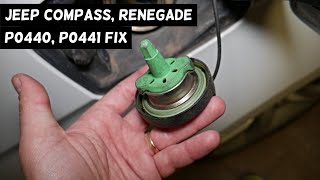
- P0440 — This is a general EVAP system fault code. A specific flow problem (P0441) can sometimes be flagged alongside the general code. TSBs for platform-mates often group these codes together as being potentially resolved by a software update. 🎬 Watch: Understanding P0440 and P0441 codes on your Jeep.
- P0442 — This code indicates a small EVAP leak. It's possible for a component to fail in a way that causes both a leak and a flow performance issue, triggering both codes.
- P0171 — System Too Lean. If the EVAP purge valve is stuck open, it creates a vacuum leak, allowing unmetered air into the intake manifold. This can cause the engine to run lean and trigger a P0171 code alongside the P0441.
- P0456 — EVAP System Small Leak. Manufacturer Bulletin #1807623 and Bulletin #18-035-25 both note that P0441 and P0456 often set together, requiring the use of a Small Leak Verification test (SLVT).
- P0506 — Idle Speed Performance Lower Than Expected. This code may be found alongside P0441 during investigations into vacuum leaks or purge performance issues, as noted in Bulletin #1807023.
Technical Service Bulletins (TSBs) & Recalls
- While not a formal TSB, a Chrysler 'Warranty Operations Newsletter' from 05-06-2020 provides diagnostic guidance for P0441, confirming it's a flow issue and not caused by the leak detection system (ESIM).
- TSB #18-022-17 REV. A and #18-023-16 for the Dodge Dart 2.4L indicate a PCM reflash can fix a false P0441 code.
- TSB #08-010-16 REV. D for the Fiat 500X 2.4L also lists a software update to resolve an overly sensitive P0441 trigger.
- Manufacturer Bulletin #18-035-25 identifies P0441 as a potential cause for Check Engine Light illumination specifically for North America and Mexico markets.
- Manufacturer Bulletin #1806122 notes that P0441 may be found in conjunction with P0452, indicating an EVAP pressure switch stuck closed.
Platform-Specific Known Issues
- Real-World Repair Story: Misdiagnosis Before Purge Valve: → Shop Vapor Canister A Reddit user with a 2017 Jeep Cherokee 3.2L (a close relative) reported getting a P0441 code. A repair shop charged them $600 to replace the ESIM, Vapor Canister Seal, and Leak Detection Pump, none of which fixed the issue. The Check Engine Light returned with the same P0441 code. The owner then replaced the purge valve themselves, which is the correct and most common fix for this specific code.
Mechanic-Grade Diagnostic Values
- EVAP Purge Valve Solenoid Resistance — expected: 15-40 Ohms at room temperature.. Failure: A reading of near-zero ohms indicates a shorted coil. An infinite reading (OL) indicates an open coil. Either requires replacement of the valve.
- EVAP Purge Valve Connector Voltage — expected: Approximately 12V (battery voltage) on one of the two pins with the key on, engine off.. Failure: No voltage on the power supply pin points to a problem upstream in the wiring or a blown fuse, not the valve itself.
Scan Tool Commands That Help
- wiTECH or equivalent professional scanner: EVAP Purge Solenoid Actuation / Duty Cycle — This bidirectional command allows a technician to manually command the purge valve to open and close. It's used to verify if the solenoid clicks audibly and to check if it physically opens and closes by testing for vacuum flow, confirming the mechanical and electrical integrity of the valve itself.
- wiTECH or equivalent professional scanner: EVAP System Test — This is an automated, forced-monitor test that runs the entire EVAP diagnostic sequence. It is used after a repair to verify the fix without needing to perform a full, lengthy drive cycle. It can also be used to confirm an intermittent fault is currently present. Manufacturer Bulletin #1807623 specifically recommends the wiTECH Small Leak Verification test (SLVT) if P0456 is present alongside P0441.
Wiring & Ground Locations
- PCM Connector C1, Pin 4 — On the main Powertrain Control Module (PCM), which is typically located in the engine bay.. This is the specific pin that the PCM uses to control the EVAP purge solenoid. A wiring diagram for the 2018 Compass identifies this wire as Dark Blue/White. Testing for a signal at this pin can isolate a wiring fault between the PCM and the purge valve.
- G300 / G301 — On other Jeep platforms, these are major chassis grounds located under the center console or seats. The exact location on the MP Compass may vary.. The PCM and its sensors rely on clean ground connections. A corroded or loose main ground can cause erratic electrical behavior and phantom codes, including EVAP faults. Checking major ground points is a valid diagnostic step when direct electrical tests on the component are inconclusive.
Model Year Variations Within This Range
- 2017: The 2017 model year was a transition year. Both the first-generation 'MK' Compass and the second-generation 'MP' Compass were sold. They are entirely different vehicles and do not share EVAP components like the vapor canister. It is critical to verify which platform a 2017 model is before ordering parts.
- 2017-2022: Parts listings specify engine variants such as '2.4L I4 MultiAir Engine w/ ESS' and '2.4L I4 Zero Evap M-Air Engine w/ESS'. The 'ESS' (Engine Stop-Start) and 'Zero Evap' designations may indicate slight differences in the EVAP system's components or control strategy to meet stricter emissions standards, though the primary P0441 causes remain the same.
Diagnostic Flowchart
Real Owner Stories
Aggregated from forums and TSBs cited above. Mileages and costs reflect what owners reported in those sources.
2017 Jeep Cherokee 3.2L
Symptoms: Check Engine Light returned with the same P0441 code after a shop replaced the ESIM, Vapor Canister Seal, and Leak Detection Pump.
What fixed it: The owner replaced the purge valve themselves after the shop's misdiagnosis.
Cost: $600
Source hint: Real-World Repair Story: Misdiagnosis Before Purge Valve (Reddit)
2015 Jeep Compass
Symptoms: Occasional sporadic drops in idle.
What fixed it: Advised that the purge solenoid is the most common culprit and to inspect vacuum hoses.
Source hint: Reddit r/MechanicAdvice
2016 Jeep Cherokee
Symptoms: P0441 code present, other repair attempts failed.
What fixed it: Replacing the Fuel Pressure sensor.
Source hint: KBB Service Advisor Comment Section
Jeep Cherokee Owner Report
Symptoms: An owner reported the engine light on for a P0441 code with a possible powertrain EVAP leak, noting that the transmission temperature was bouncing back and forth and the vehicle felt like it was "not wanting to get gas."
Source hint: NHTSA ODI #11516014
Related OBD-II Codes
Frequently Asked Questions
Is there a software update for the 2017-2022 Jeep Compass 2.4L to fix a false P0441 code?
My Jeep Compass is hard to start right after I get gas. Is this related to P0441?
Could the ESIM or Leak Detection Pump cause the P0441 code on my Compass?
Where is the EVAP purge valve located on the 2.4L Multiair engine?
How can I easily test if the purge valve on my Compass is bad?
What is the Mopar part number for the 2.4L Multiair purge valve?
Helpful Videos

Used OEM Parts in Stock
New Aftermarket Parts Available


The information in this article is provided for general reference and educational purposes only. Vehicle specifications, procedures, and part compatibility can vary by production date, trim level, and region. Always consult your vehicle's factory service manual and verify part numbers before purchasing or performing repairs. Safety-critical components such as airbags, seat belts, and braking systems should be installed by a qualified professional.
- Jeep Compass:
- 🧭 Diagnostic Flowchart
- 🎬 Helpful Videos
- 🛍️ Shop This Part
- What's Unique About the 2017-2022 Jeep Compass
- Symptoms You May Notice
- Most Likely Causes
- Rare But Worth Checking
- Diagnosis Steps
- Parts You'll Likely Need
- Related Codes That Often Appear With This One
- Technical Service Bulletins (TSBs) & Recalls
- Platform-Specific Known Issues
- Mechanic-Grade Diagnostic Values
- Scan Tool Commands That Help
- Wiring & Ground Locations
- Model Year Variations Within This Range
- Real Owner Stories
- 2017 Jeep Cherokee 3.2L
- 2015 Jeep Compass
- 2016 Jeep Cherokee
- Jeep Cherokee Owner Report
- Related OBD-II Codes
- Frequently Asked Questions
- 🎟️ Get 5% Off