

P0441 on 2016-2020 Kia Optima: Incorrect Purge Flow Causes and Fixes
For the 2016-2020 Kia Optima, code P0441 is most frequently caused by a faulty canister purge valve that is stuck open. This is a relatively inexpensive part (around $25-$75) and is easily accessible in the engine bay, making it a common DIY repair that can often be completed in under 30 minutes. The most specific symptom is difficulty starting the engine immediately after refueling.
- P0441 on a 2016-2020 Kia Optima almost always points to a faulty canister purge valve.
- Before buying any parts, check that the gas cap is tight and its seal is not cracked.
- The purge valve is an affordable part and is accessible in the engine bay, making this a very manageable DIY repair for most people.
- Driving with this code is safe, but it will cause you to fail an emissions inspection.
- Do not replace the more expensive charcoal canister unless a smoke test confirms it is leaking or it has been contaminated by overfilling the fuel tank.
What's Unique About the 2016-2020 Kia Optima
While many vehicles can get a P0441 code, on this generation of Kia Optima and its platform mates like the Hyundai Sonata, the canister purge valve is a very common, almost characteristic, failure point. The failure is almost always mechanical, with the valve getting stuck open, allowing un-metered fuel vapor to enter the intake manifold at the wrong time. This leads to the very specific and frequently reported symptom of a long crank or stall immediately after refueling, as the engine is flooded with vapor. Unlike some other Kia models that had software-related issues causing this code, for the 2016-2020 Optima, the issue is overwhelmingly a physical part failure.
Symptoms You May Notice
- Check Engine Light is on.
- Difficulty starting the engine, long crank times, or stalling immediately after refueling. This is the most specific symptom of a stuck-open purge valve.
- Slightly rough or fluctuating idle, especially when stopped.
- A faint smell of fuel is possible but uncommon.
- Slight decrease in fuel economy due to the inefficient burning of fuel vapors.
- Replacing the charcoal canister when the problem is the purge valve. The purge valve is a much more common failure point and should be tested first.
- Replacing the gas cap without checking the purge valve. While a bad gas cap can cause EVAP codes, P0441 on this vehicle, especially with the hard-start-after-refueling symptom, points very strongly to the purge valve.
Most Likely Causes
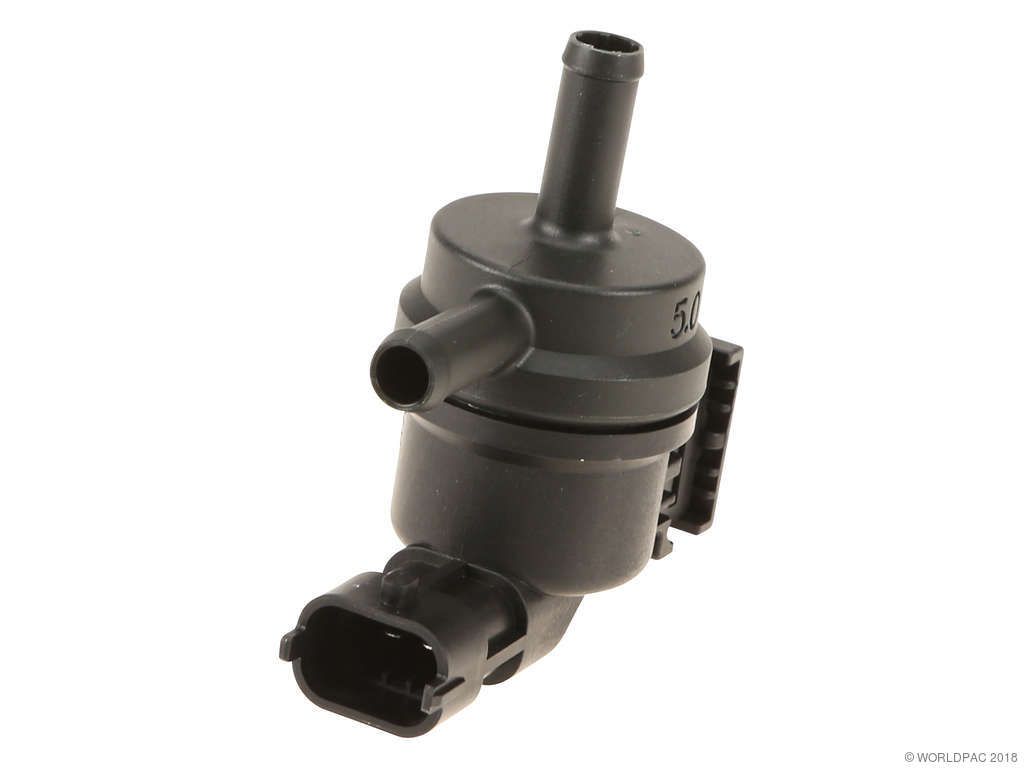
- Faulty Canister Purge Valve (Purge Control Solenoid) 🔴 High Probability → Shop Vapor Canister This specific component is a known high-failure item on many Kia and Hyundai models from this era, including the Optima, Sonata, and Forte. It tends to fail mechanically by getting stuck open, allowing a constant, incorrect flow of fuel vapors into the engine.
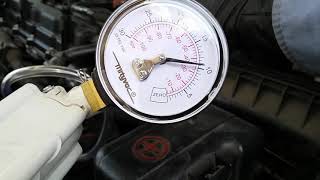
How to confirm: With the engine off, disconnect the purge valve. Try to blow through it from the canister side to the intake side. It should be closed and allow no air to pass. If you can blow through it, it is stuck open and faulty. Alternatively, with the engine off, use a hand-held vacuum pump on the valve's intake manifold port; it should hold vacuum. If it doesn't, it's faulty and needs to be replaced.
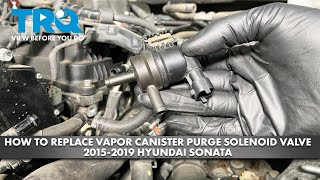
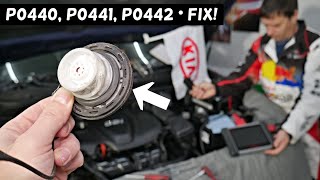
Typical fix: Replace the canister purge valve. It is located on top of the engine's intake manifold, held by one or two bolts, and connected by two hoses and an electrical connector. It is a simple replacement. 🎬 See this step-by-step guide to replacing the purge valve.
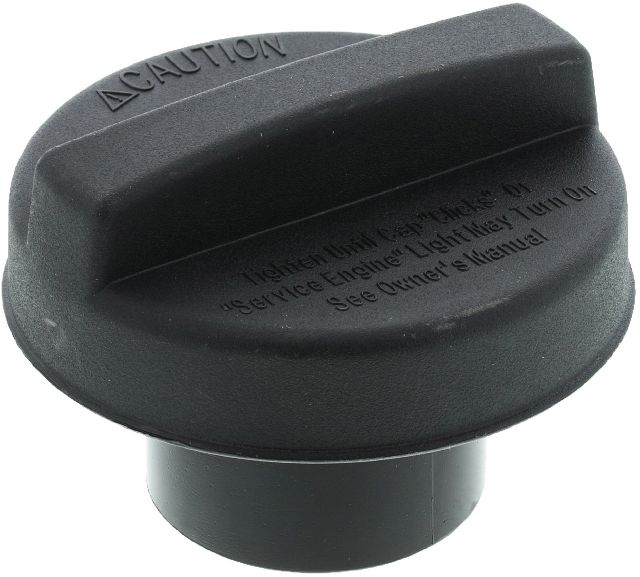
Est. part cost: $25-$75 - Loose or Faulty Gas Cap 🟡 Medium Probability → Shop Fuel Tank Cap The gas cap is a critical sealing point for the EVAP system. Over time, the seal can degrade, crack, or the cap's internal pressure relief valve can fail. Using a non-OEM cap can also cause sealing issues. While a bad cap usually throws a leak code (P0455/P0457), it's a simple and cheap item to check first.
How to confirm: Visually inspect the gas cap's rubber seal for cracks, tears, or signs of hardening. Ensure the cap clicks at least once when tightened. If the seal looks worn or the cap feels loose, it's suspect.
Typical fix: Replace the gas cap with a new, OEM-equivalent part. This is an inexpensive and simple first step in diagnosis.
Est. part cost: $10-$25 - Cracked or Disconnected EVAP Hoses ⚪ Low Probability Engine bay heat and vibrations can cause the rubber and plastic EVAP lines to become brittle and crack over time, especially at the connection points to the purge valve.
How to confirm: Visually inspect all accessible EVAP hoses between the purge valve, the intake manifold, and the line running back towards the charcoal canister. Look for obvious cracks, breaks, or loose connections. A smoke test performed by a mechanic is the most effective way to find small, hard-to-see leaks.
Typical fix: Replace the damaged section of hose. Ensure all connections are secure.
Est. part cost: $5-$30
Rare But Worth Checking
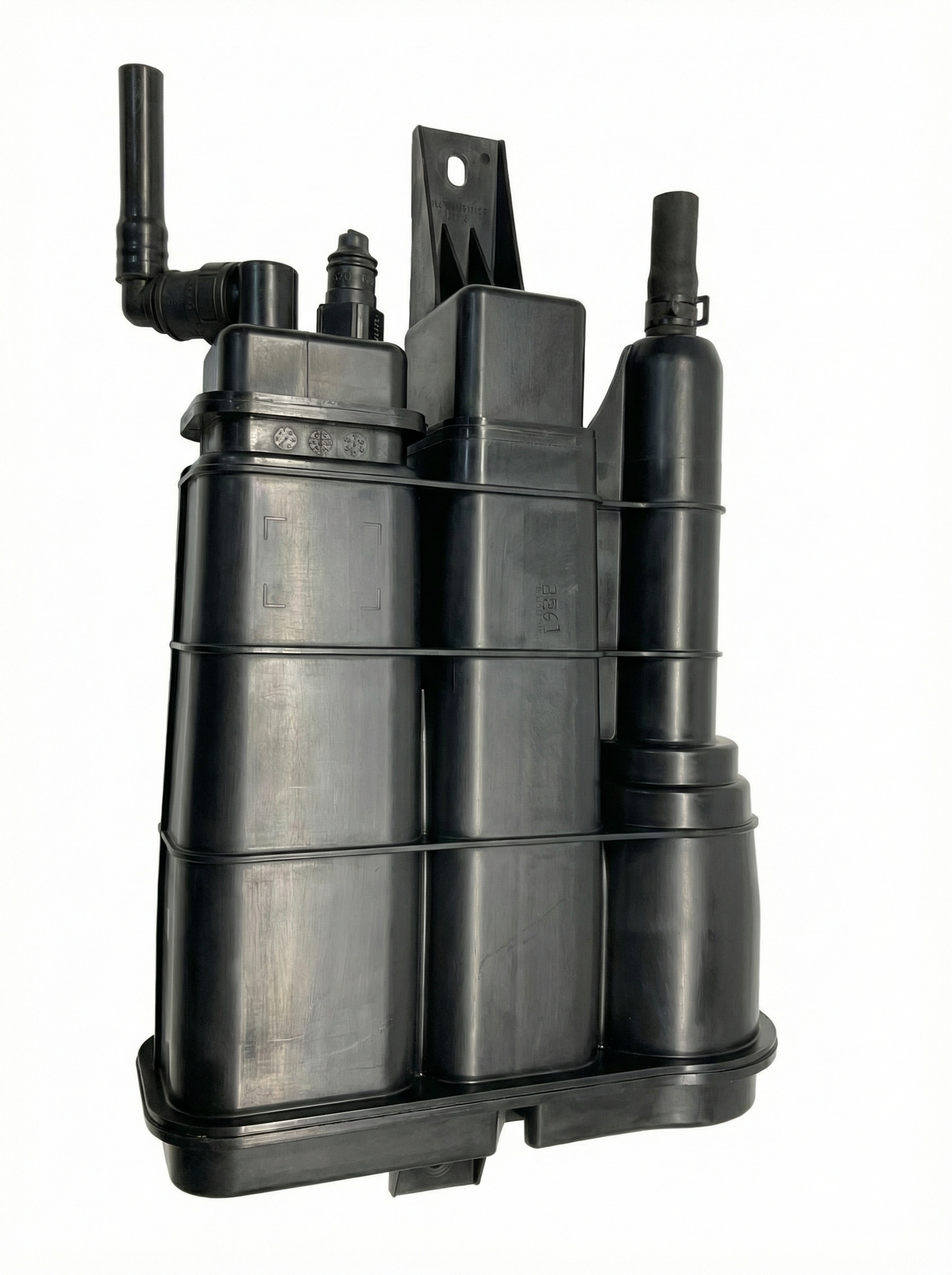
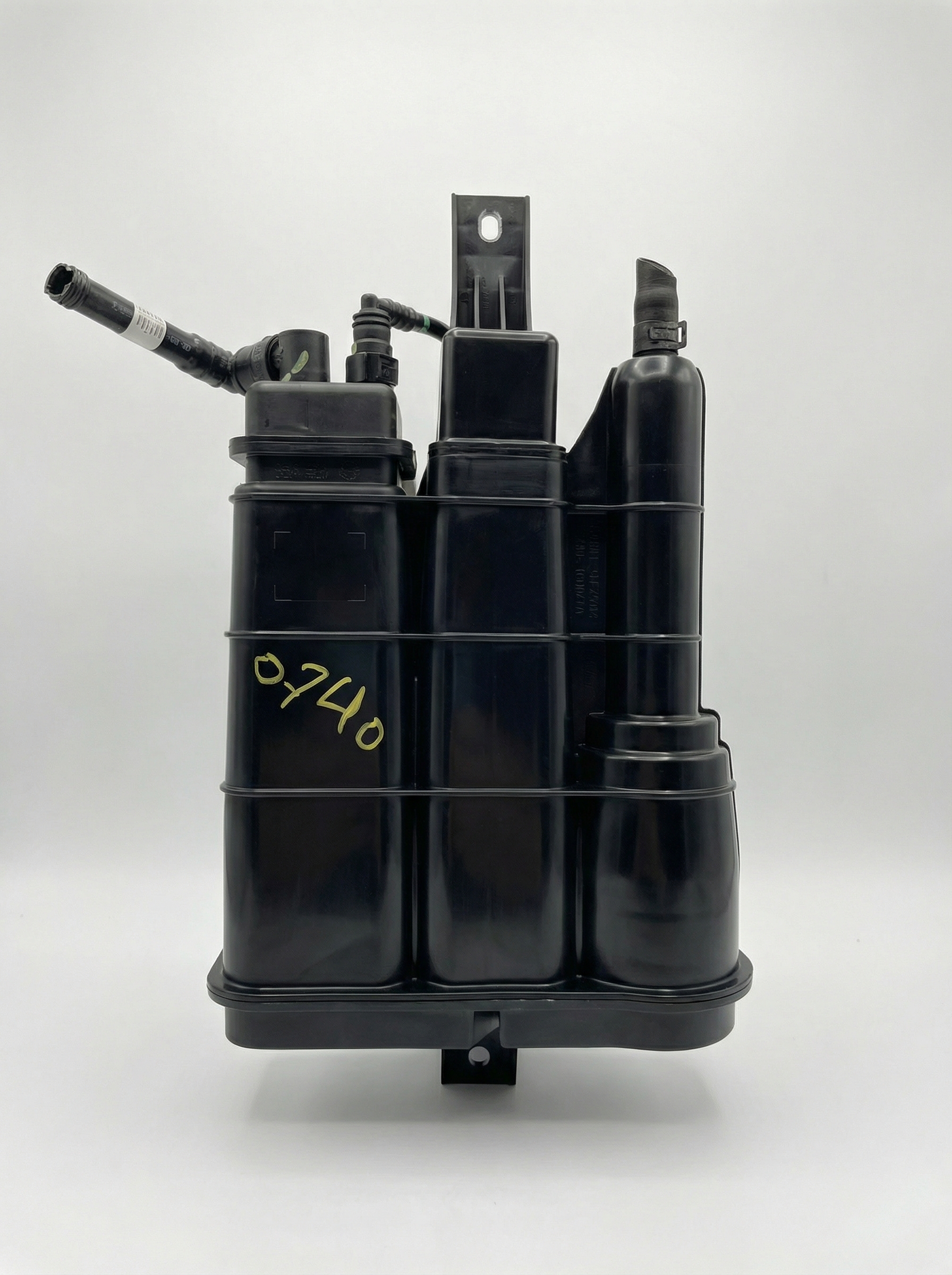
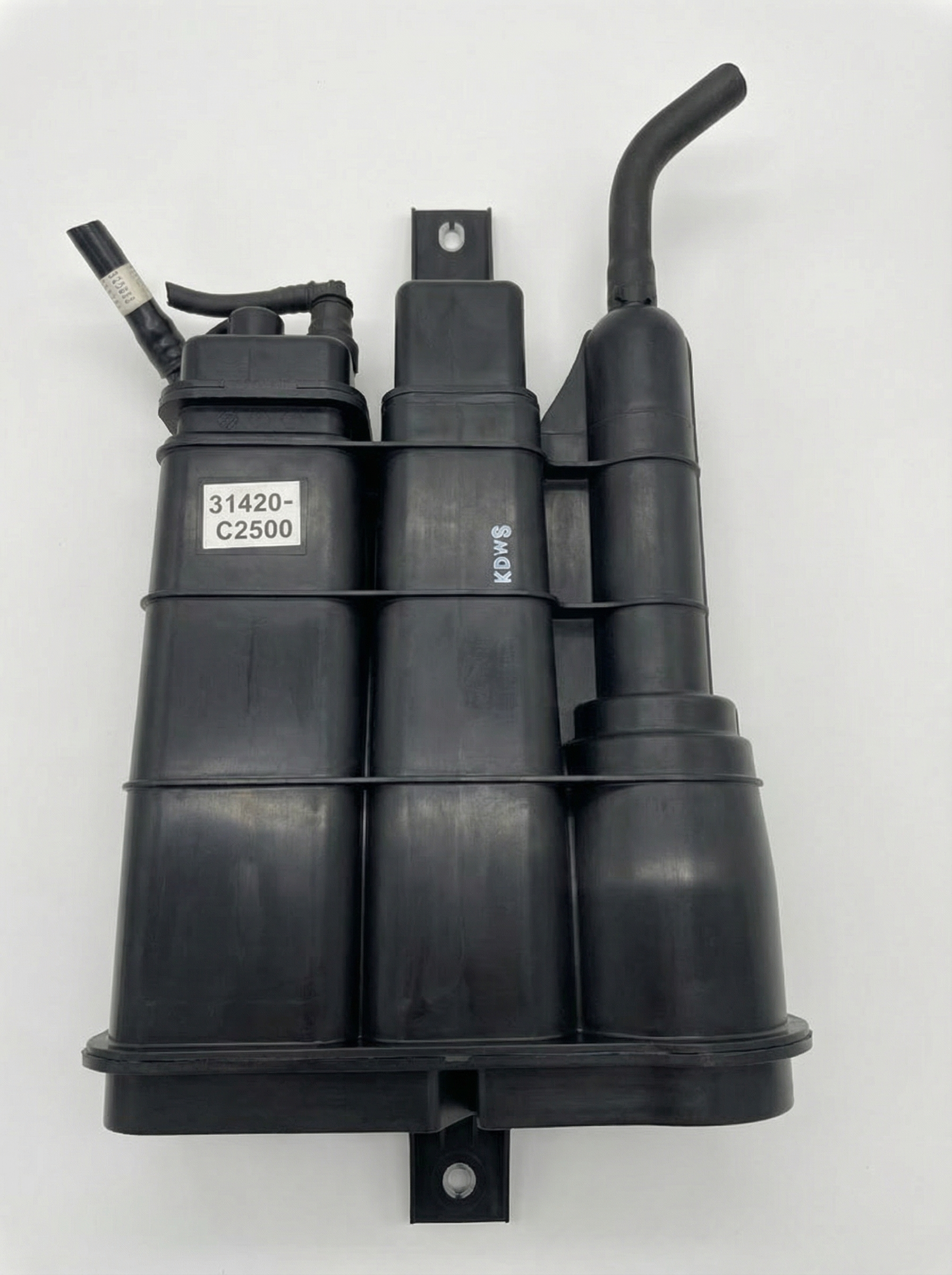
- Faulty Charcoal Canister or Vent Valve: → Shop Vapor Canister This is more common if you frequently overfill your gas tank ('topping off'), which can saturate the canister with liquid fuel and send charcoal pellets into the lines, clogging the purge valve. A failure here usually throws other codes like P0442 or P0455, but it can sometimes manifest as P0441.
- Blown Fuse for Purge Valve Circuit: → Shop Vapor Canister The purge valve is an electronic solenoid that requires power. If the fuse for the 'SENSORS' or EVAP circuit blows, the valve cannot operate, which could trigger a flow fault.
- Faulty Fuel Tank Pressure Sensor (FTPS): → Shop Fuel Tank The ECM uses the FTPS to verify correct purge flow. If the sensor itself is faulty and sending incorrect voltage readings, the computer may falsely believe there is a purge flow problem. This is a rare cause and should be investigated only after the purge valve has been confirmed to be working correctly.
Diagnosis Steps
- Read the code with an OBD-II scanner to confirm P0441 is the primary code. 🎬 Watch: A professional walkthrough for diagnosing P0441 on your Optima.
- Inspect the gas cap. Check for a tight fit and look for any cracks or damage on the rubber seal. Ensure it clicks when tightened. If in doubt, it's an inexpensive part to replace.
- Locate the canister purge valve in the engine bay, usually mounted directly on the intake manifold.
- Visually inspect the hoses connected to the purge valve for any obvious cracks, disconnections, or brittleness.
- Test the purge valve (engine OFF). Disconnect the hoses. Try to blow through the valve from the canister-side port to the intake-side port. It should be completely sealed and allow no air to pass. If air passes through, the valve is stuck open and must be replaced. This is the most common failure.
- If the valve is not stuck open, you can test its electrical operation. Apply 12V power to the solenoid's pins; it should click open and allow air to pass. If it doesn't click or open, it has failed electrically.
- If the purge valve and gas cap seem fine, the next step is a professional smoke test to check the entire EVAP system for small leaks in hoses or the charcoal canister.
- Check the fuse for the EVAP system/purge valve circuit in the fuse box (often labeled 'SENSORS 2' in the engine bay fuse panel) to rule out a simple electrical issue.
Parts You'll Likely Need
- Canister Purge Valve
(OEM #28910-3C200 or 29014-3E200 (Verify with VIN))— This is the most common failure point for code P0441 on this vehicle. It fails mechanically by sticking open. Part numbers can vary by engine type (2.4L, 2.0T, 1.6T), so it is critical to verify with your vehicle's VIN before purchasing. The part number from pass 1 (28910-26900) is incorrect for this generation.
Trusted brands: Hyundai/Kia Genuine, Standard Motor Products (SMP), Dorman
OEM price range: $40-$70
Aftermarket price range: $25-$50 - Fuel Cap
(OEM #31010-3L600)— A worn or damaged gas cap seal is a common cause for many EVAP system codes and is a simple, inexpensive part to rule out. Always consider an OEM cap for best fitment.
Trusted brands: Hyundai/Kia Genuine, Stant
OEM price range: $20-$30
Aftermarket price range: $10-$20
Related Codes That Often Appear With This One
- P0440 — General EVAP System Malfunction. This can appear alongside P0441 as it indicates a broader system fault.
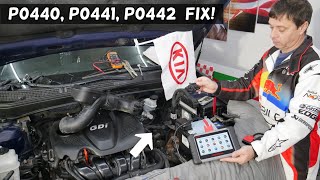
- P0442 — EVAP System Small Leak Detected. A failing purge valve that isn't sealing correctly can be interpreted by the system as a small leak. 🎬 Watch: How to fix multiple EVAP codes at once.
- P0455 — EVAP System Large Leak Detected. If the purge valve is completely stuck open, the system may interpret this as a large leak.
Technical Service Bulletins (TSBs) & Recalls
- Issued in August 2022 for 2016-2020 Optimas with the 2.0L T-GDI engine, this TSB provides an ECU logic update to improve fuel quantity learning and decrease deterioration of the rear Oxygen Sensor. While not directly for P0441, it shows that Kia has addressed emissions system logic on this platform via software updates.
- While not for the 2016-2020 Optima, this TSB for other Kia models (Rio, Soul) highlights that Kia has addressed P0441 with ECU logic updates in the past, though it's less likely to be the cause for this specific Optima range where mechanical failure is more common. For example, TSB Bulletin #TSBENG164_R2 and TSB Bulletin #TSB-ENG164 describe an ECU upgrade for P0441 logic improvement on the Kia Soul. Similarly, TSB Bulletin #TSB-ENG164R1 provides information for a software upgrade to address P0441 logic on the Kia Rio.
Platform-Specific Known Issues
- Owner reports on forums like Reddit frequently point to the purge valve as the immediate fix for P0441, often after experiencing the classic symptom of the car struggling to start after filling the gas tank.
Mechanic-Grade Diagnostic Values
- Canister Purge Valve Solenoid Coil Resistance — expected: 14-18 Ohms (based on similar Kia solenoids). Failure: A reading of infinite resistance (open circuit) or near-zero ohms (short circuit) indicates a failed solenoid.
- Fuel Tank Pressure Sensor (FTPS) Voltage at Idle (0 psi) — expected: ~2.5 Volts. Failure: Voltage is significantly higher or lower than 2.5V, indicating a biased or failed sensor that can fool the ECM into setting a P0441.
- Fuel Tank Pressure Sensor (FTPS) Voltage under Vacuum — expected: ~0.5 Volts at -0.54 psi. Failure: Voltage does not drop appropriately when the purge valve opens and pulls a vacuum on the tank, suggesting a flow problem or a bad sensor.
- Fuel Tank Pressure Sensor (FTPS) Voltage under Pressure — expected: ~4.5 Volts at +0.54 psi. Failure: Voltage does not rise as expected during EVAP system self-tests, pointing to a sensor or system sealing issue.
- Purge Valve Solenoid Power Supply Voltage — expected: Battery Voltage (approx. 12V) with key on, engine running.. Failure: No voltage at the power supply pin of the connector indicates a blown fuse or wiring issue upstream.
Scan Tool Commands That Help
- Kia GDS (Global Diagnostic System): EVAP Leakage Test — This is an automated, dealer-level test to command the EVAP system components (purge valve, vent valve) and monitor the FTPS to verify correct operation and sealing. It provides a pass/fail result to quickly confirm or deny a system fault after a repair.
- High-end bidirectional scanner (e.g., Autel, Snap-on): Purge Valve Actuation / Duty Cycle Control — This command allows a technician to manually open and close the purge valve while the engine is off. You can listen for an audible click and, with a vacuum gauge attached, confirm if the valve opens and seals on command, directly testing its mechanical and electrical function.
Wiring & Ground Locations
- Purge Valve Fuse — In the engine compartment fuse box.. The purge valve solenoid requires power to operate. A blown fuse, often labeled 'SENSORS 2', will prevent the valve from opening, causing the ECM to detect no purge flow and set code P0441.
- Purge Valve Connector — Directly on the canister purge valve, mounted to the intake manifold.. This 2-pin connector provides power and ground control from the ECM. Corrosion or a loose connection here can cause an open circuit (similar to a P0444 code) or intermittent operation, leading to a P0441 flow fault.
- Main Engine Ground — Typically a strap from the engine block to the chassis, or a bolt on the cylinder head/intake manifold area.. While not a direct cause, a poor engine ground can create floating voltages and erratic behavior in all engine sensors and actuators, including the purge valve and fuel tank pressure sensor, potentially leading to false codes. A wiring diagram is needed for the specific ground point (e.g., G###).
Real Owner Repair Stories
- YouTube channel 'Eazi DIY' (2011 Kia Sorento (platform shares many components)) — Engine would not start or had a very long crank time immediately after refueling. Check engine light was on with code P0441.
❌ Tried (didn't work) Replacing the gas cap twice.
✅ What actually fixed it Replacing the canister purge valve (solenoid) in the engine bay. After replacement, the vehicle started immediately after being refueled, confirming the fix. - Reddit user, r/MechanicAdvice (2016 Kia Optima LX Turbo) — P0441 code appeared. The original gas cap was loose ('shaking').
❌ Tried (didn't work) Replacing the loose OEM gas cap with an aftermarket one. The code did not clear after 3 days and 150km of driving.
✅ What actually fixed it The user's post was a request for help, but the common forum response was that the next logical step is to test and likely replace the canister purge valve, as the hard-start symptom strongly points away from the gas cap and towards the valve.
"I Checked Everything" — The Actual Cause
- If a smoke test shows no leaks in the EVAP system, the cause of P0441 is very likely not a physical leak but a functional failure. The most common scenario is a faulty Fuel Tank Pressure Sensor (FTPS) providing incorrect data to the ECM. The ECM determines 'incorrect flow' by watching the FTPS voltage change when the purge valve is opened. If the sensor is bad and its voltage doesn't change as expected, the ECM will set a P0441 code even if the purge valve and all hoses are perfectly fine.
OEM Part Supersession History
28910-3C200→28910-3L000 (for 1.6T engine in later years)— Part consolidation and potential design updates across model years and engine types.
Heads up: It is critical to verify the part number with the vehicle's VIN. While the valves may look physically similar, the flow rates and electrical characteristics can differ between engines (1.6T, 2.0T, 2.4L), and using the wrong part can cause the P0441 code to persist.
Model Year Variations Within This Range
- 2019-2020: For the 2019 model year refresh, some engine configurations (notably the 1.6T) may use a different purge valve part number (e.g., 28910-3L000) compared to the earlier 2016-2018 models which more commonly use 28910-3C200. Always verify by VIN.
Diagnostic Flowchart
Other Known Issues on This Vehicle
Issues unrelated to this code that are worth knowing about as an owner of this generation:
- Theta II GDI Engine Failure 🔴 High — Widespread across 2.4L GDI and 2.0L Turbo GDI engines. Can occur at various mileages, often preceded by knocking sounds and high oil consumption. (Ref: Subject of multiple recalls (e.g., SC147 for earlier models), a major class-action lawsuit, and subsequent lifetime warranty extensions for affected vehicles.)
- Excessive Oil Consumption 🟠 Medium — Commonly reported on the 2.4L and 2.0T engines, often a precursor to more serious engine problems. (Ref: Related to the engine class-action settlement and warranty extensions.)
- High-Pressure Fuel Pipe Leak 🔴 High — Less common than engine bearing failure, but a critical safety issue. (Ref: A recall was issued for some models within this generation because the fuel pipe connecting to the high-pressure pump could leak, increasing fire risk.)
- Transmission Shifting Issues 🟡 Low — Some owners report hard shifts, hesitation, or delayed engagement, particularly on cold starts. (Ref: Multiple TSBs exist for transmission logic updates and fluid application guides, such as TSB_TRA046_R3.)
- A/C Compressor Failure 🟡 Low — Reports of the A/C system providing weak cooling or the compressor failing entirely.
Used vs. New Parts: Buying Guide for This Vehicle
When a used part is the smart pick: For the common P0441 repair (canister purge valve), buying a used part is generally not recommended. The part is inexpensive new (typically $25-$70), and failure is due to internal wear and tear. A used part from a junkyard carries a high risk of having the same issue or failing shortly after installation.
Donor-vehicle mileage cap: roughly under 60000 miles for the part to have meaningful remaining life.
What to inspect on the donor part:
- If buying used is unavoidable, test the part before purchase.
- Attempt to blow through the valve; no air should pass when it is unpowered.
- If possible, apply 12V power to ensure the internal solenoid clicks open and closed.
- Inspect the plastic housing for cracks or heat damage.
OEM-only on this vehicle (don't cheap out):
- Fuel Cap - Aftermarket fuel caps are a frequent source of EVAP system problems due to improper sealing. It is strongly recommended to use a genuine Hyundai/Kia OEM cap to avoid introducing new issues.
Aftermarket brands forum-validated for this vehicle:
- Standard Motor Products (SMP) - Often cited in forums as a reliable alternative to OEM for various sensors and solenoids.
- Dorman - A widely available aftermarket option, though some professional technicians have mixed opinions, it is generally considered a viable replacement for this specific part.
Brands owners have reported issues with on this vehicle:
- No-name, unbranded parts from online marketplaces. While very cheap, these parts have a high failure rate and can be dimensionally incorrect, leading to wasted time and money.
Real Owner Stories
Aggregated from forums and TSBs cited above. Mileages and costs reflect what owners reported in those sources.
2016-2019 Kia Optima
Symptoms: Check engine light with P0441 code.
What fixed it: Replacement of the purge valve with a part that was a 'perfect fit'.
Source hint: eBay Feedback
2016-2020 Kia Optima
Symptoms: The car was struggling to start after filling the gas tank.
What fixed it: Replacing the purge valve, which is frequently cited as the immediate fix for these symptoms.
Source hint: Reddit - r/MechanicAdvice - P0441 error code
Related OBD-II Codes
Frequently Asked Questions
My 2017 Kia Optima 2.0L Turbo is having trouble starting after I fill up the gas tank. Is there a TSB for this?
Can I test the purge valve on my Optima myself before buying a new one?
How much should I expect to pay for a new purge valve for a 2016-2020 Optima?
Could a loose gas cap really be the cause of a P0441 on my Kia?
Is there a specific fuse I should check for the EVAP system on this vehicle?
Does the P0441 code relate to the Theta II engine failure issues on the Optima?
Helpful Videos


Used OEM Parts in Stock

New Aftermarket Parts Available


The information in this article is provided for general reference and educational purposes only. Vehicle specifications, procedures, and part compatibility can vary by production date, trim level, and region. Always consult your vehicle's factory service manual and verify part numbers before purchasing or performing repairs. Safety-critical components such as airbags, seat belts, and braking systems should be installed by a qualified professional.
- Kia Optima:
- 🧭 Diagnostic Flowchart
- 🎬 Helpful Videos
- 🛍️ Shop This Part
- What's Unique About the 2016-2020 Kia Optima
- Symptoms You May Notice
- Most Likely Causes
- Rare But Worth Checking
- Diagnosis Steps
- Parts You'll Likely Need
- Related Codes That Often Appear With This One
- Technical Service Bulletins (TSBs) & Recalls
- Platform-Specific Known Issues
- Mechanic-Grade Diagnostic Values
- Scan Tool Commands That Help
- Wiring & Ground Locations
- Real Owner Repair Stories
- "I Checked Everything" — The Actual Cause
- OEM Part Supersession History
- Model Year Variations Within This Range
- Other Known Issues on This Vehicle
- Used vs. New Parts: Buying Guide for This Vehicle
- Real Owner Stories
- 2016-2019 Kia Optima
- 2016-2020 Kia Optima
- Related OBD-II Codes
- Frequently Asked Questions
- 🎟️ Get 5% Off