

P0441 on 2003-2009 Lexus GX 470: EVAP Incorrect Purge Flow Causes and Fixes
On a 2003-2009 Lexus GX 470, code P0441 is most often caused by a worn-out gas cap or a faulty vacuum switching valve (VSV). Always check that the gas cap is tight and the seal is good before suspecting other parts. A new OEM gas cap is under $35, while replacement VSVs can range from $50 to $150.
- Start with the simplest fix: check and/or replace your gas cap. Use an OEM cap for best results.
- If the gas cap doesn't fix it, inspect the vacuum hoses in the engine bay for cracks, especially around the purge valve.
- The P0441 code on a GX 470 is very unlikely to cause any driving issues; it is an emissions-related fault.
- Don't be alarmed by the VSC lights; they are a secondary warning and will clear once the Check Engine Light is resolved.
- If you can't find the issue with a visual inspection, a smoke test performed by you or a professional is the fastest way to locate a leak.
What's Unique About the 2003-2009 Lexus GX
The 2003-2009 Lexus GX 470 (J120 platform) shares its EVAP system design with other Toyotas of the era, like the 4th Gen 4Runner. This system uses several vacuum switching valves (VSVs) both in the engine bay and near the charcoal canister in the rear. While the gas cap is a very common failure point, these VSVs are also known to stick or fail over time, causing incorrect vapor flow. Owners often find that after checking the gas cap, the next most likely culprits are the purge valve in the engine bay or one of the valves on the canister assembly itself. A stuck-open purge valve can sometimes lead to intermittent rough running or drivability issues as unmetered air enters the engine.
Symptoms You May Notice
- Check Engine Light is on
- VSC TRAC and/or VSC OFF lights are illuminated (this is a common secondary warning on Lexus/Toyota vehicles)
- No noticeable change in drivability or performance
- A faint fuel smell may be present in rare cases
- Slight difficulty starting or rough idle immediately after refueling
- Gas cap does not 'click' when tightened or feels loose
- Replacing the charcoal canister before testing the much more common and cheaper VSVs and hoses.
- Replacing O2 sensors or other unrelated emissions components because the Check Engine Light is on.
Most Likely Causes
- Loose or Faulty Gas Cap 🔴 High Probability → Shop Fuel Tank Cap The rubber O-ring seal on the gas cap degrades over time, losing its ability to maintain pressure. Owners often report the cap no longer 'clicks' tightly or feels loose even when fully screwed on. This is the most common cause for all EVAP codes, including P0441.
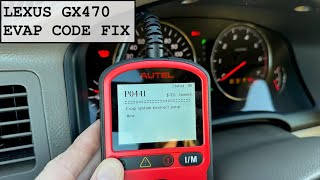
How to confirm: First, ensure the cap is tightened until it clicks multiple times. Inspect the rubber seal for cracks, stiffness, or damage. If the seal is worn or the cap is old, replacement is the easiest first step. A YouTube video by Auto Obscure Garage demonstrates this exact issue and fix. 🎬 Watch: How to diagnose and fix common GX470 EVAP codes.
Typical fix: Replace the gas cap with a new, OEM-quality part. The original part number 77300-33070 has been superseded by 77300-53010, which is an improved design.
Est. part cost: $25-$40 - Faulty Purge Valve (VSV) in Engine Bay 🟡 Medium Probability → Shop Vapor Canister This solenoid is located in the hot engine bay, and over time it can fail electrically or get stuck open or closed, preventing correct vapor flow. A stuck-open valve can cause a vacuum leak, leading to intermittent drivability issues.
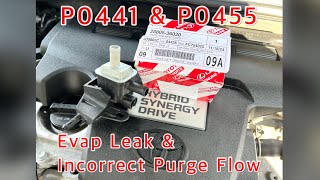
How to confirm: Locate the valve on the engine's intake manifold. With the engine off, disconnect the hoses and try to blow through it; it should be closed (no air passes). You can also apply 12V power to its two terminals; it should click open, allowing air to pass. A user on Reddit with P0441 and P0455 confirmed his valve was working with this test.
Typical fix: Replace the purge valve solenoid. This part is shared with many other Toyota/Lexus V8 models.
Est. part cost: $60-$120 - Cracked or Disconnected EVAP Hoses 🟡 Medium Probability The vacuum hoses, particularly in the engine bay, become brittle from heat and age. They can easily crack, split, or become disconnected, especially if work has recently been done under the hood (like a spark plug change). A ClubLexus user reported finding a disconnected hose under the intake tube after a service that caused a P0441.
How to confirm: Visually inspect all vacuum lines connected to the purge valve and running along the intake manifold. Pay close attention to the rubber elbows and connectors. A smoke test is the most effective way to find a leak that isn't obvious. Rodent damage is also a possible cause for chewed hoses.
Typical fix: Replace the cracked or broken section of hose with correctly sized EVAP-rated hose.
Est. part cost: $5-$25 - Sticking VSV on Charcoal Canister Assembly ⚪ Low Probability → Shop Vapor Canister The charcoal canister, located near the spare tire, has several VSVs mounted to it that control venting and system tests. These valves are exposed to the elements and can stick or fail. RepairPal notes this is a known issue with an improved valve available.
How to confirm: This is more difficult to diagnose without a bi-directional scan tool. It typically involves commanding the valves to open and close to check for response, or by removing them and testing them manually with a 12V power source. A smoke test can also help identify a stuck-open vent valve.
Typical fix: Replace the specific faulty VSV on the canister assembly. In some cases, the valves are only sold as part of the entire canister assembly, which can be costly.
Est. part cost: $50-$250
Rare But Worth Checking
- Failed Charcoal Canister: → Shop Vapor Canister While not as common, the canister itself can fail. This usually happens if the vehicle is habitually over-filled with gasoline (topping off after the pump clicks), which floods the canister with liquid fuel and ruins the charcoal. It can also crack from physical damage. This is usually suspected if other components test good.
- Rodent Damage: A user on a Reddit forum mentioned that a rat had chewed through several wires and hoses in their engine bay, leading them to suspect it could be the cause of their EVAP codes. The soy-based wiring insulation used in many modern vehicles can attract rodents.
Diagnosis Steps
- Read the Codes: Confirm P0441 is present. Note any other codes, as they can provide valuable clues (e.g., P0455 points to a large leak).
- Check the Gas Cap: This is the simplest and most common fix. Ensure the cap is tight. Remove it and inspect the rubber O-ring for cracks or damage. If it looks old or worn, replace it with an OEM part. The recommended OEM part number is 77300-53010. Clear the codes and drive for a few days to see if the light returns.
- Inspect Engine Bay Hoses: Visually inspect all vacuum hoses around the engine, particularly the ones connected to the EVAP purge solenoid. Look for any obvious cracks, splits, or disconnected lines. A user on ClubLexus found a disconnected hose was the culprit after performing other work.
- Test the Engine Bay Purge Valve (VSV): Locate the purge valve (Part No. 25860-50160). With the engine off, it should be closed (no air can pass through). With the engine running at idle, the line coming from the canister should not have a strong, continuous vacuum. A bi-directional scan tool can command the valve to open and close to verify function. You can also test it manually with a 12V power source.
- Inspect Rear Canister Assembly: If the front components are good, raise the rear of the vehicle and inspect the charcoal canister (near the spare tire) and its associated valves and hoses for any visible damage or cracks.
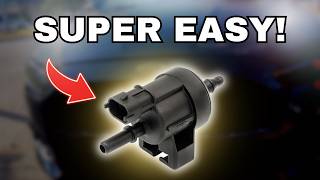
- Perform a Smoke Test: If the leak or flow issue is not visually apparent, the next step is to introduce smoke into the EVAP system via the service port. This will quickly reveal the location of any cracks or leaks in the hoses, canister, or seals. This is often the definitive next step 🎬 See how to perform a smoke test and replace the valve. after checking the gas cap and purge valve.
Parts You'll Likely Need
- Fuel Tank Cap
(OEM #77300-53010 (supersedes 77300-33070))— The seal on the original cap wears out, causing pressure loss. This is the most common and easiest part to replace for EVAP issues.
Trusted brands: Genuine Toyota/Lexus
OEM price range: $25-$40
Aftermarket price range: $15-$25 - Vapor Canister Purge Valve / Solenoid (Engine Bay)
(OEM #25860-50160)— This valve in the engine bay frequently fails due to heat and constant use, getting stuck open or closed and causing the 'Incorrect Purge Flow' condition.
Trusted brands: Denso, Aisin, Genuine Toyota/Lexus
OEM price range: $90-$150
Aftermarket price range: $50-$90 - Vacuum Switching Valve (VSV) - Canister Mounted — The valves on the canister assembly are a known failure point, often sticking due to exposure to road debris and moisture. They can be difficult to source individually.
Trusted brands: Genuine Toyota/Lexus
OEM price range: $50-$250
Aftermarket price range: $40-$100
Related Codes That Often Appear With This One
- P0446 — This code for the EVAP Vent Control Circuit often appears with P0441, as they are both part of the same system. A faulty VSV on the canister can trigger both codes.
- P0455 — This code indicates a 'Gross Leak' in the EVAP system. It frequently accompanies P0441 if the cause is a very loose gas cap or a completely disconnected hose, as this would cause both a large leak and incorrect purge flow.
- P0440 — This is a general EVAP system malfunction code. It's a catch-all that is often set alongside more specific codes like P0441 and P0446.
Platform-Specific Known Issues
- The illumination of the 'VSC TRAC' and 'VSC OFF' lights along with the Check Engine Light is standard behavior for many fault codes on this platform and does not typically indicate a separate problem with the stability control system.
Mechanic-Grade Diagnostic Values
- Engine Bay Purge Valve (VSV) Coil Resistance — expected: 30 to 34 Ω at 20°C (68°F). Failure: A reading of infinite resistance (open circuit) or zero resistance (short circuit) indicates a failed solenoid coil.
- Engine Bay Purge Valve (VSV) Function Test (Manual) — expected: With 12V applied to the terminals, the valve should click open and allow air to pass. With no power, it should be closed and block airflow.. Failure: If air passes when unpowered, the valve is stuck open. If it doesn't open or click when 12V is applied, it is seized or electrically failed.
- Engine Bay Purge Valve (VSV) Function Test (Live) — expected: When the engine is first started cold, there should be no vacuum felt at the canister-side port of the valve. After the engine warms up (5-10 minutes), the ECU will command it to open (often audibly clicking or buzzing), and a vacuum should be felt.. Failure: Feeling a vacuum immediately after a cold start indicates a stuck-open valve. Feeling no vacuum after the engine is fully warmed up suggests a stuck-closed valve or a command issue from the ECU.
Hidden / Shadow Codes Worth Checking
- Mode 6 Data (TID/CID): Mode 6 provides detailed results from the ECU's self-tests for specific components. For the EVAP system, this includes tests for purge flow, and the results are compared against minimum and maximum thresholds. A failing value here can pinpoint the part of the test that triggered the P0441 code, such as the 'stuck open' or 'stuck closed' check for the purge valve. (see via A professional scan tool or advanced OBD-II reader (like Toyota Techstream) that can display Mode 6 test results.)
Scan Tool Commands That Help
- Toyota Techstream: Evaporative System Check — This is a guided utility that allows a technician to automatically or manually command the various EVAP system valves (Purge VSV, Vent Valve/CCV) to open and close while monitoring the fuel tank pressure sensor. It is the definitive way to test the function of each component individually without manual removal, and to perform a system leak test by sealing the system and watching for vacuum decay.
- Bi-directional Scan Tool: Actuate Canister Vent Valve — During a smoke test, you can command the canister vent valve to close. If smoke still escapes from the vent, the valve is confirmed to be leaking or stuck open, a common failure on the rear canister assembly.
Wiring & Ground Locations
- PRG Pin on ECM — The Engine Control Module (ECM) is located behind the right side of the dashboard. The Purge VSV is controlled by a specific pin on the ECM connector, labeled 'PRG' in wiring diagrams.. For a deep electrical diagnosis, a technician can check for a command signal (a pulsed ground) directly at this pin to determine if the ECM is attempting to control the valve. A lack of signal points to an ECM or wiring issue, while a present signal with no valve action points to a wiring break or a bad valve.
- Junction Connectors (J1, J19, J20, etc.) — Located throughout the engine compartment and behind the dash, these connectors link various harnesses. For example, J1 is on the left side of the engine compartment, while J19 and J20 are on the right side of the dash.. Corrosion or a loose pin in a junction connector between the ECM and the purge valve can cause an open or high-resistance circuit, preventing the valve from operating correctly and triggering P0441.
Real Owner Repair Stories
- YouTube user 'melniks automotive' (2012 Lexus ISF (Similar V8 engine and EVAP principle)) — Check Engine Light with code P0441, sometimes followed by P0445.
❌ Tried (didn't work) Visual inspection of the rear charcoal canister and its hoses showed no issues., Inspection of the gas cap seal showed no cracks.
✅ What actually fixed it Found a dry-rotted and cracked vacuum hose right at the nipple of the purge solenoid in the engine bay. The end of the hose was cut off and re-secured with a clamp, which resolved the code. - BobIsTheOilGuy.com forum user (2005 Lexus GX470, 41,000 miles) — Check Engine Light with EVAP codes (P1445 in this case) appeared after a gas station attendant over-filled the fuel tank.
❌ Tried (didn't work) Resetting the code (it would return after the EVAP monitor ran).
✅ What actually fixed it The strong implication, supported by other users, was that over-filling the tank flooded the charcoal canister with liquid fuel, requiring its replacement. The user was trying to find a way to pass emissions without the costly repair. - NHTSA ODI #10381931 — An owner of a similar Lexus model reported recurring codes P0441, P0440, and P0046. While a loose gas cap was initially suspected, the actual resolution involved replacing a shorted-out canister switching valve.
Documented NHTSA Reports
- NHTSA ODI #11386326 — A report involving a Lexus vehicle noted that a non-replaced gasket created a potential fire hazard, with the vehicle displaying DTCs P0441 and P0455.
OEM Part Supersession History
77300-33070→77300-53010— Improved seal design to prevent premature wear and leakage.
Diagnostic Flowchart
Other Known Issues on This Vehicle
Issues unrelated to this code that are worth knowing about as an owner of this generation:
- Cracked/Sticky Dashboard 🟡 Low — Extremely common, especially in warmer climates. Lexus issued a Warranty Enhancement Program (ZLZ) to cover replacement for many years. (Ref: L-SB-0011-15 Rev1)
- Secondary Air Injection Pump Failure 🟠 Medium — Common on 2005+ models with the VVTi engine, typically occurring between 80,000-120,000 miles. The internal foam filter disintegrates and clogs the system.
- Seized Front Brake Calipers 🔴 High — Very common, particularly in regions with road salt. The caliper pistons corrode and stick, causing brake drag, overheating, and pulling.
- Cracked Exhaust Manifolds 🟠 Medium — A signature issue of the 2UZ-FE engine. Owners will notice a ticking sound on cold starts that may go away as the engine warms up.
- Rear Air Suspension Failure 🟠 Medium — The rubber airbags for the rear air suspension can dry rot and leak over time, causing the rear of the vehicle to sag. Many owners opt to replace the system with standard coil springs.
Used vs. New Parts: Buying Guide for This Vehicle
When a used part is the smart pick: Used parts can be a cost-effective option for larger structural components like the charcoal canister assembly (if verified to be dry and from a low-mileage vehicle) or associated mounting brackets. A complete engine bay vacuum hose assembly from a clean, low-mileage donor can also be a good value.
Donor-vehicle mileage cap: roughly under 100000 miles for the part to have meaningful remaining life.
What to inspect on the donor part:
- Inspect plastic components for chalkiness, brittleness, or fine cracks.
- Check rubber hoses for pliability; they should not feel hard or crunchy.
- Examine electrical connectors for green or white corrosion on the pins.
- If possible, source from a vehicle in a dry, non-salt-belt climate to minimize corrosion and plastic degradation.
OEM-only on this vehicle (don't cheap out):
- Gas Cap: Aftermarket gas caps are a very common source of recurring EVAP codes due to poor sealing. Always use a Genuine Toyota/Lexus cap (PN: 77300-53010).
Aftermarket brands forum-validated for this vehicle:
- Denso
- Aisin
Brands owners have reported issues with on this vehicle:
- Unnamed or 'white-box' electronic parts (like purge valves) from major online retailers are risky due to inconsistent quality control.
Real Owner Stories
Aggregated from forums and TSBs cited above. Mileages and costs reflect what owners reported in those sources.
2005 Lexus GX470 4.7L V8
Symptoms: Check engine light with P0441 and P0455 codes. Replacing the gas cap did not resolve the issue.
What fixed it: The owner performed diagnostic testing on the purge solenoid using a 12V source and investigated potential rodent damage and the need for a smoke test.
Source hint: Reddit r/MechanicAdvice: When evap codes (P0441/P0455) are not the gas cap (2005 Lexus GX470)
2nd Gen Lexus GX/IS
Symptoms: P0441 error code appeared immediately following a spark plug change.
What fixed it: Found a disconnected EVAP hose located under the intake tube that was difficult to see visually.
Source hint: ClubLexus: Error code po441
Lexus GX 470 4.7L V8
Symptoms: P0441 and P0455 codes present with drivability issues.
What fixed it: Identified a potentially stuck-open purge valve causing a vacuum leak; testing involved pinching off the hose to observe the effect on fuel trims.
Source hint: IH8MUD Forum: really stumped.
Related OBD-II Codes
Frequently Asked Questions
Why are my VSC TRAC and VSC OFF lights on when the problem is an EVAP code like P0441?
What is the correct replacement gas cap part number for a 2003-2009 Lexus GX?
Can a recent spark plug change cause a P0441 code on my GX 470?
Where is the charcoal canister located on the Lexus GX?
How can I test if the purge valve (VSV) in my engine bay is failing?
Helpful Videos

The information in this article is provided for general reference and educational purposes only. Vehicle specifications, procedures, and part compatibility can vary by production date, trim level, and region. Always consult your vehicle's factory service manual and verify part numbers before purchasing or performing repairs. Safety-critical components such as airbags, seat belts, and braking systems should be installed by a qualified professional.
- Lexus GX:
- 🧭 Diagnostic Flowchart
- 🎬 Helpful Videos
- What's Unique About the 2003-2009 Lexus GX
- Symptoms You May Notice
- Most Likely Causes
- Rare But Worth Checking
- Diagnosis Steps
- Parts You'll Likely Need
- Related Codes That Often Appear With This One
- Platform-Specific Known Issues
- Mechanic-Grade Diagnostic Values
- Hidden / Shadow Codes Worth Checking
- Scan Tool Commands That Help
- Wiring & Ground Locations
- Real Owner Repair Stories
- Documented NHTSA Reports
- OEM Part Supersession History
- Other Known Issues on This Vehicle
- Used vs. New Parts: Buying Guide for This Vehicle
- Real Owner Stories
- 2005 Lexus GX470 4.7L V8
- 2nd Gen Lexus GX/IS
- Lexus GX 470 4.7L V8
- Related OBD-II Codes
- Frequently Asked Questions
- 🎟️ Get 5% Off