

P0441 on 2002-2007 Saturn Vue: Incorrect Purge Flow Causes and Fixes
For a 2002-2007 Saturn Vue, code P0441 almost always means the EVAP purge valve has failed. A key symptom is trouble starting after getting gas. It's an affordable DIY fix, with the part costing $25-$70. Be sure to buy the correct valve for your specific engine (2.2L, 3.0L, or 3.5L), as they are not interchangeable.
- P0441 on your Saturn Vue almost always points to a bad EVAP purge valve.
- A classic symptom is your car struggling to start right after you put gas in it. This is a strong indicator the purge valve is stuck open.
- You MUST identify your engine before buying a new purge valve. The 2.2L, 3.0L, and 3.5L engines all use different parts.
- This is a very DIY-friendly repair. The part is usually easy to access in the engine bay and can be replaced in under 30 minutes with basic tools.
What's Unique About the 2002-2007 Saturn Vue
The first-generation Saturn Vue is unique because it used engines from different manufacturers. The 2.2L I4 and 3.0L V6 were GM engines, while the later 3.5L V6 was sourced from Honda. Because of this, the EVAP purge valve—the most common part to fail for code P0441—is completely different depending on which engine your Vue has. The 3.5L V6 uses a Honda-designed purge valve, a part known to be a frequent failure item on many Honda and Acura vehicles of that era. The location also varies: on the 2.2L, it's on top of the engine near the intake manifold, while on the 3.5L V6, it's under the intake manifold cover near the firewall.
Symptoms You May Notice
- Check Engine Light is on
- Difficulty starting the engine, especially right after filling the gas tank. The engine may crank but fail to start, or start and then immediately stall.
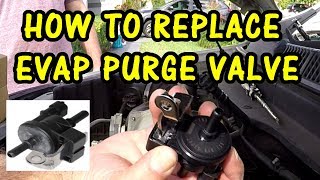
- Rough or erratic idle. 🎬 Watch: A breakdown of common bad purge valve symptoms
- Slightly reduced fuel economy
- Fuel smell (less common)
- Replacing the EVAP vent solenoid (near the fuel tank) when the issue is the purge solenoid (in the engine bay). P0441 specifically relates to purge flow, making the purge valve the primary suspect.
- Replacing the gas cap without testing the purge valve first. While a bad gas cap can cause EVAP codes, the symptom of hard starting after refueling strongly points to a stuck-open purge valve.
Most Likely Causes
- Faulty EVAP Canister Purge Valve/Solenoid 🔴 High Probability → Shop Vapor Canister The purge valve is a constantly working solenoid that can wear out or get stuck over time. On the 3.5L V6 models, the Honda-sourced valve is a known high-failure part across many vehicles. For all engines, it is the most common point of failure for this code because it can get stuck open, causing a constant vacuum leak of fuel vapors.
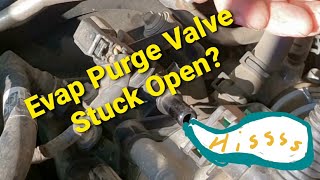
How to confirm: The simplest test is to remove the purge valve. With the engine off, try to blow through the valve from the canister side to the intake side. If any air passes through, the valve is stuck open and needs to be replaced. 🎬 See this quick and easy test for a stuck valve A scan tool can also command the valve to open and close to check for a response. Another quick check for a stuck-open valve is to start the car, disconnect the hose coming from the charcoal canister, and hold a small piece of paper over the valve's inlet port; if vacuum holds the paper to the port, the valve has failed open.
Typical fix: Replace the EVAP purge valve. Ensure you purchase the correct part for your engine, as they differ significantly.
Est. part cost: $25-$70 - Loose or Defective Gas Cap 🟡 Medium Probability → Shop Fuel Tank Cap The gas cap is a critical seal for the EVAP system. Over time, the rubber O-ring can dry out, crack, or get lost, preventing a proper seal. It's a common failure point on all vehicles and can cause various EVAP codes.
How to confirm: Inspect the gas cap for cracks or damage to the seal. Ensure it clicks at least three times when tightened. If it feels loose, the seal is damaged, or the check engine light appeared right after getting gas, it's suspect.
Typical fix: Replace the gas cap with a new OEM or high-quality aftermarket cap. This is an inexpensive and easy first step in diagnosis.
Est. part cost: $10-$25 - Cracked or Disconnected EVAP Hoses ⚪ Low Probability The rubber hoses in the engine bay are exposed to heat and can become brittle and crack over time, causing vacuum leaks. The plastic fittings can also become brittle and break.
How to confirm: Visually inspect all EVAP hoses connected to the purge valve and intake manifold for visible cracks, breaks, or loose connections. Flex the rubber sections to see if they are stiff or crack.
Typical fix: Replace the damaged section of hose or the broken fitting.
Est. part cost: $5-$20
Rare But Worth Checking
- Faulty EVAP Canister Vent Solenoid: → Shop Vapor Canister This valve is located near the charcoal canister under the vehicle. While it can cause EVAP codes, it's less likely to be the cause of P0441 specifically, which points to incorrect *flow* rather than a system leak. A failure here is more likely to trigger codes like P0446.
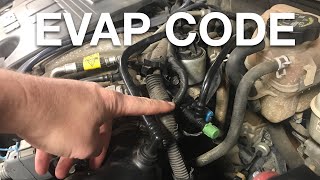
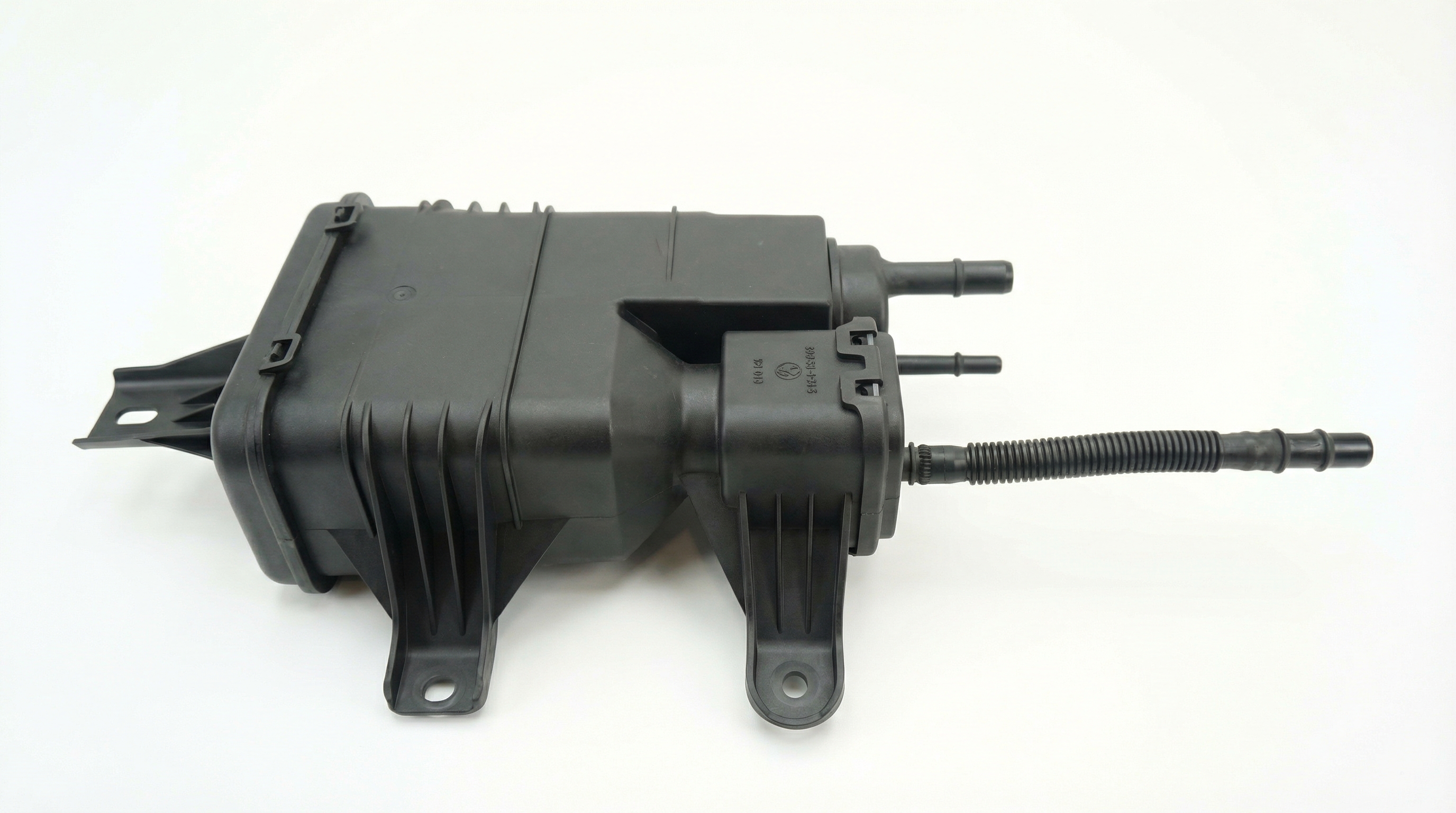
- Clogged or Failed Charcoal Canister: → Shop Vapor Canister If the charcoal canister becomes saturated with fuel (often from habitually overfilling the gas tank) or the internal filter breaks down, charcoal pellets can get into the EVAP lines and clog the purge valve, causing it to stick. If you replace a purge valve and find black pellets inside, the canister must also be replaced and the lines cleaned out. 🎬 Watch: Diagnostic and repair walkthrough for GM EVAP codes
Diagnosis Steps
- Check the gas cap. Make sure it is tight and inspect its seal for cracks or damage. If in doubt, it's an inexpensive first replacement.
- Visually inspect the EVAP hoses in the engine bay connected to the purge valve. Look for any obvious cracks, damage, or loose connections.
- Locate the EVAP purge valve. The location varies by engine: on the 2.2L, it's on the driver's side of the intake manifold; on the 3.5L, it's under the plastic engine cover near the firewall.
- Perform a manual test of the purge valve. Disconnect the electrical connector and the two hoses. Try to blow air through the valve. If air passes, it is stuck open and must be replaced.
- If the valve is not stuck open, the issue could be a blockage in a line or an electrical problem. Check for 12V at the electrical connector with the key on.
- If the purge valve and hoses are good, consider having the EVAP system smoke tested by a professional to find any hard-to-see leaks.
- Inspect the old purge valve for charcoal pellets. If found, the charcoal canister has failed and must be replaced, and the EVAP lines must be blown out to prevent the new valve from failing.
Parts You'll Likely Need
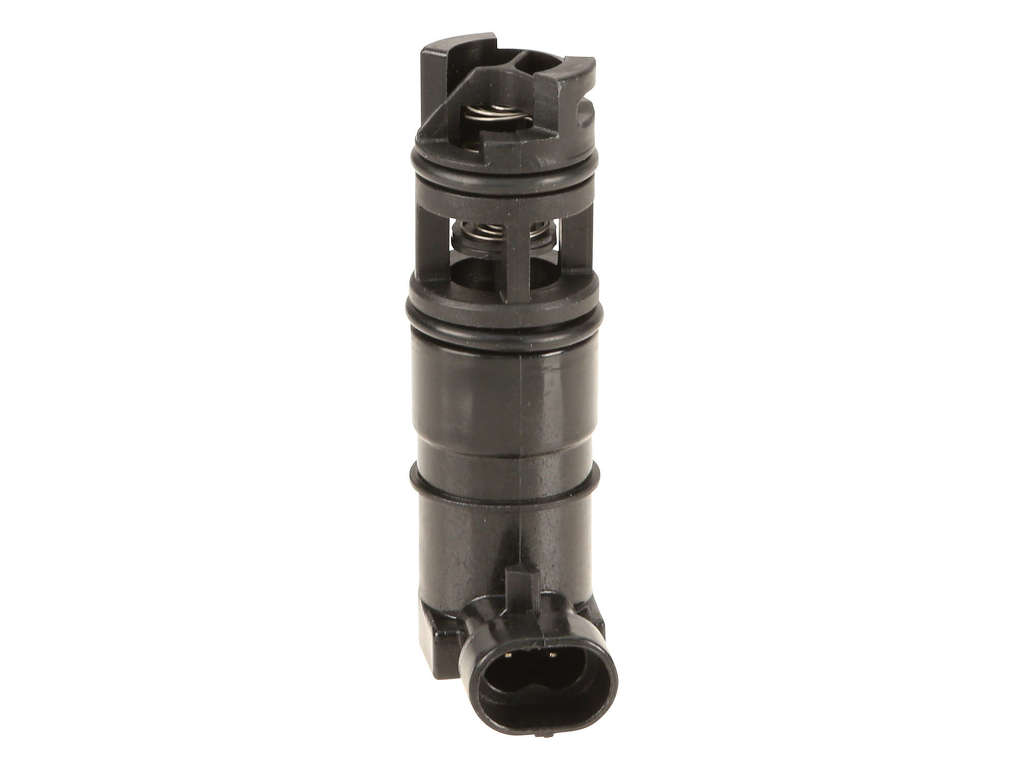
- EVAP Canister Purge Valve / Solenoid (for 2.2L L4 Engine)
(OEM #12597567)— This is the most common failure part for P0441 on the GM Ecotec engine. It gets stuck open or closed, causing incorrect purge flow.
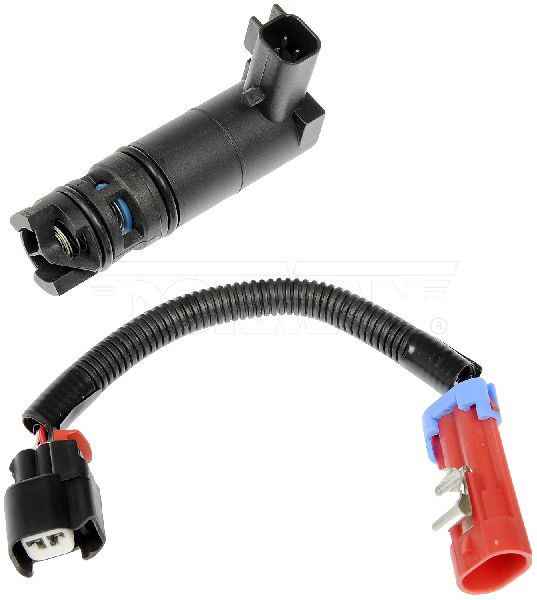
Trusted brands: ACDelco, Dorman (911-032), Standard Motor Products (CP471)
OEM price range: $30-$50
Aftermarket price range: $20-$40 - EVAP Canister Purge Valve / Solenoid (for 3.0L V6 Engine)
(OEM #12581369)— This is the most common failure part for P0441 on the GM 3.0L V6. It fails by sticking, which disrupts the flow of fuel vapors.
Trusted brands: ACDelco, Dorman, SKP
OEM price range: $60-$80
Aftermarket price range: $40-$60 - EVAP Canister Purge Valve / Solenoid (for 3.5L V6 Engine)
(OEM #36162-RDV-J01)— This Honda-made part is the primary cause of P0441 on Vues with the 3.5L engine. It is a known high-failure item across many Honda products using the J35 engine.
Trusted brands: Honda (OEM), ACDelco, Dorman (911-762), Standard Motor Products (CP509)
OEM price range: $50-$70
Aftermarket price range: $30-$50
Related Codes That Often Appear With This One
- P0440 — General EVAP System Malfunction. This can appear alongside P0441 as the system detects both a general fault and a specific flow problem.
- P0442 — EVAP System Small Leak Detected. A purge valve that is not sealing perfectly can be interpreted by the system as a small leak.
- P0455 — EVAP System Gross Leak Detected. A purge valve that is stuck wide open can be seen by the computer as a massive leak.
- P0496 — EVAP Flow During a Non-Purge Condition. This is a very similar code that specifically points to flow being detected when the valve should be closed, often caused by a stuck-open purge valve.
Platform-Specific Known Issues
- The use of three different engines (two GM, one Honda) across the 2002-2007 model years is the most significant issue. Owners must correctly identify their engine before ordering a purge valve, as the parts are not interchangeable.
- For Vues with the 3.5L V6, the purge valve is a known weak point shared with many other Honda vehicles like the Pilot, Odyssey, and Ridgeline, which all use a variant of the J35 engine.
Mechanic-Grade Diagnostic Values
- EVAP Canister Purge Valve Solenoid Coil Resistance — expected: 14 to 38 Ohms for most solenoids on this vehicle. Some GM electronic valves may be lower, in the 2.5-6 Ohm range.. Failure: A reading near 0 Ohms indicates a shorted coil. A very high or infinite (O.L.) reading indicates an open coil.
- Purge Valve Connector Power Pin Voltage (Key On, Engine Off) — expected: Battery Voltage (approximately 12.6V).. Failure: Little to no voltage suggests a blown 'EMISS' fuse or a break in the power supply wire from the under-hood fuse block.
- Purge Valve Connector Control Pin Signal (Engine Running) — expected: A pulsing ground signal commanded by the PCM. This can be observed as a fluctuating voltage on a multimeter or a flashing test light connected to battery positive.. Failure: A constant ground or no ground signal when commanded by a scan tool indicates a wiring fault or a rare PCM driver failure.
Scan Tool Commands That Help
- GM Tech 2: EVAP Service Bay Test — This function runs an automated, comprehensive test of the entire EVAP system, including the purge and vent valves and system integrity, simulating the conditions of a drive cycle while the vehicle is stationary. It will report a pass or fail for the system.
- GM Tech 2: Engine Output Controls > EVAP Purge Solenoid — This bidirectional control allows a technician to manually command the purge solenoid's duty cycle from 0% to 100%. This is used to verify if the solenoid clicks, if it opens to allow flow (checked with a vacuum gauge), and if it seals completely when commanded to 0% (checked with a smoke machine or vacuum decay test).
- GM Tech 2: Engine Output Controls > EVAP Vent Solenoid — This command forces the normally-open vent valve to close, which is essential for sealing the system to perform a smoke test or vacuum leak-down test. If smoke exits the vent area with this command active, the vent solenoid is faulty.
Wiring & Ground Locations
- EMISS Fuse — Located in the under-hood fuse block.. This fuse supplies 12V power to the EVAP purge solenoid. If this fuse is blown, the solenoid will have no power, preventing it from opening and causing a P0441 (no flow) or a P0443 (circuit fault) code.
- G105 / G107 — G105 is at the left rear of the engine (2.2L). G107 is at the rear of the engine (3.5L).. These are primary engine ground points. While not exclusively for the EVAP system, a poor connection at these locations can cause erratic behavior in various engine control components, including the PCM's ability to control the purge solenoid.
- G403 — Under the right side of the luggage compartment.. This is the main ground point for the Fuel Tank Pressure (FTP) sensor on 2.2L and 3.5L models. While not a direct cause of P0441, a bad ground here can cause incorrect FTP readings, potentially confusing the PCM's diagnosis of purge flow and leading to various EVAP codes.
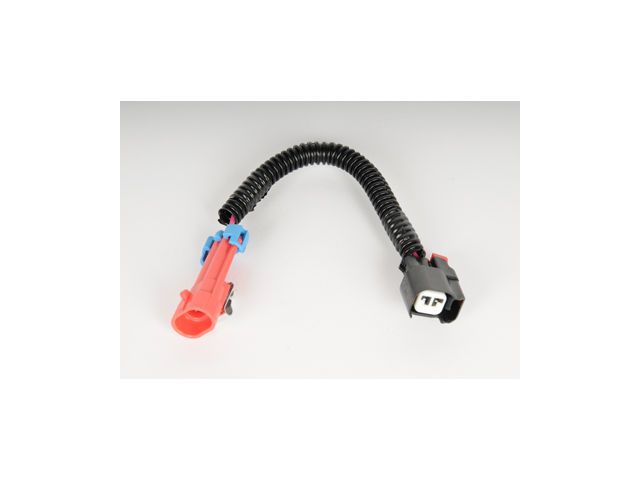
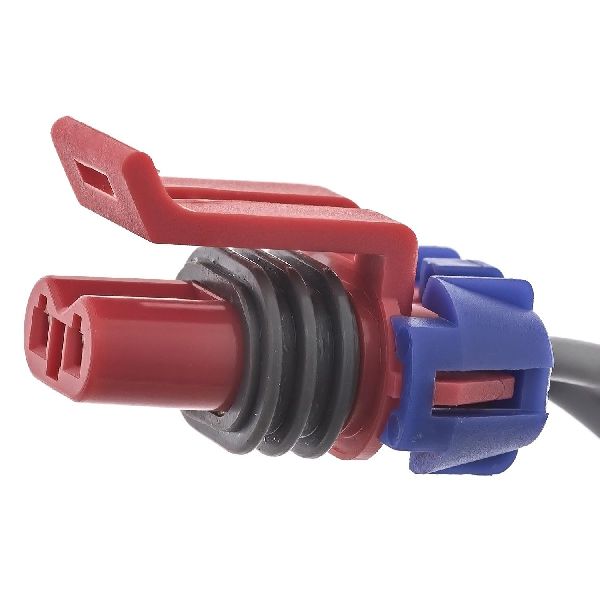
- Purge Solenoid Connector — Directly on the EVAP purge solenoid in the engine bay.. This two-pin connector is a common failure point. One pin receives 12V+ from the EMISS fuse (key on), and the other is the control wire that the PCM pulses to ground. Corrosion or a broken wire here will prevent the valve from operating. A replacement pigtail connector is available (e.g., Standard Motor Products S2931 for the 3.5L V6).
Real Owner Repair Stories
- YouTube user, 'EVAP Vent Valve Solenoid: P0446 Parts cannon series' (2004 Saturn Vue 3.5L V6) — Check Engine Light with code P0446 (Vent Control Circuit), but the diagnostic process is relevant to the entire EVAP system.
❌ Tried (didn't work) Replaced gas cap with a new GM part., Replaced the EVAP canister vent solenoid (located under the car on the charcoal canister).
✅ What actually fixed it The owner continued diagnosis by replacing the purge solenoid and then the fuel tank pressure sensor. This story highlights that even when a code points to one part (vent valve), the issue can be another component in the system, and a systematic approach is needed. The user was chasing a P0446, but the parts replaced (purge valve, vent valve, FTP sensor) are all common causes for general EVAP codes like P0441.
OEM Part Supersession History
GM 12597567 (For 2.2L Engine)→ACDelco 214-1680— Standard part lifecycle replacement.
Heads up: This part is often cross-referenced with Dorman 911-032 and fits a very wide range of GM vehicles.Honda 36162-RDM-A01, 36162-RJA-A01 (For 3.5L Engine)→Honda 36162-RDV-J01 (also sold as GM 12581985)— Part revision and consolidation for multiple Honda/Acura models.
Heads up: This part is used across many Honda J-series V6 engines from the mid-2000s, including the Accord, Odyssey, Pilot, and Ridgeline.
Diagnostic Flowchart
Other Known Issues on This Vehicle
Issues unrelated to this code that are worth knowing about as an owner of this generation:
- VTi CVT Transmission Failure 🔴 High — Extremely common on 2002-2005 4-cylinder models equipped with the VTi continuously variable transmission. Failure often occurs around 100,000 miles. (Ref: Subject of a class-action lawsuit and a special warranty extension to 5 years/75,000 miles, which has long since expired.)
- Ignition Key Removable While Not in 'Off' 🔴 High — Affected 2002-2004 models, leading to a vehicle rollaway risk. (Ref: GM Safety Recall 14506 issued in 2014 to inspect and replace the ignition cylinder if necessary.)
- Broken 35R Clutch Wave Plate (V6 Automatic) 🟠 Medium — On V6 models with the 6-speed automatic (6T70), a broken wave plate can cause loss of reverse and harsh 3-5 shifting. (Ref: A GM TSB exists advising on the correct installation procedure for the replacement plate during a rebuild.)
- Leaking Valve Cover Gaskets 🟡 Low — Reported on multiple model years, particularly around 130,000 miles. Can cause oil to leak onto hot engine components, creating a burning smell.
- Faulty Gas Cap Causing Check Engine Light 🟡 Low → Shop Fuel Tank Cap — A very common issue where the gas cap seal fails, causing an EVAP leak code (often not P0441, but P0442 or P0455) and illuminating the check engine light.
Used vs. New Parts: Buying Guide for This Vehicle
When a used part is the smart pick: Used parts are generally not recommended for this repair due to the high failure rate of the primary component, the purge valve. However, simple mechanical parts like mounting brackets or undamaged sections of hard plastic EVAP lines could be sourced from a junkyard if needed.
Donor-vehicle mileage cap: roughly under 40000 miles for the part to have meaningful remaining life.
What to inspect on the donor part:
- For a purge valve, only consider it if it's from a very low-mileage, front-end collision vehicle where the engine bay components are intact.
- Inspect all rubber and plastic parts for brittleness, cracking, or heat damage.
- Ensure electrical connectors are free of corrosion (green crust) and that the locking tabs are not broken.
Aftermarket brands forum-validated for this vehicle:
- ACDelco (often the OEM supplier for the GM engines)
- Standard Motor Products (SMP)
- Dorman (provides cost-effective alternatives, often with design improvements)
Brands owners have reported issues with on this vehicle:
- No-name, unbranded parts from online marketplaces can have very high premature failure rates. While the price is tempting, they often do not last.
Helpful Videos

Used OEM Parts in Stock
New Aftermarket Parts Available


The information in this article is provided for general reference and educational purposes only. Vehicle specifications, procedures, and part compatibility can vary by production date, trim level, and region. Always consult your vehicle's factory service manual and verify part numbers before purchasing or performing repairs. Safety-critical components such as airbags, seat belts, and braking systems should be installed by a qualified professional.
- Saturn Vue:
- 🧭 Diagnostic Flowchart
- 🎬 Helpful Videos
- 🛍️ Shop This Part
- What's Unique About the 2002-2007 Saturn Vue
- Symptoms You May Notice
- Most Likely Causes
- Rare But Worth Checking
- Diagnosis Steps
- Parts You'll Likely Need
- Related Codes That Often Appear With This One
- Platform-Specific Known Issues
- Mechanic-Grade Diagnostic Values
- Scan Tool Commands That Help
- Wiring & Ground Locations
- Real Owner Repair Stories
- OEM Part Supersession History
- Other Known Issues on This Vehicle
- Used vs. New Parts: Buying Guide for This Vehicle
- 🎟️ Get 5% Off