

P0442 on 2005-2013 BMW 3-Series: EVAP Small Leak Causes and Fixes
For a P0442 code on a 2005-2013 BMW 3-Series, the most common cause is a worn-out or loose gas cap. Replacing the gas cap (OEM part 16117222391) is an easy, sub-$40 fix and should be your first step. If the light returns, the issue is likely a faulty DMTL pump or purge valve, which can be pinpointed with a smoke test.
- Start with the simplest fix: check that your gas cap is tight. If it's old, replace it with OEM part #16117222391. This resolves the issue in a majority of cases.
- This code does not indicate an urgent problem and will not affect how the car drives, but it will cause you to fail an emissions test.
- Unlike many cars, your BMW uses a pressure pump (DMTL) to test the system, not vacuum.
- If a new gas cap doesn't fix the code, the next most likely causes are the purge valve (in the engine bay) or the DMTL pump (behind the rear driver's side wheel).
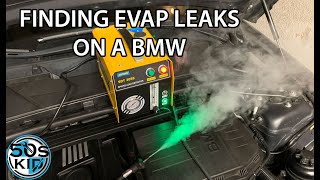
- The most definitive way to find the leak if it's not the gas cap is to have a mechanic perform a smoke test.
What's Unique About the 2005-2013 BMW 3-Series
The E9x generation 3-Series uses a unique system for leak detection called the DMTL (Diagnostic Module for Tank Leakage). Instead of creating a vacuum like many other manufacturers, the DMTL is a small electric pump that slightly pressurizes the fuel system with air after the car is off to test for leaks. The DME detects leaks by monitoring the electrical current drawn by the pump; a specific current reading corresponds to the pressure loss from a small leak, triggering the P0442 code. This can make diagnosis tricky, as the fault is an electrical interpretation of a physical leak. 🎬 Watch: Learn how the DMTL system diagnoses micro leaks. The test is often performed hours after the vehicle has been shut off to ensure thermal stability.
Generation note: This guide covers the entire E9x generation of the BMW 3-Series, which includes the E90 (Sedan, 2006-2011), E91 (Wagon, 2006-2011), E92 (Coupe, 2007-2013), and E93 (Convertible, 2007-2013). The EVAP system and common causes for this code are consistent across these models and their various engines (N51, N52, N54, N55).
Symptoms You May Notice
- Check Engine Light is on
- A 'Close gas cap' or 'Check fuel filler cap' warning message may appear on the dashboard or iDrive screen.
- A faint fuel odor near the vehicle, particularly around the rear wheel well (less common).
- No whoosh of pressure being released when opening the fuel cap after driving.
- Immediately replacing the expensive DMTL pump or purge valve without first checking or replacing the inexpensive gas cap.
- Replacing the charcoal canister when the actual leak is the small gasket for the DMTL pump that mounts to it.
- Assuming the code will clear itself immediately after tightening or replacing the gas cap. The EVAP monitor must run its self-test again, which can take several drive cycles under specific conditions. Clearing the code with a scanner is the fastest way to verify the fix.
Most Likely Causes
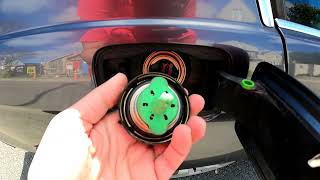
- Loose or Worn Gas Cap 🔴 High Probability → Shop Fuel Tank Cap The rubber O-ring seal on the gas cap becomes hard, brittle, and cracked over time due to age and exposure to fuel vapors, preventing a proper seal. Many owners report the original green seal cap being replaced by an updated blue seal version.
How to confirm: First, ensure the cap is tightened until it clicks at least once. Inspect the rubber seal (often green or blue) for any visible cracks, stiffness, or damage. If the seal is compromised, the cap is old, or the tether is broken, replacement is the best confirmation.
Typical fix: Replace the gas cap with a new OEM or equivalent part. After replacement, the code may need to be cleared with a scan tool.
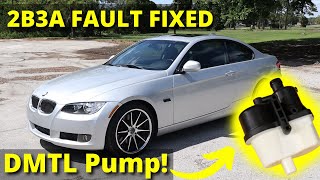
Est. part cost: $20-$40 - Faulty DMTL Pump 🟡 Medium Probability → Shop Evaporative Emissions System Leak Detection Pump The DMTL pump is a small, plastic-housed electro-mechanical part located near the charcoal canister that is exposed to the elements. The internal pump motor can fail, or the plastic housing can develop hairline cracks, causing a leak. The gasket sealing it to the charcoal canister can also fail.
How to confirm: Diagnosis requires a smoke test or a high-end bidirectional scan tool (like ISTA) to command the DMTL self-test. A smoke test will show smoke leaking from the pump housing or its connections if it is faulty. The pump is located behind the rear driver's side wheel well liner, requiring wheel and liner removal for access. 🎬 Watch: How to access and replace the DMTL pump.
Typical fix: Replace the DMTL pump and its associated gasket. The Bosch unit is a common OEM supplier.
Est. part cost: $100-$200 - Faulty Purge Valve (Tank Vent Valve) 🟡 Medium Probability → Shop Vapor Canister This solenoid, located in the engine bay, controls the flow of fuel vapors from the charcoal canister to the intake manifold. It can become stuck partially open due to carbon buildup or mechanical failure, creating a constant small leak within the system.
How to confirm: With the engine running at idle, disconnect the hose leading from the purge valve to the intake manifold and feel for suction with your finger. There should be no vacuum when the valve is not commanded on by the DME. A more definitive test involves applying 12V to the valve's pins to see if it clicks open and closed, and checking if it holds vacuum when de-energized.
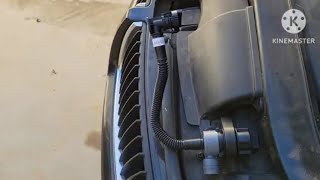
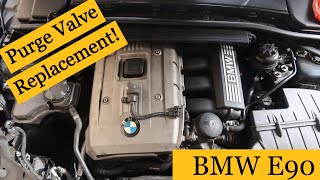
Typical fix: Replace the purge valve solenoid. This is a relatively simple replacement in the engine bay. 🎬 See this walkthrough for replacing the purge valve.
Est. part cost: $80-$120 - Cracked or Disconnected EVAP Hoses ⚪ Low Probability The plastic and rubber hoses that route fuel vapor can become brittle from engine heat and age, leading to hairline cracks. A forum user on Bimmerpost reported a line being chewed through by a mouse, which was found via a smoke test.
How to confirm: A smoke test is the most effective way to find a cracked hose. A visual inspection of the lines, particularly around the engine bay near the purge valve and under the car near the charcoal canister, may reveal obvious damage.
Typical fix: Replace the specific section of cracked hose.
Est. part cost: $20-$60
Rare But Worth Checking
- Cracked Charcoal Canister: → Shop Vapor Canister The canister itself, located behind the rear driver's side wheel well, can develop cracks from road debris impact or age, creating a leak. This is almost always found during a smoke test.
- Leaking Fuel Filler Neck: → Shop Fuel Filler Neck Corrosion or damage to the pipe leading from the gas cap to the tank can cause a leak, though this is less common than other components. A smoke test will reveal leaks in this area.
Diagnosis Steps
- Read the code with an OBD-II scanner to confirm P0442 is the primary code present.
- Inspect the gas cap. Remove it, check the rubber seal for cracks or hardness, and ensure it's the correct type for the vehicle. Ensure you hear a 'click' when tightening it.
- If the gas cap is old or shows any signs of wear, replace it with an OEM part (16117222391). This is the most common and cheapest fix. Clear the code with a scanner and drive for a few days to see if it returns. The EVAP monitor runs under specific conditions, so it may take time.
- If the code returns, perform a visual inspection of the EVAP lines in the engine bay near the purge valve and under the car near the charcoal canister (driver's side rear) for any obvious cracks or disconnections.
- Test the purge valve in the engine bay. With the engine at idle, disconnect the vapor line running to the intake manifold and check for vacuum. There should be none. If there is, the valve is stuck open and must be replaced.
- If the above steps do not resolve the issue, a professional smoke test is the most definitive next step. This involves injecting a harmless, visible vapor into the EVAP system to visually pinpoint the source of the leak. BMW issued a service bulletin (SIB 16 01 07) detailing the proper procedure for connecting a smoke machine to the DMTL port.
- The smoke test will identify leaks from the DMTL pump, charcoal canister, filler neck, or any cracked hoses that are not easily visible.
Parts You'll Likely Need
- Fuel Tank Cap
(OEM #16117222391)— This is the most frequent failure point. The seal degrades over time, is easy to replace, and is relatively inexpensive. Many owners report this as the fix.
Trusted brands: BMW (OEM), Blau, Rein
OEM price range: $30-$40
Aftermarket price range: $15-$25 - DMTL Pump
(OEM #16137193479)— The second most likely culprit after the gas cap. The pump motor fails or the housing cracks, causing a leak that the system itself is designed to detect. Bosch is the OEM manufacturer.
Trusted brands: Bosch (OEM), VDO
OEM price range: $150-$200
Aftermarket price range: $80-$130 - Purge Valve / Fuel Tank Breather Valve
(OEM #13907618643)— This solenoid is a common failure point on many vehicles. It can get stuck partially open, creating a small, constant leak path from the EVAP system to the engine intake. Bosch is the OEM manufacturer.
Trusted brands: Bosch (OEM), BMW (OEM)
OEM price range: $90-$120
Aftermarket price range: $50-$80
Related Codes That Often Appear With This One
- P0456 — P0456 indicates a 'very small leak'. These codes are closely related, differing only by the leak size detected by the DMTL system. An intermittent or developing fault could trigger either code as the leak size fluctuates.
Technical Service Bulletins (TSBs) & Recalls
- SIB 16 01 07: This Service Information Bulletin from BMW provides the official procedure for connecting a diagnostic smoke machine (like the Vacutec Leakfinder) to the EVAP system via the DMTL pump's fresh air inlet. This ensures the system isn't disturbed during testing.
- SIB 16 01 23: A newer bulletin that updates procedures for diagnosing micro-leaks using newer testing equipment.
Mechanic-Grade Diagnostic Values
- Purge Valve (Tank Vent Valve) Solenoid Resistance — expected: 27-29 Ohms or 35-45 Ohms (conflicting reports exist, but should be within a stable range, not open or shorted).. Failure: A reading of infinite resistance (open circuit) or a very high reading (e.g., 190+ Ohms) indicates a bad valve. A very low reading (near zero) indicates a short.
- DMTL Pump Current Draw — expected: The DME monitors the amperage drawn by the pump during its test cycle. The exact value is not a standard spec, but the principle is key.. Failure: The DME compares the measured current to a pre-programmed reference value for a 0.5mm leak. If the current draw is outside the expected range for a sealed system, it sets a leak code. A code like 2A17 can be set if the pump draws too much current, indicating an internal fault rather than a system leak.
Hidden / Shadow Codes Worth Checking
- 190302: Tank ventilation and purge air system, fine leak: Leakage greater than 0.5 mm. This is the direct BMW hex code equivalent for P0442. (see via BMW-specific diagnostic software like ISTA or advanced aftermarket scanners (BimmerLink, Foxwell, etc.).)
- 2A15 / 2A16: DMTL, small leak detected. These are common BMW-specific codes that correspond to P0442. (see via BMW-specific diagnostic software or advanced scanners.)
- 2A17 / P1447: DMTL, system failure. This code often points directly to a problem with the DMTL pump itself (motor failure, internal valve issue, or high current draw) rather than a leak elsewhere in the system. (see via BMW-specific diagnostic software or advanced scanners.)
- 2A18 / P240A: DMTL Pump Heater, activation / circuit open. This indicates a problem specifically with the heater element inside the DMTL pump assembly or its wiring. (see via BMW-specific diagnostic software or advanced scanners.)
Scan Tool Commands That Help
- ISTA (Integrated Service Technical Application): EVAP System Test Plan / DMTL Test Module — This is the dealer-level procedure to command the complete EVAP system self-test. It will activate the DMTL pump and seal the system, providing a pass/fail result and guiding the technician through further diagnostic steps. It is the most definitive way to test the system electronically.
- Bidirectional Scan Tool (Advanced): Vent Valve Activation / Purge Valve Activation — When performing a smoke test, the vent valve (part of the DMTL assembly on this car) is normally open. A bidirectional scanner is needed to command it closed, sealing the system. This allows the smoke to build pressure and reveal leaks instead of just venting to the atmosphere.
Wiring & Ground Locations
- DMTL Pump Connector X1714 — At the DMTL pump, located behind the driver's side rear wheel well liner, attached to the charcoal canister.. This 4-pin connector provides power and ground signals from the DME for the pump's three separate functions. A fault code could be caused by a break in one of these wires, not the pump itself. Pin 1: Pump Motor (Ground-switched), Pin 2: Heater (Ground-switched), Pin 3: Valve (Ground-switched), Pin 4: Power (+12V).
- Fuse F17 — In the Junction Box Electronics (JBE) fuse panel located behind the glove box.. This 10A fuse provides power to the entire DMTL pump assembly via the DME main relay (KL87). If this fuse is blown, the pump will be completely inoperative and may set various DMTL-related fault codes.
Real Owner Repair Stories
- Bimmerpost user on M3 Forum (BMW E9x M3) — Started with 'Tighten gas cap' warning, then 'Increased Emissions' with P0442.
❌ Tried (didn't work) Replacing the gas cap (code returned in a day)., Replacing a faulty O2 sensor (unrelated, but part of the diagnostic journey)., Replacing the DMTL pump (code returned after 2 days).
✅ What actually fixed it The user's next step was a smoke test, as replacing parts did not solve the issue. The final resolution was not posted, but the story highlights how replacing the most common parts may not be the fix, and a proper smoke test is the ultimate diagnostic step. - Bimmerpost user on E90 Forum (2006 BMW E90) — Persistent EVAP code (P0442).
❌ Tried (didn't work) Clearing the code with a scan tool.
✅ What actually fixed it A smoke test performed by the dealer revealed a hole in one of the EVAP lines near the fuel filler neck. The hole had been bitten by a mouse.
"I Checked Everything" — The Actual Cause
- In a case involving a 2004 BMW 325i with repeated DMTL pump failures, the dealer performed a smoke test and checked the gas cap, both of which were found to be OK. Despite this, the pump failed four times, throwing codes 27CC (DMTL - leakage) or 27CD (DMTL module failure). This indicates the root cause was likely not a physical leak (which a smoke test would find), but an underlying electrical issue, such as a faulty wiring harness causing intermittent shorts/opens or a problem with the DME's control of the pump, causing it to fail prematurely.
OEM Part Supersession History
16136752551, 16136764191→16137193479— Part has been redesigned and updated by BMW over the years to improve reliability.
Heads up: The newest part number (16137193479) is the correct replacement for the entire 2005-2013 generation. Using older, new-old-stock parts is not recommended. The Bosch equivalent part number is 0261222018.
Diagnostic Flowchart
Other Known Issues on This Vehicle
Issues unrelated to this code that are worth knowing about as an owner of this generation:
- Electric Water Pump & Thermostat Failure 🔴 High — Commonly fails between 60,000 and 100,000 miles, often without warning, leading to rapid overheating.
- Oil Filter Housing Gasket (OFHG) Leak 🔴 High — Extremely common across all engines (N52, N54, N55). The gasket hardens and leaks oil onto the serpentine belt, which can cause the belt to slip off and be ingested by the front main seal, leading to catastrophic engine damage.
- Valve Cover & Gasket Leak 🟠 Medium — Very common issue. The plastic valve cover can crack/warp, and the gasket becomes brittle, causing oil to leak onto the exhaust manifold (creating a burning smell) or into the spark plug wells (causing misfires).
- N54 High-Pressure Fuel Pump (HPFP) Failure 🔴 High → Shop Fuel Pump — A notorious issue on the twin-turbo N54 engine, leading to long cranks, loss of power, and limp mode. BMW issued an extended warranty for this part. (Ref: NHTSA Action Number: PE10045, BMW Extended Warranty)
- N54 Turbo Wastegate Rattle / Failure 🔴 High — Prevalent on higher-mileage N54 engines. Wear in the wastegate actuator rod causes a distinct rattling noise on deceleration and can lead to low boost fault codes. The typical fix is turbocharger replacement. (Ref: BMW extended warranty on turbochargers for some models.)
- Footwell Module (FRM3) Failure 🟠 Medium — The FRM3 module, which controls lighting and windows, can fail (or 'brick') due to low voltage during a battery change, jump-start, or even diagnostics. This results in non-functional lights, windows, and mirrors.
- N55 Plastic Charge Pipe Failure 🟠 Medium — The stock plastic charge pipe on the N55 engine is prone to cracking, especially on tuned cars, causing a sudden loss of power and a loud whoosh/bang as boost pressure escapes.
Used vs. New Parts: Buying Guide for This Vehicle
When a used part is the smart pick: For this repair, a used part is generally not recommended for electronic components like the DMTL pump or purge valve due to unknown remaining lifespan. However, a used charcoal canister from a reputable salvage yard can be a cost-effective option if the original is clogged, as it is a passive component. A used fuel filler neck could also be considered if the original is physically damaged or corroded.
Donor-vehicle mileage cap: roughly under 80000 miles for the part to have meaningful remaining life.
What to inspect on the donor part:
- For a used charcoal canister, ensure there is no smell of raw fuel and no loose charcoal pellets coming out of the ports when lightly shaken.
- Inspect the donor vehicle's records if possible to ensure it wasn't in a major collision that could have damaged the component.
- Check for physical cracks or damage on the plastic housing of any part.
OEM-only on this vehicle (don't cheap out):
- DMTL Pump
- Purge Valve
Aftermarket brands forum-validated for this vehicle:
- Bosch (This is the Original Equipment Manufacturer for both the DMTL pump and purge valve, offering OEM quality without the dealer markup).
Brands owners have reported issues with on this vehicle:
- Unnamed or generic 'white-box' brands from online marketplaces are a gamble. While some may work, forum discussions often contain stories of premature failure or incorrect operation, leading to the code returning.
Real Owner Stories
Aggregated from forums and TSBs cited above. Mileages and costs reflect what owners reported in those sources.
2006-2011 BMW 3-Series (E90)
Symptoms: Service Engine Soon (SES) light on with code P0442.
What fixed it: The owner followed a diagnostic journey that confirmed the gas cap, DMTL pump, and purge valve are the primary suspects, often requiring a smoke test for definitive diagnosis.
Source hint: e90post.com - Thread 'SES Error (P0442)'
2005-2013 BMW 3-Series
Symptoms: Small EVAP leak code P0442; visual inspection showed a damaged line.
What fixed it: A smoke test revealed a fuel vapor line had been chewed through by a mouse.
Source hint: bimmerpost.com / e90post.com forum user report
Related OBD-II Codes
Frequently Asked Questions
I see a 'Close gas cap' message on my iDrive screen; is this related to P0442?
My BMW has a green seal on the gas cap, but I heard there is an update. What should I use?
Is there an official BMW procedure for finding these small leaks?
Where is the DMTL pump located on the E90 3-Series?
Can I test the purge valve myself to see if it's causing the P0442 code?
Does BMW have a more recent bulletin for diagnosing micro-leaks?
Helpful Videos

The information in this article is provided for general reference and educational purposes only. Vehicle specifications, procedures, and part compatibility can vary by production date, trim level, and region. Always consult your vehicle's factory service manual and verify part numbers before purchasing or performing repairs. Safety-critical components such as airbags, seat belts, and braking systems should be installed by a qualified professional.
- BMW 3-Series:
- 🧭 Diagnostic Flowchart
- 🎬 Helpful Videos
- What's Unique About the 2005-2013 BMW 3-Series
- Symptoms You May Notice
- Most Likely Causes
- Rare But Worth Checking
- Diagnosis Steps
- Parts You'll Likely Need
- Related Codes That Often Appear With This One
- Technical Service Bulletins (TSBs) & Recalls
- Mechanic-Grade Diagnostic Values
- Hidden / Shadow Codes Worth Checking
- Scan Tool Commands That Help
- Wiring & Ground Locations
- Real Owner Repair Stories
- "I Checked Everything" — The Actual Cause
- OEM Part Supersession History
- Other Known Issues on This Vehicle
- Used vs. New Parts: Buying Guide for This Vehicle
- Real Owner Stories
- 2006-2011 BMW 3-Series (E90)
- 2005-2013 BMW 3-Series
- Related OBD-II Codes
- Frequently Asked Questions
- 🎟️ Get 5% Off