

P0442 on 1999-2004 Ford Mustang: EVAP Small Leak Causes and Fixes
For a 1999-2004 Mustang, the P0442 code is most often caused by a worn-out gas cap or a rotted fuel filler neck grommet. Start by replacing the gas cap with an OEM part. If that doesn't work, the filler neck grommet is the next most likely culprit, which is a more involved but common repair. A smoke test is the most definitive way to find the leak's exact location.
- Always start with the simplest fix: check and/or replace the gas cap with a quality OEM part.
- The second most likely cause on a 1999-2004 Mustang is a rotted fuel filler neck grommet (Part #2R3Z-9072-AA).
- Due to the vehicle's age, brittle plastic hoses and rubber fittings are a high-probability cause; a visual inspection is good, but a smoke test is the best way to find the leak.
- The vapor canister purge valve is in the passenger front wheel well, and the charcoal canister is in the driver's rear wheel well.
- Don't be alarmed by a P1000 code alongside P0442; it's normal after clearing codes and will go away on its own.
What's Unique About the 1999-2004 Ford Mustang
On the 1999-2004 'New Edge' Mustang, the EVAP system components are known to degrade over time, leading to this common code. Unlike later models with capless systems, the traditional gas cap and, more specifically, the rubber grommet that seals the fuel filler neck to the gas tank are frequent failure points. Due to the age of these vehicles, plastic and rubber components like vacuum lines, the filler neck grommet, and canister fittings become brittle and crack, making them a primary focus for diagnosis.
Symptoms You May Notice
- Check Engine Light is on
- A faint fuel smell, especially around the rear of the car or after filling up.
- Difficulty filling the gas tank (fuel pump nozzle clicks off repeatedly), which can indicate a clogged vent solenoid or canister.
- Audible vacuum or hissing sound near the gas cap or EVAP canister area after the engine is turned off.
- Replacing the fuel pump when the issue is a simple hose or grommet.
- Replacing the charcoal canister when the leak is just a loose fitting or a cracked hose connected to it.
- Immediately assuming a complex leak when the gas cap was not properly tightened or is a cheap aftermarket part.
Most Likely Causes
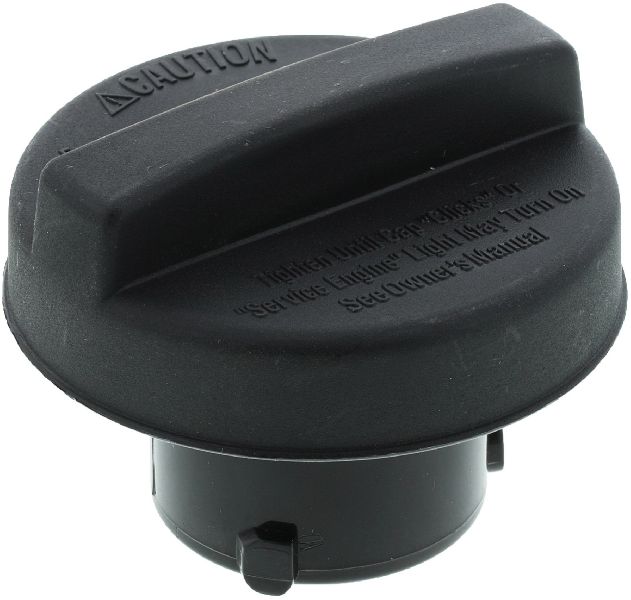
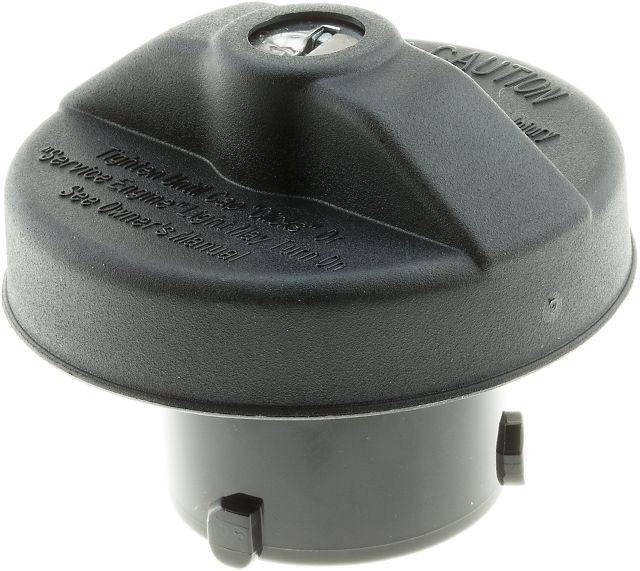
- Loose or Worn Gas Cap 🔴 High Probability → Shop Fuel Tank Cap The gas cap seal is a simple rubber O-ring that degrades, flattens, and cracks over time, preventing a proper seal. This is the most common and easiest fix.
How to confirm: Inspect the gas cap's rubber seal for any cracks, stiffness, or visible damage. Ensure it clicks at least three times when tightened. An aftermarket or incorrect cap is a very common cause of a bad seal.
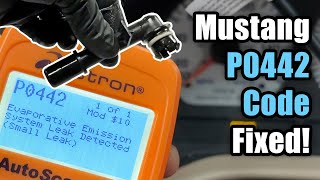
Typical fix: Replace the gas cap. It is highly recommended to use a genuine OEM Motorcraft part for a guaranteed proper seal. Clear the code and perform a drive cycle. 🎬 Watch: A complete guide to fixing code P0442 on your Mustang.
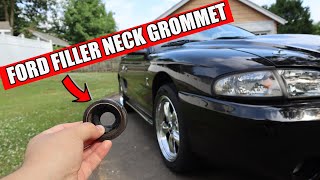
Est. part cost: $15-$30 - Deteriorated Fuel Filler Neck Grommet 🔴 High Probability → Shop Fuel Filler Neck The rubber grommet that seals the metal filler neck to the fuel tank is notorious for drying out, cracking, and crumbling on these models, creating a leak. This is one of the most cited fixes in owner forums.
How to confirm: A visual inspection may reveal cracking or signs of fuel leakage/staining around where the filler neck enters the gas tank. A smoke test is the most definitive way to confirm, as smoke will billow from the grommet area. Some owners report smelling raw fuel when the tank is more than half full.
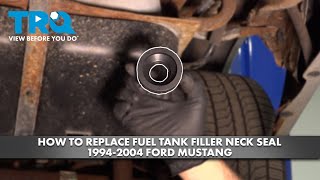
Typical fix: The fuel tank must be partially dropped to access and replace the grommet. Some owners have managed to replace it by removing the filler neck assembly without fully dropping the tank. The part number for all 1999-2004 models is Ford OEM 2R3Z-9072-AA. 🎬 See this walkthrough on replacing the fuel tank filler neck seal.
Est. part cost: $15-$25 - Cracked or Disconnected EVAP Hoses 🟡 Medium Probability With age, the plastic and rubber EVAP lines become brittle and can easily crack or break, especially at the fittings. This is common around the charcoal canister and the purge valve. A manufacturer service bulletin, TSB 25-2308, notes that P0442 can be caused by a "chaffing or rubbing condition between the fuel vapor canister line and the air vent hose."
How to confirm: Visually inspect all accessible EVAP hoses, particularly the lines running to and from the charcoal canister (located in the driver's side rear wheel well) and the purge valve (passenger side front wheel well or top of engine depending on year/model). A smoke test is the most effective method to find small cracks that aren't visible. In one instance, NHTSA ODI #10351913 describes a mechanic performing a smoke test and finding a "severed fuel line on top" of the system.
Typical fix: Replace the damaged section of hose or the broken fitting. In some cases, a specific pre-formed hose assembly may need to be ordered.
Est. part cost: $10-$50 - Faulty Vapor Canister Purge Valve 🟡 Medium Probability → Shop Vapor Canister This solenoid valve can get stuck partially open, creating a constant small leak in the system. It's a common failure item across many Ford models of this era. An owner reported in NHTSA ODI #11540072 that their check engine light for code P0442 "was caused by a faulty purge valve."
How to confirm: The valve is typically located in the passenger side front wheel well or on top of the engine near the throttle body. With the engine off, remove the valve and try to blow through it; it should be closed and block air. If air passes, it has failed. A professional can command it open and closed with a scan tool to test its function.
Typical fix: Replace the vapor canister purge valve. The Motorcraft part number varies by year; check fitment before ordering.
Est. part cost: $30-$60 - Leaking Charcoal Canister or Fittings ⚪ Low Probability → Shop Vapor Canister The plastic canister itself can develop cracks from road debris or age. More commonly, a hose fitting connected to the canister may become loose or its O-ring may fail, as documented by owners. Manufacturer bulletin SSM 49313 notes that P0442 may be due to "damage to the carbon canister which may have occurred during vehicle transportation."
How to confirm: The canister is located in the driver's side rear wheel well area. A smoke test is the best way to confirm a leak from the canister body or one of its fittings. One owner found a loose-fitting that needed to be reseated and secured with heat to reshape the retaining tabs.
Typical fix: If a fitting is loose, attempt to reseat it. If the canister body is cracked, it must be replaced. The Motorcraft part is widely available.
Est. part cost: $60-$90
Rare But Worth Checking
- Faulty Canister Vent Solenoid: → Shop Vapor Canister This solenoid, located near the charcoal canister, is normally open and closes to seal the system for testing. If it fails to close completely, it can cause a leak. It more commonly fails in a way that causes fueling issues or a P0446 code, but a partial failure could trigger P0442.
- Leaking Fuel Tank Gasket: → Shop Fuel Tank The gasket for the fuel pump assembly on top of the tank can leak, but this usually results in a much stronger fuel smell and potentially a larger leak code (P0455).
- Rusted Fuel Filler Neck: → Shop Fuel Filler Neck While the grommet is more common, the metal filler neck itself can rust through over time, creating a leak. This is often visible upon inspection.
Diagnosis Steps
- Check the Gas Cap: This is the #1 cause. Remove the gas cap, inspect the rubber seal for cracks or damage, and make sure it's an OEM or high-quality replacement. Tighten it until it clicks several times. Clear the code and drive for a few days to see if it returns.
- Visual Inspection: Thoroughly inspect all visible EVAP hoses in the engine bay (passenger side) and around the charcoal canister (driver's side rear wheel well). Look for any obvious cracks, breaks, or disconnected lines. Pay close attention to rubber elbows and plastic fittings that become brittle with age.
- Inspect Fuel Filler Neck Grommet: Safely raise the vehicle and inspect the area where the fuel filler neck enters the gas tank. Look for signs of dried, cracked rubber or fuel stains. This is a very common failure point on New Edge Mustangs.
- Perform a Smoke Test: This is the most effective way to find a small leak. A smoke machine forces low-pressure smoke into the EVAP system via the service port. Smoke will exit from any leak point, making it easy to pinpoint the exact location, whether it's a hose, grommet, canister, or valve.
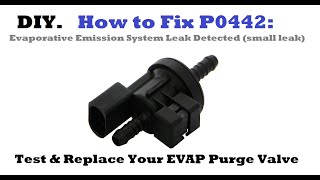
- Test the Vapor Canister Purge Valve: Locate the valve (often in the front passenger wheel well or on the engine). With the engine off, disconnect it and try to blow through it. It should be closed. If air passes through, the valve is stuck open 🎬 Watch: How to test and replace the EVAP purge valve. and needs to be replaced.
- Test the Canister Vent Solenoid: This valve is located near the charcoal canister. It is normally open and should close when voltage is applied. This test is best performed with a bi-directional scan tool that can command the valve to close.
Parts You'll Likely Need
- Fuel Filler Neck Grommet
- Fuel Cap
- Vapor Canister Purge Valve
- EVAP Vapor Canister
Related Codes That Often Appear With This One
- P1000 — This is not an error code. It simply means the OBD-II readiness monitors have not completed since the last time the codes were cleared. It will disappear on its own after a normal drive cycle and is expected to be present during diagnosis.
- P0455 — Indicates a large EVAP leak. If you see both P0442 and P0455, it could point to a component that has failed completely, like a hose that has become fully disconnected or a purge valve stuck wide open.
- P0457 — Indicates a leak detected due to a loose or missing fuel cap. This is very closely related and often points directly to a bad gas cap seal as the primary culprit.
Mechanic-Grade Diagnostic Values
- EVAP Canister Purge Valve Resistance — expected: 30 - 38 Ohms. Failure: A reading outside this range indicates a faulty valve coil.
- EVAP Canister Vent Solenoid Resistance — expected: 48 - 65 Ohms. Failure: A reading outside this range suggests the solenoid coil is bad.
Scan Tool Commands That Help
- Ford IDS, Autel, Snap-on, or similar: EVAP System Test / Service Bay Test — This function automatically commands the purge and vent solenoids to seal the system and monitors the Fuel Tank Pressure (FTP) sensor to check for a leak, confirming if a fault is present without a drive cycle.
- Ford IDS, Autel, Snap-on, or similar: Canister Vent (CV) Solenoid On/Off — During a smoke test, the CV solenoid is normally open. This command forces it closed to seal the EVAP system, allowing the system to be pressurized with smoke to find a leak.
Wiring & Ground Locations
- G400 — In the luggage compartment (trunk) on the driver's side.. This ground point serves the fuel pump driver module and rear lamps. A poor ground here can cause erratic behavior in the fuel system, which may indirectly affect EVAP readings or related components.
- G104 — Located in the engine bay on the driver's side, near the battery.. This ground is for the Data Link Connector (DLC). A poor ground here could potentially interfere with scan tool communication during diagnosis of the P0442 code.
- Secondary Power Ground — A braided strap running from the back of the intake manifold to the driver's side firewall.. This ground is critical for various engine accessories. While not directly tied to the EVAP system, it is often reported as missing or loose, and ensuring it's clean and tight is a key step in resolving any electrical gremlins on this platform.
Real Owner Repair Stories
- StangNet Forums (2001 Ford Mustang) — Check Engine Light with code P0442, strong smell of raw fuel after turning the car off, visible drip under the passenger side near the exhaust.
❌ Tried (didn't work) Initially suspected the gas cap.
✅ What actually fixed it The gas tank filler neck grommet was completely shot and had failed, causing both the fuel smell, the leak, and the P0442 code. Replacing the grommet resolved the issue. - NHTSA ODI #10852382 — An owner reported that their check engine light came on with code P0442 and "the scent of gas was present." Despite changing the fuel cap, the issue remained.
"I Checked Everything" — The Actual Cause
- A user on an SN95 forum noted that a P0442 can be set even if a smoke test shows no leaks. If the fuel tank pressure (FTP) sensor quits working or provides an incorrect reading, the PCM can interpret this as a leak, triggering the code.
Model Year Variations Within This Range
- 1999-2004: The location of the Vapor Canister Purge Valve can vary. On some models/years, it is located on the firewall near the center or in the passenger side front wheel well. On 2004 models specifically, wiring diagrams show it at the right rear of the engine compartment. Always visually confirm the location before ordering parts.
Diagnostic Flowchart
Other Known Issues on This Vehicle
Issues unrelated to this code that are worth knowing about as an owner of this generation:
- Cracked Plastic Intake Manifold (GT) 🔴 High — Very common on 1999-2001 GT models with the all-plastic manifold. The front coolant crossover is prone to cracking, causing a major coolant leak. Ford later updated the part with an aluminum crossover. (Ref: A class-action lawsuit led to an extended warranty (7 years/unlimited miles) for this part, but it has long since expired.)
- Spark Plug Ejection (2-Valve V8) 🔴 High — The cylinder heads on 4.6L 2V engines have few threads for the spark plugs, which can lead to a plug being forcibly ejected from the head, damaging the threads. It is a well-known and documented issue.
- Idle Air Control (IAC) Valve Failure 🟠 Medium — A failing IAC valve is common and leads to rough idling, stalling, or a high idle speed. It often gets clogged with carbon and can sometimes be cleaned, but replacement is a common fix.
- TR-3650 Manual Transmission Issues 🟠 Medium — The TR-3650 used from mid-2001 to 2004 can have issues with grinding shifts, particularly the 1-2 shift, and synchro wear.
- Self-Adjusting Clutch Cable Failure 🟡 Low — The factory plastic self-adjusting clutch quadrant under the dashboard is prone to breaking, leading to a loss of clutch pedal function. Many owners proactively replace it with a more durable metal quadrant and firewall adjuster.
- Cracked/Deteriorated Cowl Vent Grille 🟡 Low — The black plastic panel at the base of the windshield becomes brittle from sun exposure and cracks, which is a very common cosmetic issue.
Used vs. New Parts: Buying Guide for This Vehicle
When a used part is the smart pick: For this repair, used parts are generally not recommended for the most common failure items. However, a used but rust-free fuel filler neck or an intact charcoal canister body (if the original is physically cracked) from a dry-climate donor car could be a cost-effective option. Always test a used electronic part like a solenoid before installation.
Donor-vehicle mileage cap: roughly under 50000 miles for the part to have meaningful remaining life.
What to inspect on the donor part:
- For rubber/plastic: Check for pliability, absence of cracks, and a firm seal.
- For filler necks: Inspect for any rust, especially around the cap sealing surface and mounting brackets.
- For canisters/solenoids: Ensure there are no cracks in the plastic housing and that electrical connectors are free of corrosion.
OEM-only on this vehicle (don't cheap out):
- Fuel Cap: Aftermarket caps are a notorious cause of EVAP codes. Always use a genuine Motorcraft cap (e.g., FC-945) to ensure a proper seal.
- Fuel Filler Neck Grommet: This part (2R3Z-9072-AA) is inexpensive and critical for a proper seal. Given the labor to access it, using a new OEM part is the only sensible choice.
Aftermarket brands forum-validated for this vehicle:
- Standard Motor Products (SMP): Often cited as a reliable OE-quality alternative for EVAP components like the canister vent solenoid (CVS19) and purge valve.
Brands owners have reported issues with on this vehicle:
- Unbranded/white-box gas caps from online marketplaces are frequently reported by owners to cause EVAP codes.
Real Owner Stories
Aggregated from forums and TSBs cited above. Mileages and costs reflect what owners reported in those sources.
2004 Ford Mustang
Symptoms: The owner used a smoke machine and found a leak at a loose fitting on the charcoal canister.
What fixed it: Removed the fitting, carefully reshaped the plastic retaining tabs with a heat gun, and reinstalled it to create a tight seal.
Source hint: YouTube: Fix Code P0442 on a Mustang
1999-2004 Ford Mustang
Symptoms: Raw fuel smell and drips near the rear of the vehicle.
What fixed it: Replacement of the fuel tank filler neck gasket (grommet).
Source hint: StangNet: Code P0442? How to fix?
Related OBD-II Codes
Frequently Asked Questions
Where is the charcoal canister located on my 1999-2004 Mustang?
I smell raw fuel when my tank is more than half full; could this be related to P0442?
Where should I look for the vapor canister purge valve on my Mustang?
Is there a specific gas cap I should buy for my New Edge Mustang to fix this code?
Do I have to drop the entire fuel tank to fix a leaking filler neck grommet?
Why does the gas pump nozzle keep clicking off when I try to fill up my Mustang?
Helpful Videos
We Have This Part in Stock


The information in this article is provided for general reference and educational purposes only. Vehicle specifications, procedures, and part compatibility can vary by production date, trim level, and region. Always consult your vehicle's factory service manual and verify part numbers before purchasing or performing repairs. Safety-critical components such as airbags, seat belts, and braking systems should be installed by a qualified professional.
- Ford Mustang:
- 🧭 Diagnostic Flowchart
- 🎬 Helpful Videos
- 🛍️ Shop This Part
- What's Unique About the 1999-2004 Ford Mustang
- Symptoms You May Notice
- Most Likely Causes
- Rare But Worth Checking
- Diagnosis Steps
- Parts You'll Likely Need
- Related Codes That Often Appear With This One
- Mechanic-Grade Diagnostic Values
- Scan Tool Commands That Help
- Wiring & Ground Locations
- Real Owner Repair Stories
- "I Checked Everything" — The Actual Cause
- Model Year Variations Within This Range
- Other Known Issues on This Vehicle
- Used vs. New Parts: Buying Guide for This Vehicle
- Real Owner Stories
- 2004 Ford Mustang
- 1999-2004 Ford Mustang
- Related OBD-II Codes
- Frequently Asked Questions
- 🎟️ Get 5% Off