

P0442 on 2011-2016 Hyundai Elantra: EVAP Small Leak Causes and Fixes
On a 2011-2016 Elantra, code P0442 is most often caused by a cracked charcoal canister or a rusted fuel filler neck preventing the gas cap from sealing. A smoke test is the best way to confirm, but replacing a cracked canister is a very common fix, costing around $150-$250 for the part.
- For a 2011-2016 Elantra, P0442 is very frequently caused by either a cracked charcoal canister or a rusted fuel filler neck.
- Always check the simple things first: ensure the gas cap is tight and inspect its seal and the filler neck for rust before attempting more complex repairs.
- A smoke test is the most effective way to accurately diagnose the leak and avoid replacing unnecessary parts.
- Driving with this code is safe, but it will cause an automatic failure on an emissions test.
- The most common fix is replacing the charcoal canister, which is a straightforward DIY job for many home mechanics.
What's Unique About the 2011-2016 Hyundai Elantra
While any car can get a P0442 from a loose gas cap, the fifth-generation Elantra (2011-2016) has two very common and specific failure points. The first is the charcoal canister itself; its plastic housing is prone to developing cracks near the mounting bolts due to corrosion and stress. The second is rust buildup on the fuel filler neck, which prevents the gas cap from creating a proper seal, even if the cap itself is new. Mechanics familiar with this platform, and its Kia Forte platform-mate, often check these two locations first during a smoke test.
Symptoms You May Notice
- Check Engine Light is on
- A faint fuel odor may be present, especially when parked in an enclosed space like a garage
- The vehicle will not pass an emissions inspection
- Replacing the gas cap when the fuel filler neck is rusted. A new cap cannot seal against a corroded surface.
- Replacing the Fuel Tank Pressure Sensor. This sensor rarely fails in a way that causes a leak code; it is more likely to set its own specific electrical fault codes.
Most Likely Causes
- Cracked Charcoal Canister 🔴 High Probability → Shop Vapor Canister The plastic housing of the canister, especially around the metal sleeves for the mounting bolts, becomes brittle over time. Rust and corrosion on the bolts expand and put stress on the plastic, causing it to crack and leak. This is a well-documented failure on both the Elantra and its platform-mate, the Kia Forte.
How to confirm: A smoke test is the definitive method. Smoke will be seen escaping directly from the body of the canister, often around the mounting points. You may need to remove the canister to see the cracks on the top side where the bolts pass through.
Typical fix: The charcoal canister must be replaced. 🎬 Watch: A step-by-step walkthrough of the charcoal canister replacement. It is a single assembly located near the rear of the vehicle, typically on the driver's side. Some owners apply anti-seize to the new canister's mounting bolts to help prevent future corrosion.
Est. part cost: $150-$250 - Rusted Fuel Filler Neck 🔴 High Probability → Shop Fuel Filler Neck The metal lip of the filler neck where the gas cap's rubber O-ring seals is susceptible to rust and pitting, especially in regions that use road salt. This prevents the cap from sealing properly, even with a brand new cap.
How to confirm: Remove the gas cap and visually and physically inspect the metal sealing surface. Feel for any roughness, rust flakes, or pitting. During a smoke test, smoke may appear to come from the gas cap area even with a new cap installed.
Typical fix: Use a piece of emery cloth or a Scotch-Brite pad to carefully clean the rust off the filler neck until the surface is smooth and shiny. 🎬 See how to inspect and clean a rusted filler neck. Apply a very thin layer of silicone paste or grease to the cleaned surface to help the cap seal and prevent future rust.
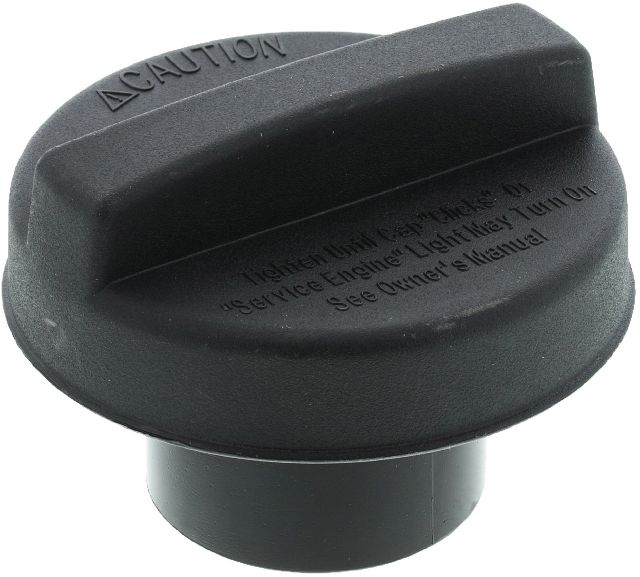
Est. part cost: $0-$5 - Loose or Faulty Gas Cap 🟡 Medium Probability → Shop Fuel Tank Cap
How to confirm: First, ensure the cap is tightened until it clicks several times. If the light returns, remove the cap and inspect the rubber O-ring seal for cracks, stiffness, or damage.
Typical fix: If the cap was loose, tightening it and clearing the code may be the only fix. If the seal is damaged, replace the gas cap with a new OEM part for the best fit.
Est. part cost: $20-$40 - Faulty Purge Control Solenoid Valve (PCSV) ⚪ Low Probability → Shop Vapor Canister Purge Solenoid
How to confirm: The PCSV can be tested with a handheld vacuum pump to see if it holds vacuum when closed. Alternatively, with the engine running, you can disconnect the hose leading to the intake manifold and feel for suction; there should be none at idle before the valve is commanded open.
Typical fix: Replace the purge control solenoid valve. It is typically located in the engine bay near the intake manifold.
Est. part cost: $30-$60
Rare But Worth Checking
- Cracked or disconnected EVAP hose: While less common than the canister failing, a rubber hose anywhere in the EVAP system can become brittle and crack. A smoke test will quickly identify such a leak.
- Faulty Canister Close Valve (CCV): → Shop Vapor Canister This valve is mounted on or near the charcoal canister. If it fails to seal completely, it can cause a leak. However, a stuck-open CCV more commonly results in a large leak code (P0455).
- Fuel-saturated charcoal canister: → Shop Vapor Canister If the canister is saturated with raw fuel (often due to overfilling the gas tank), it can fail a smog check liquid fuel leak test and may contribute to other EVAP codes. Owners have reported this failure even without a check engine light.
Diagnosis Steps
- Read the code with an OBD-II scanner to confirm P0442 is the primary code.
- Inspect the gas cap. Ensure it is tight. Remove it, check the seal for damage, and inspect the fuel filler neck for rust or debris.
- Clean any rust from the filler neck with an emery cloth or Scotch-Brite pad.
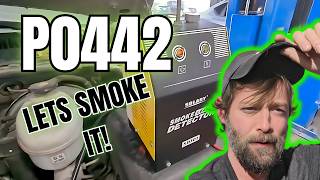
- If the cap and filler neck look good, the next step is a professional smoke test to find the leak's source without guessing. 🎬 Watch: How to perform a professional smoke test for leaks.
- Connect a smoke machine to the EVAP service port, typically on a hose near the engine's purge valve in the engine bay.
- Command the canister close valve (vent valve) shut with a scan tool, or pinch off the hose leading to it, to seal the system.
- Introduce smoke into the system and look for leaks. Pay close attention to the charcoal canister body (especially around the mounting bolts), all hose connections, the purge valve, and the gas cap area.
- Once the leaking component is identified, replace it.
- Clear the trouble codes and perform a drive cycle to allow the EVAP monitor to run and confirm the fix.
Parts You'll Likely Need
- Charcoal Canister Assembly
(OEM #31420-3X500)— This is the most common failure point on the 2011-2016 Elantra for code P0442. The plastic housing cracks from stress and corrosion.
Trusted brands: Hyundai (OEM)
OEM price range: $200-$250
Aftermarket price range: $150-$200 - Fuel Cap
(OEM #31010-3L600U)— A worn seal on the gas cap is a common cause for P0442 on any vehicle. It's an inexpensive and easy first part to replace during diagnosis. This part number is widely used across many Hyundai and Kia models.
Trusted brands: Hyundai (OEM), Gates, Stant
OEM price range: $25-$40
Aftermarket price range: $15-$25 - Purge Control Solenoid Valve
(OEM #28910-2E000)— This valve cycles frequently and can wear out, causing a small leak. It's a possible cause if the canister and cap/filler neck are confirmed to be good.
Trusted brands: Hyundai (OEM), Bosch, Standard Motor Products
OEM price range: $50-$70
Aftermarket price range: $30-$60
Related Codes That Often Appear With This One
- P0456 — P0456 indicates a 'Very Small Leak'. These codes are closely related and can be triggered by the same faults, sometimes appearing together or interchangeably depending on test conditions.
- P0455 — P0455 indicates a 'Large Leak'. While less common to see with P0442, a significant crack in the charcoal canister or a completely failed gas cap seal could eventually be interpreted as a large leak by the ECM.
Technical Service Bulletins (TSBs) & Recalls
- tsb_id: 17-ST-002 | tsb_title: Steering Coupler Replacement | tsb_description: This TSB is for a different common issue on this platform (a worn steering coupler causing a clicking noise) but is a good example of Hyundai acknowledging a widespread, non-safety-critical flaw with an extended warranty.
- A manufacturer service bulletin, Bulletin #5NPY6N5B02, notes that the fuel filler cap seal may not provide proper sealing, triggering the Check Engine Light for P0442.
- Bulletin #21-01-035H describes how EVAP leakage related DTCs like P0442 primarily occur in coastal areas subject to salt air, which can lead to corrosion-related sealing issues.
- Bulletin #5NP-Z2J3V-04 confirms that several Hyundai models may experience a check engine warning light for P0442, P0455, or P0456.
Platform-Specific Known Issues
- The charcoal canister's plastic housing is known to crack around the mounting bolt locations, causing a leak that is best found with a smoke machine.
- The fuel filler neck's sealing surface is prone to rusting, which compromises the gas cap's seal and causes a leak.
Mechanic-Grade Diagnostic Values
- Canister Close Valve (CCV) Coil Resistance — expected: 19.5 ~ 22.5 Ω at 20°C (68°F). Failure: A resistance measurement outside of this range indicates a failing solenoid coil.
- Fuel Tank Pressure Sensor (FTPS) Voltage — expected: Approximately 2.5V with the system at atmospheric pressure (e.g., gas cap off).. Failure: During a manual leak test, voltage should drop to ~1.0V and hold steady. If it rises quickly, a leak is present.
Scan Tool Commands That Help
- Hyundai GDS (or equivalent): EVAP Leak Test — This is an automated, bidirectional function that commands the Canister Close Valve (CCV) shut and can be used to verify a leak exists or confirm a repair has been successful without a smoke machine. It monitors the Fuel Tank Pressure Sensor to measure pressure decay.
- Hyundai GDS (or equivalent): Canister Close Valve (CCV) Activation — During a smoke test, this command is used to manually close the CCV, sealing the EVAP system so it can be filled with smoke to find the source of a leak.
Wiring & Ground Locations
- Purge Control Solenoid Valve (PCSV) Connector — In the engine bay, on the intake manifold.. This is the connection point for testing the PCSV. On some models, one pin will have battery voltage (Solid Blue wire) and the other is the control from the ECM (Solid Green wire) which can be used for testing.
- Canister Close Valve (CCV) Connector — At the charcoal canister assembly, near the rear of the vehicle.. This is the connection point for testing the CCV. One pin should have 12V power with the key on (Blue/Orange wire on some models), and the other is the ground control from the ECM (Solid Blue wire on some models).
Real Owner Repair Stories
- YouTube video by 'AutoLine Pro' (2014 Hyundai Elantra, 73,000 miles) — Check Engine Light with code P0442.
❌ Tried (didn't work) The video implies that simply replacing the gas cap or purge valve are common but often incorrect first steps.
✅ What actually fixed it A smoke test revealed a leak from the top of the charcoal canister. Upon removal, multiple cracks were visible around the corroded mounting bolt sleeves. The canister was replaced with a used unit, and anti-seize was applied to the mounting points to prevent future corrosion. - In NHTSA ODI #11170436, an owner reported that the check engine light came on with a P0442 code and four different mechanics could not find the issue despite changing the gas cap twice and performing purge valve service.
- NHTSA ODI #11570498 describes a situation where an owner repeatedly found common codes including P0442 during readings at local auto parts stores.
"I Checked Everything" — The Actual Cause
- In a case documented by 'The Flat Rate Mechanic' on YouTube, a smoke test on a Hyundai Elantra with P0442 showed no visible leaks from the canister or hoses. The actual cause was found to be a heavily rusted fuel filler neck sealing surface, which prevented a new-looking gas cap from sealing correctly. Cleaning the rust off with a Scotch-Brite pad and applying silicone paste resolved the issue.
Diagnostic Flowchart
Other Known Issues on This Vehicle
Issues unrelated to this code that are worth knowing about as an owner of this generation:
- Engine Ticking / Piston Slap / Seizure 🔴 High — Widespread issue, particularly in 2011-2013 models with the 1.8L Nu engine. Can occur at various mileages, often starting as a cold-start tick and progressing. (Ref: Service Campaign 966 (TSB 21-01-023H-2) was issued to update software to detect abnormal bearing noise, but no direct recall was issued for the Elantra's engine failures, unlike the Sonata.)
- Worn Steering Coupler 🟠 Medium — Extremely common. Owners report a clicking or 'thud' noise in the steering wheel when turning. The flexible rubber coupler inside the electronic power steering motor disintegrates over time. (Ref: Hyundai extended the warranty for this part to 10 years/100,000 miles under TSB 17-ST-002.)
- Premature Rear Coil Spring Corrosion 🟠 Medium — Common in regions using road salt. The front coil springs can corrode, fracture, and potentially puncture a tire. (Ref: NHTSA Recall 15V629000 was issued for certain 2011 Elantra models.)
- Rough Idle or Stalling 🟡 Low — Often caused by a faulty crankshaft position sensor or carbon buildup in the throttle body.
Used vs. New Parts: Buying Guide for This Vehicle
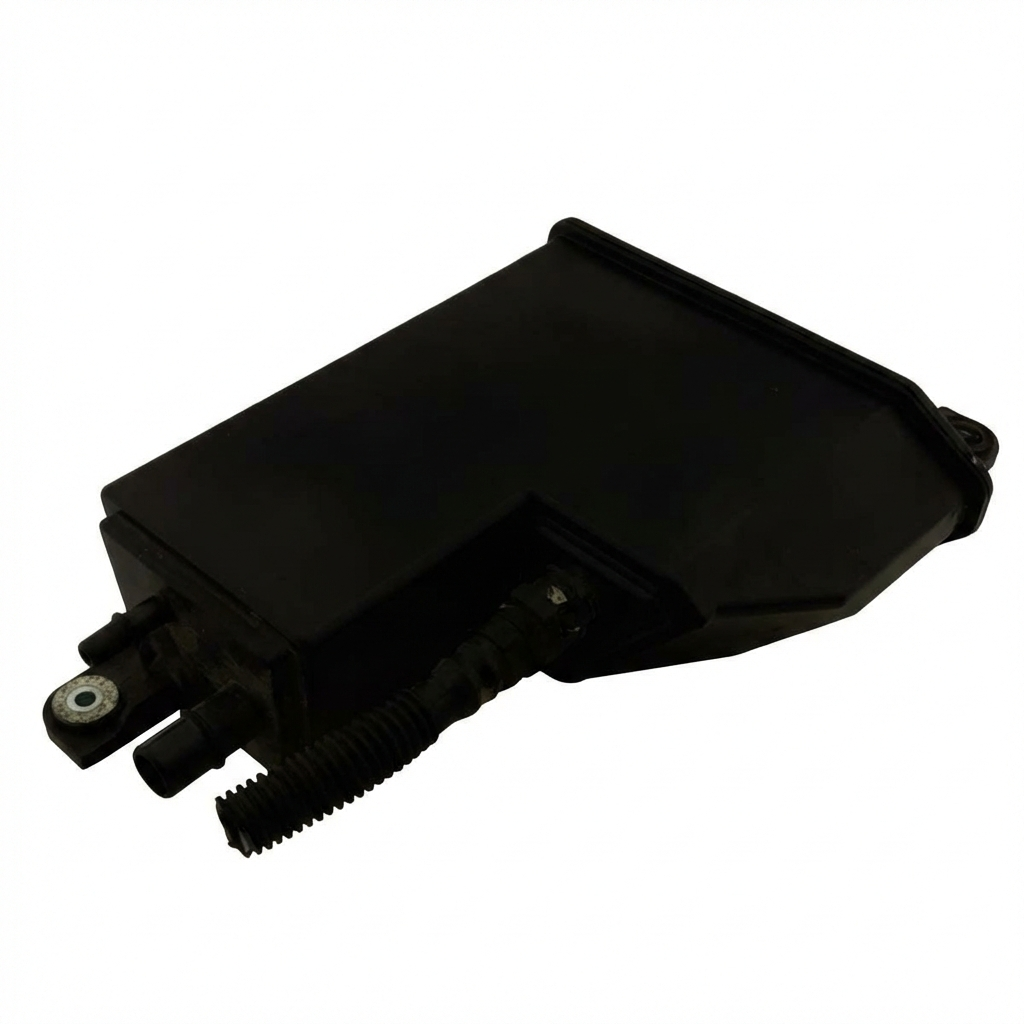
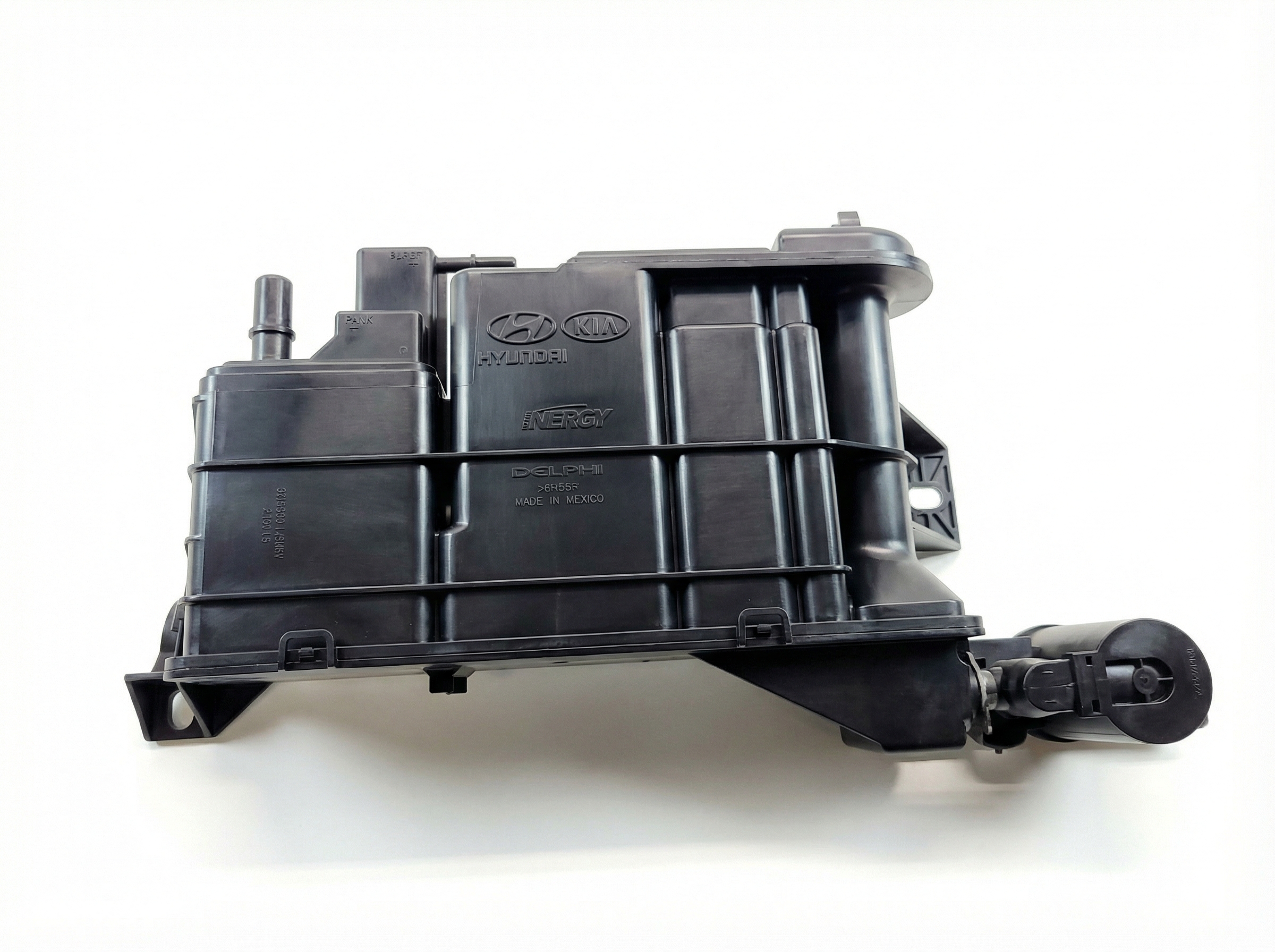
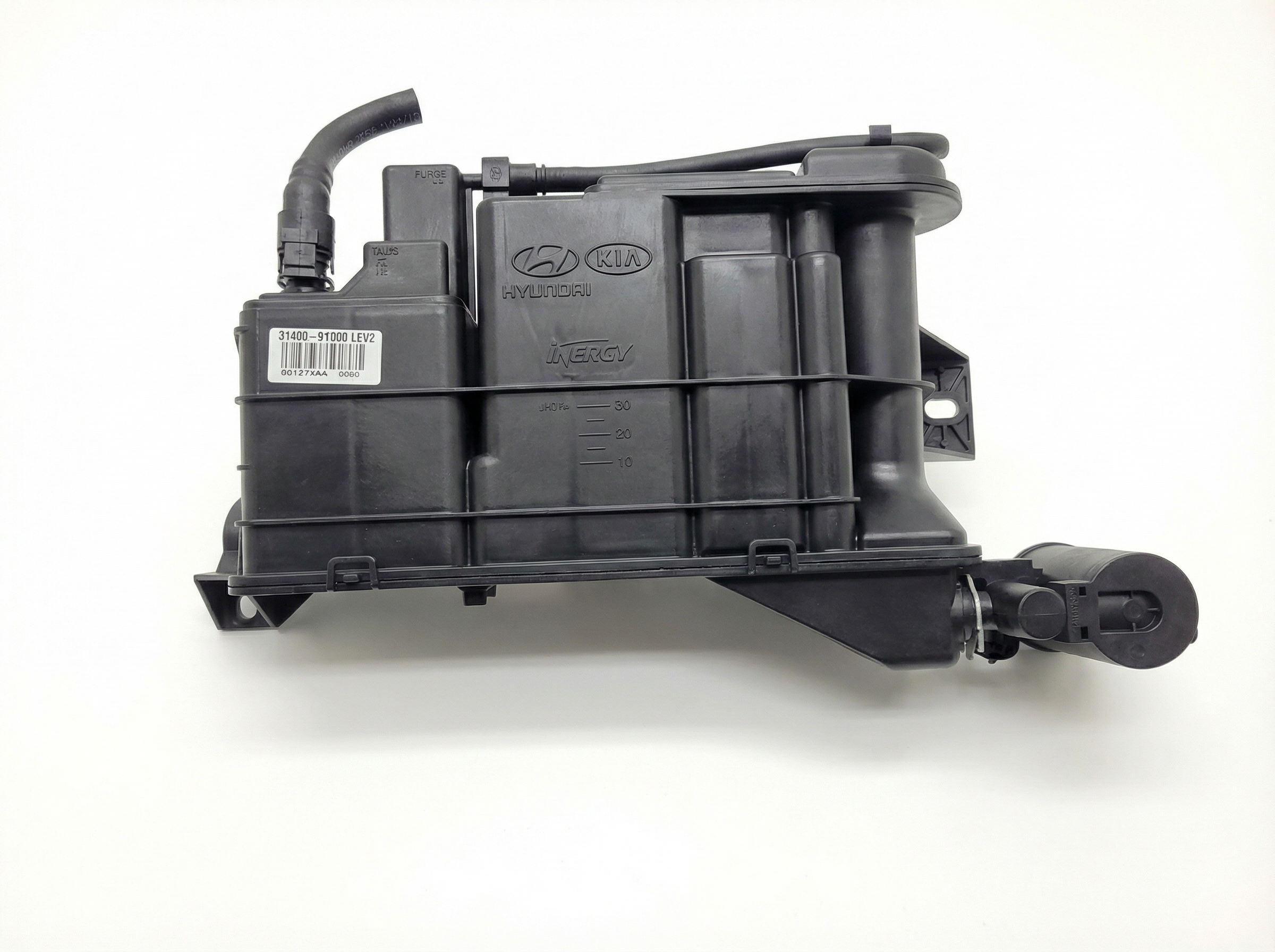
When a used part is the smart pick: A used OEM charcoal canister can be a cost-effective option, as the primary failure mode on this vehicle is cracking of the plastic housing, which is visually inspectable. An intact used part from a low-mileage donor in a dry climate is likely to have significant life remaining.
Donor-vehicle mileage cap: roughly under 80000 miles for the part to have meaningful remaining life.
What to inspect on the donor part:
- Shake Test: Gently shake the canister. If it rattles like a maraca, the internal charcoal bed has broken apart and the part is useless.
- No Cracks: Meticulously inspect the plastic housing, especially around the metal sleeves for the mounting bolts, for any hairline cracks.
- Intact Ports: Ensure all hose connection ports are round, free of cracks, and not brittle.
- Source Vehicle: If possible, choose a part from a vehicle in a 'rust-belt' state, as this suggests the canister itself is less prone to the specific corrosion-induced cracking failure.
OEM-only on this vehicle (don't cheap out):
- Purge Control Solenoid Valve (PCSV)
Aftermarket brands forum-validated for this vehicle:
- Standard Motor Products (For Canister)
- Dorman (For Canister)
Brands owners have reported issues with on this vehicle:
- Some mechanics report that aftermarket Purge Control Solenoid Valves can be unreliable for this platform and recommend sticking with the OEM part for that specific component.
Real Owner Stories
Aggregated from forums and TSBs cited above. Mileages and costs reflect what owners reported in those sources.
2014 Hyundai Elantra — 73000 miles
Symptoms: Check engine light on with code P0442.
What fixed it: Replaced the faulty charcoal canister. The mechanic noted cracking and corrosion around the bolt holes of the old canister.
Source hint: YouTube comment by George Parker
2014 Kia Forte — ~110000 miles
Symptoms: Small evap leak PO442; replaced the gas cap and purge valve with no success.
What fixed it: Removed the charcoal canister and found multiple cracks around the mounting bolts, which were not visible while the canister was installed.
Source hint: Reddit r/kia - 'Small evap leak PO442'
2011-2016 Hyundai Elantra
Symptoms: P0442 Small EVAP Leak; gas cap area leaking even with a new cap.
What fixed it: Cleaned the rusted fuel filler neck surface with a Scotch-Brite pad to allow the gas cap O-ring to seal properly.
Source hint: Reddit r/automotivetraining - 'P0442 Small EVAP Leak Hyundai Elantra "Easy Fix"'
Related OBD-II Codes
Frequently Asked Questions
Does TSB 17-ST-002 apply to my P0442 evap leak on my 2011-2016 Hyundai Elantra?
I replaced my gas cap but the P0442 code came back. What is the most likely vehicle-specific cause?
Where is the charcoal canister located on my Elantra, and why does it fail?
Is there a specific way to confirm if my charcoal canister is cracked without removing it?
Can I use a generic gas cap to fix this code?
Is the P0442 code related to the engine ticking or piston slap issues common in the 2011-2013 1.8L models?
Helpful Videos
Used OEM Parts in Stock
New Aftermarket Parts Available


The information in this article is provided for general reference and educational purposes only. Vehicle specifications, procedures, and part compatibility can vary by production date, trim level, and region. Always consult your vehicle's factory service manual and verify part numbers before purchasing or performing repairs. Safety-critical components such as airbags, seat belts, and braking systems should be installed by a qualified professional.
- Hyundai Elantra:
- 🧭 Diagnostic Flowchart
- 🎬 Helpful Videos
- 🛍️ Shop This Part
- What's Unique About the 2011-2016 Hyundai Elantra
- Symptoms You May Notice
- Most Likely Causes
- Rare But Worth Checking
- Diagnosis Steps
- Parts You'll Likely Need
- Related Codes That Often Appear With This One
- Technical Service Bulletins (TSBs) & Recalls
- Platform-Specific Known Issues
- Mechanic-Grade Diagnostic Values
- Scan Tool Commands That Help
- Wiring & Ground Locations
- Real Owner Repair Stories
- "I Checked Everything" — The Actual Cause
- Other Known Issues on This Vehicle
- Used vs. New Parts: Buying Guide for This Vehicle
- Real Owner Stories
- 2014 Hyundai Elantra — 73000 miles
- 2014 Kia Forte — ~110000 miles
- 2011-2016 Hyundai Elantra
- Related OBD-II Codes
- Frequently Asked Questions
- 🎟️ Get 5% Off