

P0442 on 2007-2012 Hyundai Santa Fe: EVAP Small Leak Causes and Fixes
For a 2007-2012 Hyundai Santa Fe, code P0442 is most often caused by a loose or worn-out gas cap. If the cap is secure, the next most likely culprits are a faulty canister purge valve (in the engine bay) or canister close valve (at the rear of the vehicle). A professional smoke test is the best way to find the leak, which could also be a cracked hose or a rusted fuel filler neck.
- Always check that your gas cap is tight and its seal is intact before attempting any other repairs for a P0442 code.
- If the gas cap isn't the issue, the most likely culprits are the purge valve (in the engine bay) or the vent/close valve (at the rear by the fuel tank).
- A smoke test is the most efficient and accurate way to diagnose the exact location of a small EVAP leak, which can save you from replacing the wrong parts.
- Driving with this code is not dangerous, but it will cause you to fail an emissions inspection.
What's Unique About the 2007-2012 Hyundai Santa Fe
On the second-generation (CM) Hyundai Santa Fe, the causes for P0442 are fairly typical for Hyundai vehicles of this era. While the gas cap is always the first suspect, owners and technicians frequently report failures of both the canister purge valve (located in the engine bay) and the canister close valve (located near the charcoal canister at the rear of the vehicle). A common point of failure is also the fuel filler neck, which can rust at the sealing surface, preventing a good seal even with a new cap. Diagnosing which component has failed often requires a smoke test to pinpoint the exact source of the small leak.
Symptoms You May Notice
- Check Engine Light is on
- A faint fuel smell may be noticeable, particularly when parked in an enclosed space like a garage.
- Slight decrease in fuel economy.
- Replacing the oxygen (O2) sensors. O2 sensors are not related to the EVAP system and will not fix a P0442 code.
- Replacing the fuel pump. While a Reddit user reported a dealer replaced the fuel pump in an attempt to fix a P0442, this is not a standard cause and did not solve their issue. The fuel level sending unit, which is often part of the fuel pump assembly, can fail but typically causes fuel gauge issues, not EVAP leak codes.
Most Likely Causes
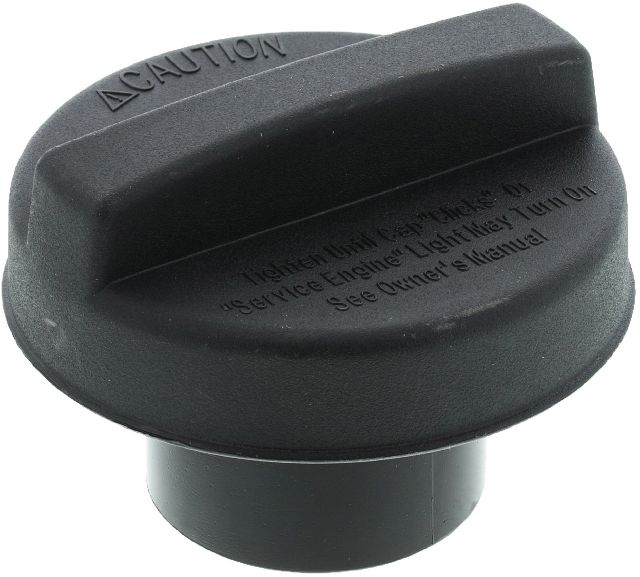
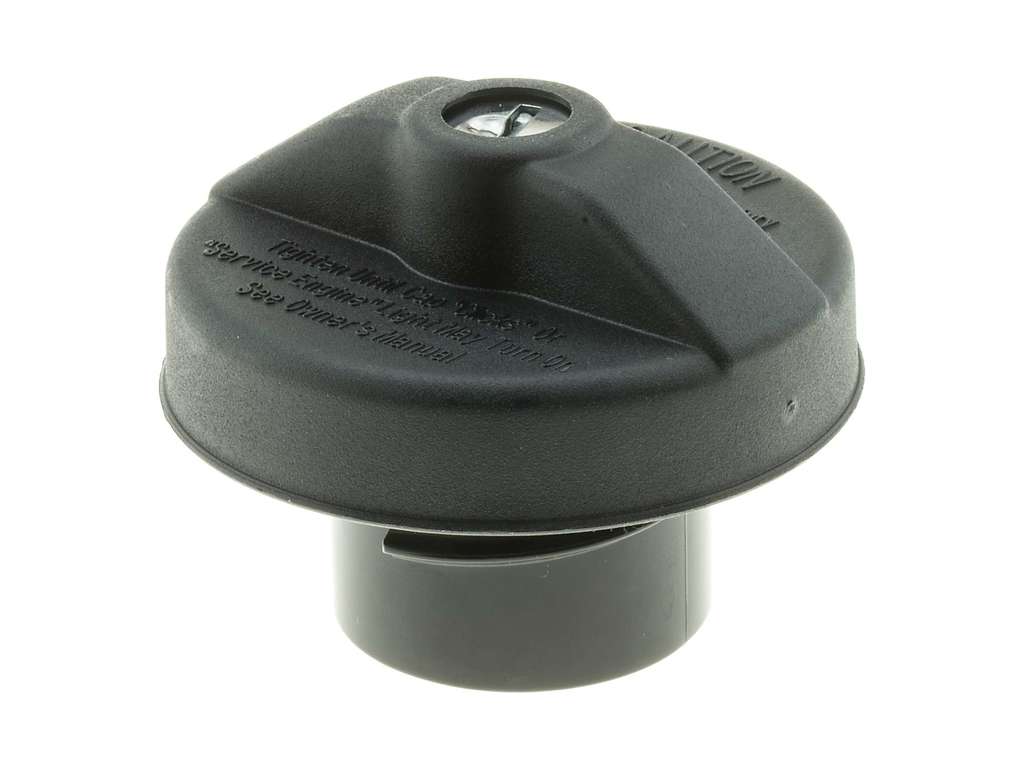
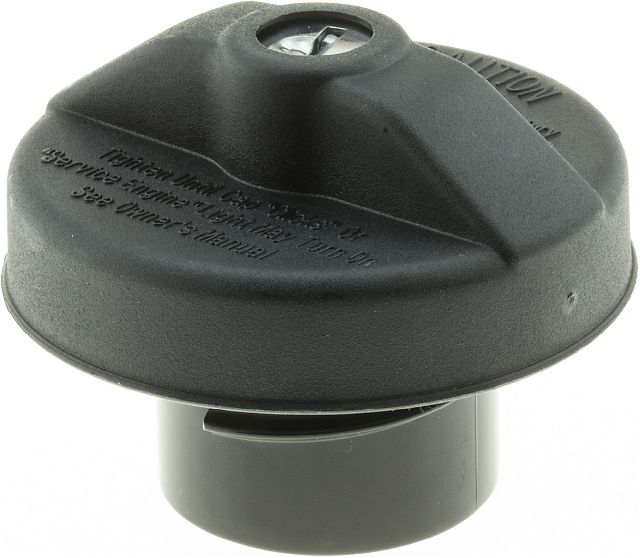
- Loose or Faulty Gas Cap 🔴 High Probability → Shop Fuel Tank Cap This is the most common cause for a P0442 code on any vehicle, as the cap is frequently removed and its rubber O-ring can wear out, crack, or stiffen over time. Manufacturer Bulletin #5NPY6N5B02 notes that the fuel filler cap seal may fail to provide proper sealing, specifically triggering P0442 and P0456 codes.
How to confirm: Ensure the gas cap is tightened until it clicks at least once. Inspect the rubber O-ring on the cap for any cracks, stiffness, or damage. Check the fuel filler neck for any rust or debris that could prevent a proper seal.
Typical fix: If tightening doesn't work, replace the gas cap. It is strongly recommended to use an OEM (Original Equipment Manufacturer) part to ensure a perfect seal, as aftermarket caps can sometimes fail to seal properly.
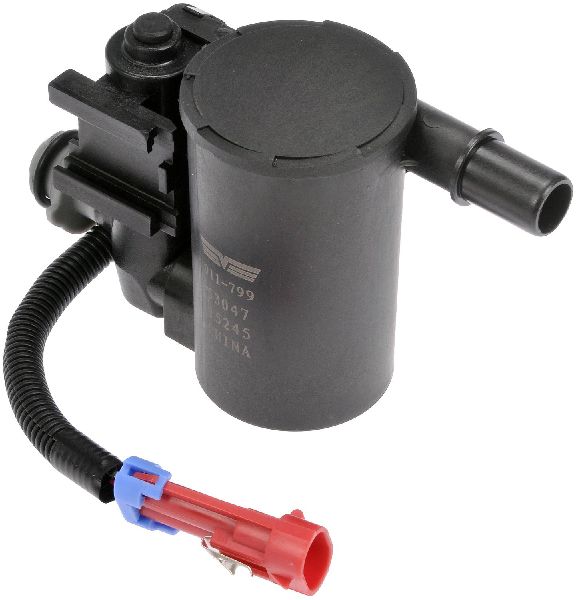
Est. part cost: $15-$40 - Faulty Canister Purge Valve (Purge Solenoid) 🟡 Medium Probability → Shop Vapor Canister This valve is a common failure point on many Hyundai models. It can become stuck open or closed due to carbon buildup or wear, causing a leak in the EVAP system.
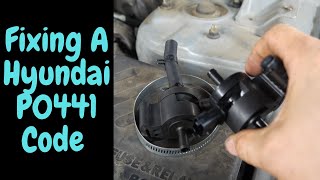
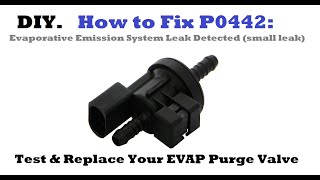
How to confirm: The purge valve is located in the engine bay, typically on or near the intake manifold. 🎬 Watch: How to test and replace the EVAP purge valve With the engine running, you can disconnect the vapor line and feel for suction; if there is constant vacuum when there shouldn't be, the valve is stuck open. A professional will use a scan tool to command the valve open and closed while checking for flow.
Typical fix: Replace the canister purge valve. This is a moderately easy DIY job for those comfortable working in the engine bay.
Est. part cost: $50-$120 - Faulty Canister Close Valve (CCV) / Vent Valve 🟡 Medium Probability → Shop Vapor Canister This valve is exposed to road debris and moisture at the rear of the vehicle, making it prone to failure. It can get stuck open or fail to seal properly when commanded closed for the system test.
How to confirm: The valve is located near the charcoal canister, behind the driver's side rear wheel. It is normally open and closes when the ECM tests the system. Diagnosis involves a smoke test to see if smoke escapes from the valve when it is commanded closed by a scan tool. It can also be bench-tested by applying 12V power to see if the solenoid actuates and seals.
Typical fix: Replace the canister close valve. This requires lifting the vehicle to gain access.
Est. part cost: $40-$90 - Rusted Fuel Filler Neck 🟡 Medium Probability → Shop Fuel Filler Neck Rust and corrosion can form on the metal lip of the fuel filler neck where the gas cap seals. This prevents even a new gas cap from sealing correctly, creating a small leak. This is a known issue on many vehicles in regions where road salt is used. Manufacturer Bulletin #21-01-035H confirms that EVAP leakage codes like P0442 primarily occur in coastal areas subject to specific environmental conditions.
How to confirm: When inspecting the gas cap, carefully examine the filler neck's sealing surface for any signs of rust, pitting, or bubbling paint. Run a finger over the surface to feel for imperfections. A mechanic on YouTube demonstrated cleaning this surface with emery cloth to solve a P0442 on a Hyundai Elantra.
Typical fix: Minor surface rust can sometimes be cleaned off with a Scotch-Brite pad or fine-grit sandpaper to restore a smooth sealing surface. If the rust is severe or has created pits, the entire fuel filler neck must be replaced.
Est. part cost: $5-$15 (cleaning supplies) or $60-$200 (for a new filler neck). - Cracked or Disconnected EVAP Hoses ⚪ Low Probability Over time, the rubber and plastic hoses in the EVAP system can become brittle from heat and age, leading to small cracks.
How to confirm: A visual inspection may reveal obvious cracks, but a smoke test is the most reliable method to find a small hose leak. The test involves filling the EVAP system with a harmless, visible smoke and looking for where it escapes.
Typical fix: Replace the cracked section of hose and any associated clamps.
Est. part cost: $10-$50
Rare But Worth Checking
- Cracked Charcoal Canister: → Shop Vapor Canister The plastic housing of the charcoal canister can develop cracks from age or impact from road debris, creating a leak. This is usually found during a smoke test.
- Faulty Fuel Tank Pressure Sensor: → Shop Fuel Tank While less common, the sensor that monitors the pressure in the EVAP system can fail and provide incorrect readings to the ECM, falsely triggering a leak code.
Diagnosis Steps
- Read the code with an OBD-II scanner to confirm P0442 is the only code present.
- Inspect the gas cap. Remove it, check for cracks in the seal, and ensure it's the correct type for the vehicle. Clean the sealing surface on the fuel filler neck, checking carefully for rust or corrosion. Reinstall the cap, making sure it clicks several times.
- Clear the code with the scanner and drive the vehicle for a few days to complete a full drive cycle. If the light does not return, the issue was a loose cap or dirty filler neck.
- If the light returns, perform a visual inspection of all accessible EVAP hoses in the engine bay and around the canister for obvious cracks or disconnections.
- The most effective diagnostic step is to have a smoke test performed. This test will pressurize the system with visible smoke, making even the smallest leak easy to spot, 🎬 Watch: How a professional mechanic uses a smoke test whether it's from a hose, the purge valve, the vent valve, the filler neck, or the canister itself.
- Based on the smoke test results, replace the component identified as the source of the leak. If no leak is found, further testing of the purge and vent valves with a scan tool or power source is necessary.
Parts You'll Likely Need
- Gas Cap
(OEM #31010-3L600)— This is the most frequent and simplest fix for a P0442 code. The seal wears out over time. This part number is widely used across many Hyundai models from this era.
Trusted brands: Hyundai (OEM)
OEM price range: $25-$40
Aftermarket price range: $15-$30 - Canister Purge Valve / Purge Control Solenoid
(OEM #28910-3E100)— A common failure item on Hyundai vehicles that gets stuck open or closed, causing a leak to be detected by the ECM. Note: The part number 28910-22040 from Pass 1 appears to be for older or different models. 28910-3E100 is a more likely fit for the V6 Santa Fe models of this generation.
Trusted brands: Hyundai (OEM), Standard Motor Products (SMP), Bosch
OEM price range: $90-$120
Aftermarket price range: $45-$75 - Canister Close Valve / Vent Valve Solenoid
(OEM #31430-2B500)— Located at the rear of the vehicle, this valve is exposed to the elements and can fail, preventing the EVAP system from sealing during its self-test. The original part may be superseded by 31420-2B501.
Trusted brands: Hyundai (OEM), Dorman
OEM price range: $60-$90
Aftermarket price range: $40-$70
Technical Service Bulletins (TSBs) & Recalls
- While no specific TSB for P0442 on the 2007-2012 Santa Fe was found, Hyundai has issued general EVAP-related bulletins. For example, TSB 10-FL-003 for other models addressed ECM logic for the EVAP monitor, and TSB 21-EM-002H for newer models confirms stuck valves as a cause for P0442. A general TSB for VW (13-40) also discusses P0442 and P0456 codes related to the leak detection pump, showing the
- Manufacturer Bulletin #5NP-Z2J3V-04 notes that several Hyundai models may experience a check engine warning light with DTC P0442, P0455, or P0456 found stored.
Platform-Specific Known Issues
- A forum thread on hyundai-forums.com for a 2008 Santa Fe with P0442 detailed a successful fix by replacing the Canister Close Valve (CCV). The owner noted the original valve was stuck and replacing it resolved the Check Engine Light after a few drive cycles.
- Another owner on the same forum fixed their P0442 by discovering and cleaning significant rust off the fuel filler neck where the gas cap seals, highlighting this as a key inspection point before buying parts.
Mechanic-Grade Diagnostic Values
- Canister Purge Valve (CPV) Solenoid Resistance — expected: 15 to 30 Ohms (Ω) across the two pins.. Failure: A reading of infinite ohms (open circuit) or near-zero ohms (short circuit) indicates a failed solenoid.
- Fuel Tank Pressure Sensor (FTPS) Voltage — expected: Approximately 2.5 Volts with the system at atmospheric pressure (e.g., gas cap off).. Failure: Voltage that does not change or is stuck high/low when pressure/vacuum is applied indicates a faulty sensor. During a leak test, the voltage should drop to near 1.0V and hold steady if no leak is present.
- Canister Purge Valve (CPV) Connector Voltage — expected: Approximately 12 Volts (battery voltage) on one of the two pins in the electrical connector with Key On, Engine Off (KOEO).. Failure: No voltage suggests a problem in the wiring harness or a blown fuse, not a faulty valve.
Scan Tool Commands That Help
- Hyundai GDS (or equivalent advanced scan tool): EVAP Leak Test (automated function) — This is the factory-level, automated test to verify a leak exists or to confirm a repair. The tool commands the Canister Close Valve (CCV) to shut, actuates the purge valve, and monitors the Fuel Tank Pressure Sensor (FTPS) to measure pressure decay over time, confirming a leak without a smoke machine.
- Hyundai GDS (or equivalent advanced scan tool): Vent Valve Activation Test (forced command) — Used to manually command the Canister Close Valve (CCV) to close. This is a critical step before performing a smoke test, as it seals the system. It also simultaneously tests if the CCV solenoid is responding to the command.
Wiring & Ground Locations
- G05 — Base of the left "B" pillar.. This is a listed ground point in the engine performance wiring diagram for the 2009 Santa Fe, which includes circuits for EVAP components.
- G52 — Left rear of the engine compartment.. Another key ground point in the engine performance wiring diagram for the 3.3L V6 Santa Fe. A poor ground here could affect sensor readings or solenoid operation.
- Canister Close Valve Connector — Beneath the center of the vehicle, above the drive shaft (on AWD models), near the charcoal canister.. This connector's location makes it susceptible to corrosion and damage. The wiring diagram for a 2009 Santa Fe 3.3L identifies the wires for testing voltage and ground.
- Fuel Tank Pressure Sensor Connector — Above the fuel tank, beneath the rear seat.. Accessing this connector requires removing the rear seat bottom cushion. It's necessary for testing the sensor's voltage output directly at the source.
Real Owner Repair Stories
- YouTube user (2010 Hyundai Santa Fe 3.5L V6) — Strong gas smell in the cabin, Check Engine Light with codes P0442 and P0456.
❌ Tried (didn't work) Replacing the gas cap.
✅ What actually fixed it The owner removed the rear seat to access the fuel pump assembly. The plastic top of the sub fuel sending unit was found to be severely cracked and broken, causing a major vapor and liquid fuel leak under the rear seat. The owner sealed the cracks with Permatex form-a-gasket sealant as a temporary fix. The root cause was the failed plastic housing of the sending unit. - YouTube channel "The Flat Rate Mechanic" (2009 Hyundai Elantra (demonstrates a common Hyundai issue)) — Check Engine Light with code P0442.
❌ Tried (didn't work) A smoke test showed no visible leaks from hoses or valves., The gas cap had already been replaced with a new one.
✅ What actually fixed it The mechanic found significant rust buildup on the fuel filler neck's sealing surface. Even with a new gas cap, the rust prevented a proper seal. The fix was to clean the rust off the filler neck with a Scotch-Brite pad and apply a light coat of silicone paste to protect the surface and ensure a good seal. This resolved the small leak. - NHTSA ODI #11170436 — An owner reported that their check engine light came on shortly after purchase with a P0442 code. Over two years, four different mechanics were unable to find the issue despite changing the gas cap twice and performing purge valve work.
- NHTSA ODI #11570498 — A driver noted that common codes including P0401 and P0442 have repeatedly appeared on their vehicle.
"I Checked Everything" — The Actual Cause
- In a well-documented case on a similar Hyundai, a smoke test revealed no leaks, and the gas cap was new. The P0442 code was ultimately caused by rust on the fuel filler neck, which prevented the new cap from sealing properly. The fix was to sand the rust off the neck's sealing surface to restore a smooth finish. This is a classic example of a leak source that a smoke test might not easily reveal if the test adapter seals differently than the actual gas cap.
OEM Part Supersession History
31430-2B500→31420-2B501 (Note: This may be a kit or assembly number)— Part revision or consolidation by the manufacturer.
Heads up: While Pass 2 listed 31430-2B500, some parts catalogs suggest it is superseded. It is critical to verify the correct part number by VIN, as there can be variations. For example, some older Elantra models used a canister assembly (31420-2D501) which was later superseded by 31420-2D511. Always confirm the specific part for the Santa Fe.
Model Year Variations Within This Range
- 2010-2012: The 2010 model year refresh introduced new engine options, including a 2.4L 4-cylinder and a 3.5L V6, replacing the previous 2.7L and 3.3L V6 engines. While the EVAP system functions similarly, the physical location and part numbers for components like the canister purge valve may differ between these engine types. The purge valve for the 3.5L V6 may not be identical to the one on the earlier 3.3L V6.
Diagnostic Flowchart
Other Known Issues on This Vehicle
Issues unrelated to this code that are worth knowing about as an owner of this generation:
- Faulty Fuel Level Sending Unit 🟠 Medium — Very common on 2007-2009 models. The fuel gauge becomes erratic or reads empty, often triggering a check engine light.
- Leaking Valve Cover Gaskets (V6 Engines) 🔴 High — Extremely common on the 3.3L V6. The front valve cover gasket leaks oil directly onto the alternator, causing premature alternator failure and potential stalling. (Ref: Hyundai issued a service campaign (not a full recall initially) to address this. TSB #23-01-076H-1 is related.)
- Engine Failure / Stalling (Theta II 2.4L & Lambda 3.5L) 🔴 High — Affects 2010-2012 models. The 2.4L Theta II engine was part of a major recall for bearing failure leading to seizure. The 3.5L V6 also had complaints of stalling while driving. (Ref: Yes, multiple recalls and lawsuits related to Theta II engine failures.)
- Premature Suspension Wear 🟡 Low — Ball joints, tie rods, and control arm bushings can wear out relatively quickly, leading to suspension noise and alignment issues.
- Malfunctioning Stop Lamp Switch 🟠 Medium — Widespread across many Hyundai models of this era, including the Santa Fe. A faulty switch can prevent brake lights from working or cause issues with push-button start and shifting out of park. (Ref: Yes, covered under Hyundai Recall 110.)
Used vs. New Parts: Buying Guide for This Vehicle
When a used part is the smart pick: For this repair, a used Fuel Filler Neck from a donor vehicle in a dry, rust-free region can be an excellent value, especially if the original is severely corroded. A complete Charcoal Canister assembly might also be a good used buy if it includes the Canister Close Valve, but it must be tested.
Donor-vehicle mileage cap: roughly under 80000 miles for the part to have meaningful remaining life.
What to inspect on the donor part:
- For a charcoal canister, shake it vigorously. If you hear any rattling, the internal charcoal has broken down, and the part is useless.
- Inspect the plastic housing of any component for hairline cracks, especially around mounting points and hose connections.
- For a fuel filler neck, ensure the sealing surface where the gas cap sits is perfectly smooth, with no pitting or bubbling paint.
- Check that all hose ports are clean and free of charcoal dust, which indicates a failed canister.
OEM-only on this vehicle (don't cheap out):
- Gas Cap — Aftermarket gas caps are a frequent cause of P0442 codes because their seals may not meet the precise pressure specifications of the Hyundai EVAP system.
Aftermarket brands forum-validated for this vehicle:
- Standard Motor Products (SMP)
- Dorman (for Canister Close Valve)
Brands owners have reported issues with on this vehicle:
- No-name, unbranded electronic parts (valves, solenoids) from online marketplaces should be avoided as their quality and specifications can be inconsistent.
Real Owner Stories
Aggregated from forums and TSBs cited above. Mileages and costs reflect what owners reported in those sources.
2008 Hyundai Santa Fe
Symptoms: The Check Engine Light was on with code P0442. The owner noted the original valve was stuck.
What fixed it: Replacing the Canister Close Valve (CCV). The light resolved after a few drive cycles.
Source hint: hyundai-forums.com
2007-2012 Hyundai Santa Fe
Symptoms: Check Engine Light (P0442) persisted even after considering part replacements.
What fixed it: Cleaning significant rust off the fuel filler neck where the gas cap seals.
Source hint: hyundai-forums.com
Hyundai Elantra (applicable to Santa Fe)
Symptoms: P0442 small leak detected.
What fixed it: Cleaning the filler neck sealing surface with emery cloth to ensure the gas cap could seal properly.
Source hint: youtube.com/watch?v=k-Im_seGijc - 'The Flat Rate Mechanic'
2007-2012 Hyundai Santa Fe
Symptoms: P0442 code; owner had multiple failed repair attempts.
What fixed it: A faulty valve (purge or vent) was the ultimate fix.
Source hint: reddit.com/r/HyundaiSantaFe
Related OBD-II Codes
Frequently Asked Questions
Is there a specific TSB for the P0442 code on my 2007-2012 Santa Fe?
Where is the Canister Close Valve (CCV) located on my Santa Fe?
I replaced my gas cap but the P0442 code is still there. What should I check next on the filler neck?
How can I test if my Purge Control Valve is the cause of the leak?
Should I use an aftermarket gas cap to fix this code?
Can I clean the rust off my filler neck instead of replacing it?
Helpful Videos
We Have This Part in Stock


The information in this article is provided for general reference and educational purposes only. Vehicle specifications, procedures, and part compatibility can vary by production date, trim level, and region. Always consult your vehicle's factory service manual and verify part numbers before purchasing or performing repairs. Safety-critical components such as airbags, seat belts, and braking systems should be installed by a qualified professional.
- Hyundai Santa Fe:
- 🧭 Diagnostic Flowchart
- 🎬 Helpful Videos
- 🛍️ Shop This Part
- What's Unique About the 2007-2012 Hyundai Santa Fe
- Symptoms You May Notice
- Most Likely Causes
- Rare But Worth Checking
- Diagnosis Steps
- Parts You'll Likely Need
- Technical Service Bulletins (TSBs) & Recalls
- Platform-Specific Known Issues
- Mechanic-Grade Diagnostic Values
- Scan Tool Commands That Help
- Wiring & Ground Locations
- Real Owner Repair Stories
- "I Checked Everything" — The Actual Cause
- OEM Part Supersession History
- Model Year Variations Within This Range
- Other Known Issues on This Vehicle
- Used vs. New Parts: Buying Guide for This Vehicle
- Real Owner Stories
- 2008 Hyundai Santa Fe
- 2007-2012 Hyundai Santa Fe
- Hyundai Elantra (applicable to Santa Fe)
- 2007-2012 Hyundai Santa Fe
- Related OBD-II Codes
- Frequently Asked Questions
- 🎟️ Get 5% Off